 Newshot
Main
Early and late H. erectus finds in East and Southeast Asia represent a key part of the hominin evolutionary history of the Asian region, with China sitting in an important location to understand the dispersal, interactions and adaptations of this species6,7,8. There is a rich fossil record for H. erectus in China in Yuanmou (1.7 million years ago)9,10,11, Gongwangling (1.6 million years ago)12, Zhoukoudian (780–400 ka)13, Nanjing (approximately 650 ka)14 and Hexian (410 ka)15 (Supplementary Information 1). However, most of these sites are located in north and central China, with reliably identified and dated H. erectus fossils being conspicuously rare in southern China, especially during the Middle Pleistocene. This makes it particularly challenging to establish their ecological preferences. Furthermore, evidence of younger H. erectus (less than 400 ka) is almost entirely absent from China. This temporal gap is particularly striking given that H. erectus persisted in Java until 117–108 ka at Ngandong2, raising fundamental questions about the species’ distribution, ecological adaptations and ultimate fate in mainland China.
Establishing the environmental context of H. erectus is essential for understanding the species’ ecological flexibility and adaptive capabilities. The youngest Javanese H. erectus at Ngandong2 persisted in woodland refugia as rainforests expanded across the region, raising questions about whether encroaching closed-canopy forests contributed to the species’ eventual extinction2,16. Yet, there have been very few stable isotope studies on H. erectus evidence, as the material is often limited by diagenetic alteration3. Recent work has debated whether non-H. sapiens Middle Pleistocene hominins possessed the adaptive capabilities to exploit tropical rainforest environments17,18. Studying the forested landscapes of tropical southern China during the Middle and Late Pleistocene19 thus provides a crucial test case for assessing H. erectus ecological adaptations. Furthermore, understanding mobility patterns through techniques such as strontium isotope analysis can reveal how these populations used their landscapes and how they connected with contemporaneous populations across broader regional scales20,21.
Since the Pleistocene, tropical forest and grassland environments in southern China have provided a critical biogeographical corridor for faunal dispersals between northern latitudes and insular Southeast Asia22,23,24. The karst landscapes and cave systems of the region have yielded abundant Pleistocene faunal assemblages, yet there is currently no clear evidence that H. erectus was part of the Stegodon–Ailuropoda fauna in this region6. This raises questions as to whether the absence of H. erectus in southern China, particularly during the late Middle Pleistocene, is a consequence of ecological constraints preventing H. erectus from exploiting southern China’s tropical forest environments18, representing an effective biogeographic barrier25, or results from other factors such as an imbalance in research intensity7, a reflection of real absence of the species in the region due to alternative dispersal routes through the Tibetan corridor6, the absence of secure dating data on many out-of-context teeth, the misidentification of fragmentary remains (particularly with morphologically similar Pongo teeth26), taphonomic and preservation biases in tropical environments18, lower population densities leading to reduced fossil representation27 or the occupation of an ecological niche that is not readily preserved in cave deposits18. Distinguishing between these scenarios requires well-dated, robustly identified hominin fossils with detailed environmental context—evidence that has been lacking.
To provide a temporal and environmental context for the eight H. erectus teeth6 from Baxian and Naxian caves in southern China (Fig. 1, Supplementary Information 2 and 3 and Extended Data Figs. 1–3), we used five independent dating techniques to constrain the sediments: post-infrared infrared-stimulated luminescence (pIR-IRSL) dating of feldspars, optically stimulated luminescence (OSL) dating of quartz (Supplementary Information 4), uranium-series (U-series) dating of fossil teeth (Supplementary Information 5), coupled U-series–electron spin resonance (US-ESR) dating of fossil teeth (Supplementary Information 6) and U-series dating of carbonate capping flowstones (Supplementary Information 7), all integrated through the use of two Bayesian age models—ChronoModel and OxCal (Supplementary Information 8). Environmental reconstruction was achieved through faunal analysis (Supplementary Information 3), bulk and sequential stable isotope analysis of faunal and H. erectus tooth enamel (Supplementary Information 9) and clumped isotope thermometry of cave sediments (Supplementary Information 10). Finally, we assessed individual mobility patterns through laser-ablation trace element mapping and strontium isotope analysis of hominin tooth enamel, integrated with a regional strontium isoscape constructed using random forest machine learning to identify potential source regions (Supplementary Information 11). These multiple lines of evidence, replicated across laboratories in China and Australia, provide, to our knowledge, the first comprehensive temporal, environmental and behavioural context for late H. erectus in southern China.
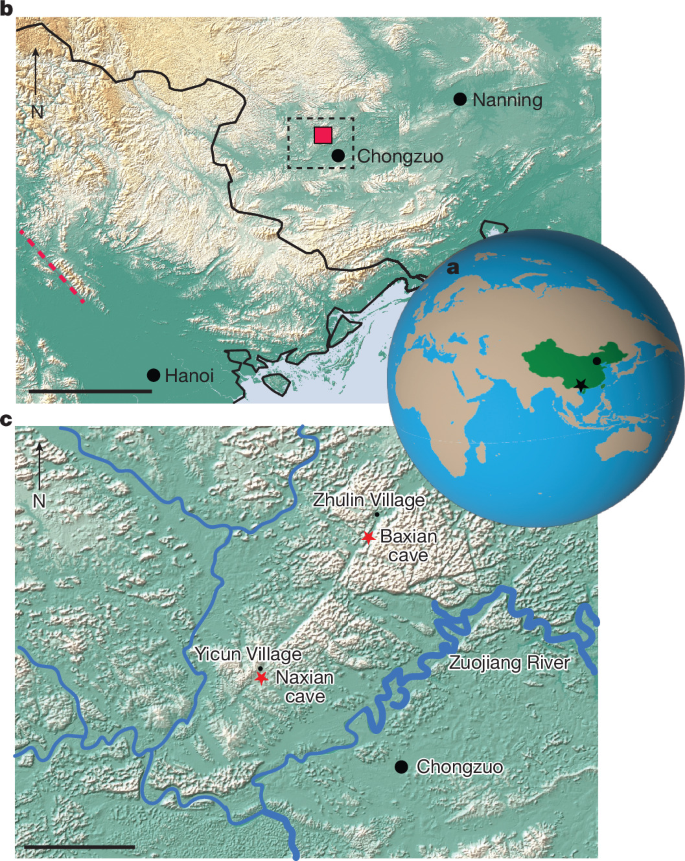
a, The locations of China (green region on the world inset), Beijing (black dot) and the Chongzuo study area located in Guangxi Zhuang Autonomous Region province, southern China (black star). b, The location of Chongzuo city in relation to Nanning and Hanoi, illustrating the dense network of karst (tan topography) that comprises this landscape. The black dashed box marks the study region and the red square represents the cave locations. The location of the lower section of Red River valley in Vietnam (discussed in the text) is marked by a red dashed line. c, Location of the Naxian and Baxian caves (red stars) connected by a 15-km karst corridor near the meandering Zuojiang River and the city of Chongzuo. Scale bars, 100 km (b), 10 km (c). Maps adapted from ref. 19, CC BY 4.0.
The Naxian and Baxian caves, located 15 km apart and situated 13 km to the northwest and 20 km to the north of Chongzuo City, respectively, are connected by a straight karst valley corridor (Fig. 1, Extended Data Fig. 1a,b,e,f and Supplementary Information 2). They are both horizontal caves at 226 and 218 m above sea level, positioned 5–7 m above the valley floor (Extended Data Fig. 2), with small fossil chambers at the rear of each cave (Fig. 2). The chambers contain remarkably similar dense, cemented, cataclastic breccias that have yielded a combined total of over 18,000 mammalian fossils, which were initially accumulated by porcupines28, including hominin remains (Supplementary Information 2). The fossil-bearing breccias (Extended Data Fig. 3) were capped by thick flowstone and underlain by younger mixed sediments (Extended Data Fig. 1d,h). This similarity suggests deposition under comparable environmental conditions.
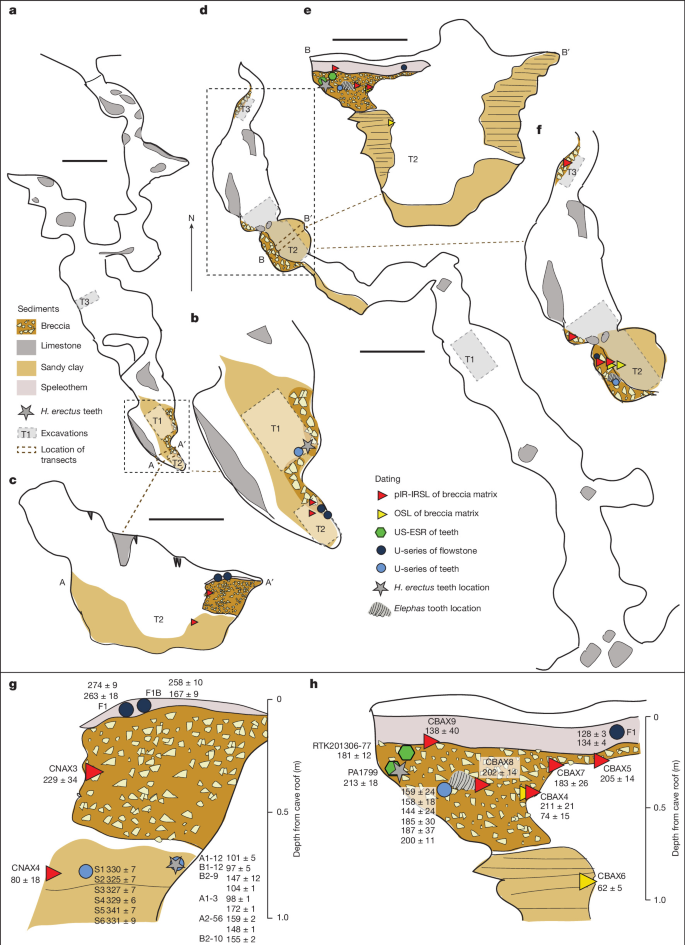
a, Cave plan for Naxian cave, showing the locations of the test pits (T1–T3) and fossil chamber at the rear of the cave. b, Expanded illustration of test pits T1 and T2 and fossil chamber in a, showing the spatial relationship between the sampling locations. c, Cross-sectional stratigraphic profile of the fossil chamber and excavation pit T2, drawn from location A–A′ in a, showing the sampling locations in the breccia, flowstone and underlying mixed unit. d,Cave plan for Baxian cave, showing the location of the two fossil chambers at the rear of the cave and the location of the test pits (T1–T3). e, Cross-sectional stratigraphic profile of the fossil chamber and excavation pit T2 drawn from location B–B′ in d, showing the sampling locations that correspond to the legend. f, Enlarged fossil chamber, showing the spatial location of the sampling in pits T2 and T3 in d. g,h, Composite stratigraphy for Naxian (g) and Baxian (h) caves, showing the sampling locations within the flowstone, breccia and underlying sandy clay. At each location, the symbols refer to the dating techniques in the legend, and the sampling codes and results have been included. Scale bars, 5 m (a), 1 m (c,e), 10 m (d).
Of the resulting 45 radiometric ages from both caves (Extended Data Figs. 4–7), 43 were modelled and given similar modelled age estimates (OxCal: 312–161 ka; ChronoModel: 324–184 ka at 2σ uncertainties; Extended Data Fig. 8), but the ChronoModel results were used owing to their greater outlier robustness and more reliable lower age limit. These results indicate that the age of H. erectus fossil evidence lies between 324 and 184 ka for the Baxian caves, and between 319 and 241 ka for the Naxian caves. These error limits are overlapping and broadly contemporaneous, and indicate a 95% probability that H. erectus was in this area sometime between 324 and 184 ka (see Supplementary Information 4–8 for all dating tables, data and discussion of limitations, uncertainties and choice of model; Fig. 3). The overlapping age uncertainties for the caves of approximately 78,000 years suggest a contemporaneous or near-contemporaneous presence on this landscape. The modelled ages are consistent across all five dating techniques within their respective uncertainties, providing robust constraints on the timing of H. erectus presence in this region.
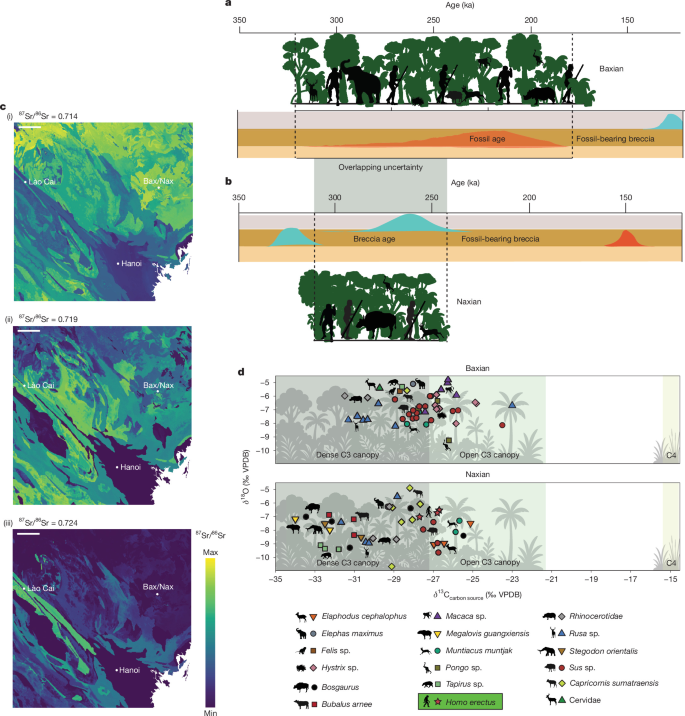
a, Stratigraphy (overlying flowstone, fossil-bearing breccia and underlying clay) and modelled age range using ChronoModel (324–184 ka) of the fossil-bearing breccia for Baxian cave. The image depicts the landscape at this time, including an enclosed rainforest, H. erectus and associated fauna. b, Stratigraphy and modelled age range (319–241 ka) for the Naxian fossil-bearing breccia, along with a reconstruction of the environment around the cave at that time. The age uncertainties for the caves overlap over a period of approximately 78,000 years (green box). These reconstructions are derived from trace element and stable isotope data from the human and faunal remains seen in c and d. The dashed lines in a and b denote the age ranges for Baxian and Naxian caves, respectively, and correspond to the length of the landscape image for each cave. c, Geographic assignment based on UnionP probability surfaces calculated for three distinct 87Sr/86Sr values measured in H. erectus—(i) 0.714, (ii) 0.719 and (iii) 0.724—showing its mobility across southern China and northern Southeast Asia. The corresponding strontium isoscape and full method are provided in Supplementary Information 11. d, Biplots of δ13Ccarbon source and δ18O values by taxon in relation to vegetation type. Biplot of faunal enamel δ13Ccarbon source (plant-equivalent values; ‰ Vienna Peedee Belemnite standard (VPDB)) and δ18O (‰ VPDB) at Baxian (top; 324–184 ka) and Naxian (bottom; 319–241 ka) caves. Each taxon is represented by a unique combination of colour and shape. Shaded background areas indicate ecological zones: dense-canopy forest (green shading), C3 vegetation (light green shading) and C4 grassland (yellow shading). The unshaded interval between C3 and C4 represents the C3–C4 intermediate zone. This framework allows direct comparison of faunal isotopic signatures against expected vegetation regimes. A large proportion of taxa from both sites fall within the dense-canopy forest zone, supporting the interpretation of closed-canopy rainforest environments. Scale bars, 50 km (c). Bax, Baxian; Nax, Naxian.
The faunal assemblages from the Baxian and Naxian caves are taxonomically diverse and remarkably similar in composition (Supplementary Information 3 and Extended Data Fig. 3). Both assemblages include numerous taxa that have since become locally extinct, including Pongo, Elephas and rhinoceros Dicerorhinus, though most remain extant elsewhere in Asia. Notably, H. erectus, Stegodon and ‘Megalovis’ are globally extinct. Habitat preference analysis indicates that both assemblages are strongly dominated by forest-dwelling taxa (Supplementary Fig. 3), which is consistent with predominantly forested landscapes during the time of deposition.
The plant-equivalent stable carbon isotope values for the Baxian faunal teeth, after correction for species-specific diet-to-enamel enrichment factors based on body mass29 (Supplementary Information 9), range from −31.5 to −23.0‰ (average = −27.6 ± 1.87‰ (1σ)), while lower values observed at the Naxian cave range from −34.0 to −25.1‰ (average = −29.4 ± 2.45‰ (1σ)). Both assemblages yield values well below the dense-canopy forest threshold of −27.5‰ (ref. 28), with no evidence of C4 plant consumption or even C3–C4 intermediate signatures (Fig. 3 and Extended Data Fig. 9). These data indicate that the fauna at both sites derived their dietary carbon exclusively from C3 vegetation, with the frequency of canopy-related values exceeding those reported for equatorial African rainforest systems29 and being comparable to that documented for western Amazonian forests30,31,32. This pattern is particularly notable given that several of the taxa represented in the assemblages are known elsewhere to exploit mixed C3–C4 resources or to incorporate substantial C4-derived inputs into their diets in more open environments16.
Independent oxygen isotope (δ18O) and clumped isotope (Δ47) analyses further support these environmental reconstructions, indicating humid tropical conditions with higher precipitation and cooler temperatures than modern values in this region (Extended Data Fig. 9 and Supplementary Information 9 and 10).
Three H. erectus teeth from the Naxian cave (NX-B1, NX-B2 and NX-A1) show similarly low isotopic values, with carbon values ranging from −15.0 to −14.0‰, which fall at the boundary between dense-canopy forest and more open C3 vegetation. Although the dataset is limited (n = 3) and currently restricted to the Naxian locality, these values are fully consistent with those observed across the much larger faunal assemblage and fall within the range expected for consumers deriving their dietary carbon from closed-canopy C3 vegetation, demonstrating that these late H. erectus populations exploited tropical rainforest resources.
High-resolution trace element mapping on one H. erectus individual from the Baxian cave (PA1799) yielded 87Sr/86Sr ratios ranging from 0.7110 to 0.7220 (Supplementary Information 11 and Extended Data Fig. 10), while three H. erectus teeth sampled from the Naxian cave showed overlapping but distinct ranges. All four individuals indicate either movement between geologically distinct regions or consumption of resources from multiple locations during childhood (2–6 years), corresponding to the period of tooth formation.
A regional strontium isoscape for southern China and northern Southeast Asia33 (Supplementary Information 11) reveals substantial spatial heterogeneity in predicted 87Sr/86Sr ratios, with the local Baxian–Naxian region characterized by relatively homogeneous values (0.710–0.715), reflecting the dominant Carboniferous–Permian limestone karst geology (Fig. 3 and Extended Data Fig. 10). More radiogenic signatures (0.717–0.723) occur to the west and northwest in mountainous areas underlain by Precambrian and Palaeozoic metamorphic rocks, while intermediate to more radiogenic values (0.715–0.720) characterize regions to the south, including the Red River valley of northern Vietnam.
Geographic assignment probability maps generated for three representative 87Sr/86Sr values observed in the human tooth profiles indicate that these H. erectus individuals may have moved between the local limestone karst regions and more distant areas during childhood, with the most radiogenic signatures potentially pointing towards areas as far afield as northern Vietnam, which connect southern China with mainland Southeast Asia (Figs. 1 and 3 and Extended Data Fig. 10).
Our results demonstrate that H. erectus was present in southern China between 324 and 184 ka (Fig. 3 and Extended Data Fig. 8), representing, to our knowledge, the youngest reliably dated occurrence of this species in China and the first with robust chronological constraints from southern China. The integration of multiple independent dating techniques combined with Bayesian age modelling provides unprecedented temporal resolution for late H. erectus in mainland Asia. These findings fundamentally alter our understanding of the species’ persistence and distribution in China, extending the documented record by more than 200,000 years beyond the previous youngest occurrences in Hexian and Nanjing14,15, and establishing southern China as a key region for late-surviving populations during the late Middle Pleistocene (for example, ref. 19).
The temporal importance of this discovery extends beyond simply filling a chronological gap. The age uncertainty range of 324–184 ka places these H. erectus populations at some point within marine isotope stages 9 through 6, raising intriguing questions about potential contemporaneity or overlap with Homo longi (Denisovans) identified in Cobra cave (Laos)34, Baishiya cave (Tibetan Plateau)35, Harbin (northeast China)36,37,38 and the Penghu Channel off the western shore of Taiwan39. The temporal proximity of these various hominin populations across China during the late Middle Pleistocene suggests a more complex biogeographical landscape than previously recognized, with multiple hominin lineages potentially coexisting across different ecological zones and elevational gradients.
Moreover, the environmental context revealed by our multi-proxy analyses challenges prevailing assumptions about late H. erectus ecological constraints and mobility patterns. The combined evidence demonstrates unequivocally that these late H. erectus populations exploited closed-canopy tropical rainforest environments and may have conducted long-distance movement beyond the local karst terrain during childhood. The ecological implications of this rainforest use and mobility are profound. Archaeological evidence has so far suggested that H. sapiens was the only member of our genus to specialize in the regular exploitation of these environments18, as early as 150 ka in western Africa40,41. In Southeast Asia, recent isotopic observations of declines in C4 environments and expansion of rainforest in the Middle to early Late Pleistocene have been associated with the disappearance of non-H. sapiens hominin taxa42,43, seemingly unable to shift from mixed savannah–woodland habitats to these increasingly closed forests16,44. However, our data directly challenge this view by demonstrating that H. erectus was not ecologically excluded from rainforest environments (Fig. 3) and that long-distance mobility into these environments may have been a common behavioural pattern rather than exceptional behaviour by isolated individuals.
These findings contrast markedly with Early and Middle Pleistocene H. erectus occupations at Trinil3 and Sangiran in Java4 (Extended Data Fig. 9b). The youngest Javanese H. erectus at Ngandong2 persisted in relatively open woodland refugia2, leading to suggestions that expanding rainforests may have contributed to the species’ eventual extinction in Java2,16. Among early hominin-bearing sites in East and Southeast Asia (Extended Data Fig. 9b), the Naxian and Baxian cave results most closely resemble those from Lida Ajer, Sumatra (73–63 ka), an early H. sapiens site also characterized by closed-canopy rainforest45. This demonstrates that H. erectus was, at minimum, capable of persisting among rainforest fauna, even if such habitats did not represent its optimal ecological niche.
Areas in northern Vietnam, such as the Red River valley (Figs. 1 and 3), have long been recognized as a critical biogeographical corridor connecting the karst uplands of southern China with the lowlands of mainland Southeast Asia24. The limited strontium isotope evidence tentatively suggests that late H. erectus populations may have been utilizing similar corridors for seasonal movements, long-distance migrations or resource procurement. This large range (potentially around 250 km) through mostly enclosed environments challenges assumptions about the limited ranging behaviour of H. erectus and suggests behavioural sophistication in landscape use.
Our findings collectively demonstrate that late Middle Pleistocene H. erectus was present in southern China, surviving contemporaneously with H. longi and exhibiting considerable ecological and behavioural flexibility. Rather than being restricted to open savanna or woodland habitats, as traditionally assumed, these populations persisted in closed-canopy tropical rainforests while simultaneously engaging in potential long-distance mobility across diverse ecological and geological landscapes. This evidence challenges the characterization of H. erectus as a species unable to exploit complex tropical forest environments. Whether these adaptations were specific to the late-surviving populations in southern China alone remains to be seen, but further stable isotope work on other Middle Pleistocene sites is vital to address this question. However, the presence of morphologically and genetically confirmed H. erectus in southern China between 324 and 184 ka, combined with the environmental and suggested mobility evidence, is sufficient to necessitate a re-evaluation of the species’ adaptive capabilities, biogeographical range and ultimate fate in mainland Asia.
Methods
Speleology and excavation techniques
The caves were discovered using local knowledge and targeted reconnaissance hunting for breccia in the rear chambers. The locations of test pits within the caves were selected on the basis of these reconnaissance surveys. Excavation grids were based on the shape of cave passages and distribution of fossil-rich deposits. Jackhammers were used to break blocks of fossil breccia, and the fossils were extracted using geological hammers. Fine cleaning, identification and cataloguing were conducted in the laboratories at Shandong University and the Institute of Vertebrate Palaeontology and Palaeoanthropology (IVPP).
Luminescence dating of breccia matrix
The fossil-bearing breccia and associated sediments from the fossil chambers of both caves were sampled in situ under subdued red-light conditions (Fig. 2a,d) and were processed using standard sample purification procedures for quartz and feldspar separation including a 40% and 10% wash in hydrofluoric acid for 45 and 10 mins, respectively46. Single aliquots of 90–125 µm feldspar and 180–212 µm quartz or feldspar grains were processed in a Riso TL-DA-20 equipped with an automated DASH set-up, a dual-laser single-grain attachment47 and a blue- and ultraviolet-sensitive Electron Tube photo-multiplier tube (PDM9107Q-AP-TTL-03), using either a blue filter pack (Schott BG-39, 2 mm, and Corning 7-59, 4 mm) for feldspars or U340 filters (2 × Hoya U340, 3.5 mm) for quartz. Data were collected using Sequence Pro v.4.65 and analysed in Analyst v.4.57, DRAC v.1.3 and on spreadsheets designed in Microsoft Excel 365 v.2607. Feldspar equivalent doses were corrected according to the results of the anomalous fading tests (using a weighted mean fading rate of 2.0 ± 0.2% per decade)48, but no residual corrections were undertaken, and the equivalent doses for both feldspar and quartz were then run through either a central age model for the single-aliquot results or a minimum age model49 to identify the single-grain population that experienced the most bleaching before burial. All luminescence analysis was conducted at the ‘Traps’ luminescence dating facility at Macquarie University in Sydney, Australia.
Measurements of 238U, 235U, 232Th and 40K were estimated using Geiger–Muller multi-counter beta counting and thick-source alpha counting of dried and powdered sediment samples in the laboratory, combined with in situ gamma spectrometry in the field. The corresponding (dry) beta and gamma dose rates were obtained using the conversion factors in ref. 50 and the beta-dose attenuation factors in ref. 51. Cosmic-ray dose rates were estimated from previously published relationships52, making allowance for the sediment overburden at the sample locality (ranging from 3.99 to 0.20 m), the altitude (ranging from 2,000 to 176 m above sea level) and geomagnetic latitude and longitude of the sampling sites.
U-series dating of teeth
Seven H. erectus teeth from the Naxian (n = 6) and Baxian (n = 1) caves were analysed for U-series dating across two laboratories in China and Australia. U-series measurements were undertaken using a laser-ablation multi-collector inductively coupled plasma mass spectrometer (MC-ICP-MS) at the Geoarchaeology and Archaeometry Research Group (GARG), Southern Cross University, according to protocols in ref. 53 and in a Neptune MC-ICP-MS at the School of Geography Science, Nanjing Normal University according to refs. 54,55. Laser ablation (at Southern Cross University) was performed with a New Wave Research 213 nm laser, and thorium (230Th, 232Th) and uranium (234U, 235U, 238U) isotopes were measured on a Thermo Neptune XT MC-ICP-MS. Teeth were ablated using rasters of 5 min each and were measured with standards before and after. Uranium and thorium were separated using conventional anion-exchange chromatography at Nanjing, and the U–Th solution was then introduced into the MC-ICP-MS via a DSN-100 desolvation nebulizer system. Isotopic ratios were measured using a detector configuration that allows for the simultaneous measurement of U and Th isotopes56,57.
Coupled U-series–ESR dating of teeth
One H. erectus tooth and one Pongo tooth from the Baxian cave (n = 2) were selected for coupled ESR and U-series dating at GARG, Southern Cross University. Enamel fragments from each tooth were separated using a hand-held diamond saw following the protocol developed in ref. 58. Fragments were then measured at room temperature on a Freiberg MS5000 ESR X-band spectrometer at a modulation amplitude of 0.1 mT, 10 scans, 2 mW power, 100 G sweep and 100 kHz modulation frequency. Each fragment was irradiated, following exponentially increasing irradiation times. Sediment elemental concentrations, external beta and gamma dose rate contributions, and water content were obtained from in situ measurements. The external beta-dose rates have been extrapolated from the U, Th and K contents measured on a portion of sediment sub-sample (approximately 8 g). The external gamma dose rates were determined in situ using a portable gamma spectrometer at each site. The equivalent doses were estimated using Matlab-based MCdose software v.2.0.
U-series dating of carbonates
Separate sub-samples were hand-drilled from the fresh cross-section of the in situ capping flowstones from Naxian and Baxian caves and processed at the Radiogenic Isotope Facility, University of Queensland (n = 6), and six soda straws and one sample of secondary calcite cement were processed at the School of Geography Science, Nanjing Normal University (n = 7). The powdered sub-samples were subjected to chemical treatment and isotopic measurements by mass spectrometry56. U-series dating of the speleothem samples were conducted at the University of Queensland using a Nu Plasma MC-ICP-MS, and analytical procedures followed previous publications for MC-ICP-MS57,58,59. The 230Th/234U ages were calculated using Isoplot EX 3.75 (ref. 60) and half-lives of 75,690 years for 230Th and 245,250 years for 234U (ref. 61). U-series dating of the speleothem samples was carried out at Nanjing Normal University using a Neptune MC-ICP-MS. U-series ages were calculated using the half-lives of 75,584 years for 230Th and 245,620 years for 234U (ref. 62). Non-radiogenic 230Th was corrected using an assumed bulk-Earth atomic 230Th/232Th ratio of (4.4 ± 2.2) × 10−6 (refs. 54,55).
Modelling
Two Bayesian modelling programs were used to analyse selected independent age estimates (n = 43) (Supplementary Information 8) and to evaluate the uncertainties associated with the combined dating techniques applied to both sites (Supplementary Tables 7–15): OxCal (v.4.4.4, available at https://c14.arch.ox.ac.uk/oxcal.html)63 and ChronoModel (v.3.2.7, https://chronomodel.com/)64. The analyses incorporated the probability distributions of individual ages, constraints imposed by stratigraphic relationships and the reported minimum or maximum nature of some of the individual age estimates. Each individual age was included as a Gaussian distribution (with mean and s.d. defined by the age estimate and their associated uncertainties), and the resulting age ranges for each phase of deposition were presented at 2σ. OxCal allows the identification of boundary ages between each layer to constrain the fossil layer and ChronoModel was applied to assess the extent to which identical or similar data could be obtained. Both modelling results have been presented for transparency.
Stable isotope analysis
Three H. erectus specimens from the Naxian cave, as well as 47 faunal teeth from the Baxian cave and 38 from the Naxian cave (n = 41 in total), were taxonomically identified and prepared for stable isotope analysis, following established preparation methods65 (but see refs. 66,67). The resulting δ13C and δ18O values were measured using a ThermoFisher MAT253+ in six separate measurement blocks per sample at the Earth and Environmental Sciences’ Stable Isotope Geochemistry Laboratory at the University of Queensland. The evolved CO2 gases from the Naxian teeth were analysed for carbon and oxygen isotope compositions using a Thermo Delta V Advantage isotope ratio mass spectrometer housed at the Key Laboratory of Archaeological Sciences and Technology, Shandong University. Stable isotope measurements on the three H. erectus teeth were carried out at the Service de spectrométrie de masse isotopique du Muséum national d’Histoire naturelle, Paris, and analysed using a Thermo Delta V Advantage isotope ratio mass spectrometer. To assess isotopic differences among sites, we applied non-parametric and multivariate tests. For univariate comparisons, Kruskal–Wallis tests revealed highly significant differences in both δ13Ccarbon source (χ² = 181.5, d.f. = 6, P < 0.001) and δ18O (χ² = 114.4, d.f. = 6, P < 0.001) among sites. All statistical analyses were conducted using the open-source program R software (v.4.5.1)68.
Clumped isotope analysis of breccia sediments
Three in situ samples were collected in bulk (CBAX2, CBAX3, CBAX4) from the breccia at Baxian and the clumped isotope analysis was undertaken in the Macquarie GeoAnalytical Stable Isotope Facility using a ThermoFisher dual-inlet MAT253+ mass spectrometer. The results were processed using the Easotope software package69. The final Δ47 value for each sample was then averaged and reported with 95% confidence intervals, before temperatures were calculated using the calibration in ref. 70 for 90 °C reactions. Using these temperatures, the oxygen isotopic composition of the precipitating fluid (δ18Ofluid) was calculated using the equation in ref. 71.
Trace element and strontium analysis of teeth
One H. erectus tooth from Baxian was sectioned with a high-precision diamond saw and polished to a smoothness of greater than 5 μm. Laser ablation combined with ICP-MS was used for trace elemental mapping analyses using an ESI NWR193 coupled to an Agilent 7900 ICP-MS at GARG, Southern Cross University, according to the procedures in refs. 19,72. A laser spot size of 40 μm, a scan speed of 80 μm s−¹, a laser intensity of 60% (approximately 1 J mm−2) and a total integration time of 0.50 s were used to produce data points that corresponded to a pixel size of approximately 40 × 40 μm. NIST610 and NIST612 (certified standard reference materials) were used to assess signal drift. Strontium isotope analysis (87Sr/86Sr) was conducted on four H. erectus teeth: one from Baxian cave and three from Naxian cave, also using laser-ablation MC-ICP-MS at the GARG facility. Enamel fragments were carefully extracted from regions showing low uranium concentrations and distinct elemental signatures from the surrounding dentine according to the mapping results. To contextualize the 87Sr/86Sr values obtained and assess potential mobility patterns, a regional strontium isoscape was constructed for southern China and northern Southeast Asia. The isoscape modelling was based on random forest ensemble machine learning analyses adapted from the original script developed in ref. 33 and followed the method fully described in ref. 21.
Reporting summary
Further information on research design is available in the Nature Portfolio Reporting Summary linked to this article.