 Newshot
The agentic hardware-in-the-loop IDE
Nihil obstat
Nothing stands in the way.
Aerospace has flown its software on simulated hardware for decades, because real prototypes are expensive and deadlines are impossibly tight. Now it’s on your desk.
Start from nothing, or import any board you’ve ever made. Nihil’s agents design the PCB and the CAD, write the firmware, prove it all against a digital twin and hand you fab-ready files. Pair with them on every decision, hand them the whole job, or just the parts you’d rather sleep through.
Invite-only alpha · Unreal pipeline included · Windows, macOS, Linux
- Nihil never hosts a model, resells tokens or marks up compute.
Watch it run
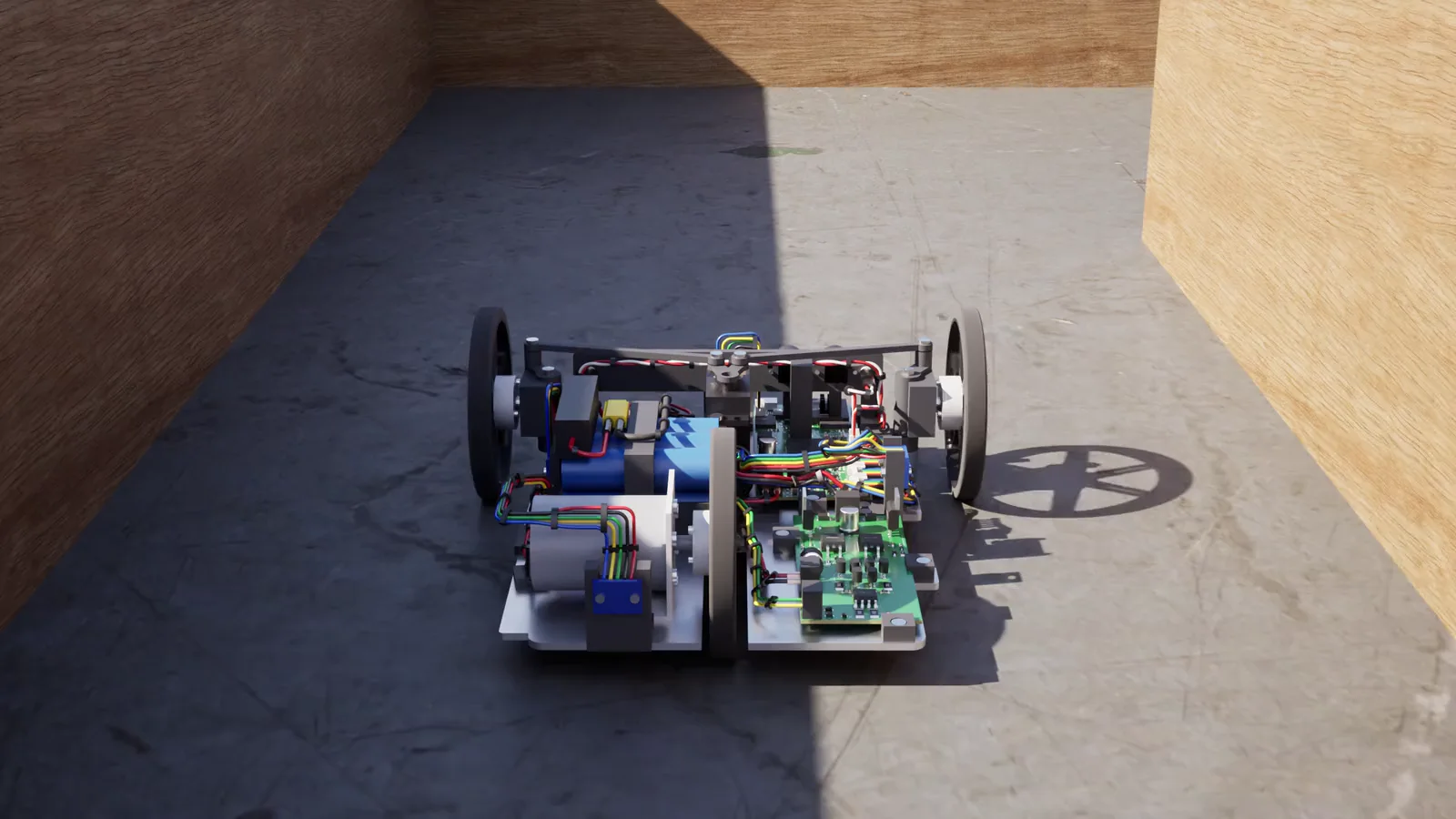
Bring your own agent.
Nihil runs no model and resells no tokens; the name was a hint. Keep Claude Code, Codex, Gemini or Antigravity exactly as you have them, on your subscription, in your terminal, now inside the app. Nihil owns the build, the gates and the record.
- 0models run by Nihil
- 0tokens resold
- 0changes to your setup
- Claude Code$ claude
- Codex$ codex
- Gemini$ gemini
- Antigravity$ agy
- OpenRouterany model
- Local LLMyour hardware
OpenRouter and local models work too. Local can be rough; it depends on your specs.
- build 14 / 14
- gates ERC 0 / 0 DRC 0 / 0 / 0 circuit 4 / 4
- record every run, in Memoria
- car_ctrl_gerbers.zip
- BOM_car_ctrl.csv
- CPL_car_ctrl.csv
- car_ctrl.step
Any board you have ever made, or will make.
Drop in a KiCad, Altium or Eagle project, an old Gerber set, a PDF schematic or a photo of the circuit you drew on paper. Nihil converts it hands-off into a generator, runs the 14 steps and the circuit gate on it, builds the digital twin and starts improving it. No matter how complex.
- Hands-off conversion KiCad imports out of the box: every .kicad_pcb is read through KiCad's own python into a generator (parts, nets, footprints, placement, outline). Altium and Eagle come through KiCad's importer. Anything else, the agent writes its own port script on the spot.
- It asks, it does not guess Anything it cannot read with confidence becomes a question to you. For a drawing, it asks “does this match?” before it builds a thing.
- The twin, on your board The pipeline, the circuit gate and the twin run on what you already have, not a blank one.
- No matter how complex Multi-board systems, dense multi-layer boards, firmware on several MCUs: the engine is written for it.
- car_ctrl.kicad_pcbKiCad
- car_ctrl.kicad_schKiCad
- pwm_amp.PcbDocAltium
- schematic_v2.pdfPDF
- napkin.jpgPhoto
- chassis.stepSTEP
- firmware/main.cC
- gerbers/Gerber
- RC car2 boards · 1 assembly
- car_ctrlstep 14 / 14
- pwm_amp2 layers
- esp32p4_rccarESP32-P4
- RC car chassis189 parts
The board runs before it exists.
Every pad is a node, every trace a resistor that warms the board, and the real firmware runs on the chip's pins. Hot-plug, brown-out, a stalled motor, a warm start: eight stress rules judge them before KiCad is opened, then again on the routed copper.
Loading the recorded run
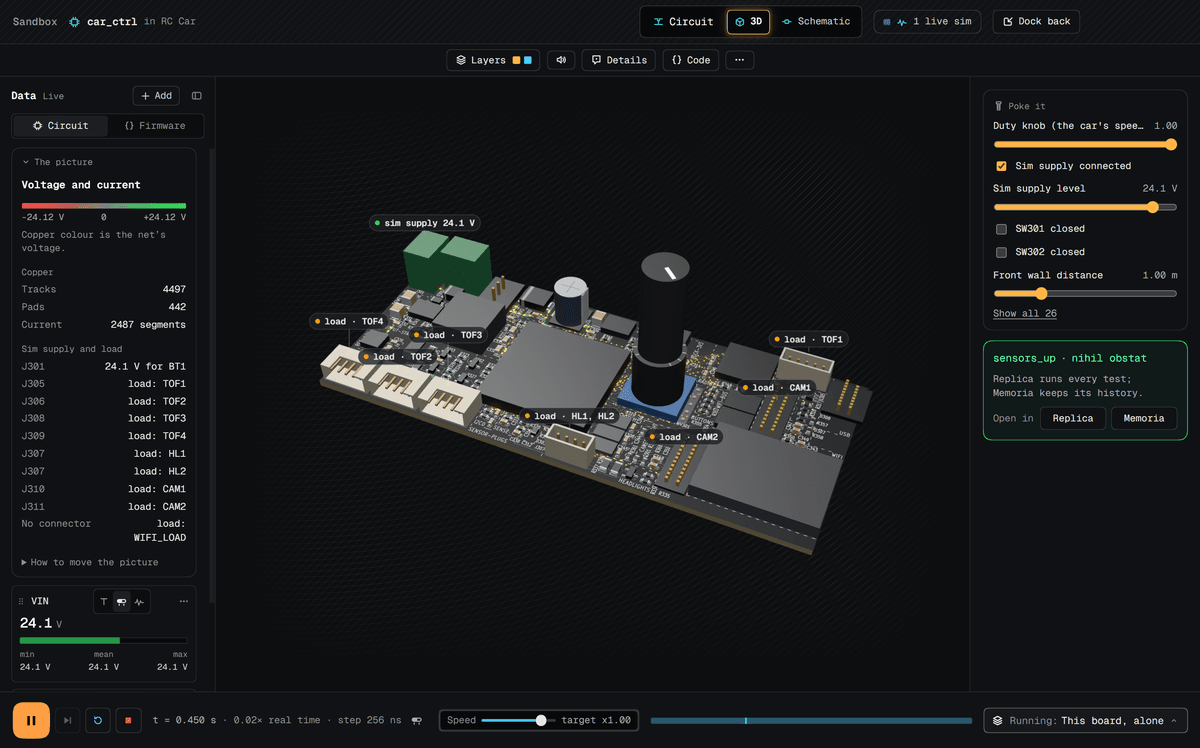
- Copper by voltage, live Every net on the real board, coloured by what it is doing right now; current and heat as layers.
Copper by voltage, live
Every net on the real board, coloured by what it is doing right now; current and heat as layers.
- Probe it. Poke it. Read any net. Hover the copper and the whole net lights up.
Probe it. Poke it.
Read any net. Hover the copper and the whole net lights up.
- Bit-identical, on CPU or CUDA A Monte-Carlo sweep over the parts' tolerances runs on either, with the same bits out.
Bit-identical, on CPU or CUDA
A Monte-Carlo sweep over the parts' tolerances runs on either, with the same bits out.
Same core. Compiled twice.
The control core has no vendor headers. It is built once for the target and once for the PC, where it runs against the twin through the same station protocol, so the firmware is proven before the board exists.
- Out-of-tree builds, host suites Thousands of checks with a parseable summary line; a test that exits 0 without it is a failure, an empty suite is a failure.
Out-of-tree builds, host suites
Thousands of checks with a parseable summary line; a test that exits 0 without it is a failure, an empty suite is a failure.
- Seeds, and a hash Every scenario runs over a seed sweep; the trace hash must come out identical on the same toolchain.
Seeds, and a hash
Every scenario runs over a seed sweep; the trace hash must come out identical on the same toolchain.
- Arduino AVR, ESP32, RP2040, RP2350, STM32, SAMD, Teensy 4, Jetson Two MCUs on the example board each run their own C firmware on their own simulated pins.
Arduino AVR, ESP32, RP2040, RP2350, STM32, SAMD, Teensy 4, Jetson
Two MCUs on the example board each run their own C firmware on their own simulated pins.
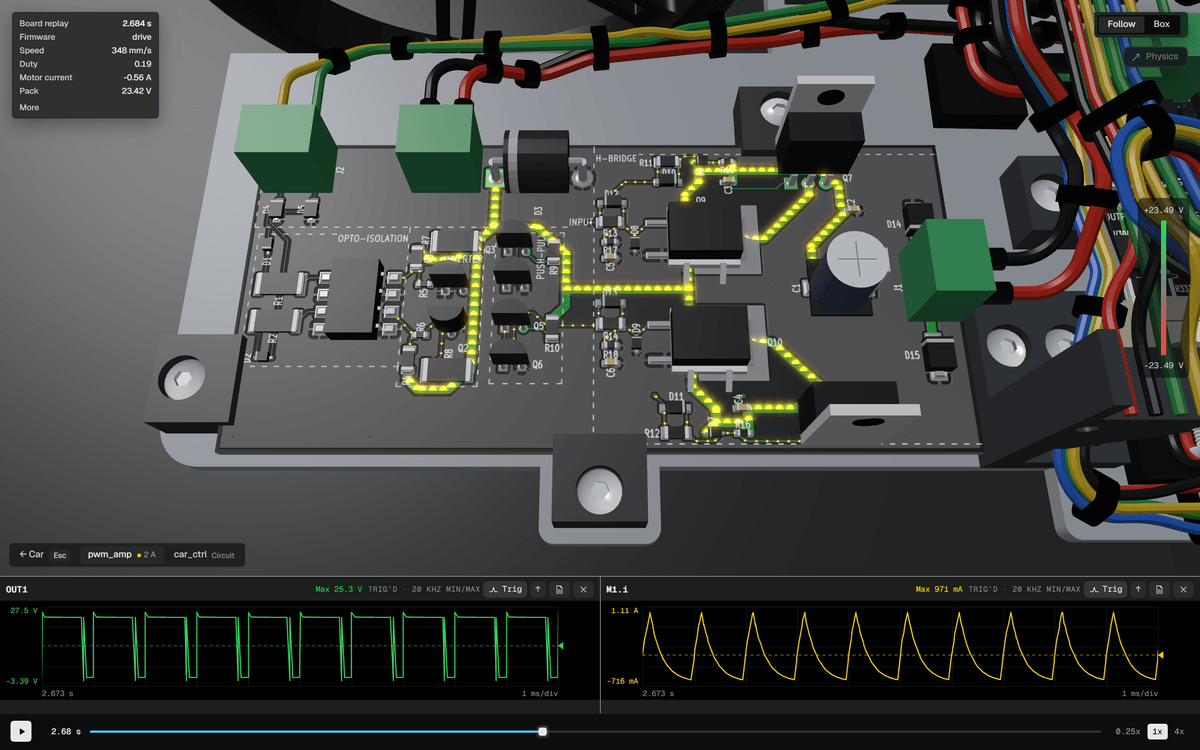
- One board Full. One board not. pwm_amp on copper solves every copper element and draws where the current really went. car_ctrl as a circuit runs its firmware on an averaged model, no copper, no flow, and the session runs at 0.12x real time instead of 0.019x.
One board Full. One board not.
pwm_amp on copper solves every copper element and draws where the current really went. car_ctrl as a circuit runs its firmware on an averaged model, no copper, no flow, and the session runs at 0.12x real time instead of 0.019x.
- Recorded, not drawn Six simulated seconds, 361 frames, every net and part the engine wrote, in about a megabyte. Scopes read the recording back; a probe nobody recorded says so.
Recorded, not drawn
Six simulated seconds, 361 frames, every net and part the engine wrote, in about a megabyte. Scopes read the recording back; a probe nobody recorded says so.
- Then it is yours Orbit, click a board, add a scope, scrub the run. What's missing is the Run button: no solver on this page, no engine to steal.
Then it is yours
Orbit, click a board, add a scope, scrub the run. What's missing is the Run button: no solver on this page, no engine to steal.
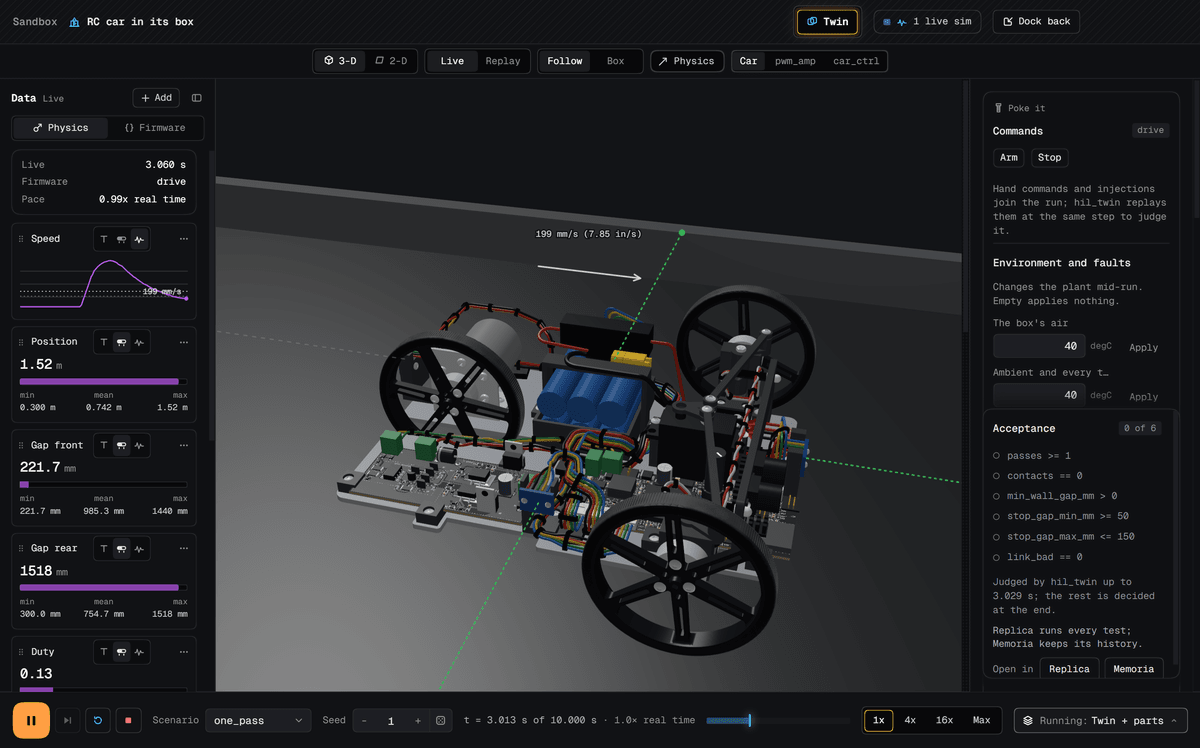
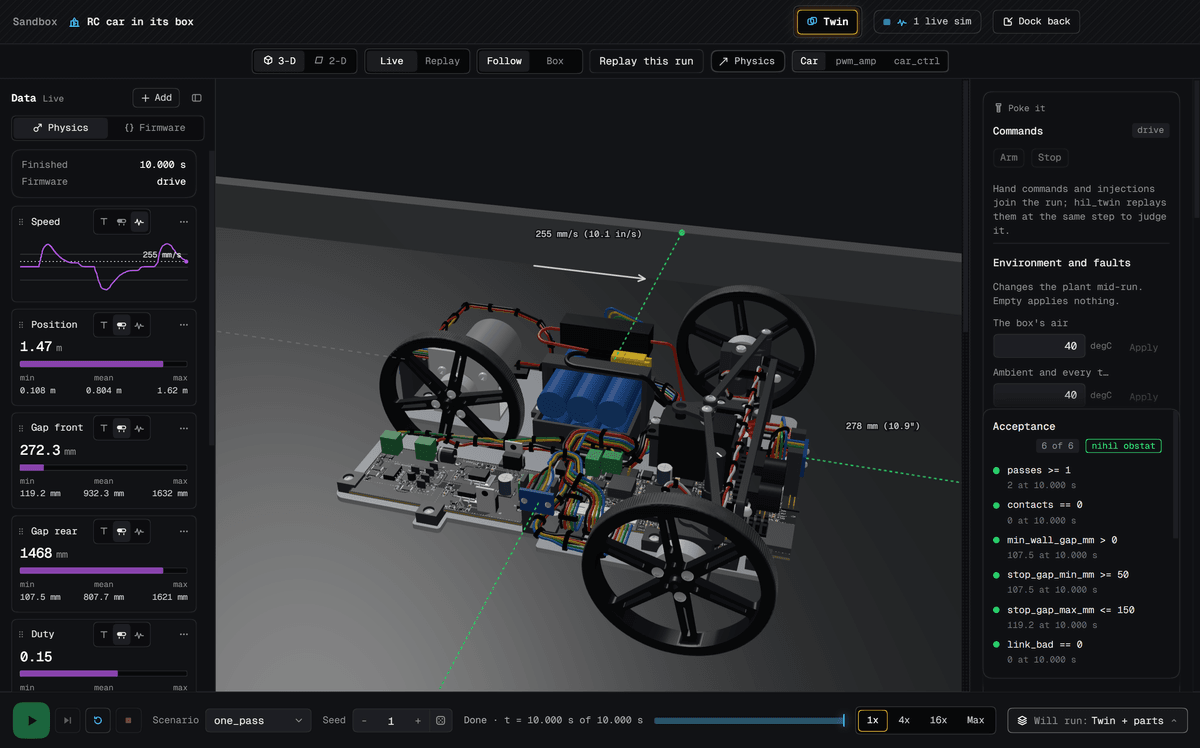
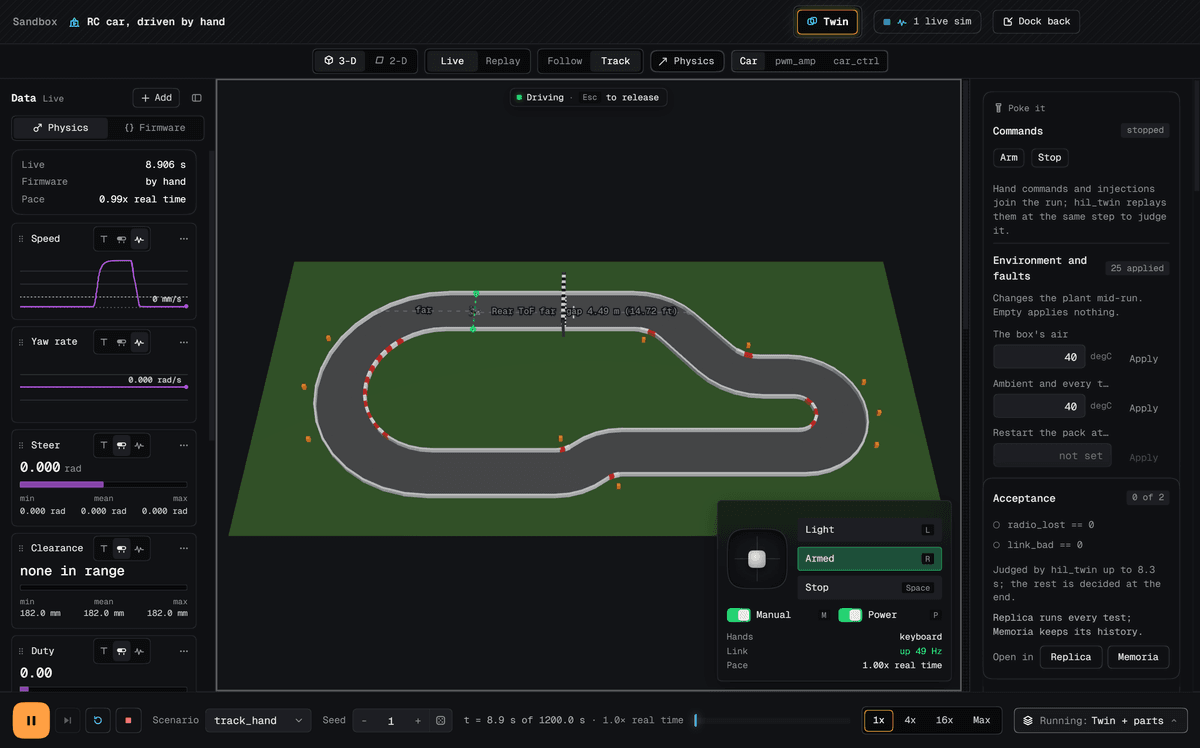
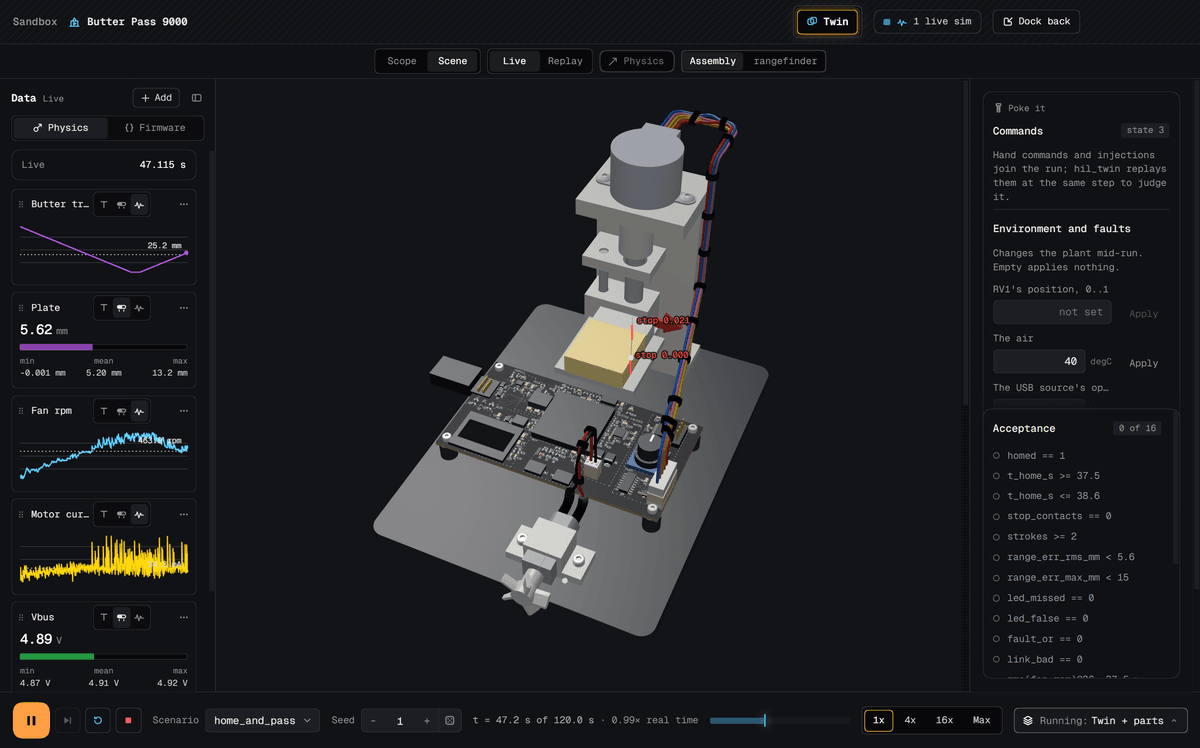
- One place things run In the app a page is a calm viewer and the Sandbox is where it runs. Press Sandbox and the page’s picture morphs into it. Play, Step, Reset and Stop sit on the timeline.
One place things run
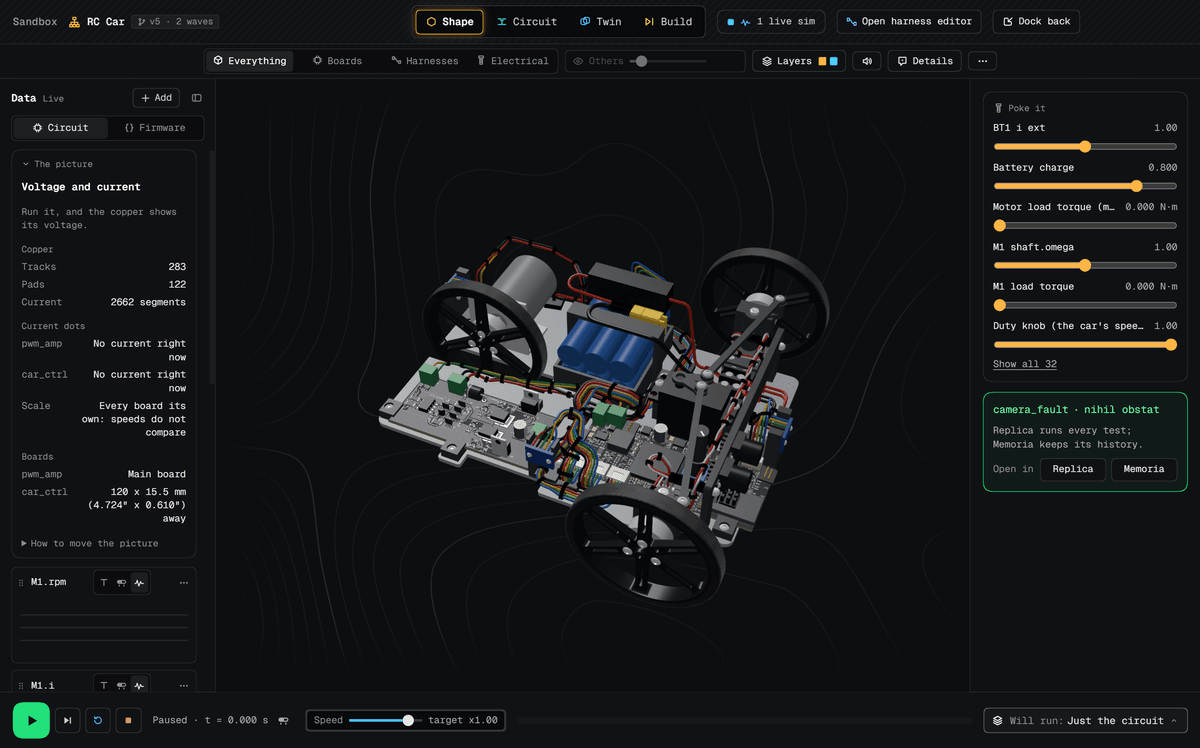
In the app a page is a calm viewer and the Sandbox is where it runs. Press Sandbox and the page’s picture morphs into it. Play, Step, Reset and Stop sit on the timeline.
- A data panel you arrange What the run is doing, as tiles at the left: a number, a bar on its range with low, high and mean, or a rolling scope. Add one, drag it, flip its kind.
A data panel you arrange
What the run is doing, as tiles at the left: a number, a bar on its range with low, high and mean, or a rolling scope. Add one, drag it, flip its kind.
- Layers, in visible light or IR Copper by voltage or through the IR camera, current flow with its dots, power glow, pin numbers, net names. One menu, grouped Light, Show and Camera.
Layers, in visible light or IR
Copper by voltage or through the IR camera, current flow with its dots, power glow, pin numbers, net names. One menu, grouped Light, Show and Camera.
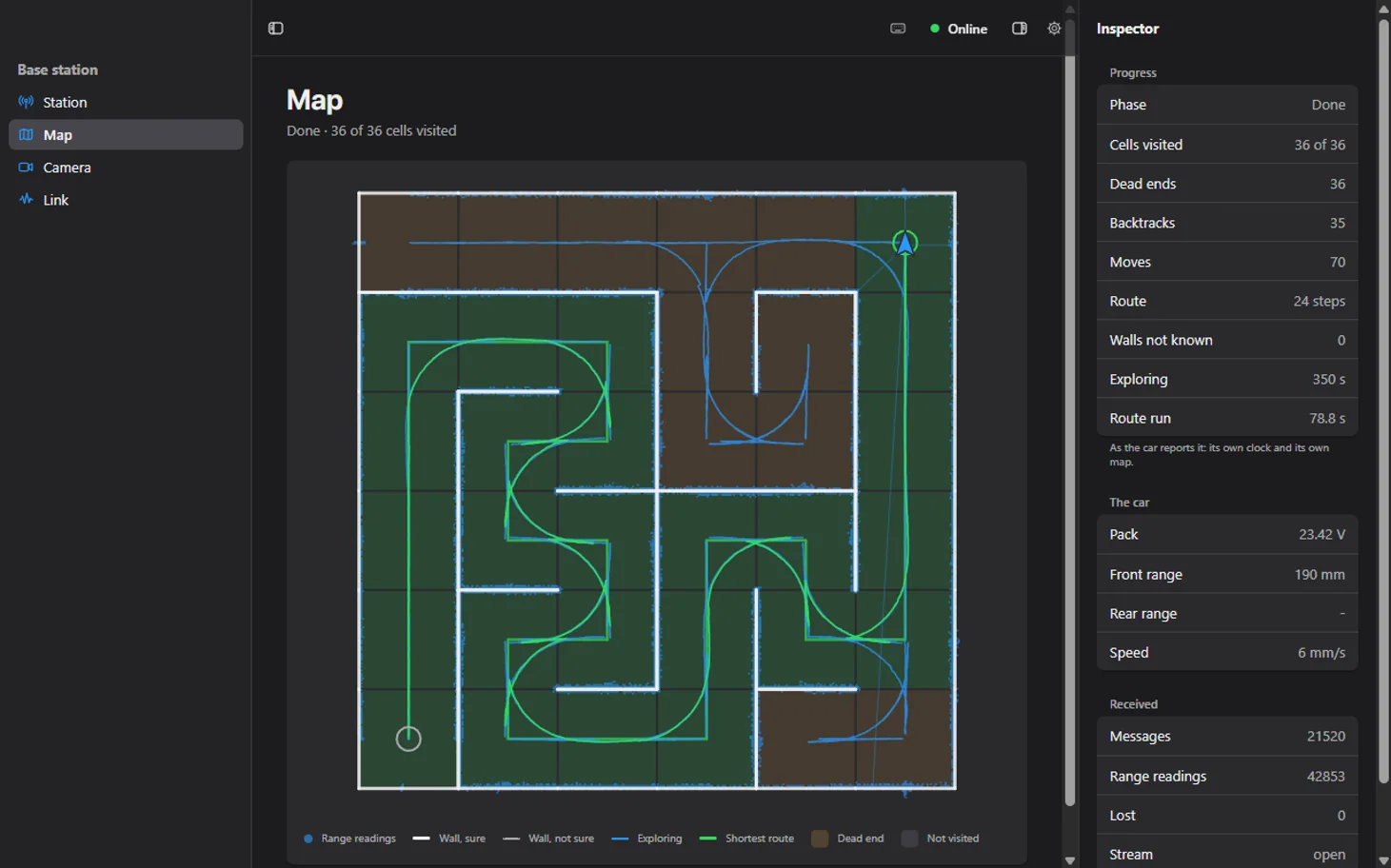

- It drifts like a real robot No wheel encoder, so the car dead-reckons and corrects against the walls it has already seen. Worst error over the run: 36 mm. Switch the corrections off and it ends up to 4.25 m lost and never finds the goal.
It drifts like a real robot
No wheel encoder, so the car dead-reckons and corrects against the walls it has already seen. Worst error over the run: 36 mm. Switch the corrections off and it ends up to 4.25 m lost and never finds the goal.
- Judged against the truth The plant knows the real maze. The run passes only if every cell was visited, the car’s map has no wrong wall and the route it planned is exactly the shortest one: 24 steps.
Judged against the truth
The plant knows the real maze. The run passes only if every cell was visited, the car’s map has no wrong wall and the route it planned is exactly the shortest one: 24 steps.
- Your base station runs too nihil new service and nihil new app make companion programs that run beside simulated hardware. This one heard 21,520 radio frames from the car and lost none. Point the same binary at the bench with one flag.
Your base station runs too
nihil new service and nihil new app make companion programs that run beside simulated hardware. This one heard 21,520 radio frames from the car and lost none. Point the same binary at the bench with one flag.
- Bring your own Unreal Install Unreal Engine 5.8, free from the Epic Games Launcher. Nihil’s installer carries its own plugin and finds the engine. Every alpha invite includes the Unreal pipeline.
Bring your own Unreal
Install Unreal Engine 5.8, free from the Epic Games Launcher. Nihil’s installer carries its own plugin and finds the engine. Every alpha invite includes the Unreal pipeline.
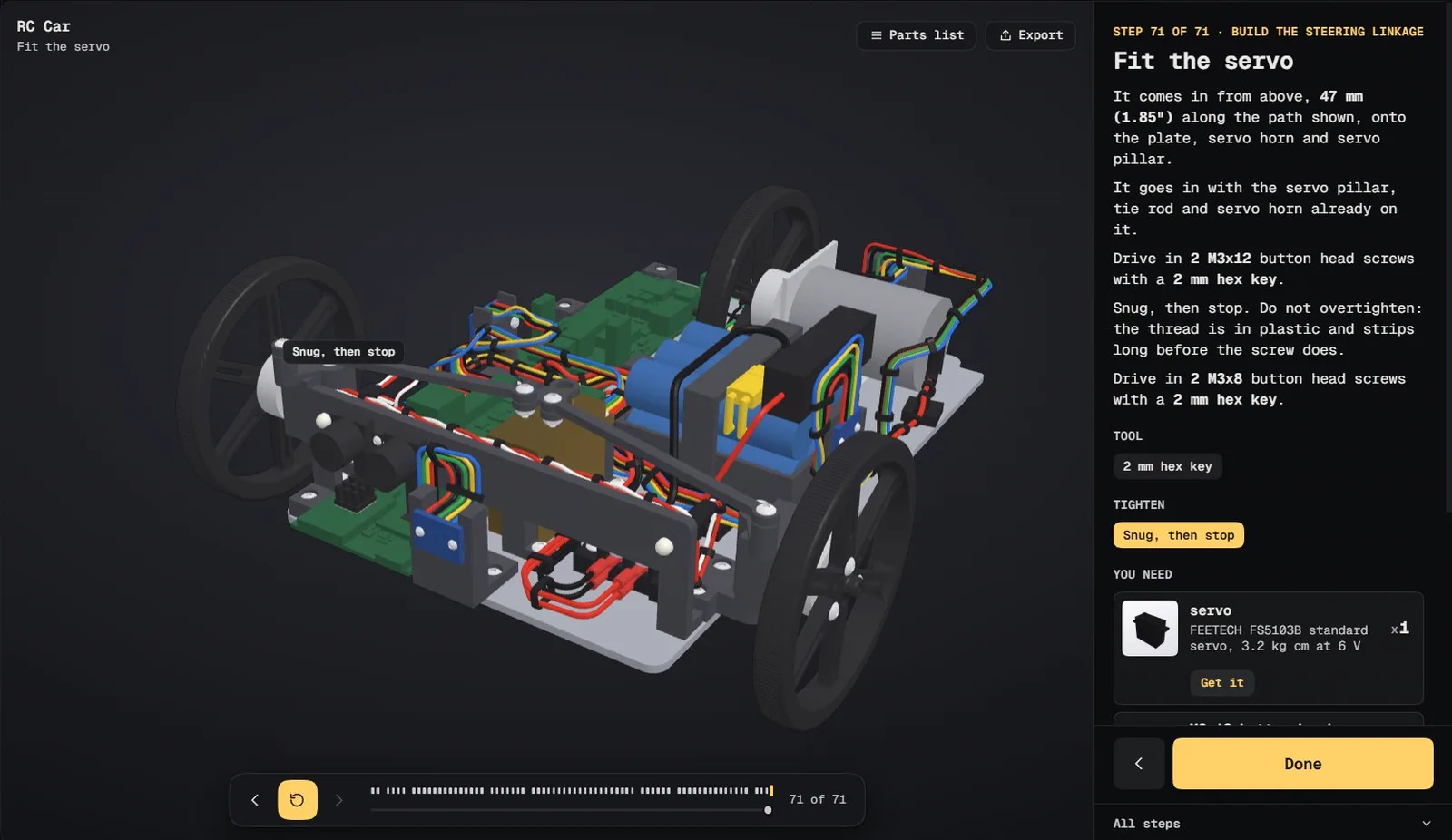
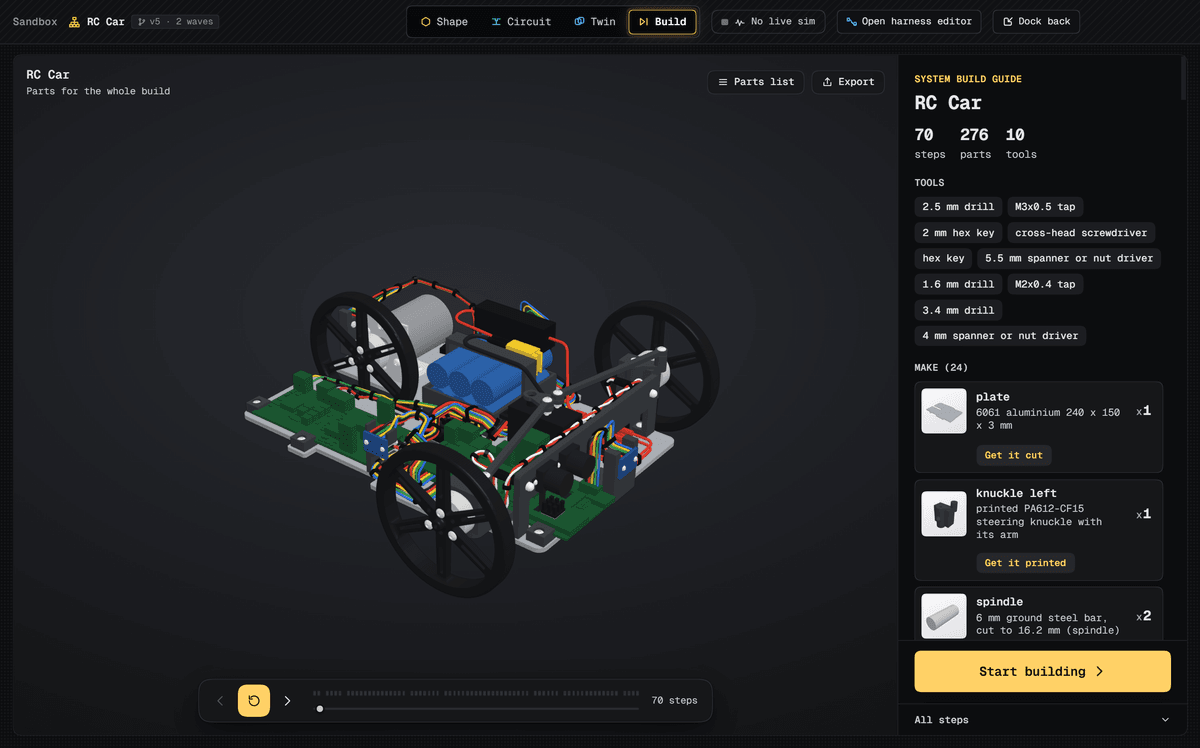
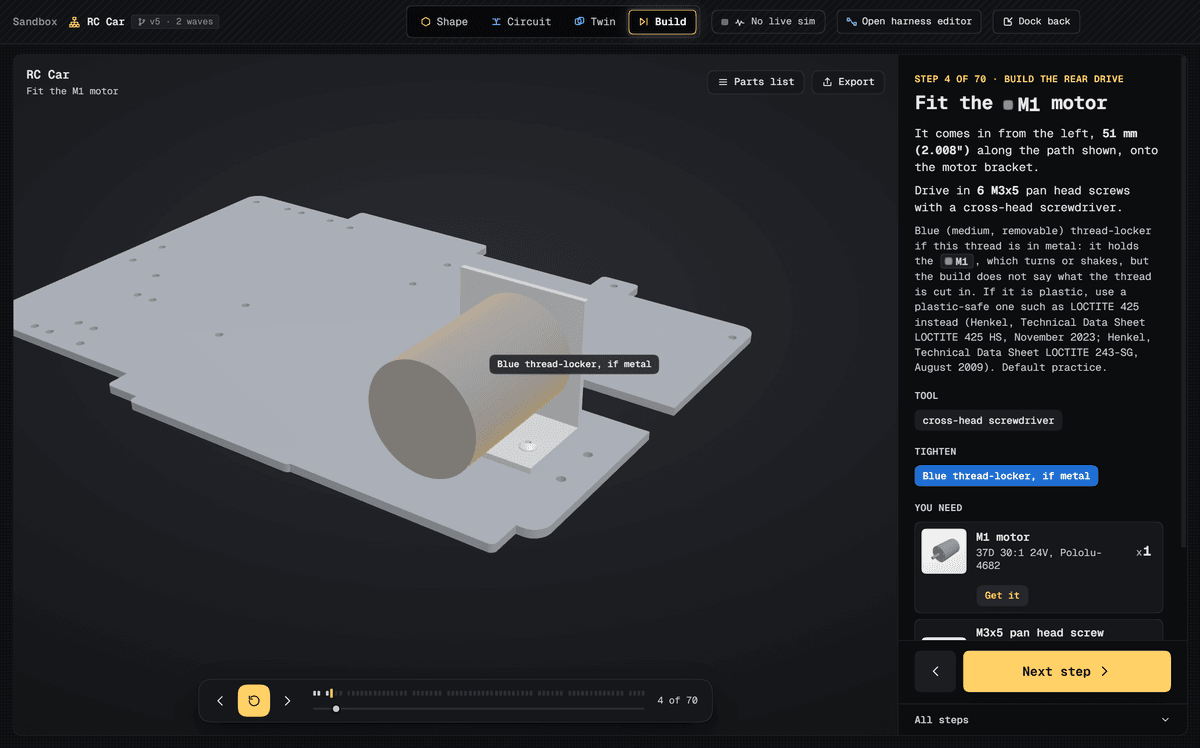
- Parts and tools first The guide opens on the parts list for the whole build and the tools it takes. Every part gets a card: a picture, the name, how many, the tool, the size. A printed part brings its print card: the face up on the bed, the walls, the supports, the material.
Parts and tools first
The guide opens on the parts list for the whole build and the tools it takes. Every part gets a card: a picture, the name, how many, the tool, the size. A printed part brings its print card: the face up on the bed, the walls, the supports, the material.
- One step, one move Each step shows the build so far, this step’s parts coming in along their paths and seating, and the screws turning in. Orbit it, replay it, scrub it.
One step, one move
Each step shows the build so far, this step’s parts coming in along their paths and seating, and the screws turning in. Orbit it, replay it, scrub it.
- Holes finished before fitting A printed part gets its own step between the printer and the build: drill the close-fit holes to size, tap, countersink, set the heat-set inserts, each tool named once. Metric or SAE is the project’s choice.
Holes finished before fitting
A printed part gets its own step between the printer and the build: drill the close-fit holes to size, tap, countersink, set the heat-set inserts, each tool named once. Metric or SAE is the project’s choice.
- Then the wiring For a cable, both connectors light up, the run is laid from one to the other, and each tie and mount goes on where the harness puts it.
Then the wiring
For a cable, both connectors light up, the run is laid from one to the other, and each tie and mount goes on where the harness puts it.
- A system builds from its assemblies The demo’s RC car goes together stage by stage: rear drive, front axle, battery box, the boards, front module, steering linkage. Boards arrive built; a board is one part.
A system builds from its assemblies
The demo’s RC car goes together stage by stage: rear drive, front axle, battery box, the boards, front module, steering linkage. Boards arrive built; a board is one part.
- One button to the end Start building, Next step, Done. Arrow keys step, space replays, a marker per step jumps. The page never scrolls away from the picture.
One button to the end
Start building, Next step, Done. Arrow keys step, space replays, a marker per step jumps. The page never scrolls away from the picture.
bench buildesp32s3_probe
- flash The target’s own script checks the chip and the flash size, then writes hash verified
- identify Firmware name and build id, held against the ELF the project built matches
- selftest Chip, 16 MB of flash, free heap, the log ring, 0 missed deadlines 5 of 5
- inject ADC 0 held at 1234, read back in telemetry, then handed back to the pin 1234
- tick 250 app ticks on the host’s clock, then the board runs free again 250 ran
- logs Decoded with the build’s ELF: the boot, the injection, adc0 rose to 1234 (threshold 1000) 0 dropped
A real ESP32-S3 dev board on its USB-UART bridge · 13 November 2026 · every value is the board’s own answer
- It knows what is on the board The board reports a build id: the first 8 bytes of its ELF’s SHA-256. Nihil holds it against the project. A board running something other than what is in the repo is the line you read first.
It knows what is on the board
The board reports a build id: the first 8 bytes of its ELF’s SHA-256. Nihil holds it against the project. A board running something other than what is in the repo is the line you read first.
- A field log at 20 bytes a record The firmware logs into a ring in RAM: no stdio, no heap, no lock. Nihil decodes it only with the exact ELF that was flashed. No match means raw records and the reason, never a guess.
A field log at 20 bytes a record
The firmware logs into a ring in RAM: no stdio, no heap, no lock. Nihil decodes it only with the exact ELF that was flashed. No match means raw records and the reason, never a guess.
- Fake the sensor, keep the silicon A bench build takes held ADC and GPIO values and a clock the host owns, so the real chip meets the case you could not stage. The release build compiles the hooks out and its board says so; that refusal is checked in tests, not yet on a board.
Fake the sensor, keep the silicon
A bench build takes held ADC and GPIO values and a clock the host owns, so the real chip meets the case you could not stage. The release build compiles the hooks out and its board says so; that refusal is checked in tests, not yet on a board.
- Flash from the project One script per target checks the chip and the flash size before it writes, and verifies after. That script flashed and verified the board above. nihil realboard flash runs the same script as one job for ESP-IDF targets; that job has not been run on a board yet.
Flash from the project
One script per target checks the chip and the flash size before it writes, and verifies after. That script flashed and verified the board above. nihil realboard flash runs the same script as one job for ESP-IDF targets; that job has not been run on a board yet.
- Every session is a record Each one is a capture in the project. History opens it as it was: the identity, each check, what was held and stepped, and the log as it read that day.
Every session is a record
Each one is a capture in the project. History opens it as it was: the identity, each check, what was held and stepped, and the log as it read that day.
- The same verbs for your agent Everything the Real board tab does is on the command line: identify, selftest, logs, inject, tick. Your agent can run the bench, and leaves the same record.
The same verbs for your agent
Everything the Real board tab does is on the command line: identify, selftest, logs, inject, tick. Your agent can run the bench, and leaves the same record.
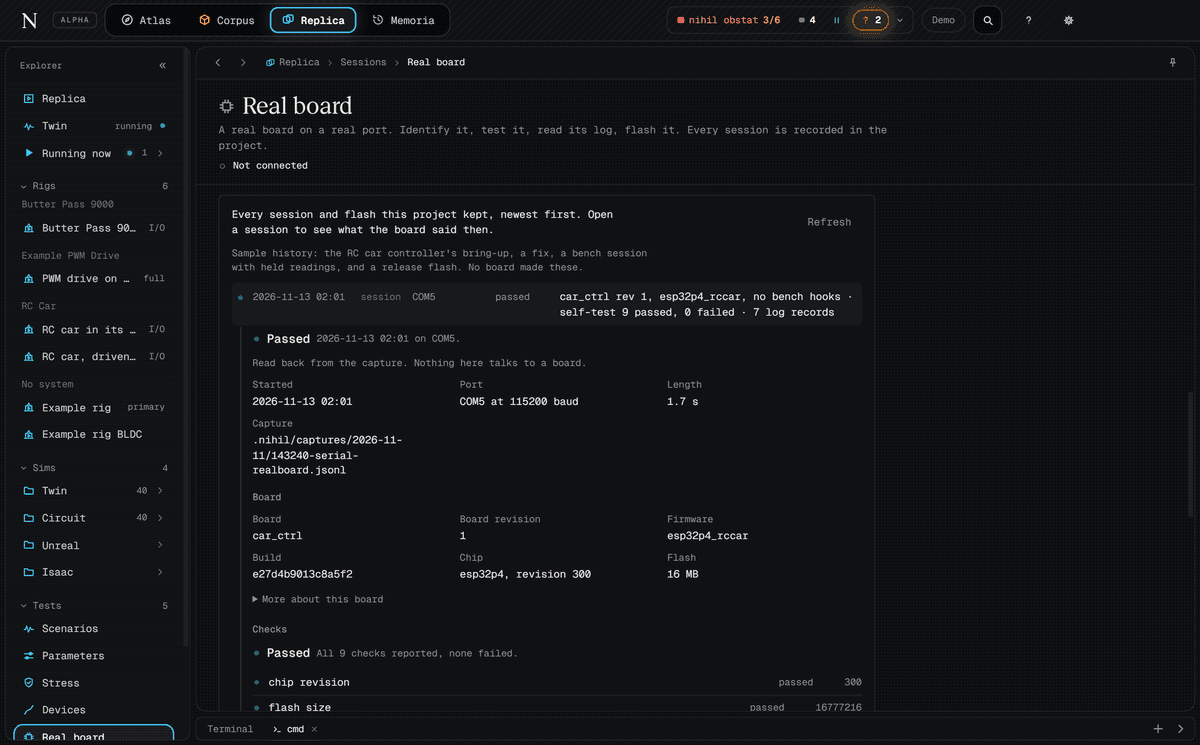
Early, and it says so: the Real board tab is off until you switch it on in Settings. The probe firmware builds for the ESP32-S3, ESP32-C3 and ESP32-P4. The S3 is the one that has been on the bench, with its bench build; a release build has not been through a board.
A board is a script.
The generator is the design. One pipeline turns it into a schematic, a routed board, a fab set and a STEP model, and stops at the first thing that is wrong.
Declare, don’t draw.
The script declares every part with its datasheet pin table, then the nets, the outline and holes, the placement, the net classes and the pours. Nobody edits the .kicad_pcb by hand. Change a line, run it again.
Same inputs, same files.
Hashed string order, uuid5 schematic ids, seeded board ids and a frozen route. Run it twice and the .kicad_pcb matches to the byte, so git shows the change you made, not a reshuffle.
Parts that exist.
113 common parts in 15 categories, each resolved live to its part number at the distributor, with a footprint that exists and a simulator model. One call, model("C21190"), brings the part with both.
Fourteen steps. One pipeline.
Every board runs the same fourteen steps and stops at the first thing that is wrong. Four of them are gates. No fab file exists until all four are clean.
Step Tool Stops the run when
GATES 2, 5, 12 and 13 must be clean before any fab file is written
0 errors, 0 warnings0/0
ERC errors / warnings
0 violations, 0 unconnected, 0 parity0/0/0
Final DRC violations / unconnected / parity
Circuit gate runs pass, before and after routing
11 verified, 0 mismatches11/0
Purchased lines verified live / mismatches
22.9 seconds22.9s
All fourteen steps, from the frozen route
From the 3.3 V LDO breakout example: 2 layers, 11 parts, 6 nets, run of 2026-11-06.
Your Loop. Your steps.
Ask your agent for a step and it exists: a check, a test, a sim, a gate. Validated, loaded, and disabled with the reason if it ever breaks.
- Addstests, tools, views (declarative or sandboxed script), native kinds, templates, library items
- Loadsafter validation, nothing unchecked
- Failsdisabled, its error on Proof; never fatal
- Runs awaya view is unloaded in 2 s
- 15Gate ITAR / export check added by your agent Stops the run when: a part or destination on the control list
ITAR / export check
added by your agent
Stops the run when: a part or destination on the control list
- 16 EMC pre‑check added by your agent Stops the run when: a loop area or edge rate over budget
EMC pre‑check
added by your agent
Stops the run when: a loop area or edge rate over budget
- 17 thermal soak, 300 s added by your agent Stops the run when: a part past its rated temperature
thermal soak, 300 s
added by your agent
Stops the run when: a part past its rated temperature
- 18 drop test, twin added by your agent Stops the run when: a joint or part over its g rating
drop test, twin
added by your agent
Stops the run when: a joint or part over its g rating
Every run ends in two words.
A board is not orderable until the circuit stress gate, ERC, the final DRC with parity and the live part check are clean. Firmware is not done until it runs in the twin and the circuit sim, deterministically. Each run keeps its record, so the proof outlives the chat that produced it.
nihil obstat
nothing stands in the way: the gate passed
car_ctrl · step 14 of 14
something does: it does not ship
pwm_amp · STRESS-08 fails
- A check that has not run is not a pass pwm_amp reads obstat: one stress row fails, and its ERC, DRC and distributor checks have not run. Nothing turns green by being left out.
A check that has not run is not a pass
pwm_amp reads obstat: one stress row fails, and its ERC, DRC and distributor checks have not run. Nothing turns green by being left out.
- Eight stress rows, pre- and post-route The circuit under the conditions it will meet, before and after the copper exists.
Eight stress rows, pre- and post-route
The circuit under the conditions it will meet, before and after the copper exists.
- Distributor check, live Every purchased part verified against stock before anything is ordered. A code that looked right once resolved to an 0603 instead of the 0402 it was assumed to be; the gate caught it.
Distributor check, live
Every purchased part verified against stock before anything is ordered. A code that looked right once resolved to an 0603 instead of the 0402 it was assumed to be; the gate caught it.
- Every run kept, every verdict searchable Memoria holds the record: who ran it, when, on what, and what it said.
Every run kept, every verdict searchable
Memoria holds the record: who ran it, when, on what, and what it said.
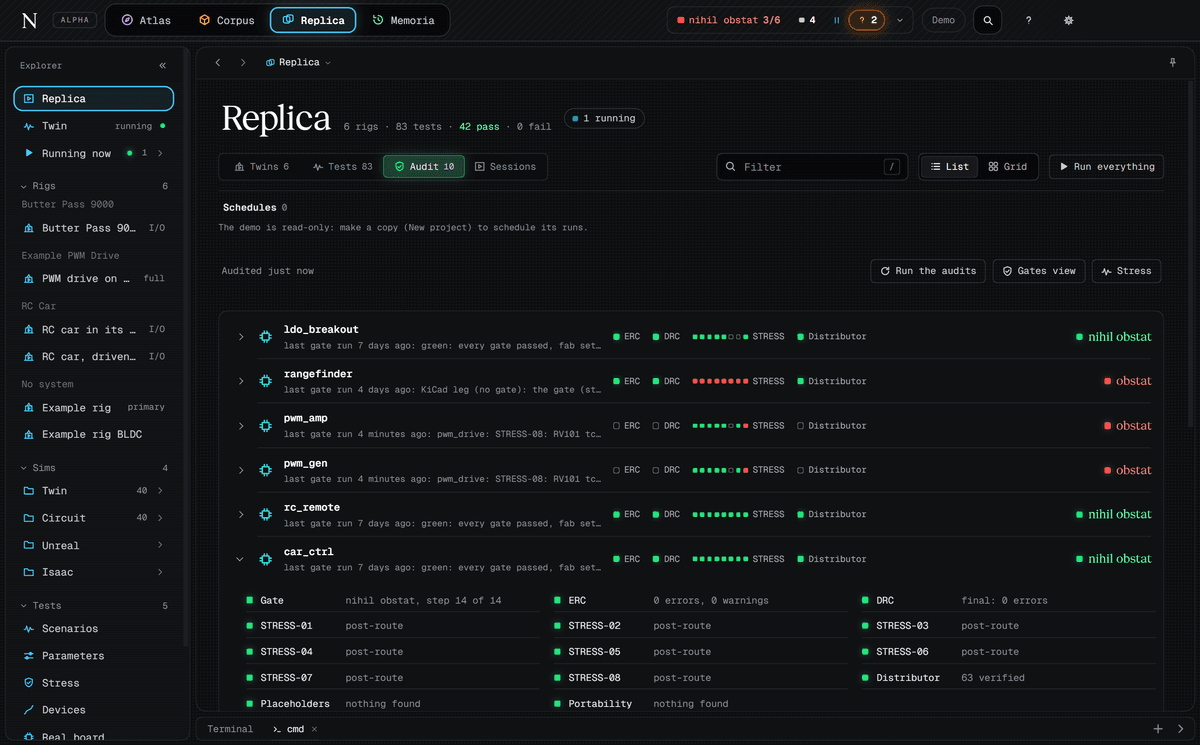
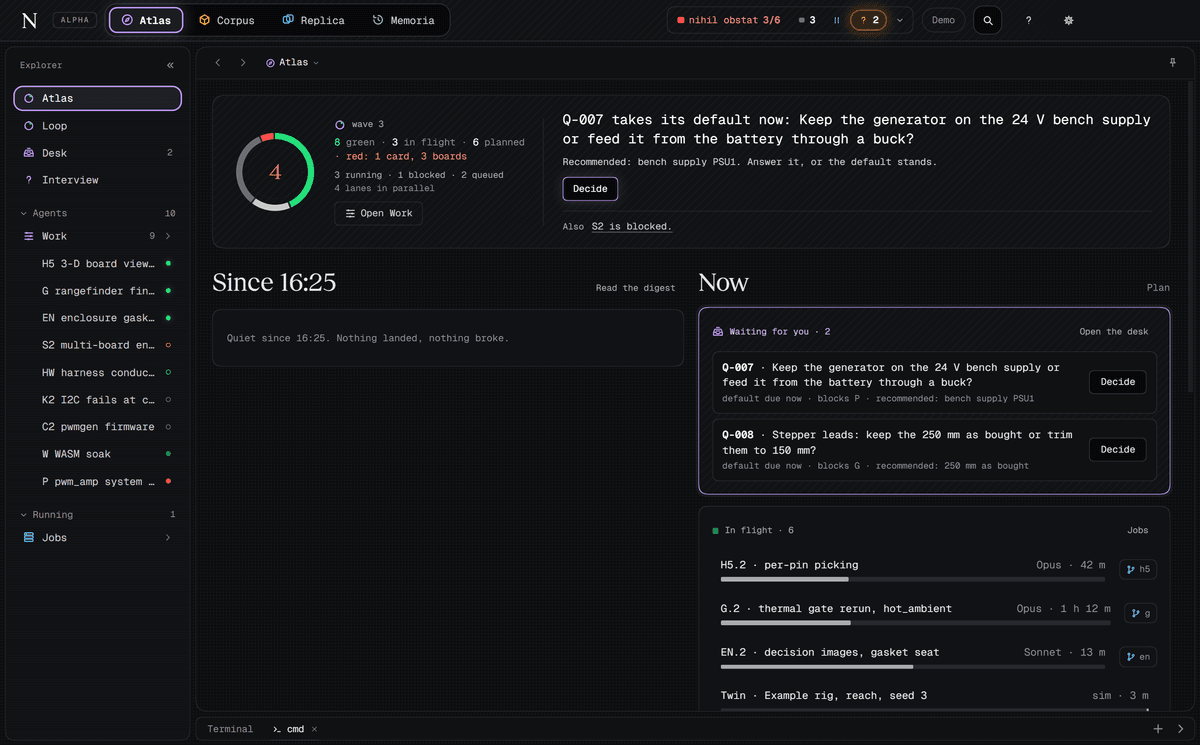
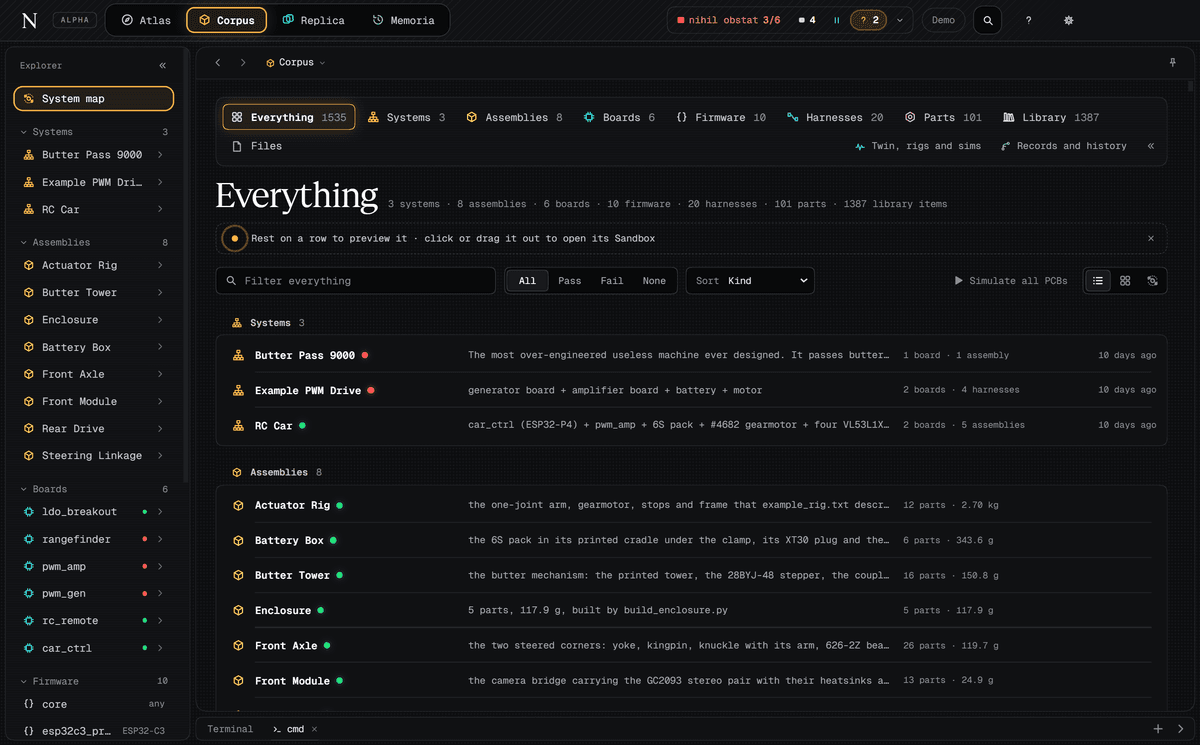
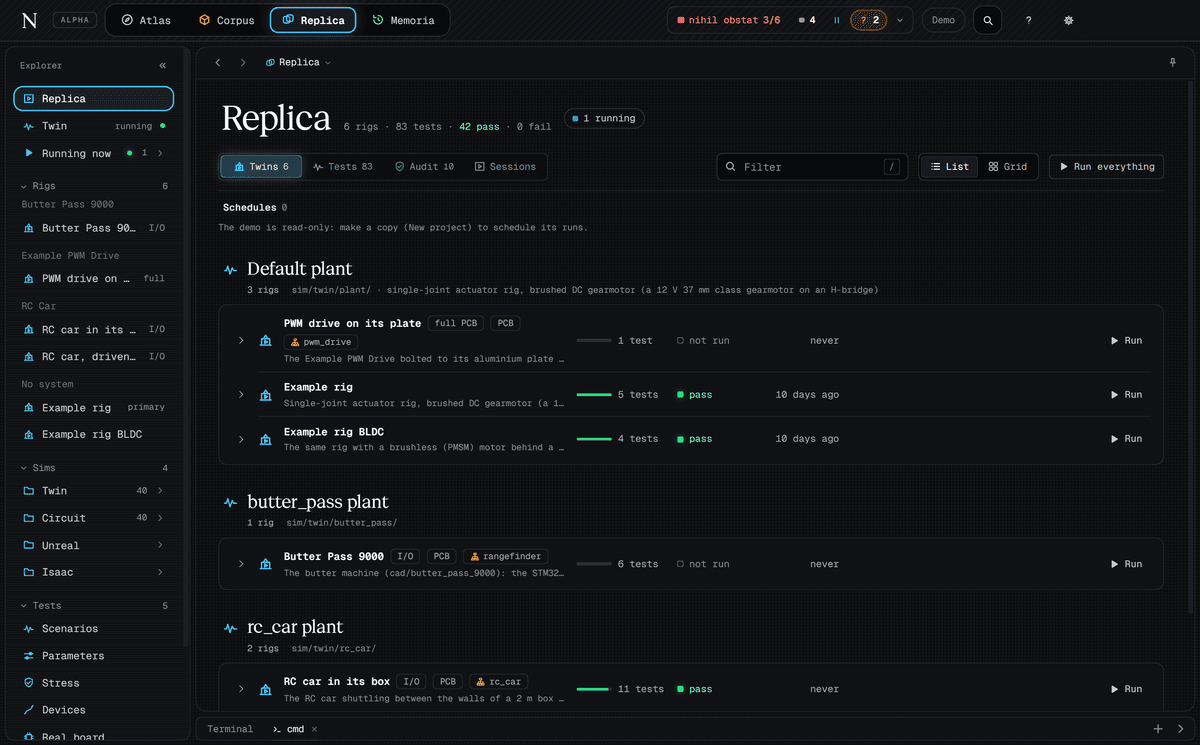
Four spaces. One window.
A project is one product: enclosure, boards, harnesses, firmware and the twin. The top bar gives you four places to stand, and every thing opens the same way from each of them: on a page of its own, with its Sandbox one press away.
Atlas
the pilot's map
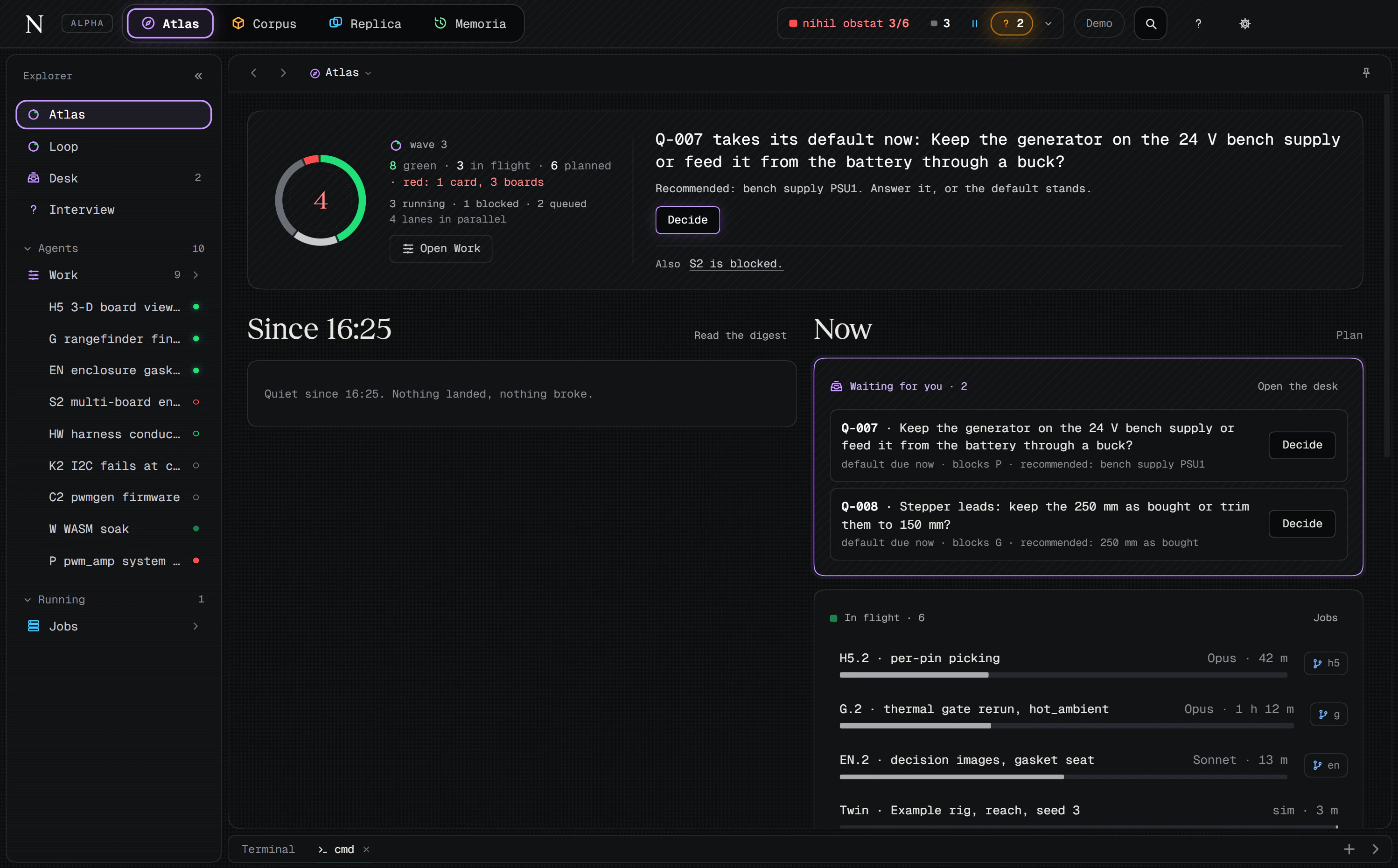
The Loop, what runs now, what waits for you, what comes next, what was touched today. Open questions land here with a default and a deadline.
Corpus
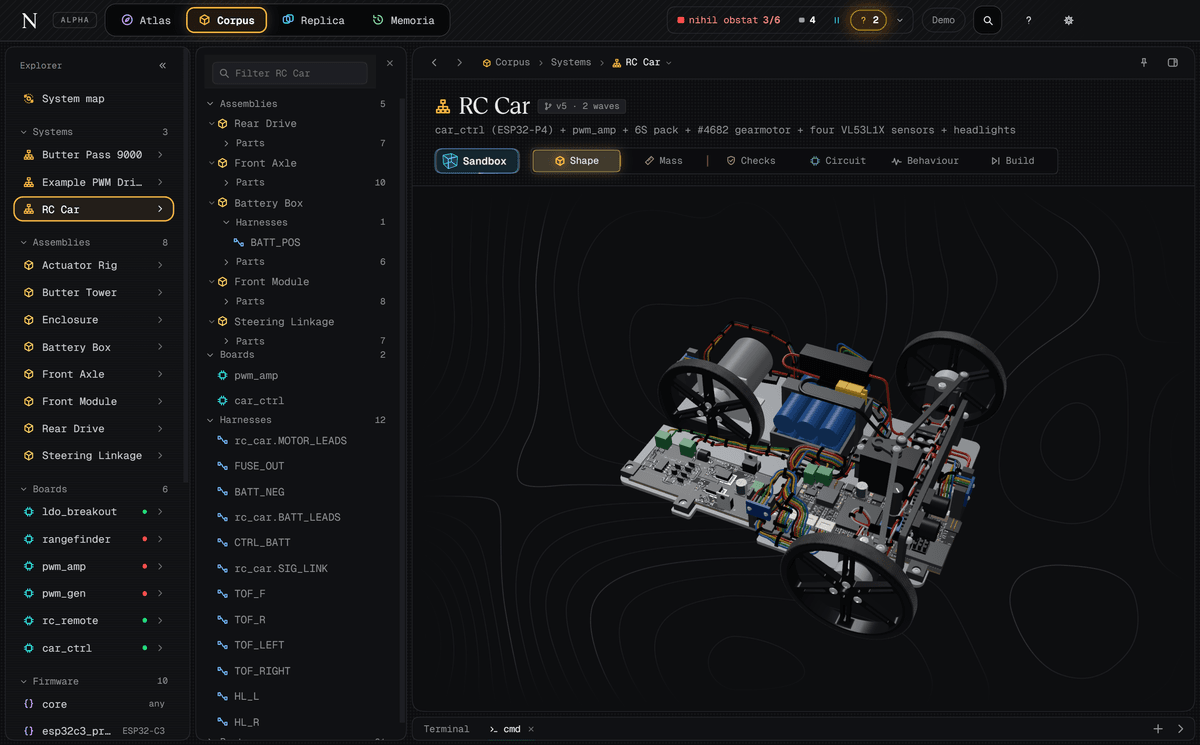
Systems, assemblies, boards, firmware, harnesses, parts, library, files. Every one has a page: a lens dial across the top (Shape, Circuit, Behaviour, Build, only the lenses it has something for), a content list beside it that follows the lens, and one button that runs it: Sandbox.
Replica
twins and tests
Rigs, scenarios, stress rows and the audit. A rig’s page lists its scenarios, its components, its last runs and its replays. Running now stays pinned beside whatever you open, so a run is never out of sight.
Memoria
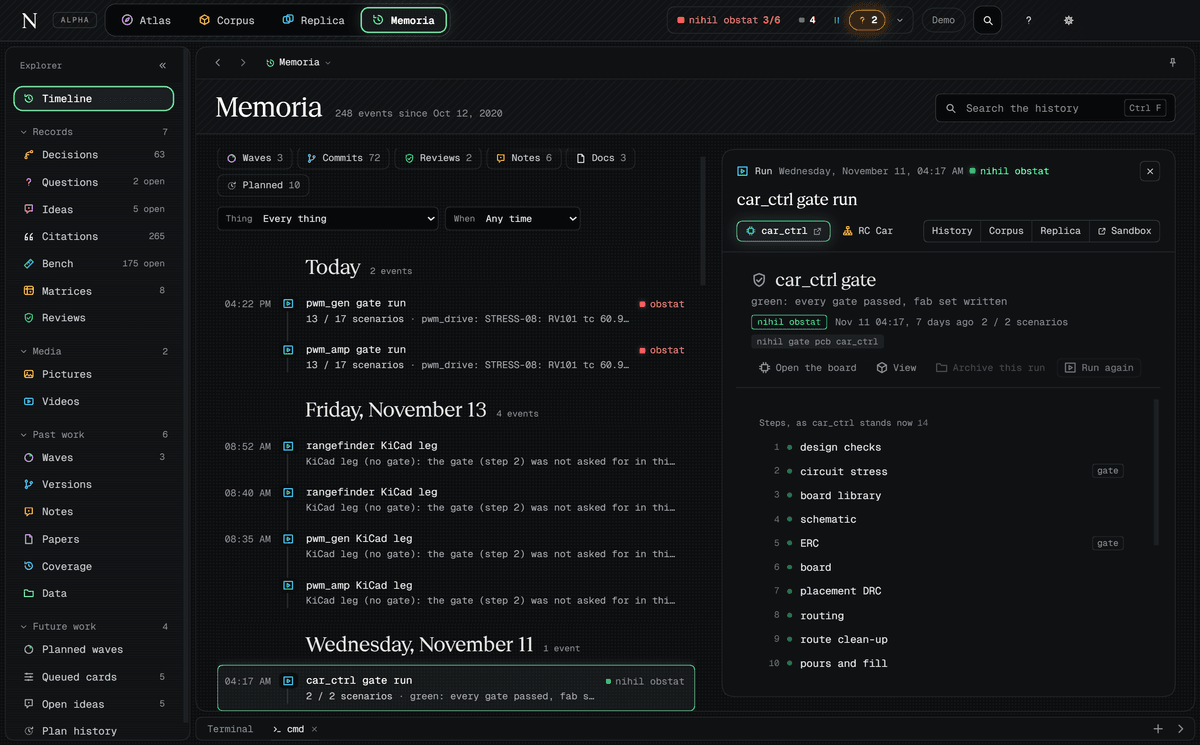
Decisions, questions, runs, waves, versions. Every gate run keeps its record. Pick an event and the whole story opens: the run, its steps, its verdict, the commit.
Sandbox
where things run
Pages show; the Sandbox runs. Press Sandbox on anything and its picture morphs into the one window where things run: the data panel at the left, the stage edge to edge, the timeline along the bottom, with Stop on it. One Sandbox, one live sim at a time.
And a fifth: Synthesis Later Synthesis, a fifth space, comes later. It is not built yet.
Every board, every cable, one map.
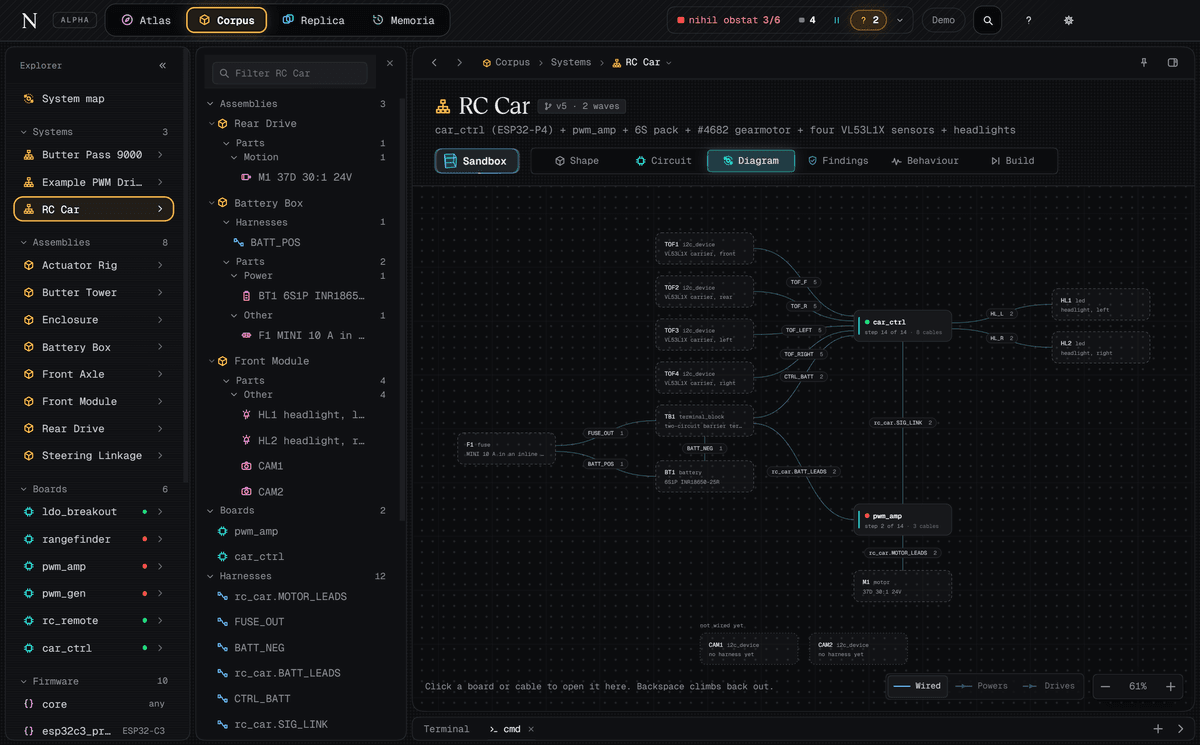
Corpus draws what your product is made of, from the project itself. This is the demo's, laid out by the app. Poke it: rest on a bubble and its cables light up; click and it tells you what it is.
bigger holds more · ring is the verdict · click anything
- Relations with a type Things are linked the way an issue tracker links issues: wired to, plugged into, mounted on, fastened to, clipped to, powers, drives, senses, runs on. A closed list, each kind drawn its own way.
Relations with a type
Things are linked the way an issue tracker links issues: wired to, plugged into, mounted on, fastened to, clipped to, powers, drives, senses, runs on. A closed list, each kind drawn its own way.
- And a block diagram A system’s Circuit lens draws the same product as blocks: boards as plates with their gate dot, the battery and the motor as outlines, every harness a cable labelled with its conductor count. Zoom in and dive into a board.
And a block diagram
A system’s Circuit lens draws the same product as blocks: boards as plates with their gate dot, the battery and the motor as outlines, every harness a cable labelled with its conductor count. Zoom in and dive into a board.
Your agent. Your terminal.
Nihil does not run a model. Claude Code, Codex, Gemini or Antigravity run in your own terminal inside the app, write the generators, the firmware and the tests, and call the gates. It argues back. So do you.
✻ Claude Code
~/outdoor_node
Opus · mcp: nihil connected
/help for help, /status for your current setup
- An open fan in the lid. Most air for the least money.
- More copper under the chip. Free, and not enough on its own.
- Throttle when it gets hot. Works today, costs you the speed.
?Q-014 · Mill the lid's bosses down, or move J2 on the board?
default mill the bosses · blocks the lid order · due today
? for shortcuts
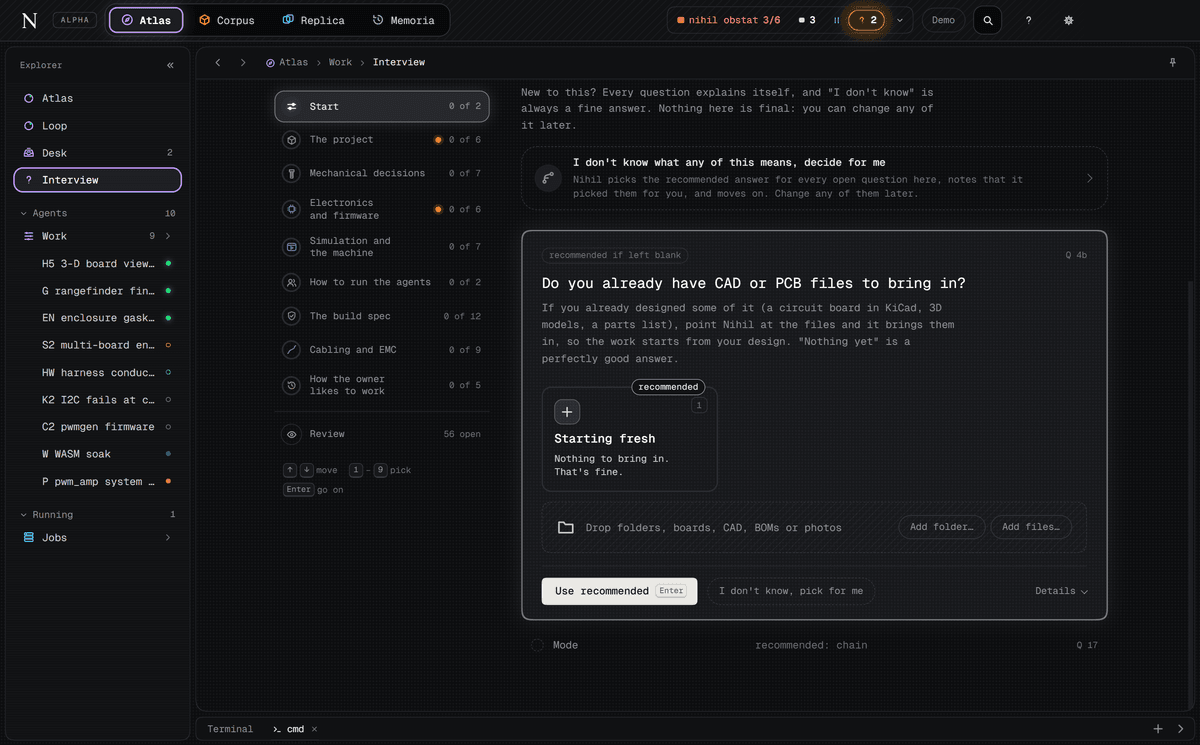
- It starts with an interview A new project opens on one question at a time, the recommended answer first and its plain words under it. “I don’t know, pick for me” is an answer, and the record says so.
It starts with an interview
A new project opens on one question at a time, the recommended answer first and its plain words under it. “I don’t know, pick for me” is an answer, and the record says so.
- Partner, autopilot, or both Pair with it on every decision, hand it the whole job, or let it run and answer the three questions that matter in the morning.
Partner, autopilot, or both
Pair with it on every decision, hand it the whole job, or let it run and answer the three questions that matter in the morning.
- Questions come to your desk With a default, a deadline and what they block. Decide, and the answer is a record the agent reads.
Questions come to your desk
With a default, a deadline and what they block. Decide, and the answer is a record the agent reads.
- Agents write. Nihil proves. nihil gate pcb car_ctrl from the terminal, and the verdict lands in Atlas, in Memoria, in the Loop.
Agents write. Nihil proves.
nihil gate pcb car_ctrl from the terminal, and the verdict lands in Atlas, in Memoria, in the Loop.
This session is scripted, so the whole argument fits in a minute. The gate runs on this page are real.
Base your branch on theirs.
A Nihil project is plain git. Atlas shows who is on which board, which CAD, which firmware, so you can start on the enclosure while the board it fits on is still in somebody else's branch.
Branches and worktrees, nothing proprietary underneath. Your project still opens without Nihil.
- rangefinderfinal DRC and gate swarm/g Opus
- enclosuregasket seat, fit check swarm/en Sonnet
- stm32g0_pwmgenfirmware, queued next no branch yet Sonnet
The projects you never had time for. Start them tonight.
Give the board you shelved to an agent, argue with it, and let the gates say what's real. Your team, moving faster than it has any right to.
Try the real thing.
The whole demo project, in the real app, in this tab. The RC car, its two boards, the twin, the gates and their records. Read-only, the way a reviewer sees it. It is a preview: circuits here play recorded runs of the real engine, and the desktop app runs them live on your own hardware.
Accept the Terms to open the demo.
loads about 3 MB · plays in this tab · nothing installed
Best on a desktop browser; it runs here too.
This host does not carry the demo build. The desktop app opens the same project in one click.
What to look at
Atlas
The Loop ring, what is in flight, and two questions waiting for a decision.
Corpus
1535 things: three systems, eight assemblies, six boards, ten firmware targets, 20 harnesses, 101 parts and the library. Rest on car_ctrl.
Replica
Six rigs and 83 tests: the RC car in its box, the car you drive by hand, the Butter Pass 9000, the PWM drive on its plate. Open a rig for its scenarios, and the Audit for every board.
Memoria
249 events since the project began. Pick the car_ctrl gate run and read its 14 steps, its verdict and the commit it landed in.
Alpha means alpha.
Nihil is new and real boards are weird. We're letting people in a few at a time so we can fix what breaks before it breaks for everyone. Got a code? You're in. No code? Tell us what you'd build.
The door is open.
Your licence runs until .
Registered as .
Accept the Terms to download.
Nihil asks for that file once, on first run. Download once; updates arrive in the app.
The installers are not posted yet. Your licence will keep.
Builds reach registered alphas by email first.
You are in line.
You are number .
One email when a code is yours. Nothing else.
The app has no identifying analytics and no tracking. With each licence the door keeps the country the request came from, the browser and operating system family, the site that referred you and the word you used, if any. With a word, a keyed hash of your address, never the address itself, is kept with your invite. An email, if you typed one, is kept apart from your licence, with the version you downloaded and when. The site sets no tracking cookies and runs no tracking scripts.
Pull the cable. Still an IDE.
Every engine runs on your machine: the pipeline, the circuit sim, the twin, the gates and the record. Activate once, then pull the cable. A lab, a plane, a cabin with no bars: the board still runs before it exists.
Your agent comes along too, as a local model. Fair warning: if you are going offline, you had better have a lot of VRAM.
- Everything local Builds, sims, gates and history stay on your disk. No server runs your loop.
Everything local
Builds, sims, gates and history stay on your disk. No server runs your loop.
- The licence activates once One call, on first run, ties it to your PC. After that it is checked offline. Updates arrive in the app, and bug reports go only when you send them.
The licence activates once
One call, on first run, ties it to your PC. After that it is checked offline. Updates arrive in the app, and bug reports go only when you send them.
- A local model works Point your agent at Ollama, llama.cpp or anything with an endpoint. Nihil does not care what answers, only what passes the gate.
A local model works
Point your agent at Ollama, llama.cpp or anything with an endpoint. Nihil does not care what answers, only what passes the gate.
A fifth space. Later.
Synthesis is where Nihil is headed: the twin makes the data, and you keep the models. A twin knows exactly what is in every frame it renders, so every frame comes with its answer.
- In the loop Generative AI as a working part of Nihil, beyond the coding agent you already bring.
Generative AI as a working part of Nihil, beyond the coding agent you already bring.
- From the twin Camera, depth and LiDAR rendered in Unreal at scale, varied scene by scene, labelled frame by frame.
From the twin
Camera, depth and LiDAR rendered in Unreal at scale, varied scene by scene, labelled frame by frame.
- Your own models Harnesses to train them on that data, and to teach them tasks inside the twin. What you train is yours.
Your own models
Harnesses to train them on that data, and to teach them tasks inside the twin. What you train is yours.
Not built yet. No date. We just couldn't keep it to ourselves.
ex nihilo.
Every project you shelved because you were juggling too much: it can run now, in the background, with an engineering partner that does not sleep. A project starts from nothing and leaves with everything: plain files, plain git, readable without Nihil. Boards you can order, CAD you can print, firmware that argued with physics on silicon that costs more than the whole board, so the cheap silicon only has to do its job, and the record of every gate that said so.
Still have a question?
Write to us. A person reads it, and the reply goes to the address you give. No account, no newsletter.
Sent.
We read everything. A reply goes to the address you gave.