 Newshot
Main
Cannibalism, the consumption of conspecifics, is widespread across the animal kingdom and is often considered to be an adaptive behaviour driven by ecological or social pressures1,2. However, its occurrence is highly context-dependent, and the underlying regulatory mechanisms remain poorly understood. In humans, cannibalism largely disappeared with cultural evolution, partly owing to prion diseases3. Similarly, insects such as crickets rarely engage in cannibalism under normal conditions, but confinement or nutritional deprivation can trigger this behaviour4. These observations highlight the influence of environmental pressures on cannibalism, although its intrinsic regulatory mechanisms remain unclear.
Locusts provide a compelling model for studies of cannibalism because of its important role in collective dynamics5,6. In juvenile migratory bands, the threat of conspecific predation from behind promotes forward movement, reducing cannibalistic risk and contributing to group cohesion5,6. Cannibalism also provides nutritional benefits, allowing locusts to compensate for food deficiencies and potentially enhancing survival and movement capacity7,8. This behaviour is strongly influenced by density-dependent phase polyphenism. At low densities, solitarious locusts avoid conspecifics, whereas increased population density promotes gregarious behaviour and cannibalistic encounters5,7. Nutritional deficiencies further exacerbate cannibalism. Field studies of South American locusts (Schistocerca cancellata) have demonstrated that carbohydrate deprivation promotes cannibalism9, whereas laboratory studies on desert locusts (Schistocerca gregaria) have shown that protein-biased diets reduce movement and increase cannibalistic interactions7. Although these findings establish the ecological importance of cannibalism, its molecular and genetic regulation remains poorly understood.
Chemical cues regulate diverse locust behaviours, including aggregation10,11, oviposition12, mating13 and cannibalism14. Our previous work identified phenylacetonitrile (PAN) as a density-dependent anticannibalistic pheromone that activates specific olfactory receptors and reduces conspecific predation in crowded populations14. However, whether chemical cues actively induce cannibalism has remained unclear. Field and laboratory observations indicate that injured locusts are preferentially targeted by conspecifics15, suggesting that injury-induced chemical signals may attract individuals and promote cannibalistic behaviour.
Guaiacol, a volatile compound produced by gut microbiota during plant digestion, has been identified as an aggregation pheromone in desert locusts16. Here we show that injury-induced microbiota-derived guaiacol coordinates immune defence and cannibalism in migratory locusts (Locusta migratoria) and elucidate the underlying mechanisms, which span microbial biosynthesis, olfactory detection, immune regulation and behavioural responses. Together, our findings identify a microbial signalling mechanism linking immunity and cannibalism, revealing how host–microbe interactions mediate a trade-off between immune protection and vulnerability to conspecific predation.
Injury signals induce cannibalism in gregarious nymphs
Cannibalism in L. migratoria exhibits phase polyphenism, with solitarious nymphs typically avoiding conspecific predation, whereas gregarious nymphs are more prone to engage in cannibalism, particularly under conditions of crowding or food scarcity14. Preliminary observations indicated that injured individuals were rapidly surrounded and attacked by nearby conspecifics (Fig. 1a), suggesting that injury itself serves as a cue that increases susceptibility to conspecific predation. To test this hypothesis, we conducted dual-choice assays with gregarious fourth- and fifth-instar nymphs, the developmental stages at which cannibalism is most prevalent14. As injury can alter locomotor performance and therefore influence predator choice independently of injury-derived signals, we controlled for this potentially confounding factor by immobilizing both prey individuals. This experimental design enabled us to specifically evaluate the contribution of injury-associated cues to predator preference. In each assay, pairs of immobilized intact and injured fourth-instar nymphs were presented at opposite ends of a chamber containing ten starved fifth-instar predators (Fig. 1b). Injuries were induced either mechanically or by previous conspecific bites. Across all assays, predators consistently exhibited a marked predation preference for injured over intact prey, indicating a significant role of injury in heightening vulnerability to conspecific predation (Fig. 1c).
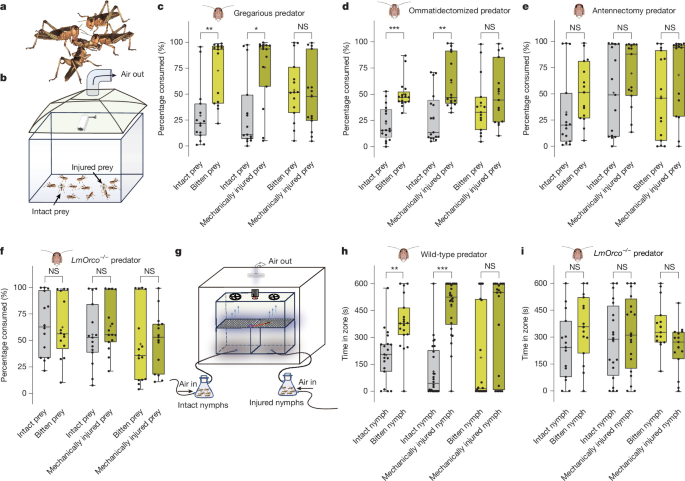
a, Representative image of fifth-instar gregarious nymphs attacking an injured fourth-instar gregarious nymph. b, Schematic of the dual-choice predation assay. Ten starved fifth-instar gregarious nymphs were presented with one intact and one injured fourth-instar nymph immobilized at opposite ends of the arena. c–f, Predation preferences of intact (c; n = 15; group 1, P = 0.009; group 2, P = 0.012), ommatidectomized (d; n = 15; group 1, P = 0.001; group 2, P = 0.006), antennectomized (e; n = 15) and LmOrco−/− (f; n = 14) nymphs. Three prey pairings were tested: group 1, intact versus bitten; group 2, intact versus mechanically injured; group 3, mechanically injured versus bitten. g, Schematic of the dual-choice olfactometer assay testing volatiles from intact and injured fourth-instar nymphs. h,i, Olfactory preference of wild-type (h; n = 19; group 1, P = 0.010; group 2, P < 0.001) and LmOrco−/− (i; n = 15) nymphs for the three pairings described above. In c–f, preference is expressed as the percentage of total prey body mass consumed from each prey individual. All behavioural data are presented as box-and-whisker plots (boxes represent median and upper/lower quartiles; centre lines indicate the median, plus signs indicate the mean and whiskers extend from the minimum to the maximum values). Statistical analyses were performed using two-sided paired-sample Wilcoxon signed-rank tests. P < 0.001; P < 0.01; P < 0.05; NS, not significant.
To determine whether the type of injury influenced predation preference, we compared predator preferences between mechanically injured and bitten prey. No significant difference was observed (Fig. 1c), indicating that injury alone, regardless of its origin, is sufficient to induce preferential predation. To explore whether injury-induced vulnerability was consistent across developmental stages, we extended the assays to first- to fifth-instar nymphs as prey. In all stages tested, fifth-instar predators consistently preferred injured prey over their intact counterparts, irrespective of injury type (Extended Data Fig. 1a). These findings demonstrate that injury-driven cannibalism is a robust and consistent trait across the development of gregarious locusts.
Next, we investigated the sensory cues mediating injury-induced predation. To assess the roles of olfactory and visual inputs, we performed antennal ablation (disrupting primary olfactory input), knocked out olfactory coreceptor LmOrco (disrupting olfactory receptor function) (Extended Data Fig. 1b) or removed the compound eyes (disrupting visual input). Predators with removed compound eyes retained their preference for injured prey (Fig. 1d), suggesting that visual cues are not required to mediate this behaviour. By contrast, predators lacking antennae or LmOrco function showed no preference for injured over intact prey (Fig. 1e,f). Notably, although antennectomized predators no longer exhibited a statistically significant preference, a weak residual bias towards injured prey remained (Fig. 1e). This observation was consistent with the anatomical organization of the locust olfactory system, in which the antennae constitute the principal but not the exclusive olfactory organs. Consequently, antennal removal might substantially reduce but not completely eliminate olfactory perception. By contrast, disruption of LmOrco, which broadly impairs odorant receptor function, resulted in a complete loss of discriminatory behaviour (Fig. 1f). Together, these findings identify LmOrco-dependent olfaction as the primary sensory modality mediating injury-induced cannibalistic predation.
Finally, we assessed whether volatile chemical cues contributed to the observed predation bias. Headspace volatiles from both injured and intact nymphs were collected and presented in a dual-choice olfactometer (Fig. 1g). Starved fifth-instar predators strongly preferred the zone containing volatiles from injured individuals over the zone containing volatiles from intact prey (Fig. 1h). No significant difference in preference was observed between volatiles from mechanically versus bitten prey (Fig. 1h), indicating that injury-induced volatile release enhances predator attraction, thereby increasing the susceptibility of injured individuals to cannibalism. By contrast, LmOrco−/− predators showed no preference for the zone containing volatiles from injured individuals (Fig. 1i), indicating that LmOrco-dependent olfaction mediated the predation preference.
Guaiacol induces cannibalism in gregarious nymphs
To investigate the chemical signals underlying injury-induced cannibalism in L. migratoria, we analysed the headspace volatiles emitted by intact, mechanically injured and bitten locust nymphs (Fig. 2a). Among the compounds detected, guaiacol emerged as the dominant injury-affected odorant (Fig. 2b and Extended Data Table 1), with emission levels approximately ten-fold higher in injured nymphs compared with intact controls and gregarious adults (Fig. 2b,c and Extended Data Fig. 2a,b). This increase in guaiacol release was consistent across all developmental instars (first to fifth) (Extended Data Fig. 2c), suggesting that an increase in guaiacol production is a consistent physiological response to injury in gregarious nymphs. By contrast, other compounds—including PAN, which has previously been linked to suppression of cannibalism14—showed no significant changes across injury conditions (Fig. 2b,c and Extended Data Fig. 2d), indicating that guaiacol is a key injury cue.
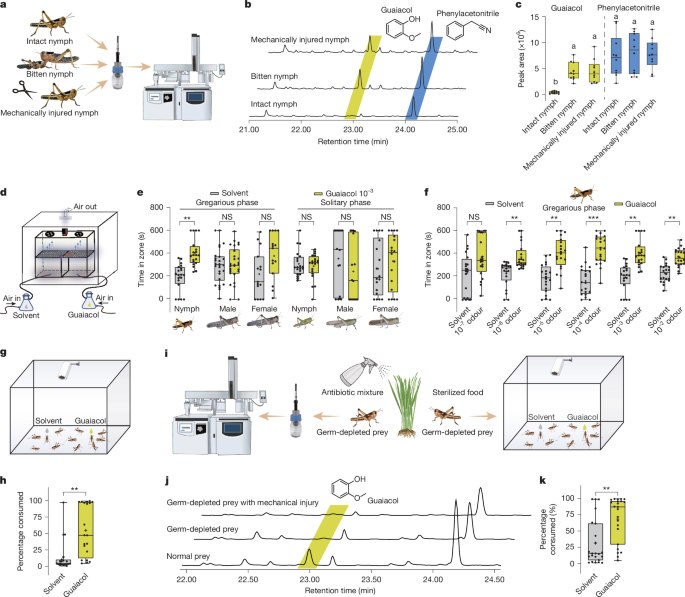
a, Schematic of volatile analysis from intact, mechanically injured and bitten fourth-instar gregarious nymphs. b, Representative gas chromatograms of volatiles emitted by the three groups, with guaiacol and PAN highlighted. c, Relative quantification of guaiacol and PAN emissions (n = 10 replicates per group; guaiacol: group 1, P < 0.001; group 2, P < 0.001). d, Schematic of the dual-choice olfactometer assay testing synthetic guaiacol against solvent. e, Behavioural responses of locusts of different phases, sexes and developmental stages to 10−3 guaiacol (n = 15; gregarious nymphs, P = 0.001). f, Dose-dependent responses of gregarious nymphs to guaiacol (n = 20 per concentration; 10−6, P = 0.008; 10−5, P = 0.004; 10−4, P < 0.001; 10−3, P = 0.001; 10−2, P = 0.002). g, Schematic of the dual-choice predation assay using intact nymphs treated with 2 µl of 10−4 guaiacol or solvent. h, Predation preference for guaiacol-treated versus control nymphs (n = 20; P = 0.006). i, Schematic of the procedure used to generate germ-depleted nymphs for chemical and behavioural assays. j, Representative gas chromatograms from intact untreated, intact germ-depleted and injured germ-depleted nymphs, with guaiacol highlighted. k, Predation preference for guaiacol-treated versus control germ-depleted nymphs (n = 23; P = 0.009). Prey in g, h and k moved freely. All data are presented as box-and-whisker plots (boxes represent the median and upper/lower quartiles; centre lines indicate the median, plus signs indicate the mean, and whiskers extend from the minimum to the maximum values). Statistical significance was assessed using two-sided paired-sample Wilcoxon signed-rank tests, except in c, in which one-way analysis of variance (ANOVA) with Tukey’s post hoc test was used. Different letters indicate P < 0.05. P < 0.001; P < 0.01; P < 0.05. The data for gregarious nymphs exposed to 10−3 guaiacol in e are the same as those shown for the 10−3 concentration in f.
To assess the behavioural significance of guaiacol, we conducted dual-choice olfactometer assays with fifth-instar nymphs and male and female adults from both gregarious and solitarious phases, testing the effects of synthetic guaiacol (Extended Data Table 2) at a concentration of 10−3 (Fig. 2d). Only gregarious nymphs exhibited strong attraction to guaiacol; solitarious individuals and gregarious adults showed no significant preference (Fig. 2e and Supplementary Video 1). This indicated that guaiacol selectively attracts gregarious nymphs. We then investigated whether the naturally emitted levels of guaiacol from injured gregarious nymphs were sufficient to trigger attraction. Quantitative headspace analysis showed that emissions from injured gregarious nymphs corresponded to concentrations equivalent to 10−5 to 10−4 dilutions of synthetic guaiacol (Extended Data Fig. 2e). To determine whether these natural guaiacol emissions were sufficient to induce attraction, we tested behavioural responses of gregarious nymphs using a full concentration series (10−7 to 10−2) in a two-choice olfactometer (Fig. 2d). Attraction to guaiacol emerged sharply at 10−6 and remained robust at higher concentrations but disappeared at 10−7 (Fig. 2f). This aligned with the physiological range of natural emissions from injured nymphs, confirming that guaiacol concentrations released by injured individuals are behaviourally relevant. As all preceding behavioural assays were conducted with individually tested locusts, we next examined whether guaiacol attraction was preserved under the social conditions that characterize gregarious populations. To address this question, we performed dual-choice olfactometer assays using groups of five gregarious nymphs and quantified the average time spent by the group on each side of the arena. Consistent with the results obtained from individually tested animals, groups of gregarious nymphs spent significantly more time on the side containing 10−3 guaiacol than on the control side (Extended Data Fig. 2f and Supplementary Video 2). These findings demonstrate that the attractive effect of guaiacol persists in a group context and therefore probably operates under ecologically relevant social conditions.
As attraction alone does not necessarily imply a decision to engage in cannibalistic behaviour, we next investigated whether guaiacol could directly trigger cannibalistic predation. We performed two-choice predation assays, providing pairs of intact fourth-instar gregarious nymphs—one treated with 2 µl of 10−4 guaiacol (representing natural emission levels from injured nymphs) (Extended Data Fig. 2e) and the other with solvent oil—to 10 starved fifth-instar gregarious predators (Fig. 2g). Guaiacol-treated nymphs were preferentially consumed, whereas solvent-treated nymphs were rarely attacked (Fig. 2h), confirming that guaiacol is a potent elicitor of cannibalistic predation. We then sought to rule out the potential influence of endogenous guaiacol on predator preference. Previous studies have shown that guaiacol is primarily synthesized by gut microbiota during plant digestion in locusts16. To eliminate this confounding factor, we generated germ-depleted gregarious nymphs by administering a cocktail of three antibiotics (tetracycline, streptomycin and ciprofloxacin) in their feed17,18,19 (Fig. 2i). This approach effectively abolished guaiacol emission in both intact and injured nymphs, providing a chemically clean background for subsequent behavioural assays (Fig. 2j). We then treated the germ-depleted gregarious nymphs with 2 µl of either 10−4 guaiacol (mimicking natural release from injured nymphs) (Extended Data Fig. 2e) or solvent oil and used them as prey in dual-choice predation assays (Fig. 2i). As observed previously, guaiacol-treated nymphs were preferentially attacked, and solvent-treated nymphs were largely ignored (Fig. 2k and Extended Data Fig. 2g). Finally, to evaluate the ecological relevance of guaiacol-mediated cannibalism under more naturalistic conditions, we performed semi-field experiments in large outdoor mesh enclosures (1.8 m × 1.2 m × 1.5 m). Each enclosure contained 500 fifth-instar gregarious predators, together with 100 fourth-instar prey perfumed with either 10−4 guaiacol or solvent alone (Extended Data Fig. 2h). After 24 h, substantially fewer fourth-instar nymphs remained in guaiacol-treated enclosures than in control enclosures, indicating a significantly higher frequency of cannibalistic interactions in the presence of guaiacol (Extended Data Fig. 2h). Consistent with direct behavioural observations, the reduction in surviving individuals was attributable to increased conspecific predation rather than escape, as all locusts were confined within the enclosure. These findings demonstrate that guaiacol-mediated promotion of cannibalism persists at the population level under seminatural conditions, supporting the ecological relevance of this injury-associated signal. Collectively, these findings establish guaiacol as a critical chemical cue that both signals injury and induces conspecific predation.
LmOR34 and LmOR36 mediate guaiacol response in nymphs
To elucidate the molecular basis of guaiacol detection in L. migratoria, we sought to identify the specific olfactory receptors involved. In our previous study, we identified LmOR34, LmOR36 and LmOR39 as receptors responsive to guaiacol, on the basis of functional characterization of 49 L. migratoria olfactory receptors20. To confirm whether other olfactory receptors were involved in detection of this compound, we expanded our analysis to include a panel of 82 of approximately 140 identified L. migratoria olfactory receptors (Fig. 3a). Consistent with our earlier findings, LmOR34, LmOR36 and LmOR39 exhibited robust responses to guaiacol in a heterologous expression system (Fig. 3a,b), while no other receptor showed comparable sensitivity.
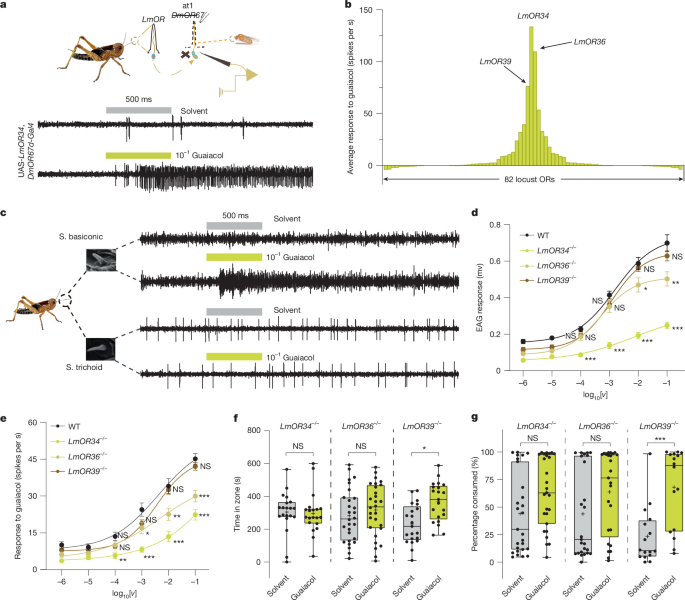
a, Schematic of the Drosophila at1 heterologous expression system and representative traces from an at1 neuron expressing LmOR34 stimulated with solvent or guaiacol (yellow bar indicates stimulus duration). b, Responses of Drosophila decoder neurons expressing 82 LmORs to 10−1 guaiacol (n = 5 recordings per receptor). All receptor response data were generated in this study. c, Representative SSR traces from locust basiconic sensilla (S. basiconic) and trichoid sensilla (S. trichoid) in response to 10−1 guaiacol. Scanning electron micrographs of both sensillum types are shown14; yellow bar indicates stimulus duration. d, EAG dose–response curves for guaiacol in wild-type (WT; n = 15), LmOR34−/− (n = 20; 10−4 to 10−1, all P < 0.001), LmOR36−/− (n = 18; 10−1, P = 0.002; 10−2, P = 0.031) and LmOR39−/− (n = 15) nymphs. e, SSR dose–response curves in wild-type (n = 30), LmOR34−/− (n = 30; 10−3 to 10−1, all P < 0.001; 10−4, P = 0.001), LmOR36−/− (n = 30; 10−1, P < 0.001; 10−2, P = 0.005; 10−3, P = 0.040) and LmOR39−/− (n = 28) nymphs. f, Behavioural responses of mutant nymphs to 10−3 guaiacol (n = 20; LmOR39−/−, P = 0.024). g, Predation preferences of mutant nymphs between freely moving germ-depleted nymphs treated with 2 µl of 10−4 guaiacol or solvent (n = 16; LmOR39−/−, P < 0.001). Data are mean ± s.e.m. (d and e) or box-and-whisker plots (f and g; boxes, interquartile range; centre lines, medians; plus signs, means; whiskers, minima and maxima). Statistical significance was assessed using two-tailed unpaired Student’s t-tests (d and e) or two-sided paired-sample Wilcoxon signed-rank tests (f and g). P < 0.001; P < 0.01; P < 0.05. Scanning electron micrographs of both sensillum types in c have been reproduced from ref. 14, American Association for the Advancement of Science.
Olfactory sensory neurons expressing different olfactory receptors are localized in distinct sensilla on the antennae of L. migratoria. To identify the sensilla responsible for guaiacol detection, we performed single-sensillum recordings (SSR) from basiconic and trichoid sensilla, which contain neurons expressing coreceptor Orco21,22. Basiconic sensilla harbour a larger population of sensory neurons (20–50), whereas trichoid sensilla contain only 2 or 3 neurons14. Owing to the higher neuronal density in basiconic sensilla, individual responses could not be distinguished on the basis of action potential amplitudes. Therefore, we measured the aggregate response of the entire neuronal population within the sensillum. Strong neuronal responses to guaiacol were detected in basiconic sensilla, whereas no response was observed in trichoid sensilla (Fig. 3c).
Inconsistent results were noted between electrophysiological and behavioural tests with respect to active concentrations of guaiacol, with a significantly higher threshold in the electrophysiological experiments. However, when we used solid-phase microextraction (SPME) technology to measure the concentration that actually reached the antenna during stimulation in the electrophysiological experiments, we found that the amount of guaiacol was comparable with the 10−6 dilution used in the behavioural assays (Extended Data Fig. 3a).
To assess the functional contribution of the LmOR34, LmOR36 and LmOR39 genes in vivo, we generated targeted loss-of-function mutants using CRISPR–Cas9-mediated genome editing. Guide RNAs (Extended Data Table 3) targeting the first exon of these genes produced frame-shift deletions of 235 bp (LmOR34) (Extended Data Fig. 3b), 262 bp (LmOR36) (Extended Data Fig. 3b) and 8 bp (LmOR39) (Extended Data Fig. 3b), resulting in predicted truncations of the encoded proteins. Electroantennography (EAG) recordings showed that the guaiacol-induced response was significantly reduced in LmOR34−/− and LmOR36−/− mutants compared with wild-type nymphs, whereas the response in LmOR39−/− mutants remained unchanged (Fig. 3d). Furthermore, SSR recordings from basiconic sensilla demonstrated that neuronal response to guaiacol was significantly reduced in the LmOR34−/− and LmOR36−/− mutants compared with wild-type nymphs, whereas LmOR39−/− locusts exhibited robust responses (Fig. 3e and Extended Data Fig. 3c). Taken together, these data indicate key roles of both LmOR34 and LmOR36 in mediation of the detection of guaiacol. We then investigated the behavioural consequences of these receptor disruptions. LmOR34−/− and LmOR36−/− mutants showed a complete lack of attraction to guaiacol (Fig. 3f), in contrast to wild-type controls, which exhibited robust attraction. This loss of attraction was accompanied by a marked impairment in predation preference for guaiacol-treated prey nymphs (Fig. 3g). By contrast, the LmOR39−/− mutants showed no alteration in their behavioural and predation preferences (Fig. 3f,g), suggesting that LmOR34 and LmOR36 are essential for mediation of the behavioural response to guaiacol.
Our previous study showed that LmOR34 and LmOR36 also responded strongly to 2,4,6-trimethylpyridine (2,4,6-TMP)20 (Extended Data Fig. 3d), a compound that is highly attractive to gregarious locusts. To test whether this compound also promoted cannibalistic behaviour, we performed dual-choice predation assays (Extended Data Fig. 3e), presenting prey nymphs treated with either 2,4,6-TMP or solvent to starved gregarious predators. Predator nymphs showed no significant preference for 2,4,6-TMP-treated prey compared with controls (Extended Data Fig. 3e). These results showed that although 2,4,6-TMP is a potent attractant, it does not directly promote cannibalism, confirming that this compound has other ecological functions. To directly compare the effects of guaiacol and 2,4,6-TMP on cannibalistic behaviour, we conducted a second dual-choice assay, in which prey nymphs were treated with either guaiacol or 2,4,6-TMP, both at a 10−4 dilution. Predator nymphs showed a strong preference for guaiacol-treated prey over 2,4,6-TMP-treated prey (Extended Data Fig. 3e). To further examine whether the observed predatory preference reflected a general response to behaviourally attractive locust volatiles, we performed a further dual-choice predation assay using 4-vinylanisole (4VA), another attractive locust odorant10. Predators were simultaneously offered two germ-depleted gregarious nymphs, one treated with 2 μl of a 10−4 dilution of guaiacol and the other with an equal volume of a 10−4 dilution of 4VA. Predator nymphs showed a significantly stronger preference for attacking and biting guaiacol-treated prey than 4VA-treated prey (Extended Data Fig. 3e). Together, these results demonstrate that enhanced predatory responses are not elicited by attractive locust volatiles in general but are specific to guaiacol, identifying guaiacol as a specialized chemical cue that promotes cannibalistic behaviour.
Notably, ligand-specific behavioural divergence despite shared receptor components has been widely documented across insects, including model species Drosophila melanogaster23,24, in which differential peripheral tuning25 and downstream circuit integration enable discrimination of chemically related cues26. To examine whether similar mechanisms operated in locusts, we compared the response properties of LmOR34 and LmOR36 to guaiacol and 2,4,6-TMP. Although both ligands activated both receptors, guaiacol elicited markedly stronger and more sensitive responses than 2,4,6-TMP (Extended Data Fig. 3f,g). Moreover, the response kinetics of LmOR34 and LmOR36 differed substantially between guaiacol and 2,4,6-TMP (Extended Data Fig. 3h,i), indicating that these ligands impose distinct temporal activation patterns at the receptor level that could be differentially decoded by downstream circuits. In addition to receptor-intrinsic differences, ligand-specific behaviours are likely to be shaped by distinct population-level coding in the antennal lobe. Consistent with this idea, our previous study showed that the antennal lobe activation patterns evoked by guaiacol and 2,4,6-TMP only partially overlapped27, suggesting other receptor inputs. For example, LmOR46 responds to 2,4,6-TMP (Extended Data Fig. 3d), whereas LmOR39 responds to guaiacol (Fig. 3b). Furthermore, because only 82 of the 140 predicted L. migratoria olfactory receptors have been functionally characterized, other receptors may remain unidentified. Although these receptors may contribute only modestly to odour detection, even weak inputs could reshape ensemble coding in the antennal lobe, thereby biasing downstream circuit activation towards distinct ecological and behavioural outcomes. Together, differential receptor tuning (sensitivity and kinetics) and ligand-specific recruitment of other receptors probably explain why guaiacol and 2,4,6-TMP produce divergent behavioural consequences despite engaging shared receptors.
Biosynthesis of guaiacol and its role in cannibalism
Guaiacol has previously been identified as a volatile produced by Pantoea agglomerans in the gut of S. gregaria and has been implicated in locust behaviour16. To identify guaiacol-producing bacteria in L. migratoria, we performed gut microbiota metagenomic sequencing but did not detect P. agglomerans (Fig. 4a), suggesting alternative microbial sources. We subsequently isolated cultivable bacteria from the gut and haemolymph of fourth-instar gregarious nymphs (Fig. 4b). Screening of more than 50 colonies identified a guaiacol-producing isolate from both tissues (Fig. 4b,c), which whole-genome sequencing identified as Enterobacter hormaechei, a dominant gut bacterium (Fig. 4a). Metagenomic analyses further confirmed high abundance of this bacterium in both the gut and haemolymph (Fig. 4a and Extended Data Fig. 4a). Although E. hormaechei was not reported in a previous study of the L. migratoria microbiome28, metagenomic sequencing and quantitative PCR (qPCR) detected it in all six geographically distinct field populations examined, with varying relative abundances (Extended Data Fig. 4b). Screening of other isolates also identified Klebsiella pneumoniae as a guaiacol producer, with emission levels comparable with those of E. hormaechei (Fig. 4c). However, we selected E. hormaechei for subsequent mechanistic analyses as it was consistently detected across samples and populations and exhibited stable guaiacol production.
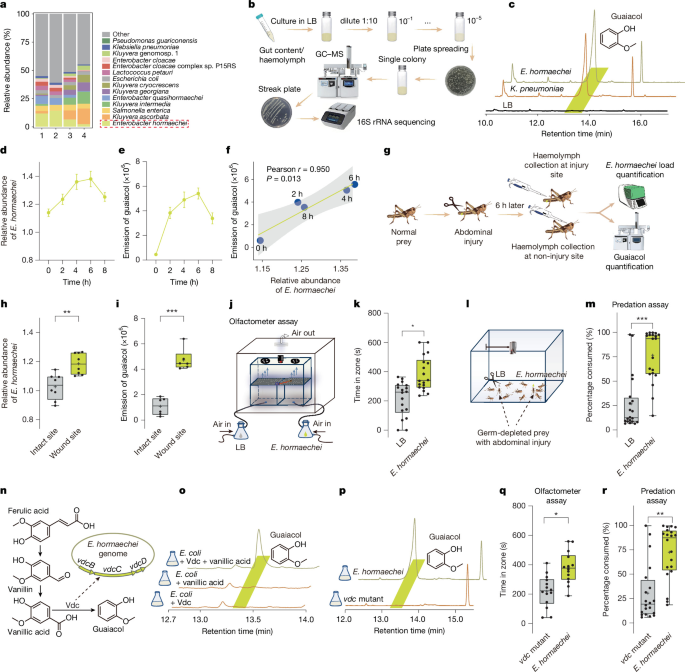
a, Intestinal microbial abundance in gregarious nymphs (1–4, individuals; red box indicates the dominant species). b, Isolation of guaiacol-producing bacteria. c, Chromatograms of E. hormaechei and K. pneumoniae volatiles (yellow bar indicates guaiacol). d,e, Wound-associated E. hormaechei titres (d; n = 3) and guaiacol emission (e; n = 6) over time. f, Pearson correlation between bacterial titres and guaiacol emission (y = 1.9 × 10⁷x − 2 × 10⁷; shading indicates the 95% confidence interval; r and two-sided P values are shown). g, Haemolymph sampling from wound and intact sites 6 h after injury. h,i, Bacterial titres (h; n = 8, P = 0.025) and guaiacol concentrations (i; n = 6, P = 0.028) at both sites. j,k, Olfactometer assay (j) and responses to bacterial volatiles (105 CFU ml−1) versus LB (k; n = 18, P = 0.014). l,m, Predation assay (l) and preference for injured germ-depleted nymphs inoculated with E. hormaechei versus LB (m; n = 20, P < 0.001). n, Guaiacol biosynthesis from ferulic acid30 (vdc cluster highlighted). o, Guaiacol production by vdc-expressing E. coli. p, Chromatograms of wild-type and vdc-mutant E. hormaechei. q, Olfactory preference for wild-type versus mutant volatiles (n = 14, P = 0.022). r, Predation preference for wild-type versus mutant-inoculated nymphs (n = 20, P = 0.005). Prey moved freely (l, m and r). Data are mean ± s.e.m. (d–f) or box plots (boxes, interquartile range; lines, medians; plus signs, means; whiskers, range). Two-sided Wilcoxon signed-rank tests were used, except in f (Pearson correlation). Independent individuals were used at each time point in d–f. Haemolymph (approximately 5 μl per locust) was pooled from 20 individuals per biological replicate. P < 0.001; P < 0.01; P < 0.05.
We next examined the relationships of injury with bacterial abundance and guaiacol emission. Following injury, both haemolymph bacterial loads (Fig. 4d) and guaiacol emission (Fig. 4e) increased over time, peaking approximately 6 h after injury and stabilizing at around 8 h (Fig. 4d,e), and their temporal changes were positively correlated (Fig. 4f). To assess localized bacterial enrichment, we collected equal volumes of haemolymph from wound sites and intact regions of the same individuals 6 h after injury (Fig. 4g). Wound-site haemolymph had significantly higher bacterial loads (Fig. 4h) and guaiacol levels (Fig. 4i), indicating localized accumulation of E. hormaechei and enhanced guaiacol production. As population density can influence locust gut microbiota29, we also compared E. hormaechei abundance between phases and found no significant difference between solitarious and gregarious nymphs (Extended Data Fig. 4c).
To determine whether E. hormaechei influenced locust behaviour, we first tested its volatiles in a two-choice olfactometer (Fig. 4j). Gregarious nymphs were significantly attracted to bacterial volatiles relative to the control medium (Fig. 4k). We then examined whether these volatiles promoted cannibalism using dual-choice predation assays (Fig. 4l). Two mechanically injured germ-depleted prey nymphs, matched for injury size and location, were presented simultaneously to ten starved fifth-instar gregarious predators, with one prey recolonized with E. hormaechei and the other left untreated. Predators preferentially attacked and consumed prey harbouring E. hormaechei, whereas germ-depleted controls were rarely targeted (Fig. 4m).
To identify the genetic basis of guaiacol biosynthesis, we sequenced the E. hormaechei genome and identified a cluster of three vanillic acid decarboxylase (vdc) genes, which have been previously implicated in microbial conversion of vanillic acid to guaiacol30 (Fig. 4n). Heterologous expression of this cluster in Escherichia coli (Extended Data Fig. 4d and Supplementary Fig. 1) confirmed its capacity to catalyse guaiacol production from vanillic acid in vitro (Fig. 4o). Conversely, deletion of the vdc genes in E. hormaechei (Extended Data Fig. 4e and Supplementary Fig. 1) completely abolished guaiacol production, as confirmed by gas chromatography–mass spectrometry (GC–MS) (Fig. 4p). These findings establish an essential role of this gene cluster in guaiacol biosynthesis.
Finally, we assessed whether microbial guaiacol biosynthesis was required for locust attraction and cannibalism. In two-choice olfactometer assays, gregarious nymphs were attracted to volatiles from wild-type E. hormaechei but not vdc-deficient mutants (Fig. 4q). Similarly, in dual-choice predation assays, starved gregarious predators preferentially attacked mechanically injured germ-depleted prey recolonized with wild-type E. hormaechei, whereas prey harbouring vdc mutants were rarely targeted despite identical injury size and location (Fig. 4r). Together, these results demonstrate that injury-associated guaiacol production by E. hormaechei is essential for converting host injury into an olfactory cue that promotes conspecific attraction and cannibalism.
Guaiacol provides immune benefits for injured nymphs
Injured gregarious nymphs release elevated levels of guaiacol despite the increased risk of conspecific cannibalism. This raises the question of why such a seemingly costly response is maintained. We considered that guaiacol release might provide compensatory benefits to injured individuals. To explore this possibility, we first considered the antimicrobial properties of guaiacol. Previous studies have shown that guaiacol can inhibit or kill a broad range of microorganisms, including bacteria and fungi; these activities were attributed to its phenolic structure, which disrupts microbial membranes and interferes with metabolic processes31,32,33. On the basis of these properties, we proposed that guaiacol produced by E. hormaechei could provide immune benefits to injured gregarious nymphs by suppressing pathogen invasion.
To test this hypothesis, we selected two pathogens commonly associated with locust mortality: intrinsic locust bacterial pathogen Proteus mirabilis34 (Extended Data Fig. 5a) and commercially available fungal insecticide Metarhizium anisopliae35 (Extended Data Fig. 5b). To determine whether guaiacol could improve resistance to pathogen invasion following injury, we used germ-depleted gregarious nymphs, which were either fed guaiacol or left untreated, and infected them with either wild-type E. hormaechei or its vdc knockout mutant (Fig. 5a). After manually injuring the nymphs, we applied infections with both M. anisopliae and P. mirabilis to the wound sites and monitored survival over several days (Fig. 5a). We found that guaiacol-fed or wild-type E. hormaechei-infected nymphs exhibited significantly higher survival rates compared with those that were non-fed or infected with the vdc-mutant E. hormaechei (Fig. 5b,c). These results indicated that guaiacol, produced by E. hormaechei, might enhance the survival of injured nymphs when exposed to pathogen infection. To confirm that this protective effect was due to the ability of guaiacol to inhibit pathogen proliferation, we quantified pathogen loads in the haemolymph of guaiacol-fed and non-fed nymphs, as well as in those infected with wild-type or vdc-mutant E. hormaechei. We observed that pathogen burdens were significantly higher in the haemolymph of non-fed and vdc-mutant-infected nymphs compared with guaiacol-fed and wild-type E. hormaechei-infected nymphs (Fig. 5d,e). These findings support the notion that guaiacol production by E. hormaechei suppresses invasion and proliferation of M. anisopliae and P. mirabilis, thereby providing immune benefits to injured locusts. Finally, to determine whether the protective effect of guaiacol-producing E. hormaechei was pathogen-specific or broadly applicable, we infected injured locusts with another opportunistic pathogen, Enterococcus faecalis34 (Extended Data Fig. 5c). As observed for P. mirabilis and M. anisopliae, guaiacol supplementation and colonization by wild-type E. hormaechei significantly suppressed pathogen infection (Extended Data Fig. 5d) and enhanced host survival (Extended Data Fig. 5e). Together, these results indicate that guaiacol functions as a broadly protective microbial metabolite that enhances host defence against diverse pathogens following injury.
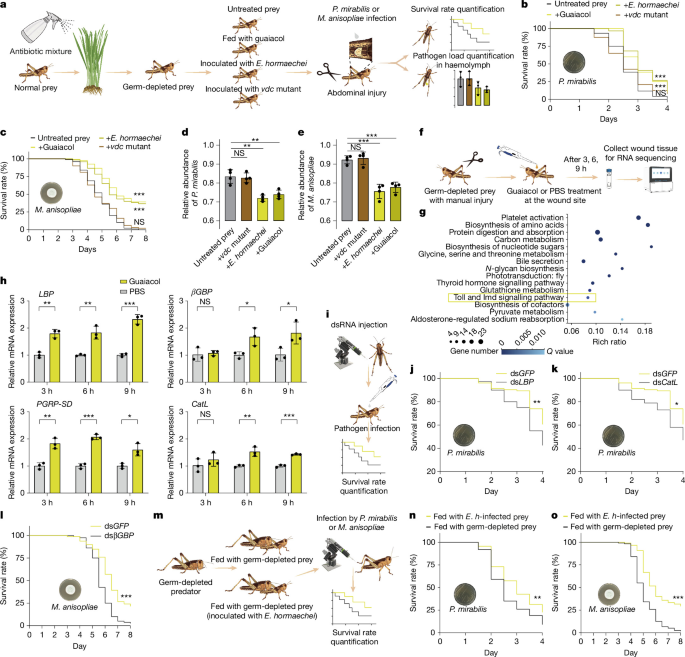
a, Workflow assessing whether E. hormaechei-derived guaiacol enhances pathogen resistance after injury. b,c, Survival of germ-depleted nymphs treated with guaiacol or wild-type or vdc-mutant E. hormaechei, followed by P. mirabilis (b; n = 120) or M. anisopliae (c; n = 100) infection (guaiacol or wild-type bacteria versus untreated, all P < 0.001). d,e, Haemolymph pathogen titres: P. mirabilis at 2 days (d; n = 4; bacteria, P = 0.001; guaiacol, P = 0.004) and M. anisopliae at 4 days (e; n = 4; both P < 0.001), versus untreated controls. f, Wound-site haemolymph transcriptomics workflow. PBS, phosphate-buffered saline. g, Functional annotation of differentially expressed genes; four Toll and Imd pathway genes are highlighted. h, Relative mRNA levels after guaiacol treatment (n = 3): LBP (3 h, 6 h, 9 h; P = 0.002, P = 0.004, P < 0.001), βGBP (6 h, 9 h; P = 0.030, P = 0.042), PGRP-SD (3 h, 6 h, 9 h; P = 0.003, P < 0.001, P = 0.014) and CatL (6 h, 9 h; P = 0.007, P < 0.001). i, RNAi workflow. j–l, Survival after knockdown of LBP (j; n = 80, P = 0.007), CatL (k; n = 100, P = 0.019) or βGBP (l; n = 80, P < 0.001) versus GFP controls. m, Workflow assessing immune benefits to predators consuming E. hormaechei-carrying prey. n,o, Predator survival after consumption of germ-depleted or E. hormaechei (E. h)-infected prey, followed by P. mirabilis (n; n = 100, P = 0.001) or M. anisopliae (o; n = 120, P < 0.001) infection. Data are mean ± s.d. (d, e and h). Two-sided unpaired Student’s t-tests were used, except in survival analyses (b, c, j–l, n, o; log-rank Mantel–Cox tests). P < 0.001; P < 0.01; P < 0.05. The dsGFP data presented in panels j and k are identical, as both originate from the same experiment.
To explore the mechanism underlying the suppression of pathogen proliferation, we first tested whether guaiacol directly inhibited the growth of M. anisopliae and P. mirabilis in vitro using the inhibition zone method. However, we found that both purified guaiacol and E. hormaechei failed to inhibit the growth of either pathogen (Extended Data Fig. 5f), suggesting that guaiacol does not directly suppress pathogen growth in vitro. Given this background, we proposed that the suppression of pathogen proliferation by guaiacol might instead be linked to an altered immune response in the locusts that confers enhanced pathogen resistance. In locusts, the haemolymph plays a critical part in immune defence36. To investigate the involvement of guaiacol in immune response regulation, we sequenced the transcriptomes of the haemolymph at the wound site from guaiacol-fed and non-fed germ-depleted gregarious nymphs after 3 h, 6 h and 9 h of injury (Fig. 5f). Differential gene expression analysis showed that substantial numbers of genes were upregulated and downregulated in the guaiacol-fed nymphs compared with the non-fed nymphs. Notably, four upregulated genes were identified in the Toll and Imd signalling pathways (Fig. 5g,h), which are known to be involved in immune defence37,38,39,40,41,42,43. These four genes, lipopolysaccharide-binding protein (LBP) and cathepsin L (CatL) have been shown to resist Gram-negative bacterial infections37,38,39, whereas β-glucan-binding protein (βGBP) has been associated with resistance to fungal infections in several insect species40,41. We proposed that in locusts, LBP and CatL might help to resist P. mirabilis infection, whereas βGBP might protect against M. anisopliae infection.
To validate the roles of these genes in pathogen resistance, we used RNA interference (RNAi) (Fig. 5i) to knock down each gene individually (Extended Data Fig. 5g-i) and assessed their contributions to resistance to M. anisopliae or P. mirabilis infections. We found that knockdown of LBP and CatL (Extended Data Fig. 5g,h) promoted the invasion and proliferation of P. mirabilis (Extended Data Fig. 5j,k), leading to significantly higher mortality compared with the control GFP RNAi group (Fig. 5j,k). Knockdown of βGBP (Extended Data Fig. 5i), on the other hand, facilitated the invasion and proliferation of M. anisopliae (Extended Data Fig. 5l), also resulting in significantly higher mortality compared with the GFP RNAi control (Fig. 5l). These results indicate that guaiacol enhances resistance to P. mirabilis infection by upregulating LBP and CatL, while enhancing resistance to M. anisopliae through upregulation of βGBP. Thus, guaiacol protects injured nymphs from pathogen infection by stimulating the immune response.
As guaiacol activated immune responses in injured locusts, we next asked whether this immune activation might also restrict the proliferation of the guaiacol-producing symbiont itself. To address this possibility, we exposed germ-depleted gregarious nymphs to guaiacol or left them untreated and subsequently inoculated them with equal amounts of E. hormaechei. Under these conditions, guaiacol exposure did not reduce E. hormaechei abundance relative to untreated controls (Extended Data Fig. 5m), indicating that guaiacol-induced immune activation does not substantially impair colonization by its microbial producer. We then examined whether elevated guaiacol emission served as a direct consequence of pathogen infection. Gregarious nymphs were infected with P. mirabilis, and guaiacol emission was quantified following infection. Pathogen infection alone did not significantly alter guaiacol release compared with uninfected controls (Extended Data Fig. 5n), suggesting that elevated guaiacol production is not a general response to infection but instead is specifically associated with injury-dependent proliferation of E. hormaechei.
Having established that guaiacol neither suppresses its microbial producer nor is directly induced by pathogen infection, we next asked whether guaiacol exposure enhanced the capacity of the host to respond to subsequent pathogen challenge. Germ-depleted gregarious nymphs were fed guaiacol before localized infection of a wound site with P. mirabilis. Guaiacol treatment resulted in upregulation of multiple genes in the Toll and Imd signalling pathways, including the immune effector genes identified earlier (Extended Data Fig. 5o). These results indicate that guaiacol may enhance host immune responsiveness during subsequent bacterial infection.
Finally, we explored whether gregarious predator nymphs benefited from consuming injured gregarious nymphs, given that these injured nymphs host large quantities of E. hormaechei. In the experimental group, we provided germ-depleted fourth-instar gregarious nymphs infected with E. hormaechei to fifth-instar gregarious predator nymphs for feeding (Fig. 5m). In the control group, we provided germ-depleted fourth-instar gregarious nymphs without E. hormaechei infection (Fig. 5m). In both groups, we ensured that all predator nymphs consumed equal amounts of prey nymphs. We found that predators consuming E. hormaechei-infected nymphs exhibited significantly better survival when subsequently infected with pathogens, compared with those that consumed non-infected nymphs (Fig. 5n,o). To directly trace microbial transmission during cannibalism, we fed germ-depleted fifth-instar predator nymphs with prey carrying E. hormaechei (Extended Data Fig. 5p). Several days after feeding, large quantities of E. hormaechei were detected throughout the haemolymph of predator nymphs, and this was accompanied by guaiacol production (Extended Data Fig. 5q,r). By contrast, predators fed prey lacking bacteria exhibited neither E. hormaechei loads nor measurable guaiacol emission (Extended Data Fig. 5q,r). These findings demonstrate that E. hormaechei acquired through cannibalism can successfully establish in the predator haemolymph and retain its metabolic capacity to produce guaiacol following transmission.
Together, these results indicate that predator locusts may derive benefits from consuming injured nymphs, probably owing to microbial and immune support provided by the accumulated E. hormaechei.
Trade-off between immune defence and cannibalism
Our findings demonstrate that guaiacol functions as both an internal and an external signal in gregarious locusts, acting internally to enhance immune defence while externally promoting cannibalism. This dual role probably represents an evolutionary adaptation that balances pathogen resistance with the risks of conspecific predation in response to fluctuating physiological conditions, such as injury severity. To investigate how injury severity influenced these opposing effects, we generated standardized injuries of increasing size (levels 1–6) using steel needles (Fig. 6a and Extended Data Fig. 6a). Guaiacol emissions remained low at injury levels 1–3 but increased significantly at levels 4–6 (Fig. 6b). Consistent with this pattern, starved gregarious predators showed no preference between intact and injured prey at levels 1–3 but preferentially attacked injured nymphs at levels 4–6 (Fig. 6a,c). The latter injuries approximated those caused by hind-tarsus loss or bites from fifth-instar locusts (Extended Data Fig. 6a). Prey movement distance and speed did not differ significantly across injury levels (Extended Data Fig. 6b,c); this enabled us to exclude differences in mobility as an explanation for predation preferences. These results indicate that elevated guaiacol emission associated with severe injury promotes cannibalistic attacks.
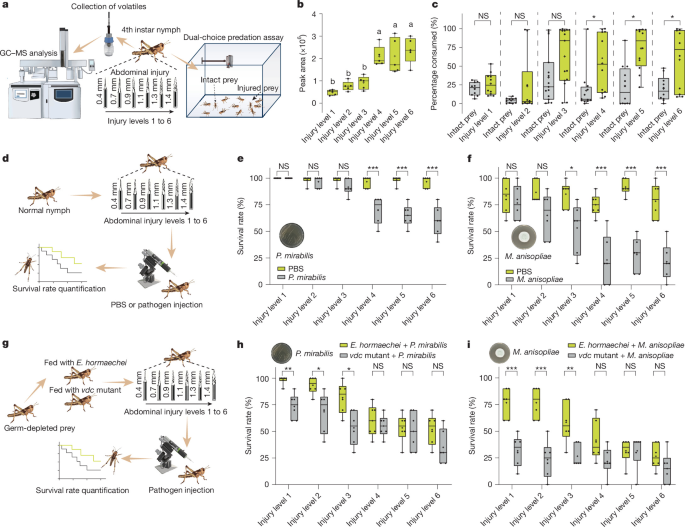
a, Workflow for generation of different injury sizes for chemical analysis and dual-choice predation assays. b, Relative guaiacol emission from nymphs with different injury sizes (n = 5 per group). c, Predation preference between intact and injured prey with different wound sizes (n = 10; level 4, P = 0.041; level 5, P = 0.019; level 6, P = 0.013). The two types of prey were immobilized at opposite ends of the arena. d, Workflow assessing the effects of injury size on survival following PBS or pathogen treatment. e,f, Survival following PBS or infection with P. mirabilis (e; level 4, P < 0.001; levels 5 and 6, P < 0.001) or M. anisopliae (f; level 3, P = 0.015; level 4, P < 0.001; levels 5 and 6, P < 0.001), quantified at 3 days and 5 days, respectively (n = 6 replicates per group; 10 nymphs per replicate). g, Workflow to assess survival of germ-depleted nymphs inoculated with wild-type or vdc-mutant E. hormaechei before PBS or pathogen treatment. h,i, Survival following PBS injection or infection with P. mirabilis (h; level 1, P = 0.003; level 2, P = 0.016; level 3, P = 0.010) or M. anisopliae (i; levels 1 and 2, P < 0.001; level 3, P = 0.005) (n = 6 replicates per group; 10 nymphs per replicate). Data are box-and-whisker plots (boxes, interquartile range; centre lines, medians; plus signs, means; whiskers, minima and maxima). Statistical significance was assessed using one-way ANOVA followed by Tukey’s post hoc test (b; different letters indicate P < 0.05), two-sided paired Wilcoxon signed-rank test (c) or two-sided unpaired Student’s t-tests (e, f, h, i). P < 0.001; P < 0.01; P < 0.05.
We next examined how injury severity affected pathogen resistance (Fig. 6d). Following infection with P. mirabilis, nymphs with injuries at levels 1–3 showed survival rates comparable with those of non-infected controls, whereas those at levels 4–6 exhibited significantly increased mortality (Fig. 6e). Similarly, following M. anisopliae infection, survival remained comparable with that of controls at injury levels 1–2 but declined significantly at levels 3–6 (Fig. 6f). These findings suggest that immune protection becomes insufficient as injury severity increases. To further assess the contribution of microbial guaiacol, we infected germ-depleted nymphs recolonized with wild-type or vdc-deficient E. hormaechei (Fig. 6g). At injury levels 1–3, nymphs harbouring wild-type bacteria exhibited significantly higher survival following pathogen challenge than those harbouring vdc mutants (Fig. 6h,i). However, at injury levels 4–6, mortality remained high regardless of bacterial genotype (Fig. 6h,i), indicating that guaiacol-mediated protection was insufficient under severe injury conditions.
Together, these results reveal an injury-severity-dependent trade-off between immune defence and cannibalistic risk. Following minor injury, microbial guaiacol enhances pathogen resistance without attracting conspecific predators, whereas severe injury results in increased guaiacol emission and cannibalistic attraction, while diminishing the protective benefits of guaiacol against infection.
Discussion
Chemical signals, whether intrinsic or extrinsic, can be exploited by eavesdroppers to gain ecological advantages44. For example, stress-related corticosteroids and predator odours induce defensive responses in mice45,46, whereas insect pheromones can attract parasitoids or facilitate their avoidance47,48. Here we demonstrate that microbial volatile guaiacol links immune defence with cannibalistic behaviour in locusts. Production of guaiacol by the gut and haemolymph symbiont E. hormaechei increases rapidly following injury, accompanied by bacterial accumulation at wound sites and local immune activation. This response resembles a fundamental feature of innate immunity, whereby tissue damage triggers rapid defences against microbial invasion49. However, this microbial interaction entails substantial costs. Whereas moderate guaiacol production enhances immune defence, severe injury elevates guaiacol emission beyond a threshold that attracts conspecifics and promotes cannibalism. Guaiacol thus functions as an intraspecific kairomone-like cue, benefiting receivers at the expense of injured individuals, despite its microbial origin. It is possible that guaiacol also functions as a damage-associated cue that allows injured locusts to anticipate infection and reinforce immune defences, although this remains to be tested. For cannibals, consumption of injured conspecifics may provide both nutritional benefits and beneficial E. hormaechei, potentially enhancing immune competence. Severely injured individuals may also be easier to capture. From the bacterial perspective, guaiacol-mediated attraction could facilitate transmission to new hosts through cannibalistic interactions, suggesting a potential microbial advantage that warrants further investigation.
The phase specificity of guaiacol-mediated attraction may reflect fundamental differences in locust social ecology14. Solitarious locusts generally avoid conspecifics and rarely engage in cannibalism and therefore have limited opportunities to acquire nutrients or beneficial microorganisms through such interactions14. Their comparatively lower immune competence36 may also increase the risks associated with exposure to injured individuals. Consequently, avoidance rather than attraction may be favoured in the solitarious phase.
Our previous work identified PAN as an anticannibalistic pheromone14. As cannibalism and PAN production both increase with swarm density, the opposing effects of PAN and guaiacol suggest a dynamic balance between inhibitory and attractive signals. In insects, attractive and aversive odours are processed through distinct antennal lobe pathways50 and integrated in higher-order centres, including the lateral horn51. We propose that PAN-mediated inhibition normally restrains cannibalism, whereas elevated guaiacol emission following injury may shift this balance towards attraction. How these competing signals are integrated remains an important question.
We identify LmOR34 and LmOR36 as essential receptors for guaiacol detection, with disruption of either receptor nearly abolishing olfactory attraction and guaiacol-induced cannibalism. Notably, both receptors also detect 2,4,6-TMP, which induces attraction without cannibalism. Similar ligand-dependent behavioural divergence has been reported in D. melanogaster23,24, in which peripheral tuning and central circuit integration contribute to odour discrimination25,26. Guaiacol and 2,4,6-TMP may therefore generate distinct activation patterns or recruit other receptors, enabling ligand-specific behavioural outputs. Moreover, robust guaiacol attraction was restricted to gregarious nymphs, suggesting developmental-, sex- and phase-dependent modulation of olfactory processing. Although antennal lobe odour representations are broadly conserved during locust development27, state-dependent central processing, as demonstrated in D. melanogaster20,52, may contribute to these differences. Developmental expansion of antennal lobe glomeruli may further influence odour coding.
Our findings also help to reconcile previous discrepancies concerning guaiacol emission and behavioural function. Earlier studies reported substantial guaiacol release from intact gregarious locusts and faeces27,53, whereas baseline emissions were considerably lower in our experiments. This difference may reflect sampling conditions: prolonged collective housing in earlier studies could have facilitated biting, injury-associated microbial activation and volatile accumulation20, whereas our shorter collection periods prevented cannibalistic interactions. Thus, elevated guaiacol emission in dense groups may partly reflect socially induced injury rather than constitutive production.
Previous studies also described guaiacol as a behavioural inhibitor10, in contrast to the attraction observed here. However, olfactory responses can vary with physiological and ecological context16,53. We observed significant guaiacol attraction only in starved gregarious nymphs, consistent with the strong association between nutritional stress and locust cannibalism14. State-dependent changes in odour valence have been well documented in insects; for example, starvation reverses the aversive response to acetic acid in D. melanogaster54. Similar physiological modulation of olfactory circuits may explain the context-dependent behavioural effects of guaiacol.
Several questions remain unresolved, in particular, how E. hormaechei is recruited from the haemolymph to wound sites and whether guaiacol directly informs injured hosts of tissue damage. Understanding these processes, together with neural integration of guaiacol and anticannibalistic signals, will further clarify how microbial communication coordinates immune and behavioural responses.
Methods
Insects
Gregarious and solitarious L. migratoria used in this study were originally collected in Guangxi, China, and subsequently maintained at the Shenzhen Agricultural Genomics Institute, Chinese Academy of Agricultural Sciences. For establishment of stable phase lines, locusts were reared under strictly controlled density conditions for at least three laboratory generations before experimentation. Gregarious locusts were maintained at high population density in ventilated cages (35 cm × 35 cm × 50 cm), each containing 400–500 first-instar nymphs. Solitarious locusts were reared individually in cylindrical containers (10.8-cm height, 8-cm diameter) equipped with independent ventilation to prevent exposure to crowding-associated visual, tactile or olfactory cues. All locusts were kept under standardized environmental conditions, including a 14 h:10 h light/dark photoperiod, temperature of 30 ± 2 °C and relative humidity of 50 ± 5%. Fresh wheat seedlings were provided ad libitum as food throughout rearing and experimental periods. For experiments involving allocation of locusts or biological samples to different treatment groups, individuals or samples were randomly assigned to experimental groups where applicable. Experimental animals were selected from the same phase, developmental stage and rearing conditions, and relevant experimental variables, including feeding status, environmental conditions and experimental procedures, were standardized across treatment groups. For dual-choice behavioural assays, the positions of treatment and control stimuli were alternated between successive trials to minimize positional bias. In experiments in which groups were intrinsically defined by genotype, injury status or severity, microbial status, pathogen treatment, developmental stage, time point, or other experimentally imposed conditions, random allocation to the defining condition was not applicable. In these experiments, comparisons were performed using animals or samples matched for relevant biological characteristics and maintained under otherwise identical experimental conditions. No additional covariate-based allocation was required because the major potential covariates relevant to each experiment were controlled by the experimental design.
Locust predation assay
Predatory preferences of gregarious L. migratoria nymphs were quantified using dual-choice predation assays conducted in a rectangular acrylic arena (20 cm × 10 cm × 10 cm) under well-ventilated laboratory conditions. Fifth-instar gregarious nymphs were used as predators, whereas gregarious prey nymphs of defined developmental stages (first to fifth instar, depending on the experiment) were used as prey. Before each assay, predator nymphs were starved for 24 h to standardize feeding motivation. To assess predation preference between intact and injured prey, ten fifth-instar gregarious nymphs were introduced into the arena as predators. Two prey nymphs were placed at opposite ends of the arena: one prey individual was left intact, whereas the other was injured. Injuries were generated either mechanically using a sterile scalpel or by controlled conspecific attack, producing wounds of comparable size at a standardized location on the abdominal cuticle. To eliminate potential confounding effects arising from differences in locomotor ability, prey individuals were immobilized at fixed positions using adhesive tape. Predation assays were performed using predators that were either intact or had been subjected to sensory manipulations, including antennal ablation to disrupt primary olfactory input, knockout of olfactory coreceptor LmOrco to impair odorant-receptor-mediated olfaction, or removal of the compound eyes to disrupt visual input. To test whether injury-associated chemical cues influenced predation decisions, dual-choice assays were conducted using guaiacol-treated and solvent-treated prey. In these experiments, 10 predators were simultaneously presented with two prey nymphs, one perfumed with 2 μl of 10−4 guaiacol and the other treated with solvent alone as a control. To evaluate the contribution of gut microbiota to predation preference, we performed further dual-choice assays using germ-depleted prey. For comparisons between E. hormaechei-infected and control prey, ten predators were presented with two injured prey nymphs, one infected with E. hormaechei and the other treated with sterile LB medium. To determine the role of bacterial guaiacol biosynthesis, we further compared predation preference between injured prey infected with wild-type E. hormaechei and a vdc-mutant strain. All microbiota-related assays were conducted as described above, except that prey individuals were allowed to move freely during the assay. In all experiments, prey individuals were weighed immediately before introduction into the arena. After a predation period of 1 h, remaining prey were retrieved and reweighed. Predation preference is expressed as the percentage of total prey body mass consumed for each prey individual. All assays were video-recorded and analysed using EthoVision XT 18.0 software (Noldus Information Technology). Behavioural parameters including attack latency, bite frequency and cumulative bite duration, and the spatial distribution of predator–prey interactions were quantified from the recordings.
Dual-choice behavioural assays
Behavioural responses of L. migratoria to volatile compounds were assessed using a two-choice olfactometer14,20. The apparatus consisted of two plastic odour source containers (28 cm × 28 cm × 18 cm) with open tops, each seamlessly connected to a central glass behavioural observation chamber (60 cm × 30 cm × 30 cm). The top of each container was covered with a perforated plastic plate (1-mm-diameter holes spaced 1 cm apart) to allow uniform airflow into the observation chamber. Clean air was supplied to each odour source container from a compressed air cylinder and sequentially filtered through a charcoal filter and a molecular sieve for removal of contaminants. Airflow through each side of the arena was regulated by a flowmeter at a constant rate of 4 l min−1. The glass chamber enclosed the region above the perforated plates and served as the behavioural observation zone. Two fans mounted at the top of the chamber generated a stable vertical airflow, ensuring homogeneous odour distribution. A high-definition digital video camera positioned between the fans continuously recorded locust behaviour. All assays were conducted in a dedicated observation room (60 cm × 70 cm × 80 cm) equipped with a ventilation system and uniform illumination provided by ceiling-mounted white light panels. Before each assay, individual locusts were starved for 24 h. Individual locusts were gently introduced into the centre of the observation chamber and allowed to explore freely for 10 min. During each assay, a control odour (intact fourth-instar prey, paraffin oil or LB medium, depending on the experiment) was delivered to one side of the olfactometer, while the test odour was delivered to the opposite side through the vertical airflow. Test odour sources included volatiles emitted from 6 intact or injured 4th-instar gregarious nymphs, guaiacol applied at concentrations ranging from 10−7 to 10−2 (dilution), or bacterial suspensions (cultured with 15 ppm vanillic acid) at 105 CFU ml−1. Odorants were applied to a piece of filter paper (3 cm × 3 cm) placed inside the corresponding odour source container. To minimize positional bias, we alternated the locations of the odorant and control sides between successive trials. After 8–10 individuals had been tested, the containers were thoroughly cleaned with 75% ethanol and ventilated for 30 min for elimination of residual odours. Locust behaviour was recorded at 30 frames per second, and the total time spent on each side of the arena was quantified manually and used as the behavioural response metric. For group-choice assays, five gregarious nymphs were released simultaneously into the observation chamber. Behavioural recordings were analysed using EthoVision XT 18.0 software (Noldus Information Technology), and the average residence time of the group on each side of the olfactometer was used for quantitative analysis. In the two-choice behavioural assay, locust behaviour was recorded for 10 min (600 s). During this period, most locusts remained either on the odour-treated side or on the control side. Consequently, the sum of the time spent on the odour-treated and control sides was 600 s for most individuals, explaining why the corresponding raw behavioural data frequently summed to 600 s.
Semi-field predation assay
To assess whether guaiacol promoted cannibalism under semi-field conditions, predation assays were conducted in outdoor mesh enclosures (1.8 m × 1.2 m × 1.5 m). Each enclosure contained 100 4th-instar gregarious nymphs as prey and 500 5th-instar gregarious nymphs as predators. Before each assay, predator nymphs were starved for 24 h for standardization of feeding motivation. In the control group, all prey nymphs were treated with 2 μl of solvent, whereas in the guaiacol group, each prey nymph was treated with 2 μl of a 10−4 dilution of guaiacol applied to the dorsal thorax. After 24 h, the remaining live 4th-instar nymphs were recovered and counted. The cannibalism ratio was calculated as the proportion of prey nymphs lost after 24 h relative to the initial number released.
Chemical analysis
Volatile compounds emitted from locust bodies, haemolymph, gut-derived microbial cultures, and bacterial cultures were analysed using SPME coupled with GC–MS. For whole-body volatile analysis, defined numbers of gregarious L. migratoria (1st to 5th instar and adult) or germ-depleted 4th-instar nymphs were placed into 100-ml glass bottles. A 65-µm polydimethylsiloxane/divinylbenzene (PDMS/DVB) SPME fibre (Supelco) was inserted into the bottle headspace through the cap using a PEAK guide piece to prevent direct contact with the insects. Headspace volatiles were collected at 30 °C for 1 h.
For analysis of volatiles derived from gut- and haemolymph-associated microbial communities, gut contents and haemolymph samples were collected aseptically and cultured in LB medium at 30 °C with shaking at 200 rpm for 12 h. The resulting enrichment cultures were transferred to 20-ml headspace vials, and headspace volatiles were collected for 30 min using the same PDMS/DVB SPME fibre. For screening of guaiacol-producing bacterial strains, isolates were cultured in LB medium containing 15 ppm vanillic acid at 30 °C with shaking at 200 rpm for 12 h. A 5-ml aliquot of each bacterial suspension was then transferred to a 20-ml headspace vial, and volatile compounds were collected for 30 min. Volatiles of the control strain lacking vdc were analysed by the same method.
For direct haemolymph volatile analysis, approximately 100 µl of haemolymph was collected from 20 gregarious 4th-instar nymphs and transferred on to a filter paper (2 cm × 5 cm) placed in a 20-ml glass vial. A 65-µm PDMS/DVB SPME fibre was inserted into the vial headspace, and volatile collection was performed at 30 °C for 30 min. For analysis of volatile emissions from E. coli strains expressing the vdc gene cluster, bacterial cultures were grown in LB medium at 37 °C with shaking at 200 rpm until the optical density at 600 nm reached 0.6–1.0. Isopropyl β-d-1-thiogalactopyranoside was then added to a final concentration of 0.5 mM to induce expression of Vdc. After 6 h of induction, vanillic acid was supplemented to a final concentration of 15 mg l−1, and incubation was continued for a further 6 h. A 5-ml aliquot of the induced culture was subsequently transferred to a 20-ml headspace vial, and volatiles were collected for 30 min using the same SPME fibre.
Volatiles from all samples except microorganism-related samples were analysed using a Thermo Scientific Orbitrap GC–MS system equipped with a WAX capillary column (30 m × 0.25-mm inner diameter, 0.25-µm film thickness). The oven temperature program consisted of an initial hold at 50 °C for 3 min, ramping to 150 °C at 5 °C min−1, followed by an increase to 260 °C at 10 °C min−1 and a final hold at 260 °C for 5 min. Volatile compounds were identified by comparison with synthetic standards and by matching of mass spectra to the NIST 2020 mass spectral library. Synthetic reference compounds were obtained from Sigma-Aldrich.
Volatiles from microorganism-related samples, including E. hormaechei, K. pneumoniae and E. coli cultures, were analysed using a SHIMADZU Nexis GC-2030 system equipped with a DB-5 capillary column (30 m × 0.25-mm inner diameter, 0.25-µm film thickness). The oven temperature was held at 40 °C for 3 min, increased to 150 °C at 5 °C min−1 and held for 1 min, then ramped to 260 °C at 10 °C min−1 with a final hold of 5 min. Chemical identification was performed by comparison with synthetic standards and NIST library matches.
Generation of germ-depleted nymphs
To generate germ-depleted fourth-instar L. migratoria nymphs, we applied a cocktail of antibiotics (tetracycline, streptomycin and ciprofloxacin)17,18,19 to autoclaved wheat seedlings, which were then provided as food to second instar nymphs. Antibiotic-treated seedlings were supplied continuously until the insects reached the fourth instar. At this stage, six nymphs were randomly selected for GC–MS analysis to verify depletion of guaiacol-emitting microbiota. Only nymphs in which guaiacol emission was no longer detectable were considered to be germ-depleted and used for downstream experiments.
Cloning of LmORs
Antennae were dissected from gregarious L. migratoria nymphs (10–20 antennal pairs in total) and pooled for RNA extraction. Total RNA was isolated using TRIzol reagent (Invitrogen) according to the manufacturer’s instructions. First-strand cDNA was synthesized from 5 µg of pooled total RNA using a HiScript III 1st Strand cDNA Synthesis Kit (Vazyme Biotech). Gene-specific amplification of odorant receptor (LmOR) coding sequences was performed using 2× Phanta Max Master Mix (Dye Plus) with primers designed on the basis of the antennal transcriptomic dataset. PCR products were separated by 1.0% (w/v) agarose gel electrophoresis, excised and purified before being subcloned into a blunt-end cloning vector (TransGen Biotech). All inserts were confirmed by Sanger sequencing. For each LmOR gene, sequences from at least four independent bacterial clones were aligned to enable us to distinguish genuine sequence polymorphisms from PCR-induced artefacts.
Transgenic expression of LmORs in D. melanogaster at1 neurons
The entire olfactory receptor coding sequences were cloned into the pUAST.attB expression vector (a gift from J. Bischof) with both XbaI and NotI restriction sites (New England Biolabs). Transgenic D. melanogaster lines harbouring UAS-ORX constructs integrated into chromosome II were generated by the CAS Center for Excellence in Molecular Cell Science (https://sjzx.sibcb.ac.cn/Cn/Index/pageView/catid/105.html). To achieve targeted expression of ORX in at1 olfactory neurons, we crossed each transgenic UAS-ORX line with the Or67d-GAL4 driver line (provided by B. J. Dickson). Through successive genetic screening and selection, we established stable homozygous transgenic lines in which the olfactory receptor transgene was specifically expressed in at1 neurons. The presence and sequence integrity of the transgenes were confirmed by genomic DNA extraction and sequencing of adult flies.
Single-sensillum recordings
To characterize the functional properties of individual locust olfactory receptors in the Drosophila empty neuron system, we performed SSRs from T1 sensilla of adult flies following established protocols with minor modifications14,20. Briefly, adult flies were immobilized in pipette tips, and the third antennal segment was positioned stably on a glass coverslip. Sensillum subtypes were visualized under an Olympus BX51WI microscope at ×100 magnification and unequivocally identified using diagnostic odorants detailed in Extended Data Table 2. Extracellular recordings of olfactory sensory neuron activity were acquired by insertion of a tungsten microelectrode into the base of the target sensillum, with a reference electrode placed in the compound eye. Signals were amplified (Syntech Universal AC/DC Probe), digitized (96,000 samples per second), and filtered (500–3,000 Hz) using an Intelligent Data Acquisition Controller (Syntech) connected to a computer. Neural spike data were extracted and analysed using AutoSpike software (v.32, Syntech).
Synthetic odorant compounds were freshly diluted in paraffin oil (Sigma-Aldrich). For each stimulation, 10 µl of the diluted odorant was freshly loaded on to a 1-cm2 piece of filter paper and inserted into a glass Pasteur pipette. Odour delivery was achieved by introducing the pipette tip into a constant, humidified airstream (600 ml min−1) flowing through a stainless steel tube with an 8-mm inner diameter, positioned 1 cm from the fly antenna. Neural activity was recorded for 10 s, encompassing a 3-s prestimulation baseline period followed by a 0.5-s odour pulse. Olfactory sensory neuron responses were quantified as the fold change in action potential frequency (spikes per second) relative to the prestimulation baseline. Raw traces were processed by means of amplitude-based spike sorting in AutoSpike, with subsequent data analysis performed in Microsoft Excel and visualization using Adobe Illustrator CS (Adobe Systems).
In addition, SSRs were conducted on basiconic and trichoid sensilla of locusts using functional ligands identified in the Drosophila empty neuron. Locusts were restrained in 1-ml plastic tubes, with their antennae immobilized using dental wax. Recording parameters and data analysis pipelines were identical to those used for Drosophila SSRs.
Electroantennography
Electroantennograms were recorded from the fifth-instar nymph of the locust. Briefly, the locust antenna was transected at the base of the flagellum, and the freshly cut end was immediately inserted into a glass capillary filled with locust Ringer’s solution (0.1 mol l−1 KCl). Of two such capillaries containing Ag–AgCl electrodes, one served as the ground electrode, and the other was linked to a high-impedance DC amplifier (10× gain; Syntech). Signals were transmitted to an IDAC-4 analog-to-digital converter (Syntech) and subsequently acquired by a computer. Raw data were analysed and archived using EAGPro software (v.3.7, Syntech).
Odorant delivery followed a standardized protocol: 10 µl of diluted odorant (prepared as described in the ‘Single-sensillum recordings’ section) was loaded on to a 1-cm2 filter paper, which was inserted into a glass Pasteur pipette, and the pipette tip was introduced into a constant, humidified airstream (600 ml min−1) flowing through a stainless steel tube with an 8-mm inner diameter. The tube outlet was positioned 1 cm from the antenna to ensure consistent stimulus delivery. EAG recordings were 10 s in duration, comprising a 3-s prestimulation baseline and a 0.5-s odour pulse.
CRISPR–Cas9-mediated knockout of olfactory receptor genes in locusts
Mutant lines of LmOrco, LmOR34, LmOR36 and LmOR39 were generated using CRISPR–Cas9-mediated genome editing with minor modifications to established protocols14,20. Fertilized eggs were collected from freshly deposited egg pods, surface-sterilized with 75% (v/v) ethanol and arranged on 1% (w/v) agarose gels for microinjection. Cas9 protein (150 ng μl−1) and gene-specific single-guide RNAs (400 ng μl−1; target sequences provided in Extended Data Table 3) were coinjected into individual embryos (approximately 27.2 nl per embryo) using a nanolitre microinjector (SYS-PV850, World Precision Instruments) fitted with custom-pulled borosilicate glass capillaries under a stereomicroscope. Injected embryos were incubated at 30 °C until hatching (approximately 12 days).
G0 nymphs were reared under standardized laboratory conditions in mesh cages (35 cm × 35 cm × 50 cm) under a 14 h:10 h light/dark photoperiod, with ad libitum access to fresh wheat seedlings at 30 °C and 60% relative humidity. Genomic DNA was extracted from adult leg tissue by alkaline lysis (45-μl mixture of 50 mM NaOH and 0.2 mM EDTA, 95 °C for 20 min), followed by neutralization with 5 μl of 1 M Tris-HCl (pH 8.0). A 2-μl aliquot of the resulting lysate was used as a template for PCR amplification of the target genomic loci.
PCR reactions (25 μl total volume) contained 12.5 μl of 2× Phanta Max Master Mix (Dye Plus), 1 μl each of gene-specific forward and reverse primers (10 μM), and 8.5 μl of nuclease-free water. Thermocycling conditions were as follows: initial denaturation at 95 °C for 3 min; 38 cycles of 95 °C for 15 s, 60 °C for 15 s and 72 °C for 45 s; followed by a final extension at 72 °C for 5 min.
PCR amplicons were subjected to Sanger sequencing, and mutations were verified by alignment with the wild-type reference sequence. Confirmed G0 mutants were crossed with wild-type individuals to generate G1 progeny, and a distinct deletion allele was used to track inheritance. G1 heterozygotes were intercrossed, and homozygous mutants were identified in the G2 generation by locus-specific PCR genotyping (primer sequences provided in Extended Data Table 3). Stable homozygous mutant lines were established through repeated intercrossing and confirmed by sequencing.
Metagenomic sequencing
Intestinal contents and haemolymph were collected from a population from our laboratory (Shenzhen, Guangdong, China). Another six geographically distinct locust populations from across China were also collected, and the total DNA was extracted from the locust intestinal contents using a QIAamp Fast DNA Stool Mini Kit (Qiagen) according to the manufacturer’s instructions. DNA concentration was measured with a NanoDrop 2000 spectrophotometer (Thermo Fisher Scientific), and DNA integrity was assessed by agarose gel electrophoresis. Genomic DNA was fragmented using a Covaris S220 Focused-Ultrasonicator (Covaris) and purified with Agencourt AMPure XP beads (Beckman Coulter). Metagenomic libraries were prepared using a TruSeq Nano DNA LT Sample Preparation Kit (Illumina) following standard protocols. Library construction, high-throughput sequencing and initial data processing were performed by OE Biotech.
Libraries were sequenced on an Illumina NovaSeq 6000 platform to generate 150-bp paired-end reads. Raw sequencing reads (FASTQ format) were quality-filtered for removal of low-quality bases and adapter sequences using Trimmomatic (v.0.36). Host-derived reads were identified by alignment to the L. migratoria reference genome using Bowtie2 (v.2.2.9) and subsequently discarded. The remaining high-quality, host-depleted reads were assembled de novo into metagenomic scaffolds using MEGAHIT (v.1.1.2). Scaffolds were split at internal gaps into contiguous sequences (scaftigs), and only scaftigs with lengths at least 500 bp were retained for downstream analyses.
Open reading frames were predicted from the assembled scaftigs using Prodigal (v.2.6.3) and translated into amino acid sequences. For construction of a non-redundant gene catalogue, all predicted open reading frames were clustered using CD-HIT (v.4.5.7) with a sequence identity threshold of 95% and a coverage cutoff of 90%; the longest sequence within each cluster was selected as the representative gene. Clean reads from each sample were then mapped back to the non-redundant gene set using Bowtie2 (v.2.2.9) with a 95% identity threshold to estimate gene abundance.
Taxonomic annotation of the non-redundant gene set was performed by alignment against the NR protein database. Species abundance profiles were inferred on the basis of gene abundance, and taxonomic abundance statistics were summarized across hierarchical levels, including domain, kingdom, phylum, class, order, family, genus and species.
Identification of microbial strains synthesizing guaiacol
To identify bacterial strains responsible for guaiacol biosynthesis, we isolated microbial communities from the gut contents and haemolymph of fourth-instar gregarious L. migratoria nymphs. Eluted microbial suspensions were initially cultured in LB medium at 37 °C for 12 h for enrichment of bacterial populations. Cultures were then serially diluted 10-fold to 10−5, which represented the highest dilution that still emitted detectable guaiacol. A 10-µl aliquot of the 10−5 dilution was spread on to LB agar plates and incubated overnight at 37 °C. Individual colonies were randomly selected and screened for guaiacol production. Each isolate was grown in LB medium, and headspace volatiles were collected using a SPME fibre, followed by analysis using GC–MS. Isolates confirmed to emit guaiacol were subjected to whole-genome sequencing, and genomic analysis identified the guaiacol-producing strain as E. hormaechei.
Targeted deletion of the vdc gene cluster in E. hormaechei
Targeted deletion of the vdc gene cluster in E. hormaechei was achieved using a homologous recombination-based allelic exchange strategy. Briefly, a DNA fragment encompassing the vdc gene and its homology arms about 500 bp upstream and downstream was amplified from wild-type E. hormaechei genomic DNA using specific primers (Extended Data Table 3). The resulting fragment was cloned into the TOPO vector, which subsequently served as a template for amplification of sequences containing an ampicillin resistance cassette and the upstream and downstream homology arms of the vdc genes, using primers TOPO-Vdc-F and TOPO-Vdc-R (Extended Data Table 3). These primers were designed with 15- or 18-nucleotide overhangs at their 5′ ends, homologous to the downstream region and the kanamycin resistance cassette, respectively. The kanamycin resistance cassette from the TOPOloxp-Kana vector was amplified using primers Loxp71F and Loxp66R (Extended Data Table 3). The amplified cassette was then fused with the fragment amplified by TOPO-Vdc-F/R through homologous recombination to generate a circular plasmid.
The recombinant plasmid was digested with PstI, and the recovered fragment was introduced into E. hormaechei by electroporation (1.8 kV, 25 μF, 200 Ω; Bio-Rad Gene Pulser Xcell or equivalent), and transformants were recovered in antibiotic-free LB medium at 37 °C for 2 h with shaking at 200 rpm. We performed selection for chromosomal integration by plating cells on to LB agar containing 50 mg l−1 kanamycin and incubating them overnight at 37 °C. The single colonies were picked up and cultured in the LB selection broth containing 50 mg l−1 kanamycin and incubated at 37 °C for 12 h. Correct integration events were verified by colony PCR and Sanger sequencing using locus-specific primers Vdc-test.F/R (Extended Data Table 3).
Prokaryotic expression of E. hormaechei Vdc proteins
The vdc locus of E. hormaechei comprises three tandemly arranged genes (vdcB, vdcC and vdcD), which together encode the functional decarboxylase complex. To reconstitute this enzymatic system in a heterologous host, we cloned the complete vdc gene cluster and expressed it in E. coli. Primers were designed to amplify the full-length cluster with flanking homology arms compatible with a double-digested pET28a expression vector (Extended Data Table 3), enabling seamless recombination-based insertion of the intact operon. The amplified fragments were purified and assembled into the linearized pET28a backbone by homologous recombination. Recombinant constructs were selected on kanamycin-containing LB agar and sequence-verified by Sanger sequencing to ensure fidelity of the coding regions. Sequence-confirmed plasmids were introduced into E. coli BL21, a strain optimized for inducible protein expression. Transformants were expanded under antibiotic selection, and overnight cultures were used to establish standardized seed cultures for expression assays.
To induce production of the Vdc complex, seed cultures were diluted into fresh LB medium containing kanamycin and grown to mid-log phase (optical density at 600 nm: 0.6–1.0), at which point protein expression was initiated by addition of isopropyl β-d-1-thiogalactopyranoside (final concentration 0.5 mM). Induction was carried out at a reduced temperature (28 °C) to favour proper protein folding and complex assembly. Samples were collected before and after induction to enable direct comparison of expression efficiency. Cells were collected and lysed under conditions designed to preserve protein solubility. Pellets were resuspended in a high-salt glycerol-containing binding buffer supplemented with protease inhibitor and lysozyme, followed by controlled sonication on ice. Soluble and insoluble protein fractions were separated by centrifugation, allowing assessment of Vdc expression levels and solubility. Expression and partitioning of the Vdc proteins were evaluated by SDS–PAGE analysis. Equivalent aliquots of soluble and insoluble fractions were denatured, resolved on precast polyacrylamide gels, and visualized by Coomassie Brilliant Blue staining. Gel images were recorded to document expression of the recombinant Vdc proteins and their distribution between soluble and inclusion body fractions.
Locust pathogen infection and survival assays
To evaluate the virulence of pathogenic isolates in locusts, fourth-instar nymphs were injected with P. mirabilis (200 nl, 104 CFU ml−1), M. anisopliae (200 nl, 106 CFU ml−1) or E. faecalis (200 nl, 104 CFU ml−1), respectively. Control insects were injected with an equivalent volume of phosphate-buffered saline (PBS). Survival was monitored at 12-h intervals, and each treatment group consisted of 60 or 80 nymphs.
To determine whether guaiacol production by E. hormaechei enhanced host survival following injury, we conducted locust pathogen challenge assays under controlled microbial, dietary, genetic and injury conditions. Germ-depleted nymphs were first generated to eliminate confounding effects of resident microbiota. Wheat seedlings were immersed in either sterile water (control) or sterile water supplemented with wild-type E. hormaechei (103 CFU ml−1), a vdc-mutant strain (103 CFU ml−1) or guaiacol (10−4). After 24 h of feeding on these diets, nymphs were subjected to standardized abdominal wounding, followed by inoculation of the wound site with either P. mirabilis (200 nl, 104 CFU ml−1), M. anisopliae (200 nl, 106 CFU ml−1) or E. faecalis (200 nl, 104 CFU ml−1). Survival was monitored at 12-h intervals, and each treatment group comprised 100–120 nymphs. To directly link mortality outcomes to infection severity, we collected independent cohorts that had been subjected to identical dietary treatments for pathogen load quantification 2 days (P. mirabilis and E. faecalis) or 4 days (M. anisopliae) after inoculation.
To test whether the protective effects of guaiacol and E. hormaechei depended on host innate immune signalling, we performed parallel infection assays in double-stranded RNA (dsRNA)-treated nymphs, targeting components of the Toll and Imd pathways. At 12 h after dsRNA injection, P. mirabilis (100 nl, 104 CFU ml−1) or M. anisopliae (100 nl, 106 CFU ml−1) was delivered using a WPI UMP3 microinjector. Survival was recorded every 12 h, with 80–100 nymphs per treatment, and corresponding cohorts were sampled for haemolymph pathogen load 3 days (P. mirabilis) or 5 days (M. anisopliae) after inoculation.
To further examine whether gregarious predator nymphs benefited from consumption of injured conspecifics that harboured elevated levels of E. hormaechei, germ-depleted fifth-instar predator nymphs were fed equal amounts of either E. hormaechei-colonized prey or germ-depleted prey. Following feeding, predators were challenged by injection with P. mirabilis (300 nl, 104 CFU ml−1) or M. anisopliae (300 nl, 106 CFU ml−1), and survival was monitored at 12-h intervals, with 100–120 individuals per treatment.
To assess how injury severity modulated immune defence and interacted with microbial protection, we inflicted abdominal wounds of graded size (0.4 mm (level 1) to 1.4 mm (level 6)) before pathogen exposure. P. mirabilis (200 nl, 104 CFU ml−1) or M. anisopliae (200 nl, 106 CFU ml−1) was inoculated directly at the wound site. Ten nymphs were housed per net cage (15 cm diameter, 17 cm height) as one biological replicate, with 6 replicates per treatment. Survival was quantified at 3 days for P. mirabilis and 5 days for M. anisopliae. For determination of the specific contribution of microbial guaiacol production to wound-size-dependent immunity, germ-depleted fourth-instar nymphs were colonized with either wild-type or vdc-mutant E. hormaechei before graded injury and pathogen challenge, with the same experimental design and survival end points.
Pathogen load quantification
Pathogen loads in locust haemolymph were quantified by qPCR for assessment of infection intensity under different experimental conditions. Haemolymph (100 μl) was collected from individual locusts, and genomic DNA was extracted using a FastPure Blood/Cell/Tissue/Bacteria DNA Isolation Mini Kit (Vazyme) according to the manufacturer’s instructions. qPCR was performed on a CFX96 Real-Time PCR System (Bio-Rad). Gene-specific primers targeting pathogen and locust reference genes are listed in Extended Data Table 3. Each qPCR reaction was carried out in a total volume of 20 μl, containing 2 μl of DNA template, 10 μl of Taq Pro Universal SYBR qPCR Master Mix (Vazyme, China), 0.8 μl of primer mix (10 μM each) and 7.2 μl of nuclease-free water. No-template controls were included in every run to enable monitoring of potential reagent contamination. Thermal cycling conditions consisted of an initial denaturation followed by 40 amplification cycles of 95 °C for 10 s, 55 °C or 60 °C for 30 s (depending on the primer set) and 72 °C for 20 s. We performed melting curve analysis at the end of each run to confirm amplification specificity. All qPCR assays were conducted with three technical replicates per sample.
Absolute quantification of pathogen and host gene copy numbers was performed using standard curves generated from purified plasmid standards. PCR amplicons corresponding to each target gene were amplified with specific primers (Extended Data Table 3) and gel-purified using an EasyPure Quick Gel Extraction Kit (TransGen), cloned into a blunt-end vector and transformed into E. coli DH5α competent cells. Plasmids were extracted using a HiPure Plasmid EF Mini Kit (Magen) and quantified using a NanoDrop 1000 spectrophotometer. Five-fold serial dilutions of each plasmid standard, ranging from 2 ng μl−1 to 6.4 × 10⁻⁴ ng μl−1, were prepared and used to construct standard curves for calculation of gene copy numbers.
Pathogen inhibition zone assay
We tested the antimicrobial activity of guaiacol using an inhibition zone assay to assess whether it directly inhibited pathogen growth. A guaiacol stock solution (5 × 10⁻², v/v) was prepared in absolute ethanol, with ethanol alone serving as the vehicle control. LB agar (for bacterial growth) and potato dextrose agar (for fungal growth) were prepared and sterilized by autoclaving. After the molten media had been cooled to approximately 70 °C, 200 μl of either guaiacol stock solution or absolute ethanol was added to 100 ml of molten medium, followed by gentle mixing, and the mixture was poured into plates.
After the agar had solidified, P. mirabilis and M. anisopliae were inoculated individually at the centres of LB and potato dextrose agar plates, respectively. Plates were incubated at 30 °C under constant temperature conditions. Pathogen growth was quantified by measurement of colony diameters at 12 h for P. mirabilis and at 7 days for M. anisopliae; the different measurement times reflected the different growth rates of the bacterial and fungal pathogens.
E. hormaechei load quantification
To determine whether E. hormaechei responded to host injury, we created artificial wounds on the abdomens of fourth-instar nymphs. Haemolymph was collected from the wound sites 2 h, 4 h, 6 h and 8 h after injury, with samples collected immediately after wounding serving as the 0-h control. For each biological replicate, 100 µl of haemolymph was collected from 20 individual locusts. Three biological replicates were performed. The collected haemolymph was used for DNA extraction and bacterial quantification.
To assess whether E. hormaechei accumulated at wound sites, we again made artificial injuries on the abdomens of fourth-instar nymphs. Haemolymph was collected 6 h after injury from both the wound site and the uninjured pronotum of each locust. A total of 100 µl haemolymph from 20 locusts was pooled to form one biological replicate, and eight replicates were performed. Samples were then processed for DNA extraction and bacterial quantification as described (primer sequences are provided in Extended Data Table 3).
Seven geographically distinct locust populations across China were collected, and the gut contents of the locusts were dissected for DNA extraction. For each biological replicate, 200 mg of gut contents were collected from about 15 individual locusts. Three biological replicates were performed. The collected gut contents were used for DNA extraction and bacterial quantification.
Transcriptome sequencing and analysis
To determine whether guaiacol enhanced resistance to pathogenic microorganisms by activating the locust immune response, we performed transcriptome analyses on wound tissues under different treatment conditions. Germ-free locust nymphs were prepared, and standardized artificial wounds were inflicted on the abdomen. Wound sites were subsequently treated with either PBS (control) or guaiacol (10−4, v/v). Wound tissues were dissected and collected from both PBS- and guaiacol-exposed locusts at 3 h, 6 h and 9 h after treatment. For the subsequent infection assay, P. mirabilis (200 nl, 104 CFU ml−1) was inoculated at the wound site 3 h after initial guaiacol or PBS treatment. Wound tissues were collected from both PBS- and P. mirabilis-exposed locusts at 3 h after treatment.
Total RNA was extracted from wound tissues using TRIzol reagent (Invitrogen). RNA quality and concentration were assessed using a NanoDrop spectrophotometer and an Agilent 2100 Bioanalyzer (Thermo Fisher Scientific). RNA sequencing libraries were constructed using a NEBNext Ultra RNA Library Prep Kit for Illumina (NEB) according to the manufacturer’s instructions. After quality inspection on an Agilent 2100 Bioanalyzer, qualified libraries were amplified using phi29 to generate DNA nanoballs, each containing more than 300 copies of a single DNA molecule. DNA nanoballs were loaded on to patterned nanoarrays, and paired-end reads of 100 bp were generated on the DNBSEQ sequencing platform.
Raw sequencing reads were processed using SOAPnuke (v.1.4.0) for removal of adapter sequences and low-quality reads. Clean reads were then aligned to the reference genome using HISAT2 (v.2.0.4). Reference genome sequences and gene annotations were obtained from the corresponding genome database. For quantification of gene expression, clean reads were further aligned to the reference coding gene set using Bowtie2 (v.2.2.5), and transcript abundance was estimated using RSEM (v.1.2.12) and normalized as fragments per kilobase of transcript per million mapped reads.
Differential gene expression analysis between guaiacol- and PBS-treated samples was performed using DESeq2 based on a negative binomial generalized linear model. Genes with an adjusted P value (Benjamini–Hochberg correction) less than or equal to 0.05 and an absolute Q value (adjusted P value) less than or equal to 0.05 were considered to be differentially expressed. Functional enrichment analysis of differentially expressed genes was conducted using the clusterProfiler R package (v.4.8.1), with correction for gene length bias. Kyoto Encyclopedia of Genes and Genomes (KEGG) pathways with corrected P < 0.05 were considered to be significantly enriched. KEGG annotations were obtained from the KEGG database for contextualization of transcriptional changes associated with immune and signalling pathways.
RNAi experiments
To evaluate the functional contribution of immune-related genes to pathogen resistance, we performed RNAi using gene-specific dsRNA. Total RNA was extracted from locusts using TRIzol reagent (Invitrogen), and first-strand cDNA was synthesized from 1 µg of total RNA using a HiScript III 1st Strand cDNA Synthesis Kit (Vazyme). Approximately 500-bp fragments of each target gene were amplified by PCR using gene-specific primers containing T7 promoter sequences (Extended Data Table 3). dsRNA was synthesized using the T7 RiboMAX Express RNAi System (Promega, USA), with dsRNA targeting GFP serving as a negative control.
dsRNA was injected into fourth-instar nymphs using a WPI UMP3 microinjector. For assessment of knockdown efficiency, abdominal tissues excluding the gut were collected, and transcript levels were quantified by real-time qPCR. Ribosomal protein L32 (RPL32) and β-actin were used as internal reference genes. Each real-time qPCR reaction was performed in a total volume of 20 µl, containing 2 µl of template cDNA, 10 µl of Taq Pro Universal SYBR qPCR Master Mix (Vazyme, China), 0.8 µl of primer mix (10 µM) and 7.2 µl of nuclease-free water. Amplification was carried out for 40 cycles under the following conditions: 95 °C for 10 s, 55 °C or 60 °C for 30 s, and 72 °C for 20 s. Three technical replicates were performed for each sample. No-template controls were included in each run, and melting curve analysis was conducted to confirm amplification specificity. Relative gene expression levels were calculated using the 2−ΔΔCt method.
After confirming effective gene knockdown, we injected dsRNA into a separate cohort of fourth-instar nymphs (n = 80 to n = 100), which were subsequently subjected to pathogen infection assays. Survival rates of dsRNA-treated and control nymphs were recorded to determine the contribution of the targeted genes to resistance against pathogen infection.
Locust mobility performance bioassay
To assess whether injury severity affected prey mobility in predation assays, we quantified the locomotor performance of prey nymphs with graded injury levels (levels 1–6). Injured prey nymphs were individually introduced into a well-ventilated arena (56 cm × 28 cm × 18 cm), and their movement trajectories were recorded using a high-definition camera under standardized conditions. Recorded videos were subsequently analysed using EthoVision XT 18.0 software for quantification of total movement distance and average movement speed for each injury level.
Statistics and figure preparation
All statistical analyses were performed using SPSS 26.0. Statistical analyses were conducted using one-way ANOVA followed by Tukey’s post hoc test, one-sample Wilcoxon signed-rank test or two-tailed unpaired Student’s t-tests. Preliminary figures were constructed using software Origin 2018 (https://www.originlab.com/), curves were fitted with GraphPad Prism 9.0 and figures were drawn using Adobe Illustrator 2025.
Reporting summary
Further information on research design is available in the Nature Portfolio Reporting Summary linked to this article.