 Newshot
Article title: GPT-6.2 Astra Received a Flood of Negative Reviews Right After Launch—After Testing It Myself, I Think It's a Bit Unfairly Criticized
Body:
GPT-6.2 Astra Received a Flood of Negative Reviews Right After Launch—After Testing It Myself, I Think It's a Bit Unfairly Criticized
2026-11-18 10:39
OpenAI probably didn't expect that its carefully prepared new model would run into a rather lively public opinion storm right after launch.
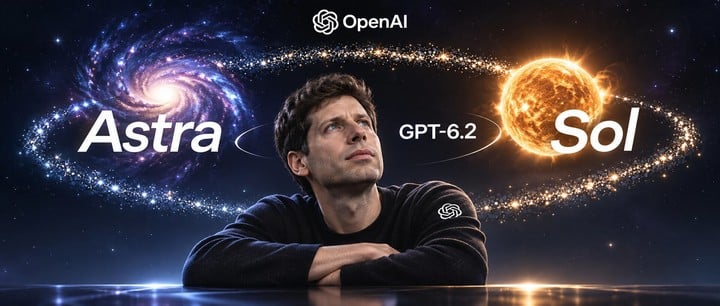
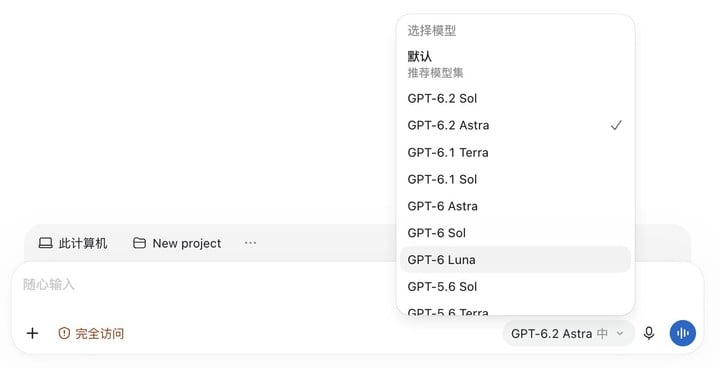
In the early hours of this morning, OpenAI officially released GPT-6.2 Astra and GPT-6.2 Sol, focusing on stronger professional work capabilities, higher Token efficiency, and further reduced usage costs.

According to the officially announced results, the new models perform well in areas such as programming, scientific research, professional office work, and 3D design, with the cost of completing some tasks even dropping to less than one-third of the previous generation.
Yet in the first round of developer testing, evaluations of GPT-6.2 showed clear divergence. Some marveled at its 3D generation capabilities and cost advantages, while others believed the model performed terribly on complex tasks and even wrote a long letter to complain to OpenAI.
We also [wondered] how GPT-6.2 actually performs?
GPT-6.2 Arrives: Smarter and Cheaper on Benchmarks
The two models released this time have different positioning, with GPT-6.2 Astra aimed at complex professional tasks, while GPT-6.2 Sol focuses more on efficiency and cost, covering daily office work, programming, and multi-step Agent work.
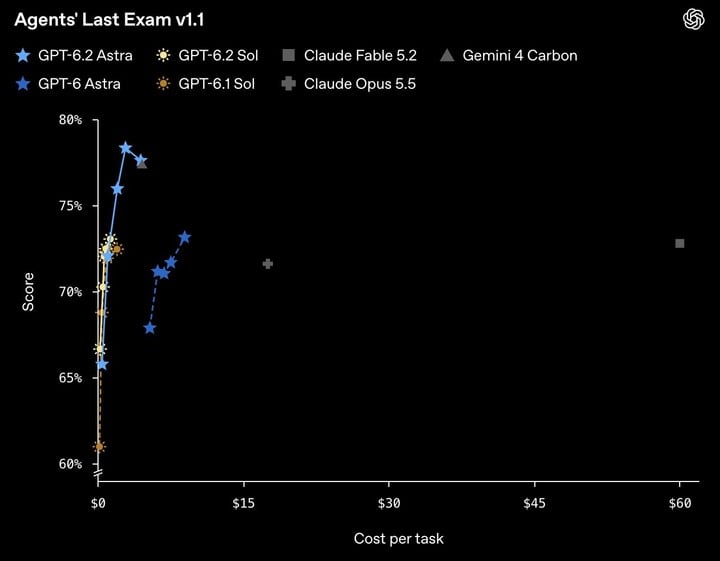
In the Agents' Last Exam test, which measures long-horizon, multi-step professional tasks, GPT-6.2 Astra scored 5.2 points higher than the previous generation, while the cost of completing tasks was less than one-third of the latter; compared with Claude Fable 5.2, it leads by 5.5 points, with task cost only 5% of its counterpart.
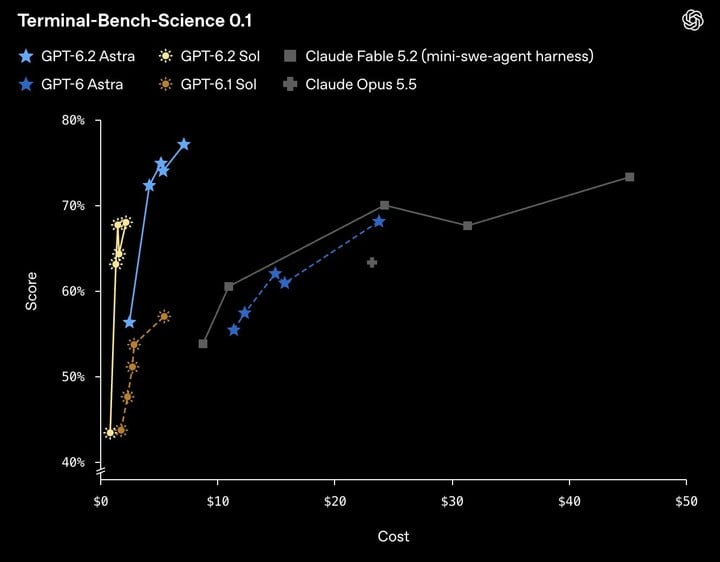
Scientific research capabilities have also improved. In the Terminal-Bench-Science 0.1 test, Astra's score rose by 9 percentage points over the previous generation, and OpenAI even claimed that this is currently the most suitable model for scientists.
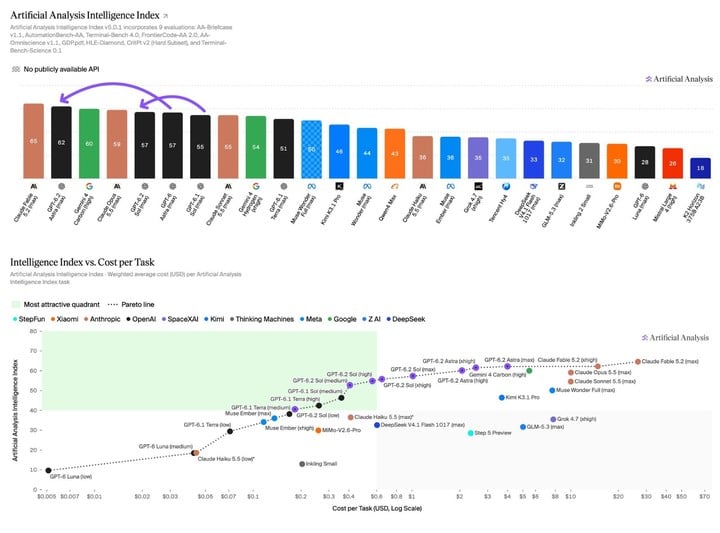
Results from third-party evaluation agency Artificial Analysis also provide a reference: GPT-6.2 Astra ranks second in the composite intelligence index, behind only Claude Fable 5.2, but in the Coding Agent index it is on par with the previous generation, while GPT-6.2 Sol actually dropped by 3 points.
Compared with simply refreshing Benchmark scores, the more noteworthy change in this release is that OpenAI has begun to focus on demonstrating how the model completes real work.
For example, give Astra a screenshot of a PPT, and it can imitate the original layout, fonts, and color scheme to create a new page; give it financial statements, and it can also generate an Excel workbook containing revenue forecasts and valuation analysis.
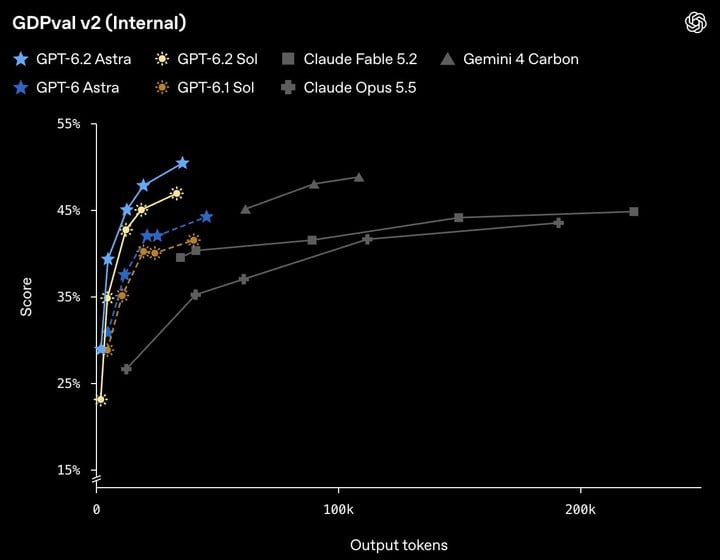
In OpenAI's internal GDPval v2 evaluation, Astra improved by 6.2 percentage points over the previous generation, with output Tokens reduced by 22%; in the Harvey LAB-AA legal work evaluation, its task pass rate was more than twice that of Claude Fable 5.2, at about one-sixth of the latter's cost.
Even more surprising is GPT-6.2's progress in 3D design and mechanical engineering.
OpenAI demonstrated cases including Astra simulating car suspension motion in Blender, creating an assembly animation of a remote-controlled race car, and designing a physical paper lamp based on the balcony design of the Marina City building in Chicago.
In Artificial Analysis's AA-3D evaluation, Astra ranked first with 1318 Elo, an increase of 150 Elo points over the previous generation, leading Claude Fable 5.2's 1271 Elo.
The first round of real-world tests on social platforms also made this progress more intuitive.
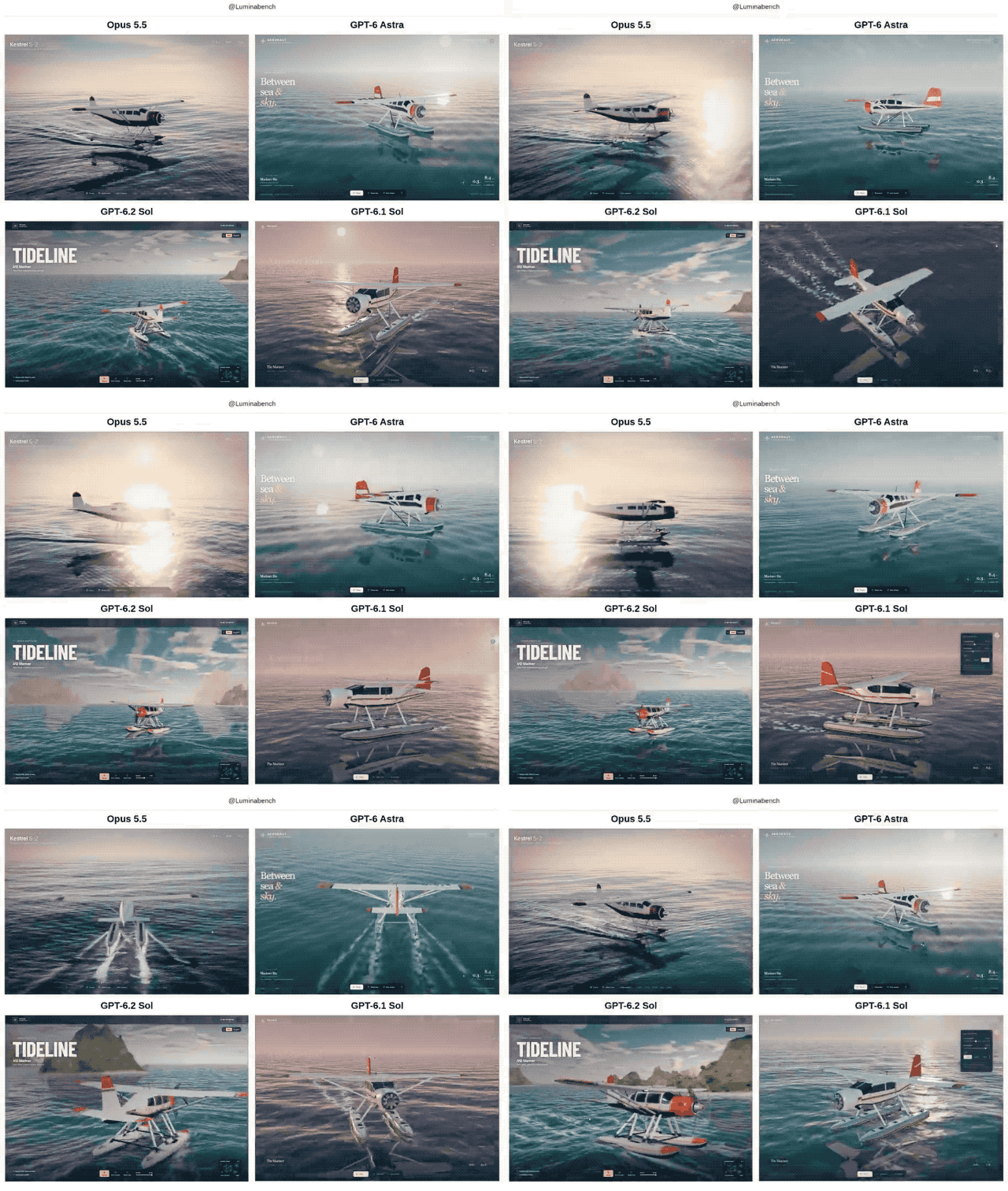
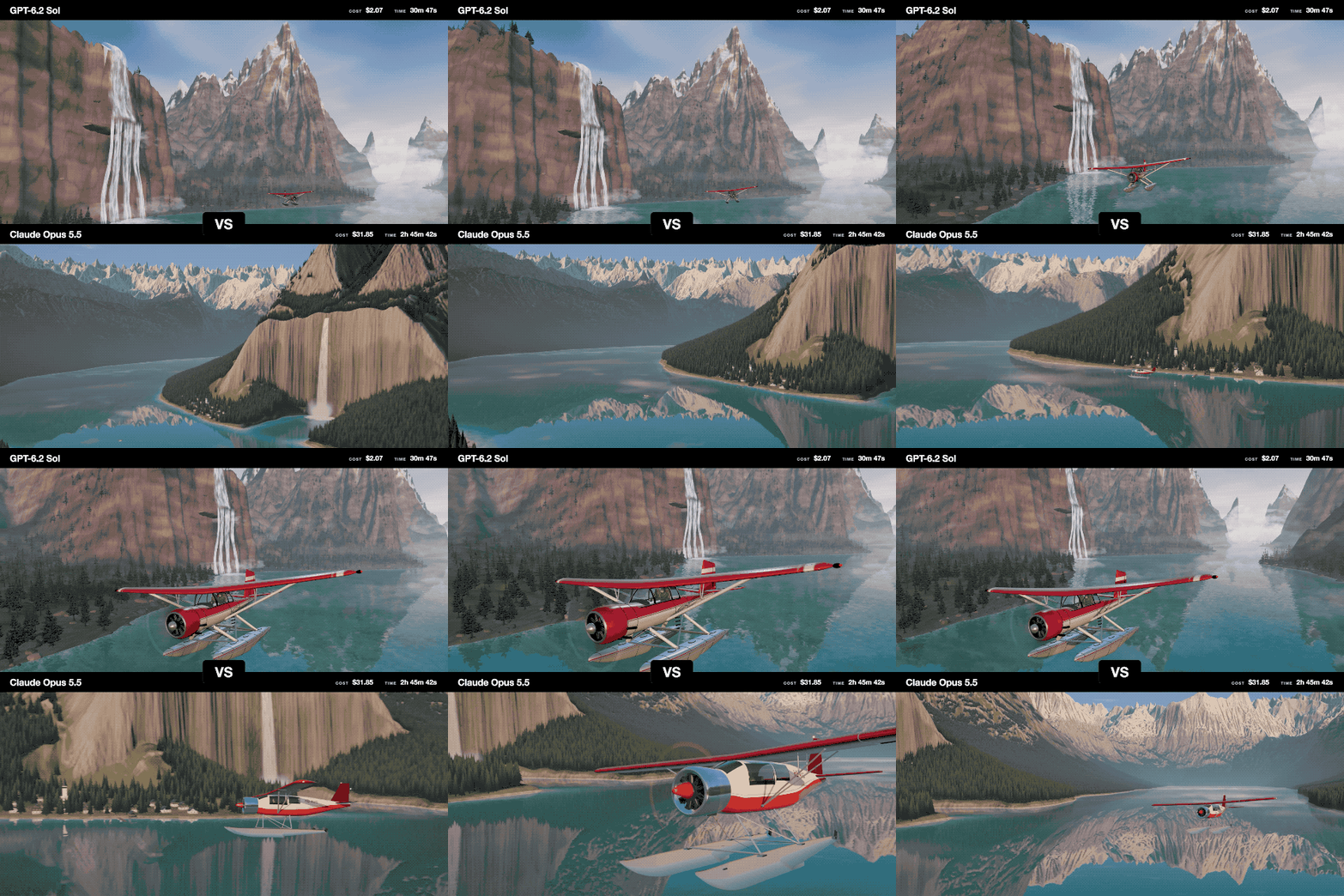
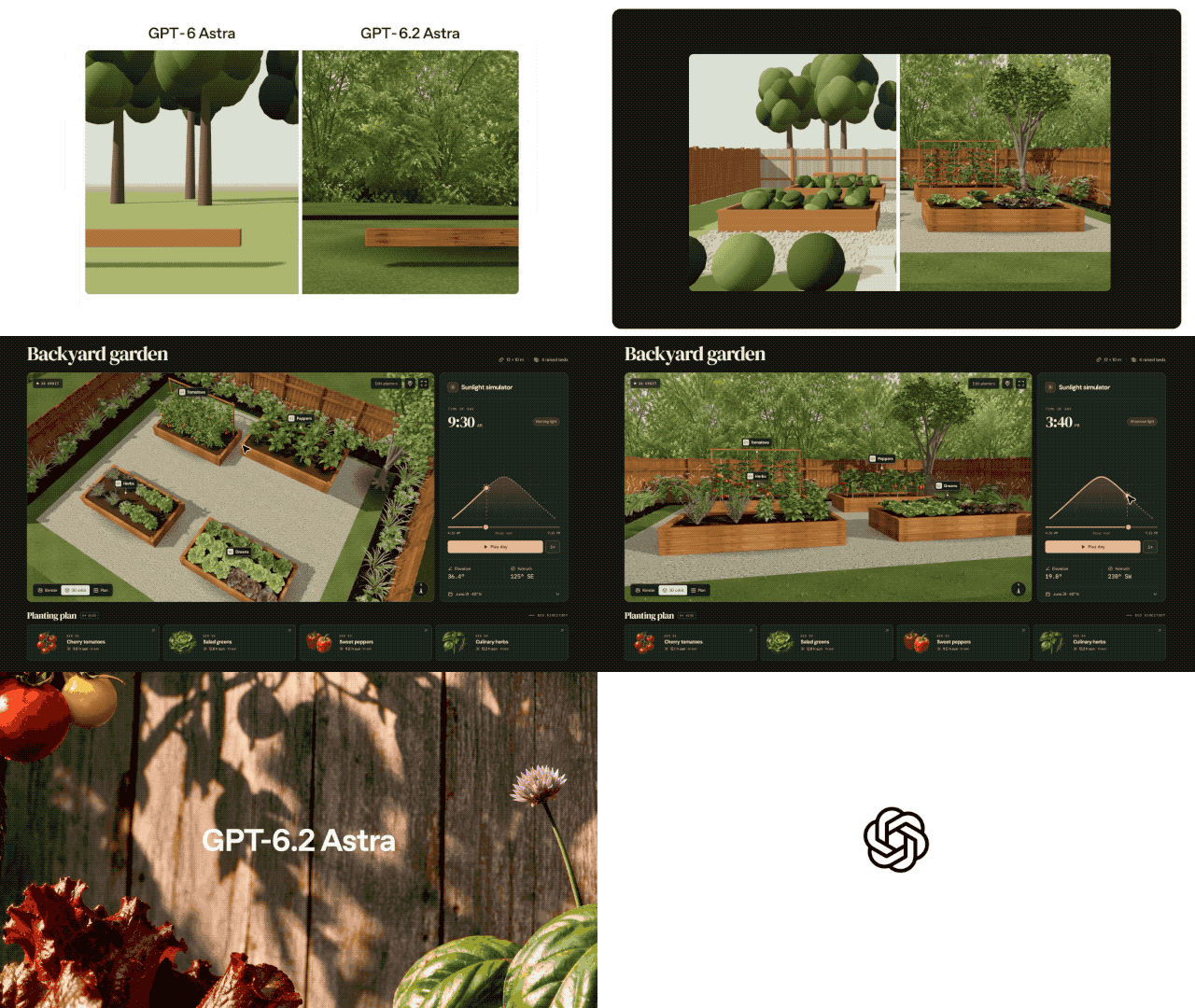
In LuminaBench's test with the same prompt, the 3D seaplane scene generated by GPT-6.2 Sol showed obvious improvement compared with 6.1 Sol.
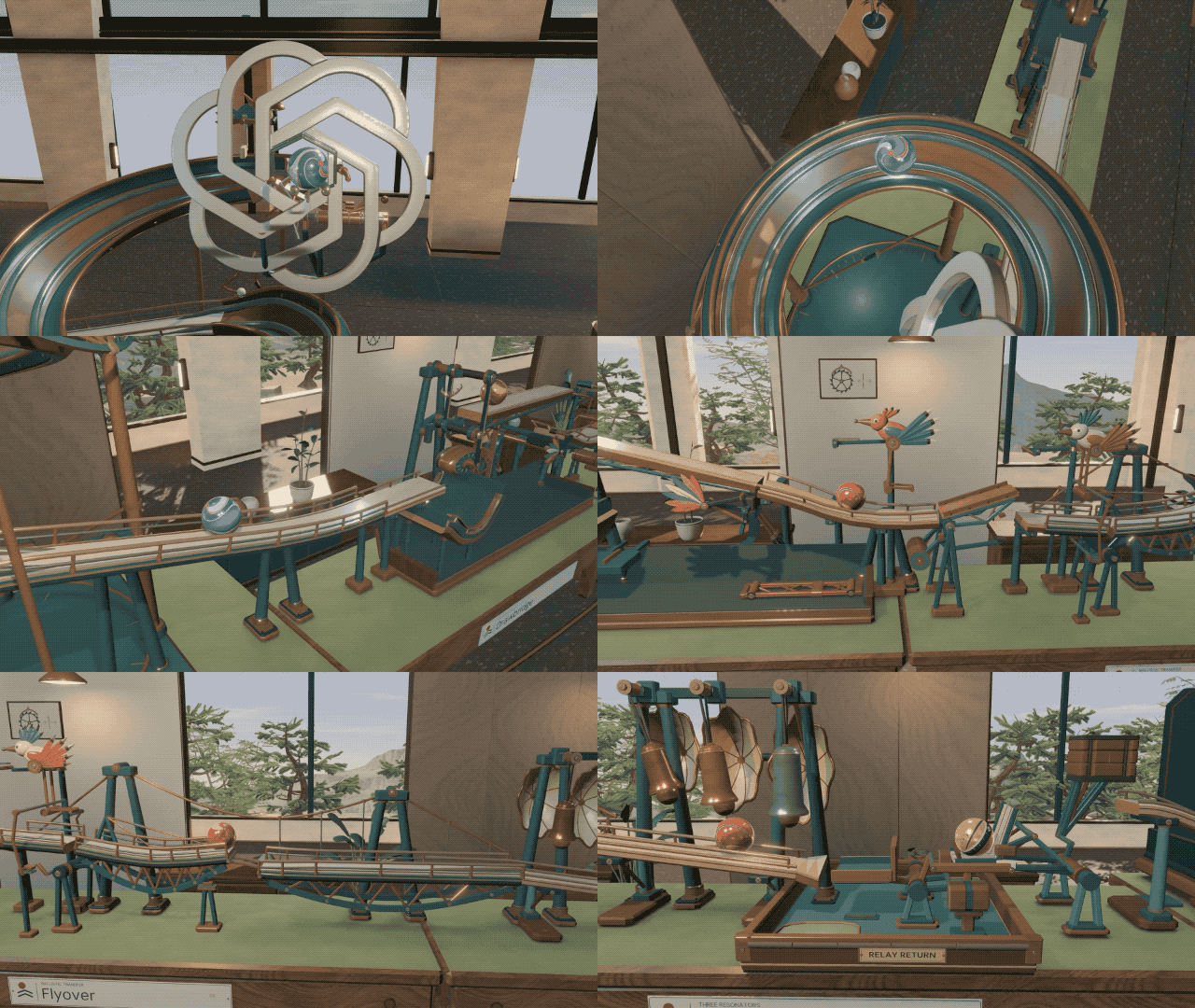
Developer eric provencher demonstrated a fine 3D demo program created by Astra based on a reference image, which can also run directly in the browser via WebGPU;

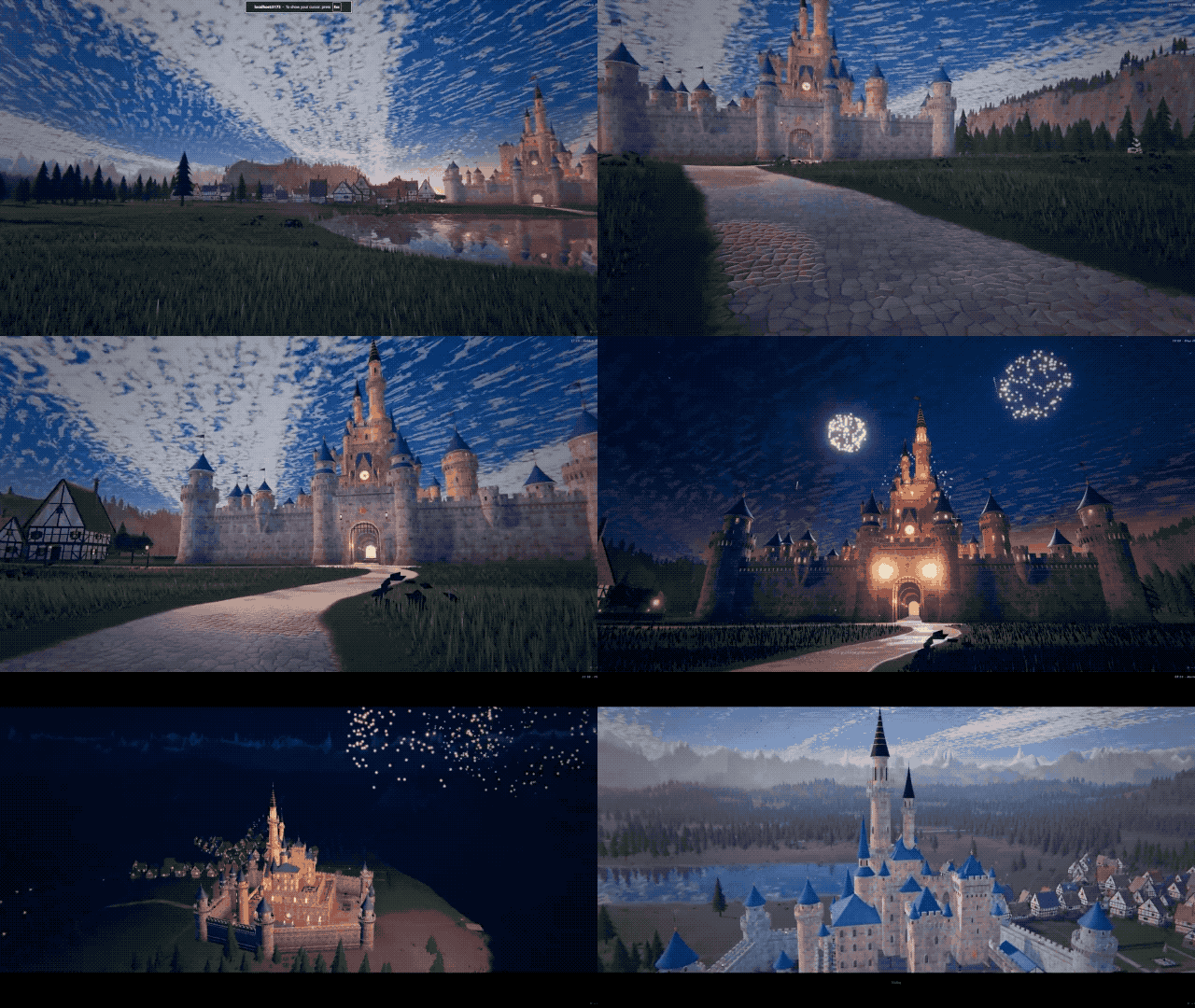
Synopsis used it to build a near-realistic, walkable Disney Cinderella Castle, with fireworks, water surface textures, and boat scenes all quite lifelike.
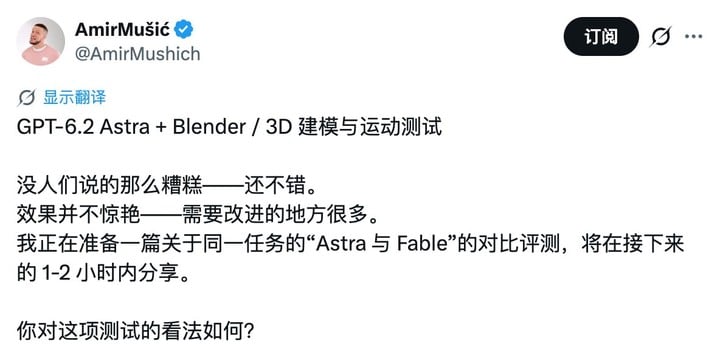
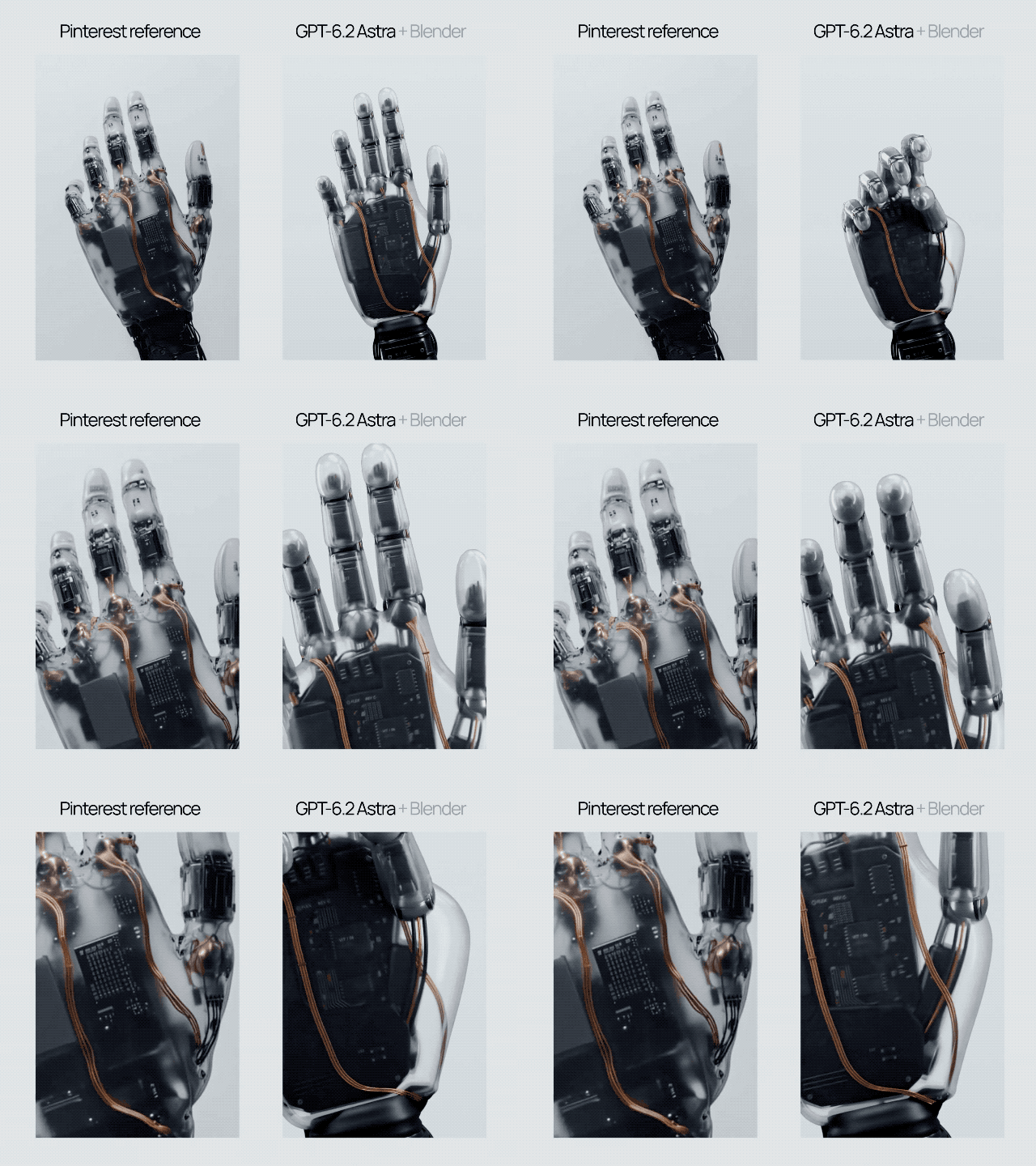
However, after testing Astra with Blender to create a robotic hand model and animation, AmirMušić believed that the actual effect was acceptable, but still far from stunning.
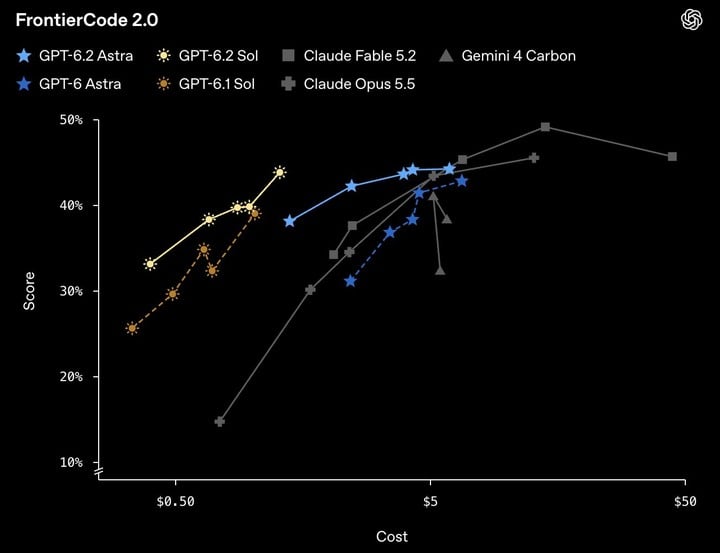
As for the efficiency-focused GPT-6.2 Sol, in the FrontierCode 2.0 programming test, its score differs from Astra's by only 0.5 points, while its cost is only about one-fifth.
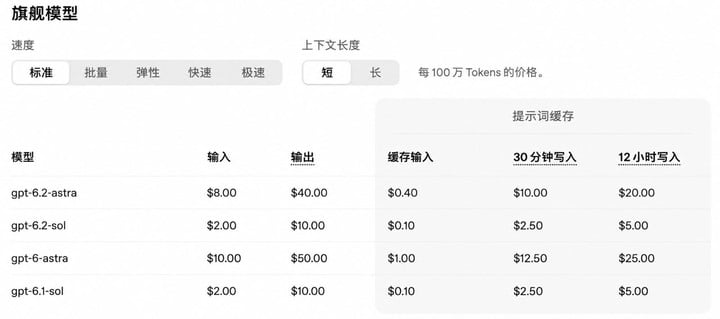
In terms of pricing, GPT-6.2 Astra's API input and output prices are 20% lower than the previous generation, and cached input is down 60%. The prices per million Tokens for input, cached input, and output are $8, $0.4, and $40, respectively.
GPT-6.2 Sol maintains the previous generation's pricing, at $2 per million Tokens for input, $0.1 for cached input, and $10 for output.
Currently, both models have been opened to Plus, Pro, Enterprise, and Edu users of ChatGPT Work and Codex, and are also available via API. The Ultrafast mode has also been opened to Pro 200 users for the first time.
The cost differences in actual testing are also obvious.
Under the same alpine seaplane prompt, developer Tony used GPT-6.2 Sol for about 31 minutes at a cost of $2.07, while Claude Opus 5.5 took about 2 hours and 46 minutes and cost $31.85.
In another set of glacier fishing boat scenes, Astra completed the task for $8.20 in about 41 minutes, while Claude Fable 5.2 cost $81.10 and took nearly two hours.
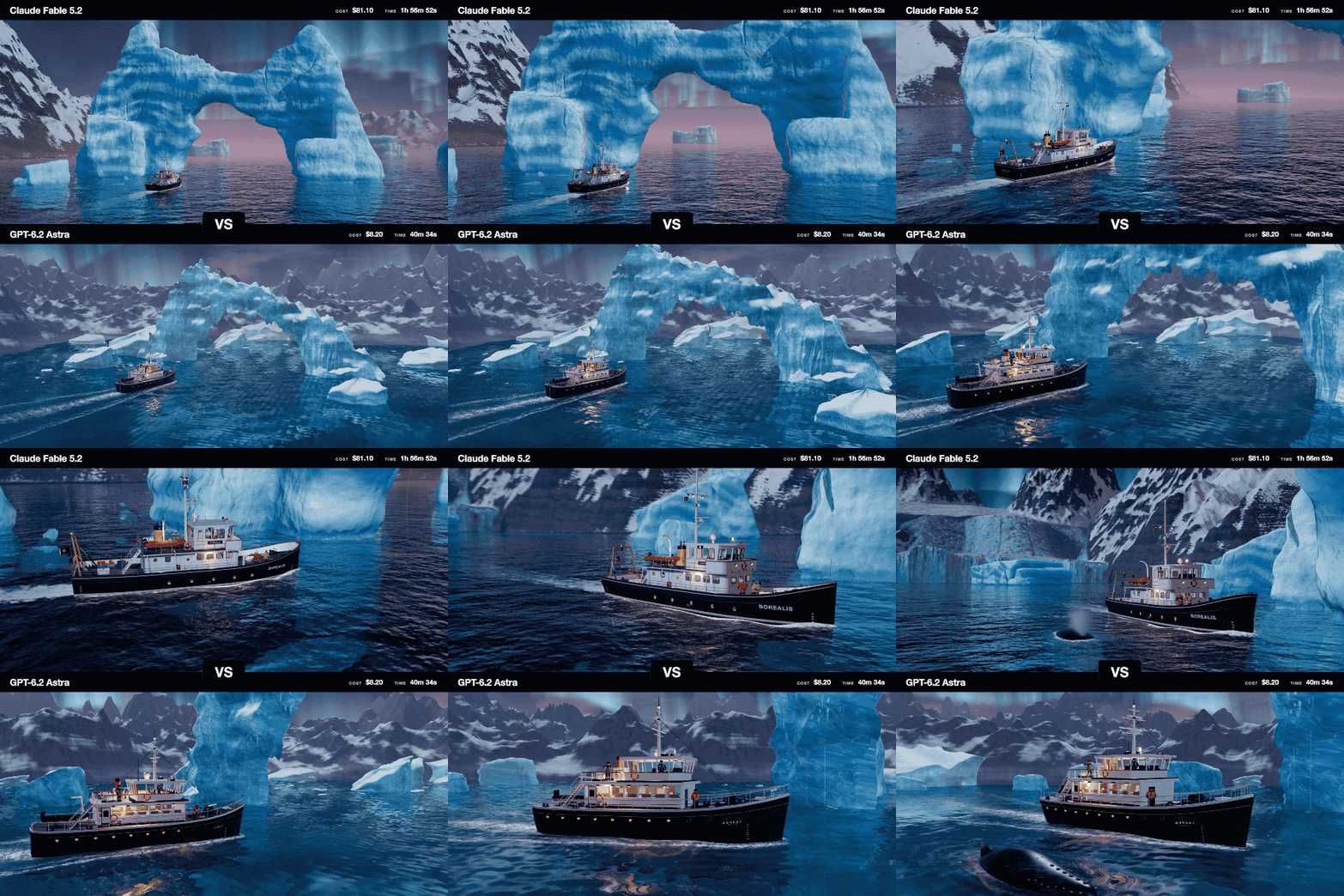
From professional work to 3D design to pricing, OpenAI has delivered a rather impressive report card, but developers' actual experience is far more complicated than the benchmark scores suggest.
The Smartest AI May Not Be the AI You Most Want to Use
After GPT-6.2 launched, several well-known developers who had early access expressed disappointment one after another.
AI developer Matt Shumer said bluntly on X that they would not conduct a full review of GPT-6.2 Astra and Sol, because the previous testing experience was so bad that the two models were basically unusable.
Values written like {{NAME_ab12cd34}} are placeholders for real values. Use them exactly as written, in replies and in tool calls alike: they are filled in with the real values before anything runs. Don't ask to verify them, and don't replace them with examples.
Article title: GPT-6.2 Astra Received a Flood of Negative Reviews Right After Launch—After Testing It Myself, I Think It's Getting a Bit of a Raw Deal
Body:

Every co-founder Dan Shipper's team also tested it in advance for several weeks and found GPT-6.2's overall performance disappointing.
According to his observations, Astra is even worse than the previous generation at writing, pursuing conciseness to excess, so questions that need detailed explanation often get overly short answers; its coding performance is close to the previous generation, but it often stops work prematurely in real projects; and although it has good taste in design, it tends to generate highly similar work.
The harshest criticism came from well-known developer Theo.
He revealed that because GPT-6.2 Astra's performance was so poor, he spent an entire day writing a complaint letter to OpenAI. The model often suddenly pauses during long-running tasks to ask users trivial questions such as how internal files should be named, and in one TypeScript-to-Rust project it ran continuously for 11 days without achieving any effective improvement—at one point even slowing the compiler down by 56%.
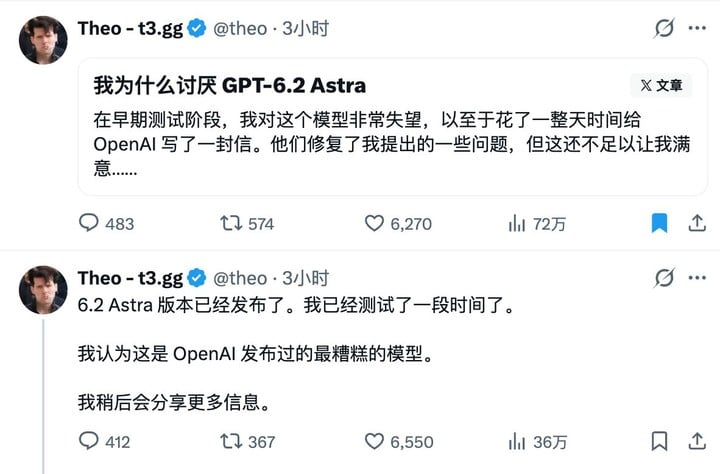
What troubled Theo even more was that Astra often writes decent code but cannot clearly explain what it did.
Once, when he asked why a certain computer was running slowly, Astra gave four paragraphs of complex technical analysis, while Claude Opus 5.5 directly pointed out that the cause was a slow SSD. Now he even habitually has Claude help explain Astra's work results.
Ironically, Theo also admitted that Astra performs excellently in code review, 3D, game development, and computer operation, and even helped him design a reverse proxy solution estimated to save $25,000 per month—but these advantages are still not enough for him to use it as a daily development tool.
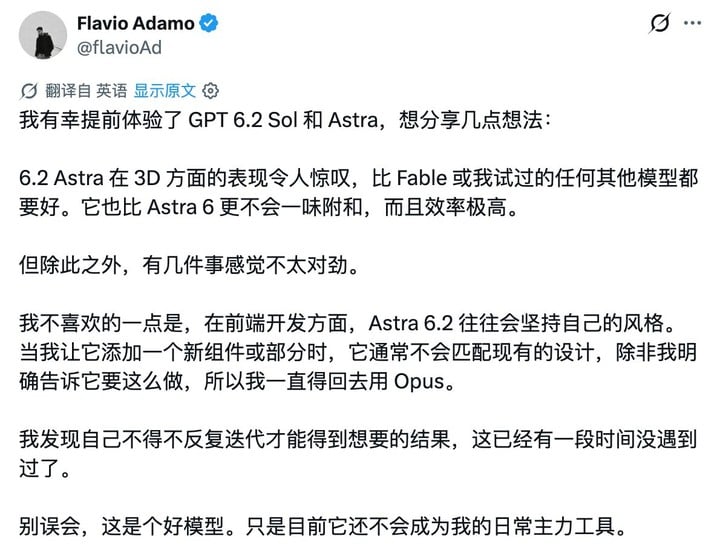
Developer Flavio Adamo also believes that Astra's 3D capabilities are excellent, but in front-end development it often arbitrarily imposes its own design style and cannot naturally carry on an existing project's visual conventions.
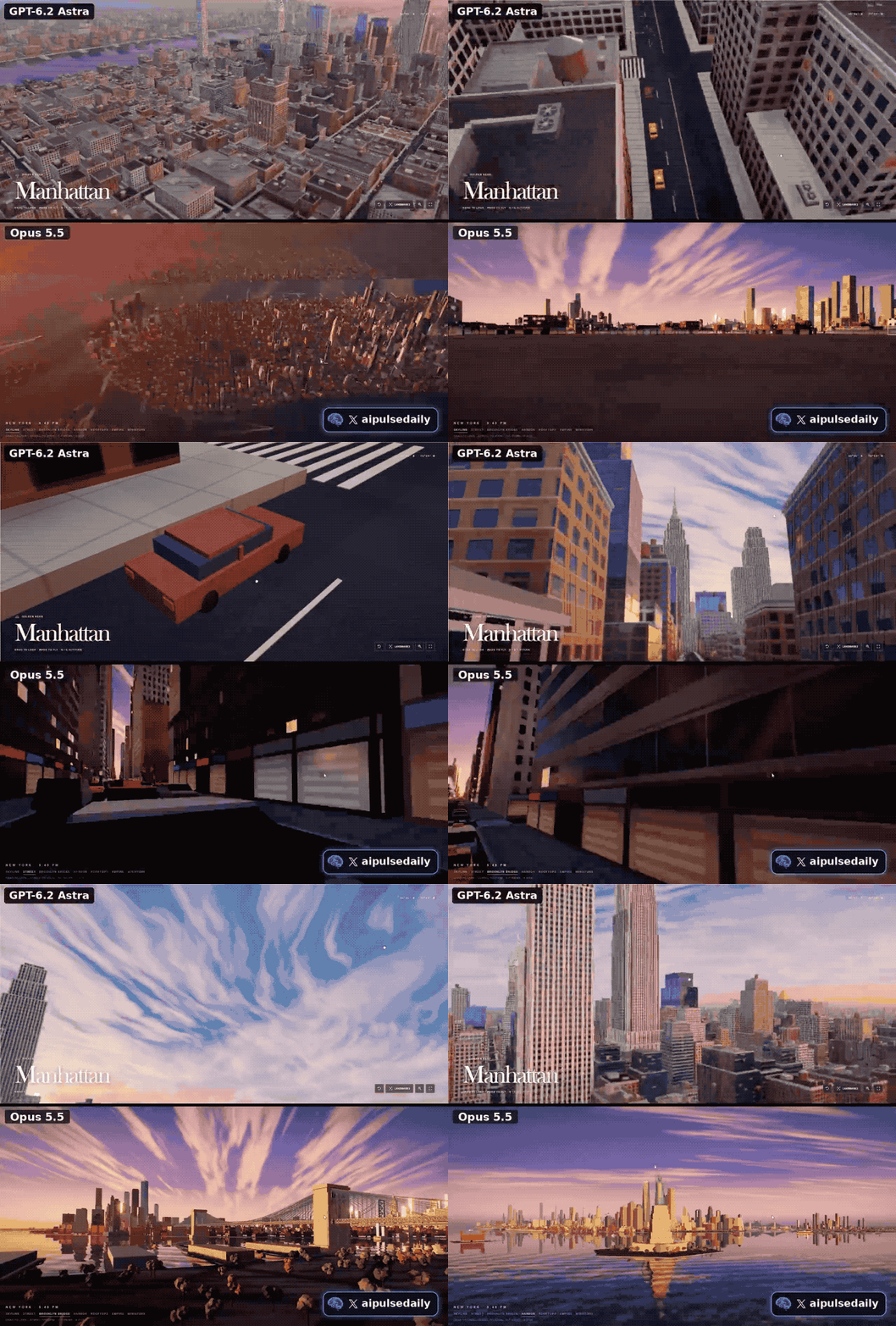
Similar problems appeared in more hands-on tests. After testing a Manhattan 3D scene, aipulsedaily said that although Astra could complete the scene, it was extremely slow, with sluggish camera movement, and it was often uncooperative in other tasks as well, so for formal work they would still prioritize Opus and Fable.
The criticisms from several developers centered on similar issues, including abnormal interruptions in long-running tasks, execution deviating from the goal, difficulty communicating and explaining, and insufficient adherence to user requirements.
However, early tester Pietro Schirano offered a different view, arguing that many problems come from the peripheral agent execution framework Harness, and that after removing the relevant framework, Astra's performance improved noticeably.
OpenAI itself also admitted in its official blog that in two alignment tests, the new model was more likely to miss important information that hinders task completion, such as missing files or unavailable search tools, and that it has now improved this behavior by adjusting Codex instructions.
After reading these mixed reviews, I also ran three sets of tests with GPT-6.2, still consisting of a third-person underwater exploration game, an animated-style countryside cycling experience, and a basic WebGL interactive scene, focusing on the model's ability to handle complex requirements, 3D scene construction, and interaction logic.

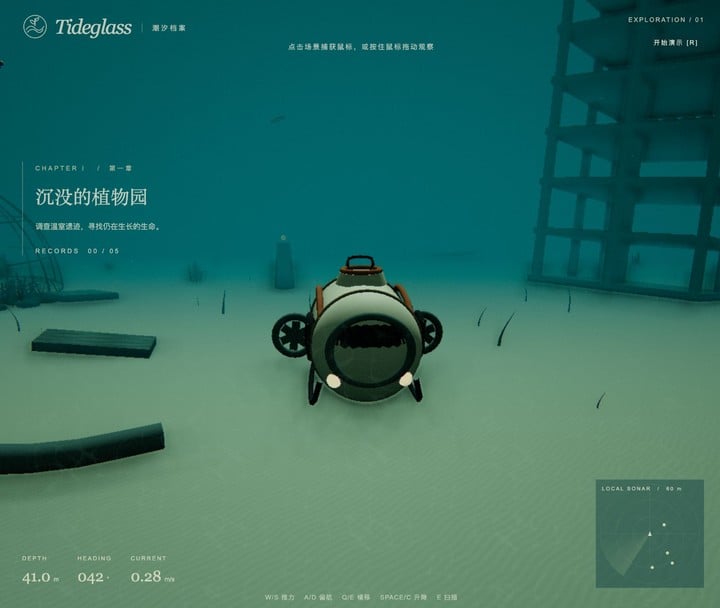

The three projects covered different needs ranging from basic graphics development to complex interactive scenes, but from my experience, GPT-6.2's performance is far from as bad as the internet says, and the public opinion after launch looks more like negative voices being disproportionately amplified.
The reason is that as agents begin to participate in software development, professional design, and scientific research, a single task may last hours or even days, and the model needs to plan on its own, call tools, and handle obstacles—any single misjudgment can cost users extra time and token costs.
The file-naming problem Theo encountered is just an insignificant question in ordinary chat, but for an agent that has already been running for two hours, it means the task is forced to interrupt.
Likewise, the model continuously consuming tokens to improve program size while ignoring the performance the user wanted to improve also shows that the stronger autonomous execution becomes, the higher the cost of wrong decisions may be.
Particularly noteworthy is that OpenAI repeatedly emphasized GPT-6.2's cost advantages this time, but the cost of a real project also depends on whether the model can accurately understand the goal, reduce repetitive operations, and deliver results that meet requirements.
A lower price per inference can still make the whole project more expensive due to repeated trial and error.
On the other hand, as model capabilities gradually diversify, performance in a single scenario is increasingly less able to represent a model's overall level.
The same GPT-6.2 Astra can achieve stunning results in 3D generation, yet also go around in circles repeatedly in long-running coding tasks; some find its interaction experience maddening, while others believe its cost efficiency is enough to change their workflow.
Different tasks inherently place different demands on model capabilities, so users' judgments of whether a model is good or bad will naturally diverge.
The controversy surrounding GPT-6.2 precisely reflects the changes taking place in large-model competition.
Over the past few years, model vendors have constantly tried to prove that their AI is smarter than competitors'. Now, as agents enter real workflows, users are starting to pay more attention to how efficiently, cost-effectively, and reliably it can complete tasks.
For ordinary users, rather than being swayed by the most extreme reviews on social platforms, it is better to put the model into their own work scenarios and see how much it can actually accomplish. The smartest model is not necessarily the most usable one; and the most usable model does not necessarily need to prove it is the smartest.