 Newshot
Main
The Bogong moth (Agrotis infusa) is an iconic Australian insect and a well-known long-distance nocturnal navigator1,2,3,4 (Fig. 1a). During their year-long lives, individual moths undertake a long spring migration of up to 1,000 km from breeding grounds distributed all over south-eastern Australia to a select number of geographically restricted aestivation sites in the Australian Alps1,2 (Fig. 1b). After around 3 months of dormancy in cool alpine refuges (Fig. 1c), the same individuals return to their breeding grounds in autumn, where they reproduce and die. To make these two great seasonal journeys, Bogong moths rely on the stars as a compass to navigate in their inherited migratory direction3. Interestingly, when the stars are obscured by clouds, moths maintain their migratory heading3, suggesting that the Earth’s magnetic field is also probably used as a compass. The Bogong moth’s previously described magnetic sense4 only reinforces this possibility. However, the ability of the Bogong moth to use a geomagnetic compass, and the nature of the moth’s magnetic sense itself, remain unknown.
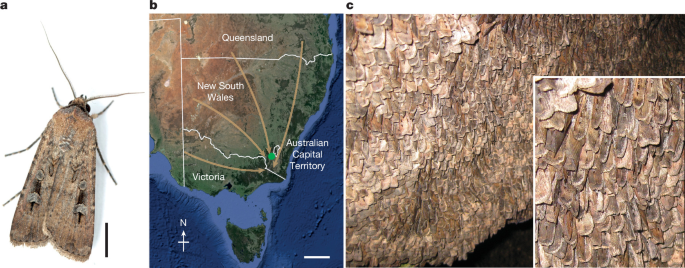
a, Male Bogong moth. b, Probable migratory routes (arrows) taken by moths during spring to alpine regions in south-east Australia. Autumn migration occurs in the reverse directions. The green dot shows the location of our specialized non-magnetic laboratory at Adaminaby. c, Around 17,000 moths per m2 aestivate on the walls of specific caves in the Australian Alps for up to 4 months before making the return migration. Inset, detail. Scale bars, 5 mm (a) and 200 km (b). Photos reproduced with permission: a, ref. 2; b, ref. 49; c, ref. 3 (all CC BY 4.0).
Here we show that Bogong moths can use the Earth’s magnetic field alone as a compass to navigate in their inherited migratory direction at night and that, similar to night-migratory songbirds6,7,8, this compass is based on the field’s inclination rather than its polarity. Our results further show that, again as in night-migratory songbirds9,10,11,12, this geomagnetic compass seems to rely on a light-dependent radical-pair-based magnetic sense5, possibly mediated by cryptochromes.
Bogong moths use a geomagnetic compass
During their biannual migrations, we captured southward-arriving spring migrants and northward-departing autumn migrants using a light trap located at Mount Selwyn, approximately 70 km north-north-east of the principal alpine aestivation sites in south-east New South Wales (NSW)3,4. Moths were transferred to a purpose-built, ferromagnetic-free dark laboratory at our nearby field site, where they were tethered and flown in a flight simulator arena3,13 (details of the laboratory, the simulator design, the tethering procedures and the criteria used to select moths for analysis are provided in the Methods and Extended Data Fig. 1). This simulator continuously measured the flight headings of actively flying moths free to turn in any azimuthal direction, thus enabling reconstruction of a ‘virtual flight trajectory’ over a certain period. The cylindrical interior wall of the flight arena was lined with blue cardboard (the ‘sky’) and the lower one-third of the wall was lined with second layer of black cardboard cut to create the panoramic silhouette of a surrounding landscape (of meadows, trees and hills). This landscape provided visual details that assisted tethered moths to control their flight.
To test whether Bogong moths possess a magnetic compass, we placed the flight simulator arena within a 3D double-wound Helmholtz coil system that created a natural local geomagnetic field (intensity 57,600 nT, angle of inclination −65.5°, angle of declination +12.8°). Without altering the magnetic intensity, these coils allowed us to: (1) rotate the azimuthal orientation of a natural geomagnetic field (NMF) within the arena without altering its angle of inclination (for example, a 180° horizontal rotation, so that magnetic north points south); (2) invert the polarity and inclination of the geomagnetic field separately or together; and (3) null (remove) the geomagnetic field.
Tethered moths were exposed to a full-spectrum (UV–red) randomized starry night sky (lacking directional information) that was projected at natural stellar intensity onto a flat screen placed on top of the cylindrical arena (Fig. 2a). The flights of tethered moths were recorded for 5 min. When exposed to the NMF and randomized stars, moths oriented in their seasonally appropriate migratory directions during two spring (2023–2024) and two autumn (2024–2025) migratory seasons. In spring, moths flew roughly south-west (mean vector direction α = 223°, n = 122, P = 9.1 × 10⁻⁶) (Fig. 2a), whereas in autumn, moths flew north–north-east (α = 17°, n = 126, P = 7.4 × 10⁻⁵) (Fig. 2a). The spread of moth flight directions was greater than we had previously observed under natural starry skies in a nulled geomagnetic field3 (also see Fig. 4), almost certainly owing to the inherent noisiness of the magnetic sense compared with the visual sense14. When the azimuth of the geomagnetic field was rotated horizontally by 180° without altering the vertical component of the field (Fig. 2b), both spring moths and autumn moths flew in almost exactly the opposite directions, turning by 191° in spring (α = 32°, n = 128, P = 1.5 × 10−10) and by 205° in autumn (α = 222°, n = 132, P = 1.3 × 10⁻⁸). In the absence of a geomagnetic field, but still in the presence of a randomized starry sky, moths were disoriented in both seasons (spring: n = 122; autumn: n = 124) (Fig. 2c). Individual datasets from each season are provided in Extended Data Fig. 2 and full statistics in Extended Data Table 1. Moth flight directions differed significantly between spring and autumn, as well as between rotated and unrotated geomagnetic fields in each season (Watson–Wheeler tests with Bonferroni correction; Extended Data Table 1).
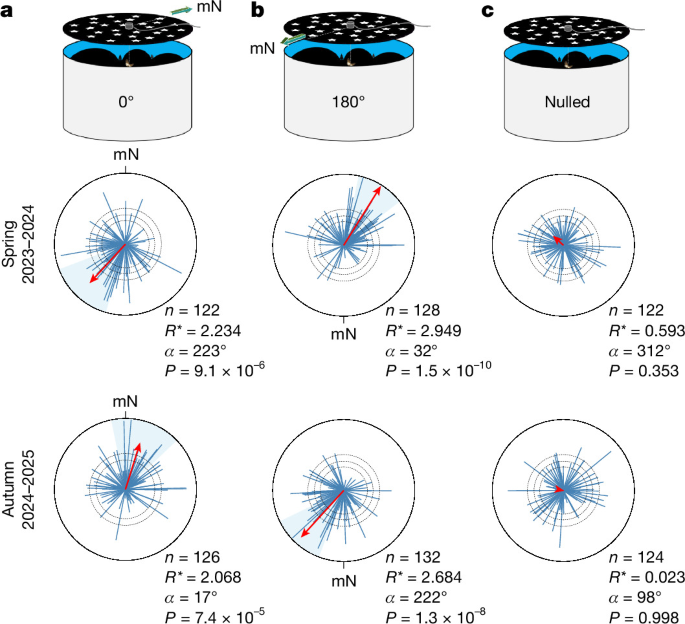
a, Migratory moths were flown in a panorama-lined arena under a projected full-spectrum randomized starry sky and within a coil-generated NMF (Extended Data Fig. 6). Moths (light blue vectors) flew in their inherited migratory directions in both spring (α = 223°, n = 122 (2023 and 2024), R = 2.234, P = 9.1 × 10⁻⁶, 95% confidence interval (CI95) = 196° to 249°) and autumn (α = 17°, n = 126 (2024 and 2025), R = 2.068, P = 7.4 × 10⁻⁵, CI95 = 348° to 46°). b, As for a except with magnetic north rotated by 180° (spring: α = 32°, n = 128, R = 2.949, P = 1.5 × 10⁻¹⁰, CI95 = 12° to 51°; autumn: α = 222°, n = 132, R = 2.684, P = 1.3 × 10⁻⁸, CI95 = 200° to 244°). c, Orientation under a randomized starry sky and in a nulled magnetic field during spring (n = 122 (2023 and 2024), R = 0.593, P = 0.353) and autumn (n = 124 (2024 and 2025), R = 0.023, P = 0.998). Each red mean vector in a–c results from weighting the mean directions and mean directedness (vector lengths) of all individual moths, as analysed by a one-sided Moore’s modified Rayleigh test (MMRT), with Bonferroni correction for multiple comparisons. The direction and directedness of the mean vector are given by the α and R values, respectively. Dashed circles indicate the required R value for statistical significance: P < 0.05, P < 0.01 and P < 0.001, respectively, for increasing radius. Outermost circles correspond to R* = 3 (mean vector) and r = 1 (individual moth vectors). The shaded area denotes CI95. mN, magnetic north.
In summary, our behavioural results demonstrate that Bogong moths can use the Earth’s magnetic field alone as a compass to navigate in their inherited migratory direction during both spring and autumn. Next we investigated whether this compass allows moths to find their direction using the polarity of the geomagnetic field, as observed in ants15, or by using the field’s inclination, as observed in night-migratory songbirds6,7,8.
A compass based on magnetic inclination
To determine whether the magnetic compass of the Bogong moth functions as a polarity or inclination compass, the flight simulator was again positioned within a 3D Helmholtz coil system in our laboratory. Three magnetic field conditions of equal intensity were established (Fig. 3): (1) an NMF (magnetic north at 0°, inclination −65.5°, field lines pointing skyward); (2) a geomagnetic field with inverted polarity (magnetic north at 180°, inclination +65.5°), which maintained the same axial direction of the magnetic field lines as in the NMF, but caused them to point groundward (the vertical and horizontal field components were both inverted); and (3) a geomagnetic field with inverted inclination (the vertical field component alone was inverted: magnetic north at 0°, inclination +65.5°, field lines pointing groundward). When spring moths were exposed to the NMF, they oriented consistently south-westward (α = 208°, n = 77, P = 1.1 × 10⁻⁷) (Fig. 3a). When magnetic polarity was inverted without altering the axial direction of the field lines (which leaves the perceived inclination unchanged), moths did not respond to the polarity inversion and maintained a south-westward flight direction (α = 213°, n = 78, P = 5.4 × 10⁻⁵) (Fig. 3b). By contrast, when magnetic inclination alone was modified by exclusively inverting the vertical component of the geomagnetic field, moths oriented north-east (α = 27°, n = 76, P = 5.4 × 10⁻⁴) (Fig. 3c). Collectively, these results demonstrate that Bogong moths, like night-migratory songbirds6,7,8, possess a geomagnetic inclination compass—one that distinguishes ‘poleward’ (or south in the southern hemisphere, indicated by progressively larger angles of inclination) from ‘equatorward’ (or north, indicated by progressively smaller angles of inclination) rather than indicating ‘north’ and ‘south’ per se (as in a polarity compass). To investigate whether this inclination-based compass relies on a light-dependent (potentially cryptochrome-based) radical-pair mechanism, we next tested the two key predictions of the radical-pair hypothesis: that the compass requires UV or blue light and should be disrupted in the presence of broadband radiofrequency (RF) noise.
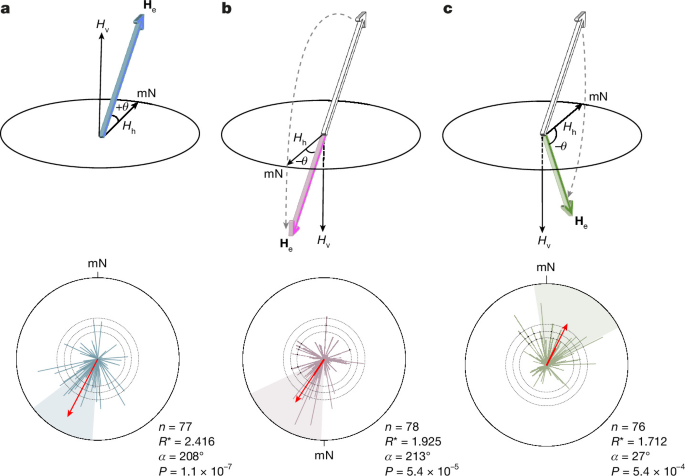
a, Spring-migratory moths were flown in a panorama-lined arena under a projected full-spectrum randomized starry sky and within a coil-generated NMF. Moths (light blue vectors) flew in their inherited migratory directions (α = 208°, n = 77, R = 2.416, P = 1.1 × 10⁻⁷, CI95 = 184° to 233°). b, When the magnetic polarity in a was inverted (by inversion of both the vertical and horizontal field components), moths (light purple vectors) persisted in their inherited migratory directions (α = 213°, n = 78, R = 1.925, P = 5.4 × 10⁻⁵, CI95 = 184° to 245°). c, When the magnetic inclination in a was inverted (by inversion of the vertical field component alone), moths oriented north-east (α = 27°, n = 76, R* = 1.712, P = 5.4 × 10⁻⁴, CI95 = 351° to 62°). Magnetic field vectors (He) above the circle (a) point skyward (that is, exit the Earth’s surface, southern hemisphere, +θ), whereas those below the circle (b,c) point groundward (that is, enter the Earth’s surface, northern hemisphere, −θ). He, geomagnetic field vector; Hh, horizontal component of He; Hv, vertical component of He; θ, angle of inclination; mN, magnetic north. All other definitions and statistics are as given in Fig. 2.
A small number of viable, non-mutually exclusive hypotheses have arisen to explain how magnetic fields may be sensed5,6,16,17,18,19. Of these, two hypotheses have received the most attention. The first involves the presence of tiny magnetite crystals clustered in or close to sensory cells20,21. Changes in the orientation of these crystals relative to the direction of the Earth’s magnetic field are thought to give rise to mechanical tensions between the magnetite crystal and the sensory cell, thereby facilitating signal transduction. This mechanism, apparently detecting the polarity of the magnetic field, has been suggested in ants15,22, fish23,24 and sea turtles25, among others. The second hypothesis involves a light-dependent cryptochrome-based radical-pair mechanism5,26,27,28,29,30,31, in which light-excited cryptochrome molecules are thought to be involved in chemical reactions that are modulated by the direction of the Earth’s magnetic field. These reactions are hypothesized to trigger sensory transduction in a magnetically sensitive cell. This mechanism, first suggested in insects in Drosophila32 (although recently contested33), is able to detect the inclination but not the polarity of the magnetic field, as has been suggested in several species including night-migratory songbirds5,6,7,8, insects31,34,35 and sea turtles25.
The radical-pair mechanism exhibits two distinguishing properties. First, certain wavelengths and intensities of light seem necessary to allow magnetic sensation9,10,32. For example, monarch butterflies (Danaus plexippus) seem capable of detecting the inclination of a magnetic field using a cryptochrome-based magnetic sense31, even though the evidence for geomagnetic orientation during migration is mixed35,36,37. This ability seems to require violet light (380–430 nm). Second, according to theory5,26,27,38, the radical-pair mechanism (and thus any magnetic sense depending on it) is disrupted by very weak broadband RF noise11,12,29,30. We used these two properties to investigate whether magnetic sensing in the Bogong moth is based on a light-dependent radical-pair mechanism.
The compass requires violet–blue light
First, we tested the light-dependency of magnetic orientation by exposing moths captured during two spring and two autumn migratory seasons (2023–2025) to NMFs under a projected sky of randomized stars (Extended Data Fig. 1c) in an arena lined with a panoramic scene (Fig. 2 and Extended Data Fig. 1d,e). Experiments were again conducted in our ferromagnetic-free laboratory, but now with UV, violet and blue light removed from the stellar illumination spectrum (using a spectral blocking filter: only light of wavelength λ > 500 nm remained). Under these conditions, moths were disoriented in both seasons (Fig. 4a and Extended Data Fig. 2d), suggesting that their geomagnetic compass is light-dependent and requires light of wavelength λ < 500 nm to function.
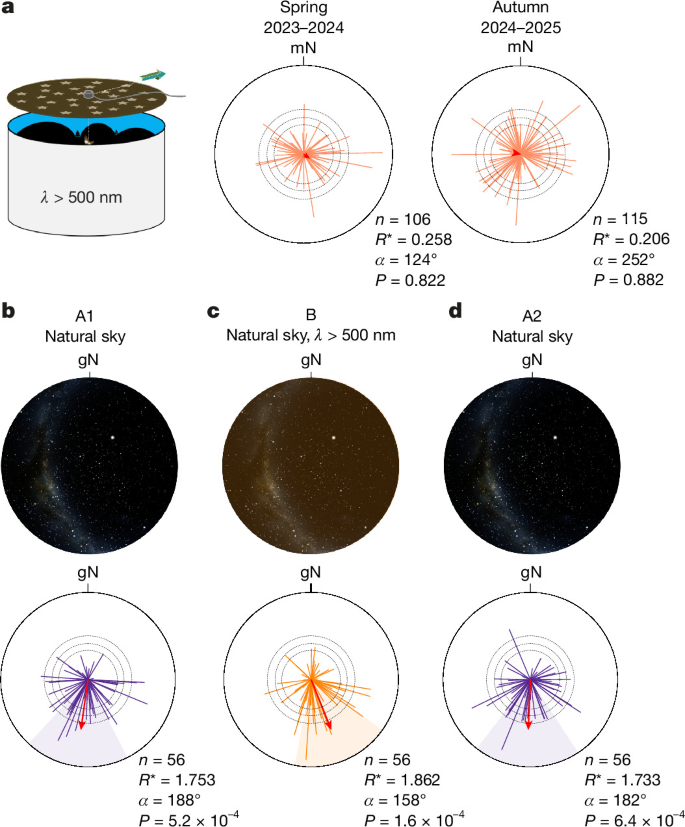
a, Using the same stimulus conditions as in Fig. 2, but with illumination restricted to λ > 500 nm, moths (orange vectors) were disoriented during spring (n = 106 (2023 and 2024), R = 0.258, P = 0.822) and autumn (n = 115 (2024 and 2025), R = 0.206, P = 0.882). b,d, Bogong moths (n = 56, purple vectors) were oriented in a nulled geomagnetic field under a natural spring local starry sky with full illumination spectrum (Extended Data Fig. 7) (phase A1: α = 188°, R = 1.753, P = 5.2 × 10⁻⁴, CI95 = 153° to 222° (b); phase A2: α = 182°, R = 1.733, P = 6.4 × 10⁻⁴, CI95 = 125° to 190° (d)). c, In phase B, moths (orange vectors) remained oriented in a nulled geomagnetic field under a natural starry sky lacking UV–blue light (λ > 500 nm): α = 158°, R* = 1.862, P = 1.6 × 10⁻⁴, CI95 = 147° to 217°. No significant orientation differences were found among the three conditions (b–d; Wheeler–Watson test: W = 2.561, d.f. = 4, P = 0.634). All other definitions and statistics are as in Fig. 2.
To address the possibility that this apparent loss in magnetic orientation was instead due to moths being unable to visually control their flight in the absence of UV, violet and blue light (and thus potentially becoming disoriented), we flew spring-migratory Bogong moths in a nulled geomagnetic field under a projected natural spring starry sky (Extended Data Fig. 1b). Under these conditions, and under full-spectrum stellar illumination, moths have previously been shown to use their stellar compass (that is, their visual sense) to orient in their inherited migratory direction3. The orientation of each moth was measured during three sequential 5-min experimental phases (Fig. 4b–d): A1, B and A2. Full-spectrum stellar illumination was provided in phases A1 and A2, but UV, violet and blue light were excluded from this spectrum during phase B. Moths maintained consistent orientation in their inherited migratory direction in all three phases (A1 (Fig. 4b): α = 188°, R = 1.753, P = 5.2 × 10⁻⁴; A2 (Fig. 4d): α = 182°, R = 1.733, P = 6.4 × 10⁻⁴; B (Fig. 4c): α = 158°, R* = 1.862, P = 1.6 × 10⁻⁴), with no significant differences between distributions (Wheeler–Watson test: W = 2.561, d.f. = 4, P = 0.634). These results demonstrate that the disorientation we observed in the absence of UV, violet and blue light (Fig. 4a) does not arise from an inability to visually control flight. Instead, it must arise from an impaired magnetic sense. This confirms that Bogong moths possess a light-dependent geomagnetic compass mechanism.
To further investigate the light-dependency of the Bogong moth geomagnetic compass, we investigated which spectral bands of illumination influence this compass. We captured moths migrating northward during autumn3,4 and transferred them to our outdoor site at Adaminaby. Here they experienced the natural night sky and the Earth’s natural magnetic field. Moths were tested in transparent UV-transmissive Perspex flight arenas13 (with a full view of the surrounding landscape) whose internal light spectrum was manipulated using spectral long-pass filter sheeting (Lee Filters; see Extended Data Fig. 3 for details) that was placed around the outer walls of the arena, as well as on its lid and floor. A wide black disk, positioned on the shaft 3 cm above the tethered moth, blocked a direct view of the entire sky, preventing moths from using their stellar compass3. Four spectrally filtered arenas were designed (Methods and Extended Data Fig. 3b): (1) a clear arena (full spectrum, λ > 310 nm); (2) a UV-blocked arena (λ > 380 nm); (3) a UV–blue-blocked arena (λ > 500 nm); and (4) a clear–neutral-density arena (full spectrum, λ > 310 nm, but reduced in intensity by approximately eight times because of the addition of 0.9 log units neutral-density filter sheeting). This fourth arena controlled for the possibility that disorientation was due to decreased illumination intensity from the UV and blue blocking filters, rather than to the restricted spectrum.
We first performed two experiments (Extended Data Fig. 3c): (1) flight orientation in a clear arena versus a UV-blocked arena, and (2) flight orientation in a clear arena versus a UV–blue-blocked arena. For each night’s experiment (1 or 2), a cohort of 40 moths was divided into two groups of 20 that then underwent two experimental phases. For each phase, the two groups were tested in parallel in each of the two arenas placed 8 m apart (Extended Data Fig. 3a). After the first phase of testing, the two groups of moths were swapped between arenas for a second phase to control for possible orientation to local landmarks seen from within each arena. In both experiments (1 and 2), there were no significant differences in the orientations of the cohorts of moths flown in each arena in the two phases (Watson–Wheeler tests) (Extended Data Fig. 4 and Extended Data Table 2), indicating that landmarks in the landscape seen through the transparent arena walls played no role in moth orientation (as also seen in earlier studies3).
In clear arenas, moths exhibited significant orientation in their inherited migratory direction in both experiments (experiment 1 (Fig. 5a): α = 23°, n = 105, R = 1.841, P = 7.7 × 10⁻⁴; experiment 2 (Fig. 5c): α = 19°, n = 122, R = 2.197, P = 1.0 × 10⁻⁵), and these two mean directions were not significantly different (Watson–Wheeler tests: W = 1.915, d.f. = 2, P = 0.384). When tested in the clear–neutral-density arena (λ > 310 nm, light levels reduced approximately eight times), moths maintained their inherited migratory direction (Fig. 5e) (α = 11°, n = 75, R = 1.559, P = 0.013). The same was true in a UV-blocked arena (λ > 380 nm (Fig. 5b): α = 24°, n = 91, R = 1.868, P = 5.8 × 10⁻⁴). However, when tested in the UV–blue-blocked arena (λ > 500 nm), moths were disoriented (n = 112) (Fig. 5d). Collectively, these findings indicate that violet–blue wavelengths between 380 nm and 500 nm are critical for the light-dependent magnetic compass sense of Bogong moths, even under reduced light intensity.
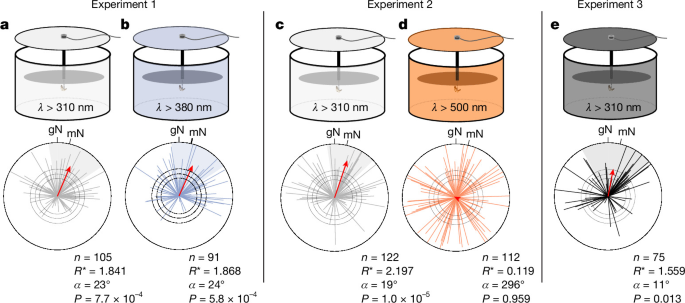
a,c, Autumn migrants tested outdoors (grey vectors) were oriented in a clear arena (passing λ > 310 nm) in both experiment 1 (α = 23°, n = 105, R = 1.841, P = 7.7 × 10⁻⁴, CI95 = 350° to 56° (a)) and experiment 2 (α = 19°, n = 122, R = 2.197, P = 1.0 × 10⁻⁵, CI95 = 352° to 46° (c)). b, Moths (light purple vectors) were also oriented in a UV-blocked arena passing λ > 380 nm (α = 24°, n = 91, R = 1.868, P = 5.8 × 10⁻⁴, CI95 = 352° to 56°). d, Moths (orange vectors) were disoriented in a UV–blue-blocked arena passing λ > 500 nm (n = 112, R = 0.119, P = 0.959). e, Moths (black vectors) were oriented (n = 75, R* = 1.559, P = 0.013, CI95 = 331° to 51°) in a clear–neutral-density arena (passing λ > 310 nm, but with a reduced illumination intensity of 0.9 log units, or approximately eight times). All other definitions and statistics are as given in Fig. 2.
In summary, our results indicate that Bogong moths use a light-dependent geomagnetic compass for long-distance navigation at night. The dependence of this compass on violet–blue light is also consistent with a magnetic sense mediated by a radical-pair mechanism (potentially cryptochrome-based). This band of wavelengths has been found to be necessary for magnetic orientation in other insects31,32 (but also see ref. 33) as well as in amphibians39 and night-migratory songbirds9,10, with these animals becoming disoriented in the absence of these wavelengths (for example, when exposed only to red light)10. Although CRY1 and/or CRY2 have been indicated to mediate light-dependent magnetosensation in some insects31,32,40, which (if any) of these CRYs underlies magnetic orientation in Bogong moths remains an open question. Our recently sequenced and annotated Bogong moth genome41 reveals that they possess three members of the CRY protein family: CRY1, CRY2 and CRY-like (J.-M. Lassance et al., unpublished data). Bogong moth CRY1 and CRY2 are similar to their counterparts in monarch butterflies, in which CRY1 (located in the eyes and/or the antennae) has been suggested to mediate magnetosensation31, whereas CRY2 functions as a transcriptional repressor in the negative feedback loop of the circadian clock31,42,43.
The compass fails with RF noise exposure
To further investigate whether the Bogong moth geomagnetic compass relies on a radical-pair mechanism, we leveraged the second key prediction of the cryptochrome radical-pair hypothesis: magnetic orientation should be disrupted by very weak broadband RF noise. Autumn-caught moths were transferred to our ferromagnetic-free laboratory and again flown in a panorama-walled arena. As before, full-spectrum (UV–red) randomized stars at natural intensity were projected above the moth, and a local NMF was generated in the arena. The arena was encircled by a specially crafted antenna connected to a signal generator (Methods and Extended Data Fig. 5a,b) that produced weak broadband RF noise (range approximately 150 kHz to 60 MHz, average intensity 41 nT, average density 2.9 pT per √Hz) (Extended Data Fig. 5c and Extended Data Table 3). In an NMF, and in the absence of RF noise, autumn migrants showed their normal inherited northward orientation (α = 18°, n = 64, R = 1.729, P = 6.4 × 10⁻⁴) (Fig. 6a). When the geomagnetic field was rotated by 180° (so that magnetic north points south) moths were oriented southward (α = 217°, n = 67, R = 2.249, P = 1.4 × 10⁻⁶) (Fig. 6c), reinforcing the results in Fig. 2. However, when weak broadband RF noise was introduced into the arena, moths became disoriented in both conditions (n = 58 (Fig. 6b) and n = 52 (Fig. 6d)). These results show that broadband RF noise disrupts the geomagnetic compass of Bogong moths, as it also does in night-migratory birds11,12,29,30, reinforcing the evidence that the magnetic sense of Bogong moths relies on a radical-pair mechanism.
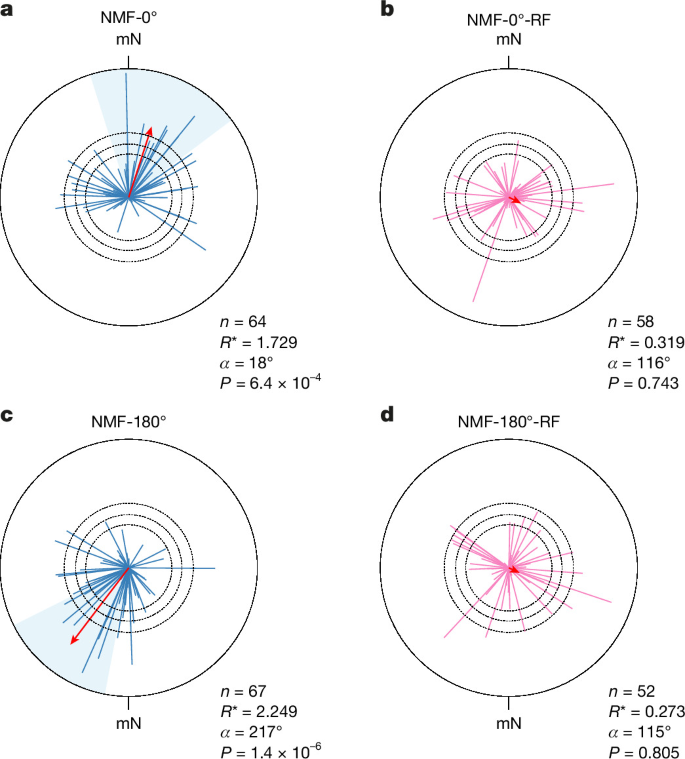
a,c, In an NMF, autumn-migratory Bogong moths (light blue vectors) were oriented in their inherited migratory direction (NMF-0°, α = 18°, n = 64, R = 1.729, P = 6.4 × 10⁻⁴, CI95 = 342° to 53° (a)), but reversed this direction when the magnetic field was rotated by 180° (NMF-180°, α = 217°, n = 67, R = 2.249, P = 1.4 × 10⁻⁶, CI95 = 191° to 243° (c)). b,d, In the presence of RF fields, moths (pink vectors) were disoriented irrespective of the rotation of the geomagnetic field (n = 58, R = 0.319, P = 0.743 (b); n = 52, R = 0.273, P = 0.805 (d)). All other definitions and statistics are as given in Fig. 2.
Two compass cues for robust navigation
Our results indicate that Bogong moths rely on two global compasses for robust nocturnal navigation—a light-dependent radical-pair-based geomagnetic inclination compass and a stellar compass3. This is also the case in night-migratory songbirds5,6,7,8,9,10,11,12,29,30,44,45, revealing an impressive example of convergent evolution in two widely separated taxa that diverged approximately 700 million years ago but share similar migratory behaviour. In the case of magnetic sensing, this convergence may indicate deeply conserved biophysical principles for sensing and using the Earth’s magnetic field for long-distance navigation. Moreover, other nocturnal insect migrants, even if not heading to a specific geographic destination like Bogong moths, may also take advantage of geomagnetic and stellar compass cues to maintain their seasonal migratory direction. Indeed, the fall armyworm moth46, and possibly the oriental armyworm moth47, have also recently been shown to possess a magnetic sense, so this sense is probably widespread in nocturnal moths. Geomagnetic and stellar compass cues could enable Bogong moths (and probably other moths48) to continue navigating in their inherited migratory direction even when the salience of one of these cues diminishes or fails (for example, because of overcast night skies or a magnetic storm). Such robust navigation may be further enhanced by the recognition of local sensory cues encountered along the journey49. The use of global and local sensory cues at different stages of their long migration probably maximizes the Bogong moth’s chances of arriving safely at their summer aestivation sites in the Australian Alps49. How these multiple sensory cues are integrated behaviourally and neurally50 to ensure robust long-distance navigation remains a promising avenue for future investigation.
Methods
Capture and care of moths
Bogong moths (Agrotis infusa) of both sexes were captured in the wild during their autumn migration (2024–2025, austral autumn, age around 9 months) and spring migration (2023–2025, austral spring, age around 5 months), using either a Lepi LED light (https://www.gunnarbrehm.de) and/or a vertical beam search light (model GT175, Ammon Luminaire Company), positioned in front of a white sheet suspended between two trees. All moths were captured near Thredbo (Dead Horse Gap, south-east NSW, Australia: 36.524° S, 148.260° E, elevation 1,580 m) and near the Mount Selwyn Snowfields (south-east NSW, Australia: 35.914° S, 148.444° E, elevation 1,600 m). Each captured moth was placed in its own small plastic container to isolate it from other moths. On capture, the moths were transported to the testing site at the property Glenhare, near Adaminaby, NSW (36.040° S, 148.864° E, elevation 1,250 m). Moths were fed a 20% honey water solution every other day and housed in a cool, sheltered environment with natural photoperiod conditions.
Attachment of tethering stalks on moths
To attach tethering stalks (thin non-magnetic tungsten rods), the scales on the moth’s dorsal thorax were carefully removed using a brush. The end of the tungsten stalk was bent using needle-nosed pliers to create a small circular footplate for connection to the thorax. The stalk was affixed to the moth’s dorsal thorax using contact cement (Impact Adhesive, EVO-STIK), and the moth was gently restrained by a weighted-down plastic mesh to ensure stability. Following stalk attachment (Extended Data Fig. 1f), each moth was transferred to a ventilated clear UV-transmissive Perspex container. Shortly before sunset (about 1 h before), containers were positioned on elevated rock formations to afford unobstructed views of the western sky, enabling observation of the setting sun and skylight polarization patterns—cues hypothesized to calibrate compass mechanisms51,52.
Controlled behavioural experiments in the laboratory
All of the controlled behavioural experiments were performed in an isolated dark room with extremely low background levels of RF disturbance in our purpose-built, highly ferromagnetic-free laboratory located at the rural property Glenhare, near Adaminaby3 (built on a concrete slab reinforced with fibreglass and constructed entirely from non-magnetic materials). Captured migratory Bogong moths were tethered and flown in our modified Mouritsen–Frost flight simulator3,13,36 in a double-wound 3D Helmholtz coil system to investigate whether moths respond to changes in an NMF (Extended Data Fig. 1a). All electrical grounds in the laboratory were connected in a single-point (star) configuration to minimize electrical noise, with the single point consisting of a metal rod. The experimental apparatus had its own dedicated earth separated from the mains earth (through a 6-mm-thick, 30-mm-wide and 12-m-long copper strap dug into the ground below the concrete slab). The arena consisted of a Perspex cylinder lined with a panoramic black cardboard silhouette of a simulated landscape (including trees, grass and hill peaks) set against a blue cardboard ‘sky’ backdrop (Extended Data Fig. 1d,e). A UV-transmissive Perspex lid (diameter, 50 cm; thickness, 0.5 cm), with a layer of UV-transmissive diffusing paper (251 Quarter White diffuser; Lee Filters), was placed on top of the arena and used for dorsal projection of celestial stimuli. A customized optical encoder53 was mounted at the centre of the lid. This encoder held a carbon fibre rod (length, 15 mm; diameter, 1 mm) that extended downwards inside the arena. The tungsten tether was connected to the end of this rod, thus connecting the moth to the encoder. This encoder allowed tethered moths to rotate freely (0–360°) in the horizontal plane and to continuously record their flight heading directions (five samples per second, angular resolution 0.9°) using customized recording software (Flash Flight Simulator Data Acquisition System, written by H.C.3,53). The recorded data therefore permitted us to reconstruct the moth’s virtual flight path for a specified period of time under different stimulation conditions. In addition, a very dim moving pattern of optic flow was projected from below, using a 45° mirror, onto a screen (251 Quarter White diffusing paper; Lee Filters) placed beneath the arena to simulate a moving view of the ground below the flying moth3,4,53. The direction of the optic flow was instantaneously coupled through feedback to the moth’s flight heading using custom software3,4,53 (H.C.) so that the optic flow always moved from head to tail below the moth (Extended Data Fig. 1g).
The three-axis Helmholtz coil system, custom built in aluminium and copper (University of Oldenburg workshop; outer coil diameters: x, 1,245 mm; y, 1,300 mm; z, 700 mm), manipulated the magnetic field around the experimental moth. The coil system was powered by three constant-current power supplies (Kepco, BOP 50-2M) and the current running through the coil system was controlled through high-speed USB carriers (USB-9162, National Instruments) and custom-written codes in MATLAB (v.R2019a; MathWorks). Before each experimental session, Meda FVM-400 magnetometer measurements ensured that the magnetic field was identical to the software settings (Extended Data Fig. 6).
Stimulation with starry skies
In the laboratory, a natural moonless starry austral night sky was projected onto the arena lid using a downward-pointing projector (LED projector ASUS S1 Mobile). The projector was mounted sufficiently high above the arena to provide clear and correctly sized dorsal images of the night sky. To avoid unwanted stray light, each projector was housed in a custom-built 3D-printed plastic box featuring an opening in front of the lens and ventilation slits above the projector. The free software Stellarium (v.24.1)54 was used to generate a celestial image simulating the moonless starry night sky over Canberra (around 80 km from Adaminaby in a straight line) at 21:30 on the night of 22 October 2022 (southern hemisphere spring 2022) (Extended Data Fig. 1b). In addition, to prevent Bogong moths from using their stellar compass3 for orientation during geomagnetic orientation experiments, a featureless starry sky of randomized stars3 (Extended Data Fig. 1c) was projected. These images were projected onto the circular screen created by the lid of the arena, with the projected sky’s dimensions matched to the screen size. Because the projectors did not emit UV light, we installed a custom-made LED-ring (built by T. McIntyre, University of South Australia; diameter, 120 mm; inner diameter, 50 mm) featuring eight UV LEDs (LED370E Ultra Bright Deep Violet LED; Thorlabs) centred around the front lens of the projector. The brightness of the LED-ring was reduced to quasi-natural levels by neutral-density filters and custom-written software in MATLAB (MathWorks).
To manipulate the intensity and spectral composition of light entering the flight arena (Extended Data Fig. 7), we used filter sheets (Lee Filters) placed in front of the projector lens. Neutral-density filters (210 ND0.6; neutral-density 0.6 log units, transmitting λ > 310 nm) were used to attenuate light intensity uniformly across all wavelengths, preserving spectral integrity. To lower illumination intensity to natural starlight levels, six layers of 210 0.6ND filter were placed in front of the projector lens. To block the UV–violet–blue part of this illumination spectrum, and to maintain approximately the same starlight illumination intensity, one layer of 768 Egg Yolk Yellow long-pass filter (λ > 500 nm; Lee Filters) and five layers of 210 0.6ND filter were placed in front of the projector lens. Upward illumination intensity and spectrum measurements of the projected starry night sky using these filter combinations were made from within the arena using an Ocean Optics QE65PRO Spectrometer (Ocean Optics) located underneath the projection screen at the position of the moth3 (Extended Data Fig. 7).
Generation and measurement of RF fields
RF fields were produced by a customized antenna and a noise generator (DG1022; Rigol) operating in noise mode. An output intensity of 2.5 Vpp (volts peak-to-peak) was selected for our experiments (Extended Data Fig. 5). The produced RF field intensities lay in the range of RF field intensities and broadband frequencies previously shown to disrupt magnetic compass orientation in night-migratory songbirds11,12 (Extended Data Table 3). A custom-constructed ring-shaped antenna with an inner diameter of approximately 51 cm was made from a coaxial cable (RG58C/U MIL-C-17 BNC connector), precisely designed to fit over the exterior wall of our flight simulator arena. In brief, a 180-cm-long coaxial cable with a BNC connector at one end was used. The braided shield at the opposite (cut) end was stripped to expose the central conductor. After determining the circumference to fit the arena (approximately 160 cm), the plastic sheath was removed over a 5-cm length of cable at a point 20 cm from the BNC connector end, exposing the braided shield (Extended Data Fig. 5a). The central conductor was then connected to this exposed shield to form a closed loop. The 2.5 Vpp noise-mode signal was selected and then transmitted through a 5-m-long coaxial cable (BNC connector) from the control room to the antenna (now fitted over the arena) to generate broadband noise in the range of roughly 150 kHz to 60 MHz (Extended Data Fig. 5c and Extended Data Table 3). The noise generator was used in ‘RF OFF’ mode and only switched to ‘RF ON’ mode for the experiments or during measurements. To calibrate the intensity of the RF noise, measurements of the generated RF fields were made at the University of Oldenburg (Germany) with a Signal Analyser (Rhode and Schwarz; FSV3004 Signal and Spectrum Analyser (10 Hz to 4 GHz)) in an RF-shielded experimental chamber29,30,55 using a calibrated active loop antenna (Schwarzbeck Mess-Elektronik; HFS 1546, 150 kHz to 400 MHz). This antenna was connected to the FSV3004 signal analyser through the wall of the chamber by means of a coaxial cable with N-connectors located on the outside of the chamber. RF fields were measured for the duration of one experimental test round (5 min). For comparison with other studies that explored the effects of broadband RF fields on the orientation behaviour of animals11,29,30,55, ‘average’ and ‘maxhold’ measurements were recorded. As described previously55 for maxhold measurements the detector was set to ‘Maxpeak’, whereas for average measurements the detector was set to ‘RMS’ (root-mean-square). The values of maxhold and average broadband RF density (\({\overline{b}}^{\max }\), \(\overline{b}\)) and intensity (\({B}_{{\rm{r}}{\rm{m}}{\rm{s}}}^{max}\), \({B}_{{\rm{r}}{\rm{m}}{\rm{s}}}\)) were calculated using equations 2.1 and 2.3 of ref. 55 for consistency and comparability (Extended Data Table 3). Notably, the ‘RF OFF’ mode (stand-by mode) provided similar measurements of density and intensity to measurements obtained with the generator set to the lowest possible output (0.004 Vpp) or turned off (Extended Data Fig. 5c and Extended Data Table 3).
Behavioural experiments under the sky in a natural landscape
Two non-magnetic Mouritsen–Frost flight simulators (the same type used in the laboratory) were placed on a hilltop at Glenhare and used to record the heading directions of tethered migratory Bogong moths experiencing the full local surrounding landscape in different light-filtered arenas (Extended Data Fig. 3c). Four flight simulator arenas were constructed from transparent UV-transmissive Perspex cylinders and lids (diameter, 50 cm; height, 35 cm), each fully enclosed (sides, lid and bottom) by distinct filter combinations: (1) a clear arena (one layer of Lee filter 130, λ > 310 nm); (2) a UV-blocking arena (two layers of Lee filter 226, λ > 380 nm); (3) a UV–blue-blocking arena (two layers of Lee filter 226 plus one layer of Lee filter 768, λ > 500 nm); and (4) a clear–neutral-density arena (one layer of Lee filter 130 plus one layer of Lee filter 211 0.9ND, λ > 310 nm). A tethered moth was connected to an optical encoder mounted at the centre of the lid (as described above). To prevent Bogong moths—known to use a stellar compass3—from accessing sky cues, a black cardboard disk 30 cm in diameter was positioned 3 cm above the tethered test moth, completely blocking its visual access to celestial cues. We ran two flight simulators in parallel on each night. The simulators were placed on each of two aluminium tables with clear UV-transmissive Perspex tops, and were placed 8 m apart. The two flight simulators were controlled from computers that were operated from inside a black light-tight cubical tent that was 10 m from the two arenas (Extended Data Fig. 3a). The tent was therefore a landscape feature (among others) that the moths could potentially see from different directions during their tethered flights. Thus, in the experiments described below, each cohort of moths was run in both arenas to control for any possible effects of differences in visual landmarks seen from each arena.
Behavioural procedures
Indoor behavioural procedures
For tethering in the panorama-walled arena, procedures were conducted under dim red light to maintain the moth’s dark-adapted visual state. The arena lid holding the optical encoder was lifted and the tungsten stalk of a vigorously flying moth (held with medical forceps) was attached to the bottom end of the encoder rod by means of a 1.5-cm length of thin rubber intravenous medical tubing that connected the stalk to the rod. The orientation of the moth was manually aligned to magnetic north and set as 0° in the software (0° = magnetic north). The optical encoder, controlled using custom software, recorded the moth’s flight heading under the projected night sky. Data were sampled at 5 Hz with a 0.9° horizontal angular resolution. Each moth was tested for exactly 5 min per stimulus condition and the resulting virtual flight trajectory was constructed from the sampled data.
Moths chosen for analysis had to meet three ante hoc criteria, two before the experiment and one during the experiment: (1) the tethering stalk had to be perfectly vertical; (2) wing flapping had to be vigorous with a large and equal amplitude for both wings, indicating that the contact cement had not interfered with the wings; and (3) the moth had to fly continuously for the full 5 min. If a moth stopped flying, the arena was gently tapped to stimulate continued flight. A moth that stopped flying four times was rejected, and the recording aborted.
Outdoor behavioural procedures
The same behavioural methodologies and inclusion criteria used in indoor experiments were applied outdoors. These field experiments aimed to characterize migratory behaviour in Bogong moths experiencing the real geomagnetic field and local landscape cues—specifically open grasslands, trees and rolling hills—from within light-filtered arenas. Experiments were performed under clear starry skies or partly overcast conditions during autumn 2025 (over ten nights during early and late April), as well as at two times of night, to test whether the migratory orientations of moths were affected by the spectrum of light.
Each night, we conducted experiments with roughly 40 Bogong moths, testing all moths in each of two arenas across two experimental phases. We used a within-subject counterbalanced design in which each moth underwent orientation measurements in both phases (in each of the two arenas) to control for individual variation (Extended Data Fig. 3c). The study comprised two main experiments (experiments 1 and 2) and an intensity control (experiment 3). In experiment 1, in which we blocked UV light, we simultaneously compared two cohorts of roughly 20 moths. In phase 1 of the experiment, one cohort was flown in the clear arena (one layer of Lee filter 130, λ > 310 nm), and one in the UV-blocked arena (two layers of Lee filter 226, λ > 380 nm). In phase 2 of the experiment, the cohorts were then swapped to the other arena and the experiment was repeated (Extended Data Fig. 3c). In experiment 2, in which we blocked UV, violet and blue light, we again simultaneously compared two cohorts of roughly 20 moths in phase 1 and swapped them to the other arena for phase 2 (Extended Data Fig. 3c). This time the two arenas were the clear arena and a UV–blue-blocked arena (two layers of filter 226 plus one layer of filter 768, λ > 500 nm; Lee Filters). Finally, in experiment 3, we controlled for the possibility that any observed disorientation in experiments 1 and 2 was not simply caused by a reduction in illumination intensity arising from the UV and blue blocking filters, rather than by the reduced spectrum itself. To do this, all 40 moths were flown in a clear–neutral-density arena (one layer of filter 130 plus one layer of filter 211 0.9ND, λ > 310 nm; Lee Filters), whose internal intensity was reduced to a level similar to the reduction caused by the UV and UV–blue spectral filters. In all experiments, the instantaneous orientations of moths were recorded in the same way as for indoor experiments. Between earlier and later experiments, tethered moths were kept isolated and in the dark in a suitcase that was warmed with hot water bottles.
Irradiances and filter transmission characteristics were again measured (Extended Data Fig. 3b) using a spectrophotometer (QE65PRO; Ocean Optics). The spectral transmission of each arena was measured at the normal location of the tethered moth under natural stellar illumination.
Data analysis
The data used for the analyses described below are available online56. Because there were no statistical differences in results obtained from male and female moths, the results were pooled.
The instantaneous heading directions (and the virtual trajectory) of each tethered flying moth were saved as a text file. Circular plot vectors, representing each moth’s mean orientation (α) and flight path directedness (r), were calculated via the classic Rayleigh test. Normality of r values was assessed using the Shapiro–Wilk test, with parametric t-tests or non-parametric Wilcoxon or Kruskal–Wallis tests used for group comparisons based on normality results. Flight paths were visualized in R (v.4.4.3, https://www.r-project.org/) and mean orientation vectors were computed for each trajectory. To leverage both mean direction (α) and directedness (r) derived from flight trajectories, we applied a one-sided MMRT with Bonferroni correction for multiple comparisons using custom R scripts (developed by H.C., adapted from refs. 53,56,57,58). The MMRT-derived R* value quantifies population-level directedness and orientation, indicating whether the flight directions of a population of tested moths deviated significantly from random. The exact MMRT-derived P value was calculated using Moore’s formula4,58 (equation 3.3 in ref. 57). For comparing flight direction distributions across conditions (for example, 0° or 180° rotated magnetic fields, and different light-filtered conditions), we used the Watson–Wheeler test59 with Bonferroni correction in R to assess significant differences in circular distributions.
Statistics and reproducibility
Behavioural data obtained under open natural skies were obtained in independent experiments over successive nights (with new moths used each night). Behavioural data obtained in the laboratory under projected starry skies generated using Stellarium were obtained in independent experiments run over several nights with each night’s cohort of moths used only once. Thus, all these experiments deal with biological replicates. Sample sizes were based on the availability of moths, with at least 50 moths (and as many as 130) being used for each experiment. Experiments were conducted without blinding and without a specific randomization protocol (apart from the random selection of moths used as replicates). Because the experimental procedure and analysis were controlled entirely by computer (with no possibility for human intervention or bias), the conditions were considered effectively blinded. However, to rule out the possibility of any human bias, one of us not involved in the experiments (B.L.) wrote a new analysis code and re-analysed a blinded data set of 975 flight trajectories, each with 1,500 flight headings (recorded five times per second over 5 min), from 16 experimental conditions (Extended Data Fig. 2 and Supplementary Methods). Before the re-analysis, H.C. (who performed the experiments and the original analysis), assigned all 975 trajectory files with randomized identifiers (for example, Trajectory_1, Trajectory_2, …, Trajectory_975), and the identities of the 16 experimental conditions were replaced with arbitrary condition codes (A, B, C, …, P). The key linking the arbitrary condition codes (A to P) to the 16 original experimental conditions was retained by H.C. and was not disclosed to B.L. Moreover, B.L. conducted the analysis without access to the original condition identities, results or analysis code. He independently wrote a new R script to calculate the mean direction of each trajectory, generate the circular plots and calculate the group-level mean directions (α), R* values, CI95 and P values. All plots and statistical outputs were finalized before the experimental-condition codes were revealed. After completion of the blinded re-analysis, the condition codes were unblinded and matched to the corresponding panels in Extended Data Fig. 2. The plots generated from this re-analysis, once unblinded, matched those from Extended Data Fig. 2, in terms of individual flight vectors, the population mean vectors and the statistics, proving that the procedure adopted was effectively blinded (Supplementary Methods).
Reporting summary
Further information on research design is available in the Nature Portfolio Reporting Summary linked to this article.