 Newshot
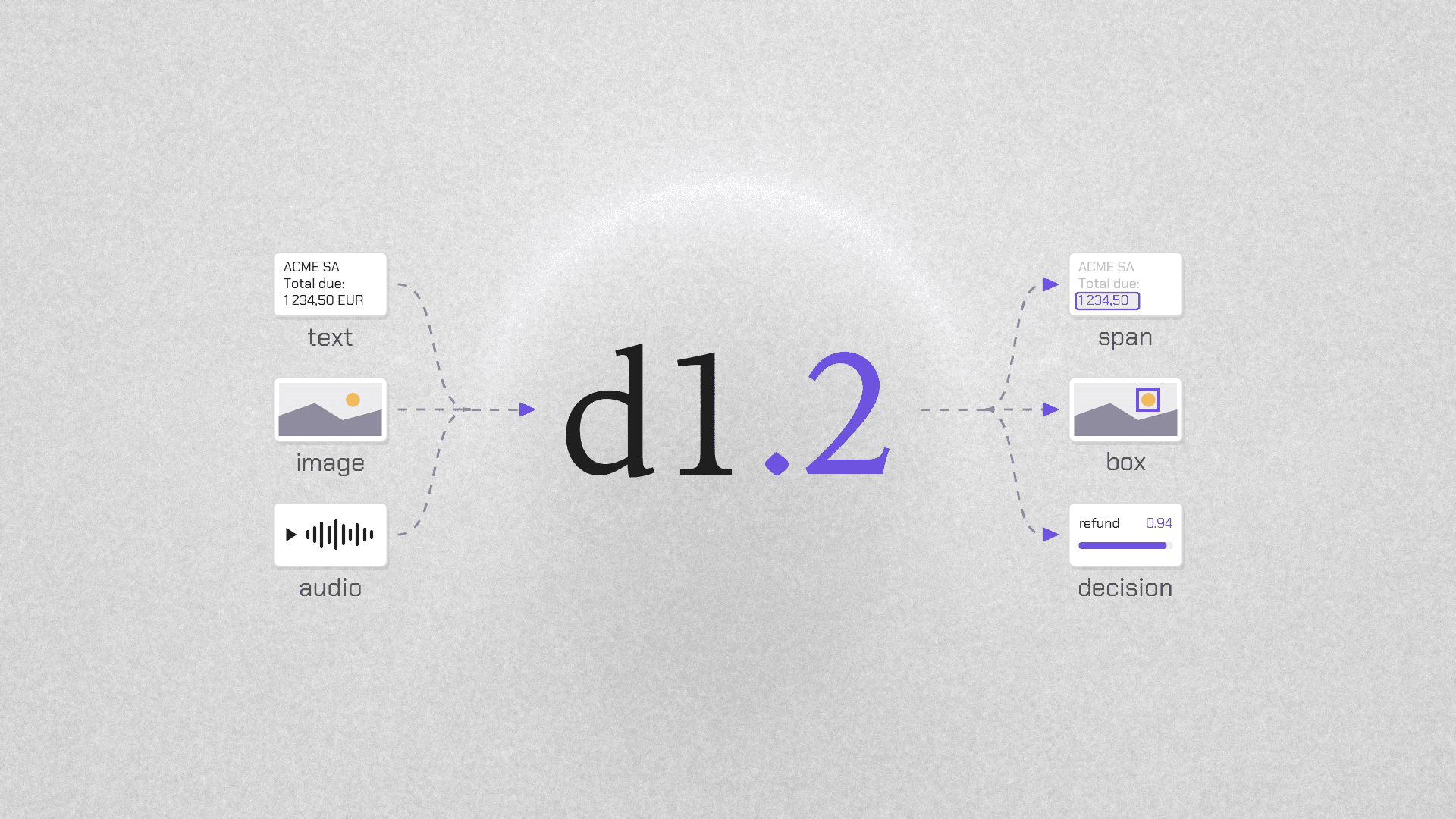
Today, we release d1.2 and d1.2-ultra, the new versions of our decision models, now supporting audio input and five new tasks. In addition, d1.2-ultra ranks first among decision models on the Artificial Analysis Decision Index v2.1.
Both models are available today on the Liquid API, at $0.02 for d1.2 and $0.042 per million input tokens for d1.2-ultra.
d1.2 and d1.2-ultra add five new tasks to the API:
- Read a value from the input (text, number or date). Ask "How much is due?" about an invoice, and the model returns the correct value with the characters it read it from. If the invoice doesn't show the value, it answers "not found" instead of guessing.
- Find every passage of a kind in a text (spans). For instance, ask for every piece of personal data in a note, and the model returns each passage, such as a name, a phone number, and an email address, with its position in the text.
- Locate things in a picture (box for one, boxes for every instance). For example, ask where the signature is on a scanned form, and the model returns a rectangle around it (or "not found"). Ask for every tree in a photo, and it returns a rectangle around each tree and the count.
- Estimate a number (number with a range). Ask how many people are in a photo, and the model returns its best guess (like 12, for example) and a range (like 10 to 14).
- Pick every option that applies (choice with multiple set to true). Ask which topics a support message raises, and the model returns each topic that applies, such as billing and delivery, each with its own probability.
d1.2 and d1.2-ultra also take audio as input. This audio input can be what you ask about, for example which language someone speaks or whether there is a siren in the background. The question itself can also be a recording, spoken instead of typed.
Artificial Analysis Decision Index
The Artificial Analysis Decision Index v2.1 evaluates decision models on six benchmarks, from decisions and extraction on resumes, receipts and research papers to tool calling and hard knowledge questions. It also scores the probability a model assigns to each answer, so a confident wrong answer costs more than a hesitant one.
d1.2-ultra scores 75, the highest on the index and two points ahead of the previous best decision model.
Both models also give the best score for their cost. On the Decision Index v2.1, no model scores higher than d1.2 for less money, and no model scores higher than d1.2-ultra at any price.
Calibration
The probabilities provided by a decision model are only useful if they're correct. When it says 80%, it should be right about 80% of the time, which lets you set a threshold. For example, you can automatically send tasks where the model has low confidence to human review.
Calibration error measures the gap between a model's predicted probability and how often it is right. Across 13 benchmarks and 22,505 questions answered by all five models, d1.2-ultra's calibration error is 0.8 points, compared with 1.2 for d1.2, 2.7 for Jev 1.14, 3.7 for Perplexity's Decider v1.3, and 7.2 for GPT-6 Luna on its Decisions API.
Accuracy on the new tasks
No public benchmark measures the five new tasks yet, so we evaluated them on internal test sets built from held-out splits of public datasets. In these internal benchmarks, a read or a box counts as right when it finds the target, or says "not found" when the target is absent.
| Task | d1.2-ultra | d1.2 |
|---|---|---|
| Read a value from a receipt ( CORD , SROIE ) | 98% | 96% |
| Find every piece of personal data in a document, precision / recall ( Nemotron PII ) | 94% / 93% | 92% / 88% |
| Locate an object described in a photo ( RefCOCO , RefCOCO+ , RefCOCOg ) | 94% | 94% |
| Estimate the number of objects in a photo, within one ( COCO ) | 93% | 92% |
| Pick every object present in a photo ( COCO ) | 87% | 90% |
Read a value from a receipt (CORD, SROIE)
Find every piece of personal data in a document, precision / recall (Nemotron PII)
Locate an object described in a photo (RefCOCO, RefCOCO+, RefCOCOg)
Estimate the number of objects in a photo, within one (COCO)
Pick every object present in a photo (COCO)
On held-out recordings, both models answer 95% to 97% of questions about which sound they hear (ESC-50) or which language is spoken (FLEURS, 43 languages). Each question offers three to six options, with close confusions such as Spanish and Portuguese among them, or asks a yes-or-no question.
Availability and pricing
Call the models as d1.2-ultra and d1.2 on the Liquid API, with a key from console.liquid.ai (Dashboard > API Keys).
The new answer types use the same endpoint and request format. This example reads three values from an invoice and asks for a fourth that the invoice doesn't state.
        import os, requests

invoice = "ACME SA\nInvoice 2026-117\nTotal due: 1 234,50 EUR\nPay before 03/04/2026 (day/month/year)"

response = requests.post(
    "https://api.liquid.ai/decisions/v1/systemone",
    headers={"Authorization": f"Bearer {os.environ['LIQUID_API_KEY']}"},
    json={
        "model": "d1.2-ultra",
        "state": invoice,
        "questions": {
            "payee": {"type": "text", "instructions": "Who issued the invoice?"},
            "total": {"type": "number", "instructions": "How much is due?"},
            "due": {"type": "date", "instructions": "By when must it be paid?"},
            "vat": {"type": "number", "instructions": "How much VAT is charged?"},
        },
    },
)

a = response.json()["answers"]
print(a["payee"]["text"], a["total"]["number"], a["due"]["date"], a["vat"]["number"])
# ACME SA 1234.5 2026-04-03 None
The full API reference is in the decision models documentation.
Both models bill input tokens only. An image costs 1.5 tokens per 32x32-pixel patch at the text rate, so a 1024x1024 image costs 1,536 tokens. A request bills its text and pictures once, and each extra question adds only its own text. Coming to OpenRouter and Vercel soon.
Citation
For citations, please use the following reference or BibTeX:
Liquid AI, "d1.2: State-of-the-Art Omnimodal Decision Models", Liquid AI Blog, Nov 2026.
        @article{liquidAI2026d1.2,
  author = {Liquid AI},
  title = {d1.2: State-of-the-Art Omnimodal Decision Models},
  journal = {Liquid AI Blog},
  year = {2026},
  note = {www.liquid.ai/blog/d1-2},
}