 Newshot

Crypto and AI super PACs spent $250 million trying to hand-pick the next Congress. But in the races where that money could actually make a difference, most of it backed candidates who lost — though you wouldn’t know it from what the industries are saying.
The most expensive loss came in the Ohio Senate special election to fill the seat vacated by JD Vance. In 2024, when Sherrod Brown lost his Senate seat, the crypto industry’s flagship Fairshake super PAC took credit almost immediately: “thanks to our efforts, he will be leaving the Senate.”1 This year, after the industry spent $64 million to keep him from returning, Brown won anyway and Fairshake has had much less to say.
For a race-by-race rundown of the results, see my [noted] post from November 4
Crypto pads the scorecard
The closest thing to a victory lap was a statistic a Fairshake spokesman handed to one industry newsletter. Crypto In America wrote that the network backed winners in 86 of the 93 races it spent in, “a roughly 92% success rate.”2
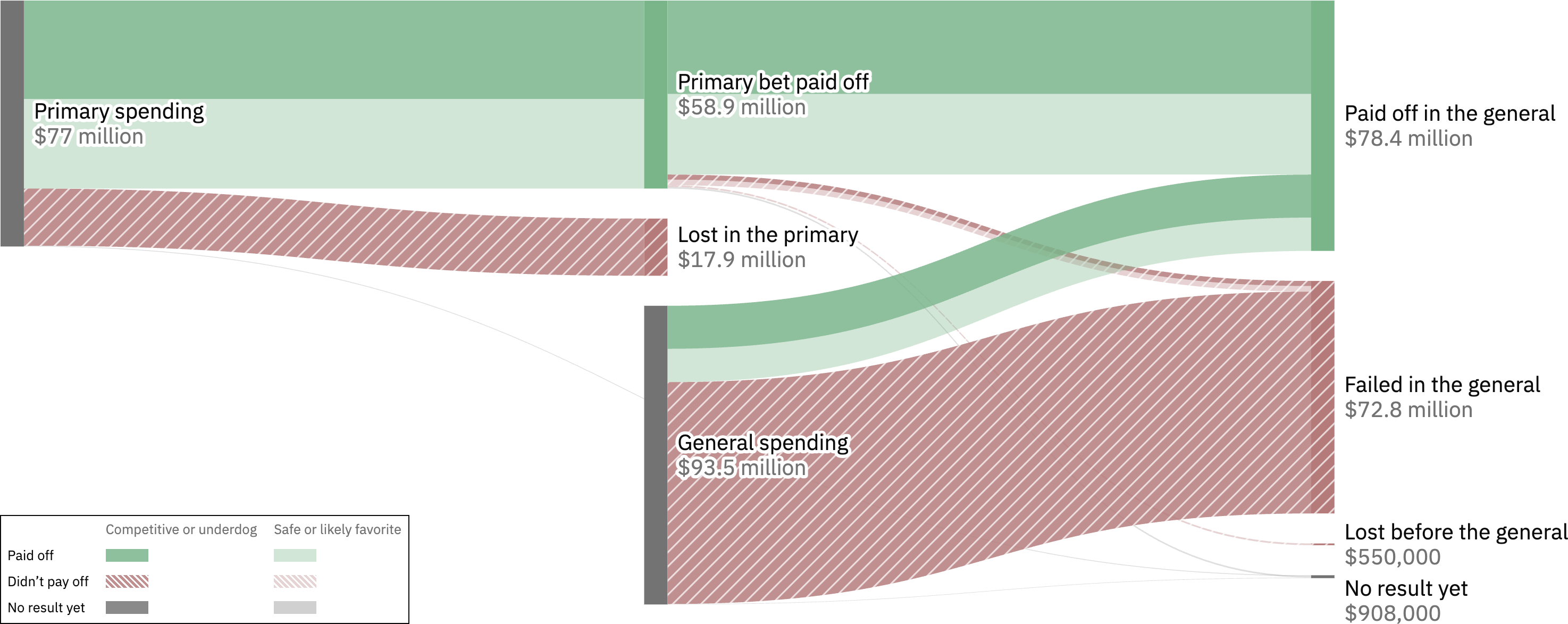
That number is much less impressive than it sounds. As I’ve written before, crypto PACs rely on a “back the winners” strategy: spreading relatively small amounts of money across races their candidates were always going to win anyway, to reward loyalty to the industry and pad the PACs’ win rates. It’s the same move Fairshake made after the last election, when it pointed to a claimed 91% win rate in 2024 as proof that “the voters last year were clear”.3 This time, Fairshake went 74 for 74 in races where its candidate was a clear or likely favorite, but just 10 for 18 in races that were actually competitive. At the end of the day, about half of the $154.5 million it spent had backed candidates who lost. Much of these PACs’ leverage in Congress stems from lawmakers’ fear of their dominance, but that dominance is now significantly diminished.
Crypto’s best results were in the primaries. Industry super PACs spent $48.5 million in competitive primaries and runoffs. $30.8 million of it backed winners including Republicans Barry Moore (AL) and Andy Barr (KY) and Democrats Christian Menefee (TX), Adrian Boafo (MD), and Jasmine Clark (GA). But the PACs notched some major losses, too: $10.3 million in a failed attempt to defeat Democrat Juliana Stratton in the Illinois Senate race, $2.5 million against Democrat La Shawn Ford in Illinois’ 7th District, and $2.1 million against Democrat Oliver Gilbert in Florida’s 24th District [I103]. All three won in November.
As I wrote at the time, it was unclear whether those rebukes previewed a voter backlash against heavy tech spending, or whether they just spent against strong candidates. November brought a clearer answer.
In the general election races that were actually competitive, Fairshake lost three of the four. Those three losses — Republicans Jon Husted in the Ohio Senate race, Bill Huizenga in Michigan’s District 4, and Bryan Steil in Wisconsin’s District 1 — accounted for $58.6 million of crypto’s $170 million in midterm spending. Its one competitive win was in the Nebraska Senate race, where it spent almost $13.5 million to oppose independent Dan Osborn in his race against incumbent Pete Ricketts, whose seat on the Senate Banking Committee drew crypto’s support.
These three losses are painful for crypto. Brown chaired the Senate Banking Committee until his 2024 defeat, and the industry was euphoric about removing him from one of the most powerful oversight posts. Tyler Winklevoss, co-founder of the crypto exchange Gemini, celebrated the ouster of a “crypto public enemy” and “Elizabeth Warren co-conspirator.”4 Brown is not expected to retake his Senate Banking chairmanship, which might sound like good news for crypto — except that Warren looks likely to take the spot. Brown may well end up heading the Senate Agriculture Committee, which oversees the CFTC: the regulator crypto has spent the last two years trying to put in charge of its industry.5
The House losses also cost crypto two of its most useful allies. Huizenga, the vice chair of the House Financial Services Committee, lost to Democrat Sean McCann. Steil, who chairs the committee’s digital assets subcommittee, lost to Democrat Mitchell Berman. Next year, House Financial Services will likely be run by Maxine Waters,6 who is reportedly already working to expand her “Crypto Investor and Consumer Bill of Rights,” originally proposed as an amendment to the Clarity Act, into a full market structure bill of her own. The consumer protection focus alone suggests the industry won’t like it, but she’s also expected to fold in many of the Senate Democrats’ proposed Clarity amendments, which focused on enforcement and on ethics provisions aimed at the president.7
Fairshake wasn’t the only crypto PAC that had a bad night. The Winklevoss-funded, explicitly pro-MAGA Digital Freedom Fund spent all of its $9 million across three Senate races, and lost all three. Most of it went to Ohio, where it added to Fairshake’s spending with its own $7.5 million to oppose Brown and support Husted. It also spent about $870,000 trying to stop James Talarico and boost Ken Paxton in Texas, and about $700,000 against Josh Turek and for Ashley Hinson in Iowa. First Principles Digital, a crypto PAC linked to Senator Cynthia Lummis, went 0 for 2: it spent $810,000 backing Mike Rogers against Abdul El-Sayed in Michigan, and $200,000 trying to unseat Democratic Representative Shomari Figures in Alabama’s 2nd District, a crypto ally the industry had helped elect in 2024. Across all crypto super PACs, they went one for six in competitive general election races. Of the $82.2 million that was spent on these races, 84% of it was spent on the losing side. In races rated safe or likely, they spent $9.1 million and went 29 for 29.
Now in fairness, this was a Democratic wave year, and some of these candidates might have lost regardless. But the crypto industry made little effort to prepare for that possibility. In 2024, even as many in the industry were confident Trump would win and Republicans would perform well in congressional elections, Fairshake still spent heavily on Democrats, including more than $10 million each to help elect Elissa Slotkin in Michigan and Ruben Gallego in Arizona. This cycle, despite polls predicting varying degrees of a Democratic wave for months, crypto went the other way. Outside of primaries, crypto super PACs did almost no significant spending to help Democrats. And the industry added new, explicitly partisan PACs this cycle. The Winklevoss-funded Digital Freedom Fund pledged to back “pro-Trump, pro-crypto champions” and to “stop Democrats from sabotaging the President’s agenda”;8 the Cynthia Lummis-linked America First Digital network vowed to elect Republicans to give the industry a “trusted and effective voice”.9 And despite Fairshake’s continual insistence that it’s bipartisan, its spending told a different story. It might have helped if the PAC had opposed even a single Republican in a Senate race, an industry source told CoinDesk.10 Instead, crypto tied itself to the party that was about to lose, and is now hoping to convince everyone that it won.
AI’s warring factions
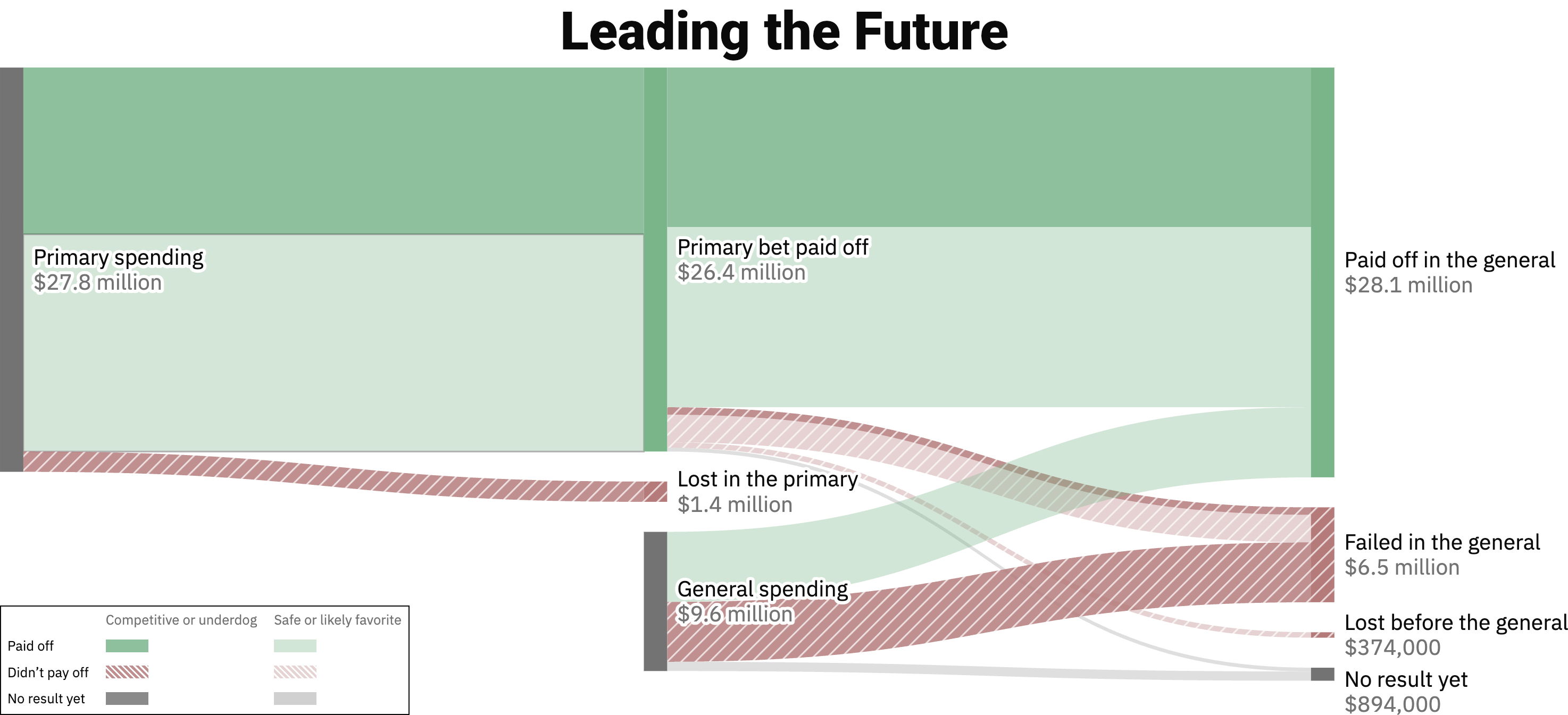
The AI industry’s super PACs, which spent about $80 million this cycle, had problems too, though somewhat different ones. The Leading the Future network, funded by Andreessen Horowitz and OpenAI’s Greg Brockman, followed the same back-the-winners strategy as Fairshake. In the primaries, where it spent $27.8 million, only seven of 37 races were competitive. But its big win, in New York’s District 12, was a costly one. It spent $8.2 million opposing Democrat Alex Bores, who ran on a platform of “AI safety”, only for Bores to lose to Micah Lasher, who campaigned on the same. All that money didn’t even buy the network an ally.
And the race mostly served to draw attention to how much AI super PACs were willing to spend to influence elections, further galvanizing voters already worried about AI and data centers in their communities. Backlash reached the PAC’s donors: Greg Brockman reportedly canceled a planned second $25 million donation amid pushback from OpenAI employees,a and venture capitalist Ron Conway, the network’s only publicly known Democratic funder, said he wouldn’t contribute again.11
That backlash likely explains why the PAC largely sat out the general election: despite announced plans to dump $125 million into the midterms,12 it ultimately spent less than a third of that. In the general election, it spent just under $10 million to back 21 sure winners. It supported only a single candidate in a competitive race: Darline Graham, who lost her South Carolina Senate race despite $4.8 million in support from the network — its largest general election expenditure and second largest overall.
A late entrant to the spending was the conservative, pro-AI Alliance for a Better Future, which advocates for “build[ing] superintelligenceb for American families, shaped by American faith, and securing our American freedoms.”13 Its advisory council lists members from groups including the Heritage Foundation, the NCOSE anti-pornography organization, and the effective altruist-aligned Future of Life Institute.c Its only participation came during the general election, where it spent $2.1 million on four Republican Senate candidates, all of whom lost: Mike Rogers in Michigan, Susan Collins in Maine, Ashley Hinson in Iowa, and Roger Marshall in Kansas.
The two factions of pro-AI super PAC spending
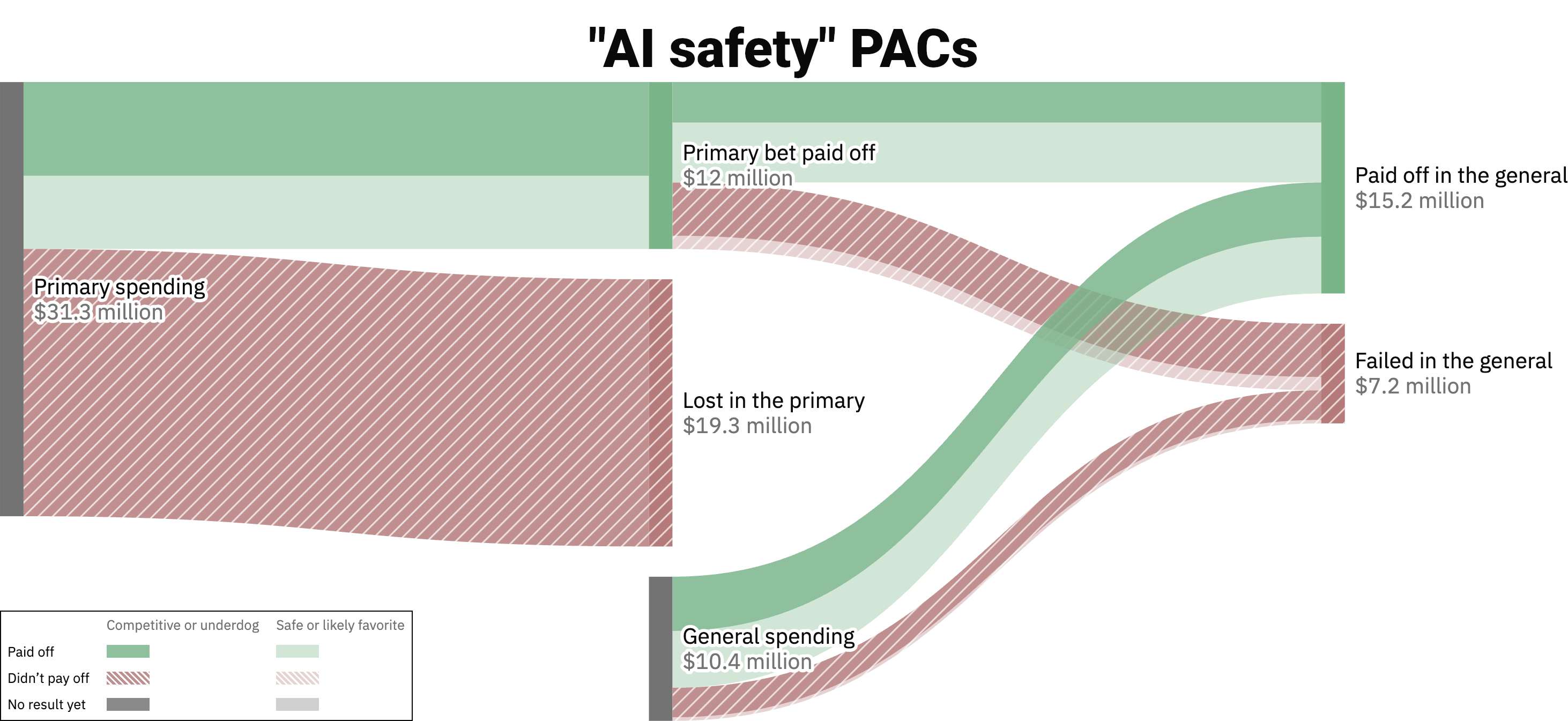
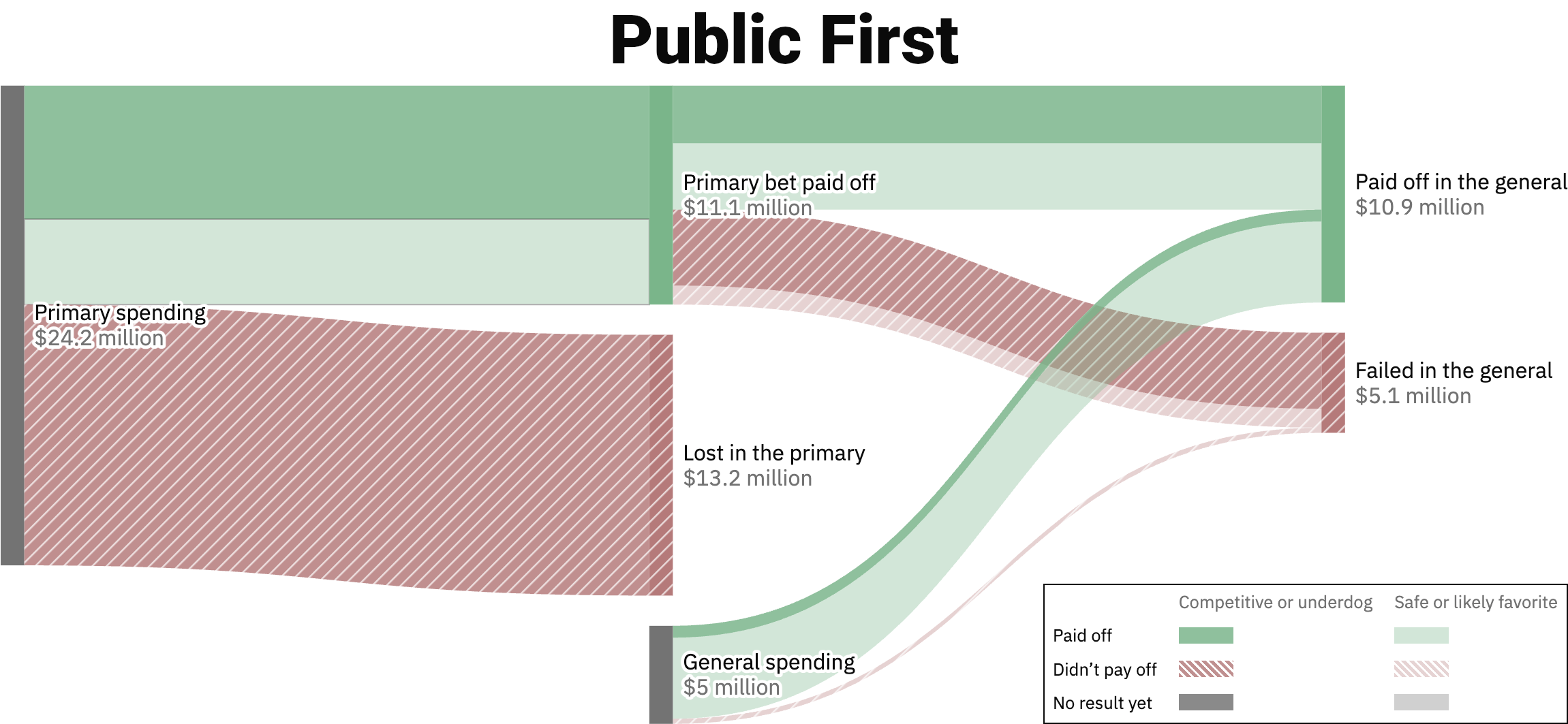
AI-focused PACs are far more fragmented in strategy than the crypto industry’s PACs. While the Leading the Future network and Alliance for a Better Futured represent the interests of AI companies that want to see little regulation, a handful of PACs emerged to oppose them and advocate for what they describe as “AI safety”.e The Public First network, funded mostly by a dark money group backed by Anthropic, spent $13.2 million of its $24.2 million in primary spending to back Alex Bores, who lost. Like Leading the Future, Public First largely stayed out of the general election, spending just $5 million across four races. Its clearest win came in California’s District 11, where it spent $4.7 million to back Democrat Scott Wiener and oppose his Democratic opponents, Connie Chan and (in the primary) Saikat Chakrabarti. Wiener earned their support through his AI regulation credentials in the state senate, where he authored SB 1047 (a frontier AI regulation bill vetoed in 2024) and its narrower successor SB 53 (which became law).
Public First co-founder Brad Carson boasted of the network’s “crushing blow to the AI industry’s anti-regulatory efforts”, and the group drew some flattering coverage for its claim that 10 of the 17 congressional candidates it backed won their races.11 But like Fairshake, Public First is overstating things by counting races rather than dollars. Following its spending through the whole cycle, only about $10.9 million of its $29.2 million helped winning candidates. Most of the rest went to Bores, and about $5 million went to candidates who won their primaries only to lose in November, like Republican Rhett Marques in Alabama’s 2nd District, whom the network spent $960,000 boosting in his primary.
The one AI-focused PAC that fared better in the general was the much smaller Guardrails Alliance, which describes itself as a group of “workers, organizers, policy experts, and everyday people who believe the most powerful technology ever built shouldn’t be controlled by a handful of unaccountable billionaires.”14 $3.3 million of its $3.6 million in spending went to five competitive general election races where it mostly opposed pro-AI candidates, and it succeeded in all five, spending against Republican Aaron Flint in Montana’s District 1, Republican Jay Feely in Arizona’s District 1, Democrat Jimmy Gomez in California’s District 34, Republican Laurie Buckhout in North Carolina’s District 1, and Republican Jon Husted in Ohio’s Senate race.
Don’t say crypto
Publicly, the crypto industry insists voters are on its side. In 2024, it worked tirelessly to promote the claim that a bloc of single-issue “crypto voters” would emerge [Voter issue]. This cycle, as the industry was pressuring Congress to pass the Clarity Act, Coinbase-linked advocacy group Stand With Crypto warned that its “millions” of “advocates” would be watching senators’ votes and “ready to cast their ballots accordingly”.15
But the industry’s ad strategy told a different story. As in 2024 [I47, 2024 spending], the industry seemed to recognize its ads would work better if voters never learned crypto was behind them. Of the 57 crypto super PAC ads I tracked this cycle, only three mentioned crypto, all of them from the Cantor Fitzgerald-funded Fellowship PAC in its handful of ads supporting Democrats. The industry’s flagship super PAC, Fairshake, which spent more than $150 million, didn’t mention crypto in a single one.
Most ads instead focused on issues their sponsors knew would actually resonate with voters. Ads supporting Republicans tended to highlight Trump endorsements and focus on issues like immigration. Those supporting Democrats promoted how candidates would stand up to Trump, and focused on issues like the cost of living and healthcare. The unctuousness was on full display in ads from Republican- and Democratic-focused arms of the same network that told two different stories: Fairshake’s Democratic arm assured voters that Georgia Democrat Jasmine Clark would fight MAGA and talked up her history of “block[ing] MAGA’s attacks on Black history in our schools” while its Republican arm ran an ad promising that Kentucky Republican Andy Barr would “stand up to Washington radicals” and “deliver the America First agenda”.
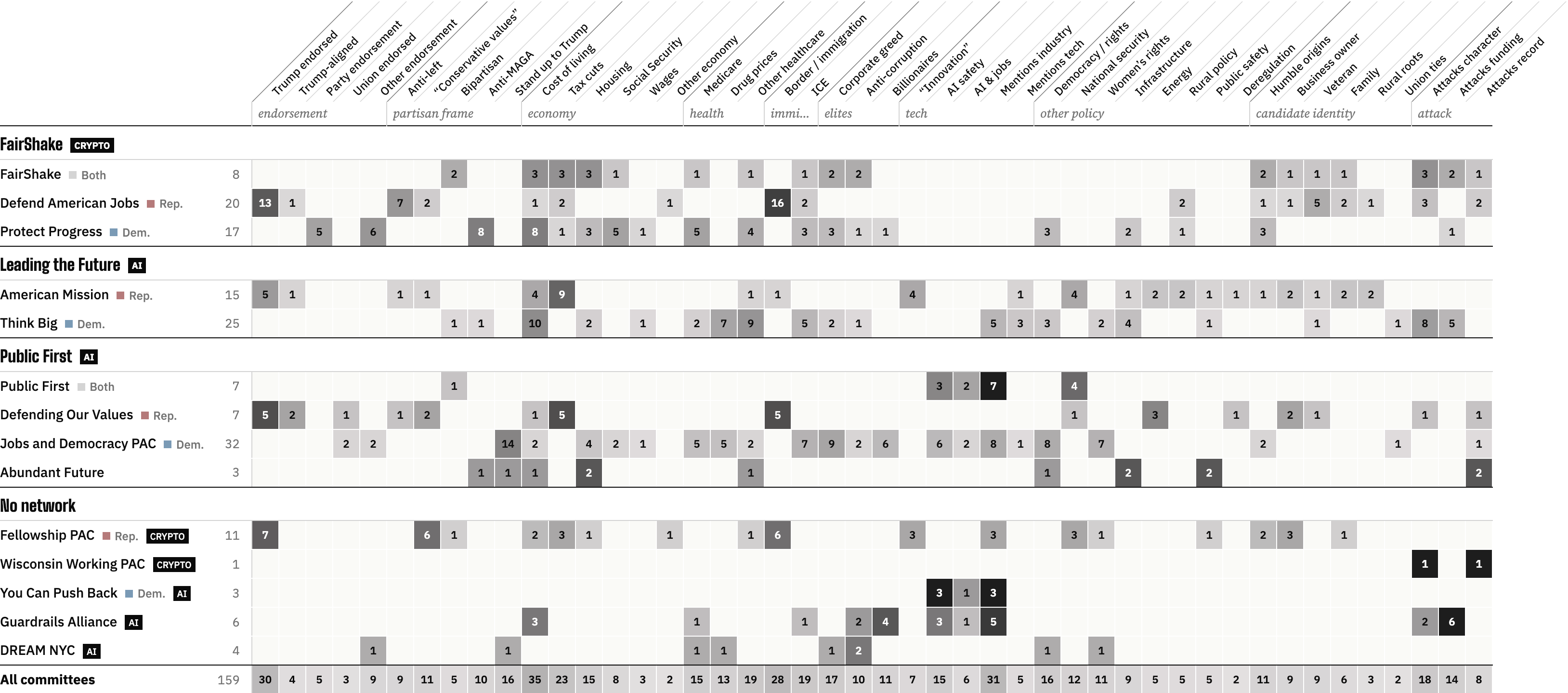
AI-focused PACs were somewhat more willing to name their industry, in 28 out of 102 tracked ads. But those ads were almost exclusively run by the super PACs calling for AI regulation. Most warned of the dangers of AI to emphasize the need for safeguards, and some were explicitly negative about the technology: speaking of AI as a surveillance tool, job killer, threat to democracy, or threat to humanity itself. The other 74 didn’t mention AI at all, instead focusing on whatever issue might win over voters. In Texas’ redistricted 9th District, an ad by Public First’s Republican arm touted Republican Alex Mealer’s endorsement by the Border Patrol union and promised she would “Remove the illegals. Seal the border.” But just a few hours north, an ad by Public First’s Democratic arm to support Colin Allred in Texas’ District 33 advertised him as “one of the strongest voices against Trump’s deportation agenda” who would “push to overhaul ICE”.
Leading the Future, the network opposing stronger AI regulation, mentioned the industry only in its primary race attack ads targeting Alex Bores in New York’s District 12, where AI had unavoidably become a part of the conversation. Four of the five ads attacked Bores for working for Palantir, highlighting the company’s work as an ICE contractor, even though Leading the Future is funded in part by Palantir co-founder Joe Lonsdale. Everywhere else, Leading the Future followed Fairshake’s lead, leaving its industry out of the ads entirely in favor of whatever it thought voters wanted to hear.
Heads we win, tails it doesn’t count
The AI industry’s PACs managed to declare victory from both sides. Public First’s Carson called the results “a crushing blow to the AI industry’s anti-regulatory efforts”.11 A Leading the Future spokesperson, meanwhile, said their group was “proud that many of the pro-innovation champions we supported this cycle won on Tuesday”, a claim that, like Fairshake’s, depends largely on the 21 sure winners it backed in the general election. The spokesperson also promised a “multi-cycle effort”, warning that “2028 will show who actually cares about passing a national regulatory framework on AI and who wants to politicize an issue that’s extremely consequential to the future of our country.”16 That’s certainly a brazen statement from a super PAC network that spent $8.2 million trying to defeat a single primary candidate.
Crypto’s Fairshake struck a similar note. “Fairshake played a meaningful role in winning competitive races across the country in 2026 and we will do it again in 2028,” the PAC told Bloomberg17 — a characterization that’s again hard to square with my numbers above. “Newly elected and current members will have a choice: protect consumers and American jobs or fight progress,” it continued. “We will be watching and ‘28 is a new map.”
Compared to 2024’s victory laps on social media and in press releases, crypto and its executives have been noticeably quieter since election night. This year, Coinbase CEO Brian Armstrong spent the day after tweeting about how his company handled a group of scammers running a bogus giveaway on a restream of Tesla’s flying car stunt.18 This was a strong departure from 2024, when he posted tweet after tweet about how “the crypto voter has spoken decisively”19 and “being anti-crypto is simply bad politics.”20
One of the few post-election public statements came from Coinbase’s VP of US Policy, Kara Calvert, in a Twitter thread that drew little attention.21 “The election wasn’t a referendum on crypto,” she insisted. It’s a remarkable position after the industry just spent $170 million on the midterms. Crypto PACs certainly didn’t shell out $64 million in Ohio because they thought the race had nothing to do with crypto.
“Crypto is 100% bipartisan,” she continued, perhaps hoping that people would simply not notice that nearly three quarters of the industry’s money backed Republicans, or that new PACs emerged promising to “stop Democrats from sabotaging the President’s agenda”8 and emphasizing the need to “stand with President Trump” and ensure Republicans are “at the helm”.9
Calvert ended by arguing that “Our playbook doesn’t need to be thrown out.” Regardless of her protests, my guess is it’s about to be rewritten anyway. Crypto and AI spent the last two years cozying up to a Republican trifecta. In January, they’ll be lobbying a Democratic Congress, potentially with Elizabeth Warren running Senate Banking and Maxine Waters at the head of House Financial Services. Stay tuned for another issue soon about what that pivot might look like, and why I expect AI to pull it off more convincingly than crypto.
Fairshake, the Fellowship PAC, Public First, and the Alliance for a Better Future did not respond to requests for comment.
Methodology
Spending figures are independent expenditures or electioneering communications reported to the FEC by crypto- and AI-focused groups, as tracked at Tech Influence Watch, with data as of November 12. Figures have been updated since my November 4 post as more races were called, so some numbers differ slightly from those in that post.
Crypto groups include the Fairshake network (Fairshake, Defend American Jobs, and Protect Progress), Digital Freedom Fund, Fellowship PAC, and the America First Digital network. AI groups include the Leading the Future network (Leading the Future, Think Big, American Mission, and Building the Future), the Public First network (Public First, Jobs and Democracy PAC, Defending Our Values, and Abundant Future), You Can Push Back, Alliance for a Better Future, and Guardrails Alliance. There is a full list here.
General election races are rated using the Cook Political Report. Toss-up and Lean races count as competitive, Likely races as likely, Solid races as safe. Cook doesn’t rate primaries, so I rated those by hand using polling data. A bet “paid off” if a candidate a PAC supported won or a candidate it opposed lost. Primary and runoff spending is scored against the result of that round. When following money through the whole cycle, primary spending on a candidate who advanced is also scored against their general election result. Races that hadn’t been called at the time of writing are excluded from win-loss figures.
The ad analysis covers 57 crypto and 102 AI super PAC ads run through Google’s ad platforms, including YouTube, in 2026. TV, streaming, mail, and other social platforms aren’t included.
P.S. Coffeezilla just published “Investigating the President”, a video that draws heavily on my map of Trump’s crypto businesses and includes an interview with me. If you’ve ever wanted a guided tour of how the president and his family are profiting from crypto, it’s a great place to start.
It’s also a good example of how the research I do here goes well beyond the newsletter. I build projects like the map and Tech Influence Watch partly so that other journalists and creators can use them. And they do — in the past week alone, the Washington Post, Fortune, 404 Media, and others have drawn on Tech Influence Watch in their election coverage.
All of this is made by one person with no team, and paid subscribers are what allow me to do it. If you’ve found any of it useful, please consider subscribing.
Footnotes
- Unsurprisingly, the insistence that “no, this PAC isn’t funded by OpenAI, it’s only funded by OpenAI’s co-founder and president” was a distinction without a difference in the eyes of the public. ↩
- “Superintelligence” is the coinage President Trump is insisting should be used for “artificial intelligence”, and anyone who does not adopt it is “THE ENEMY”.22 ↩
- The Future of Life Institute disputes any connection to either the effective altruist or longtermist movements,23 but it’s widely associated with both: co-founder Jaan Tallinn is one of the biggest funders of EA-aligned “AI safety” work, and much of its money has come from the same donor networks.24 ↩
- Alliance for a Better Future presents itself as a group pushing for AI safeguards. However, CEO Janet Kelly has warned that a Democratic president would implement “heavy-handed regulation” and “smother[] it in red tape” or allow China to surpass the US in AI development. I group it with Leading the Future here because its positions align more closely with the deregulatory wing of the industry than with the “AI safety” PACs.25 ↩
- I put “AI safety” in quotes because it’s largely a branding exercise by the PACs and their funders. The rules they promote tend to focus more on speculative catastrophic risks rather than the harms people are already experiencing, whether it’s data centers in their communities or workplace surveillance. They happen to suit a company (Anthropic) that has built its brand on being the responsible AI developer. While these groups are sometimes presented as a counterbalance to the AI industry’s interests, they are really just a different faction. ↩
References
- “Crypto Lobby Secures Major Victory as Sherrod Brown Loses Senate Seat in Ohio”, Decrypt. ↩
- “First Tokenized Stock Venue Goes Live Under SEC Innovation Exemption, But Corporate America Isn't Sold”, Crypto In America. ↩
- “Crypto-focused PAC Fairshake amasses $141 million war chest ahead of 2026 elections”, The Block. ↩
- Tweet by Tyler Winklevoss. ↩
- “The crypto world braces for Liz Warren’s return. Has anything changed?”, Fortune. ↩
- “Launching chair bid, Waters targets crypto, prediction markets, private equity”, Politico. ↩
- “House Democrats Eye New Crypto Market Structure Bill As Party Prepares to Take Control of Congress”, Crypto In America. ↩
- Digital Freedom Fund website (archive). ↩
- America First Digital website (archive). ↩
- “What the election results mean for crypto: State of Crypto”, CoinDesk. ↩
- “AI Safety Advocates Make Gains After $110 Million Midterm Fight”, Bloomberg. ↩
- “OpenAI has good opening night in 2026 primary season”, Axios. ↩
- Alliance for a Better Future website (archive). ↩
- Guardrails Alliance about page (archive). ↩
- “Stand With Crypto: Senate’s Failure to Advance CLARITY Act Leaves Millions of Americans in Limbo”, Stand With Crypto. ↩
- “AI’s forever wars”, Politico. ↩
- “Crypto’s Megadonors Learn a Hard Election Day Lesson”, Bloomberg. ↩
- Tweet by Brian Armstrong. ↩
- Tweet thread by Kara Calvert. ↩
- “Trump says anyone who does not refer to AI as ‘super intelligence’ is ‘THE ENEMY’”, Politico. ↩
- Frequently asked questions, Future of Life Institute. ↩
- “Does bipartisan mean politically neutral? Invited influencers reflect on ‘pro-human’ rally organized by AI lobbying network”, Straight Arrow News. ↩
- “The Path To Securing President Trump’s Super Intelligence Legacy”, The Daily Wire. ↩
Have information? Send tips (no PR) to molly0xfff.07 on Signal or [email protected] (PGP).
I have disclosures for my work.