 Newshot
Original text(via HN AI)
Post
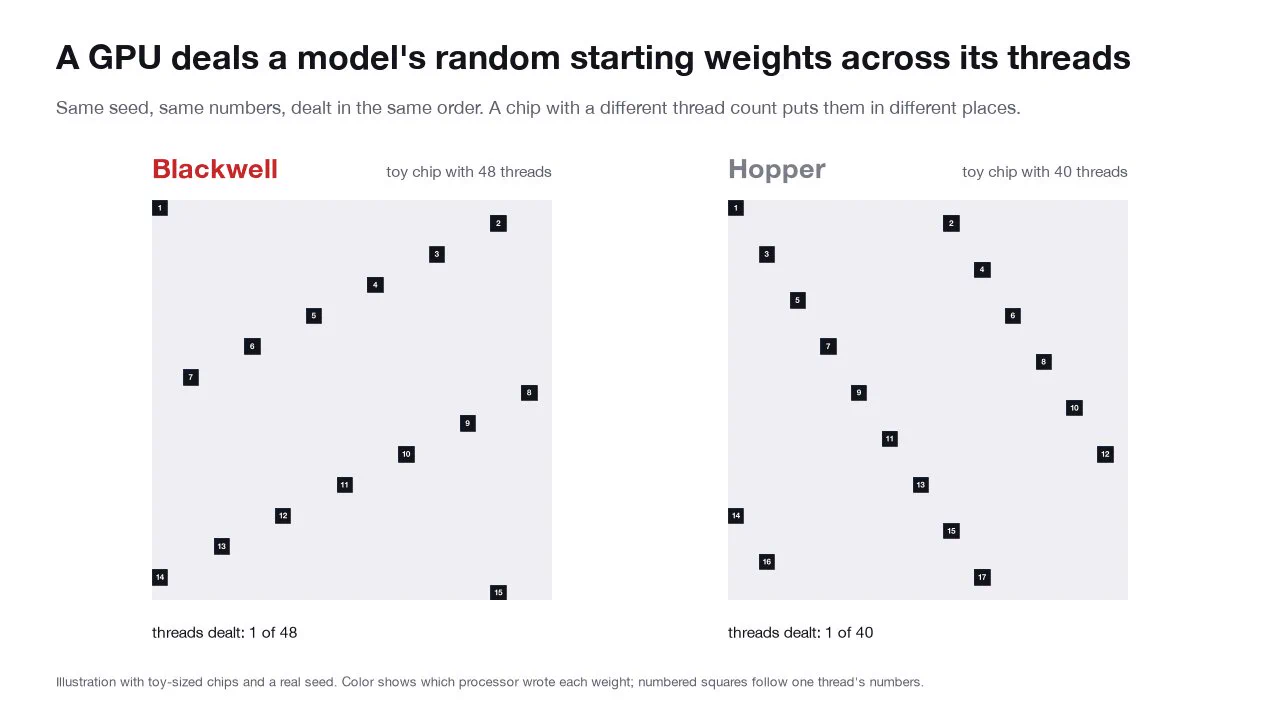
will depue on X: "I have a major result to share. I’ve found conclusive forensic evidence that the top 4 Chinese AI labs—DeepSeek, Moonshot, MiniMax and Ant Group—have built their newest models on NVIDIA’s most advanced Blackwell chips, which are barred from export to China. This sounds insane, but I discovered that almost every AI model carries a hidden signature of the GPU that trained it. When a model is first set up, the starting values of its weights are laid out in a pattern that depends on the exact GPU. Each combination of GPU and seed number produces a unique pattern—a sort of fingerprint of the hardware used to create the model. Traces of that pattern survive training into the published model. Again, this evidence isn’t based on any insider information or leaking. It’s based on a forensic analysis of the model weights released by the companies themselves. I searched more than six trillion combinations of chip layout and seed number and matched them to open-weights models. In doing so, I found conclusive evidence that six Chinese AI models—including DeepSeek-V4-Pro, Kimi K3, and MiniMax-M3—were initialized on NVIDIA Blackwell systems. Four of the models match Grace Blackwell, the GB200 and GB300 parts in NVIDIA’s flagship liquid-cooled rack-scale systems. I then verified these results on real hardware. Running unmodified PyTorch with the seeds I’d recovered, a Blackwell B300 reproduced DeepSeek-V4-Flash’s untouched starting weights bit for bit, and a rented GB200 reproduced Kimi K3’s to a correlation of 0.999995. A Hopper H100 reproduced none of DeepSeek-V4-Flash’s, and changing the seed by one broke the match. (DeepSeek’s seed is 953049583 by the way.) The method also was verified to match 24 known open-weights models to the hardware that developers said they used. It is exceedingly unlikely that these results are a coincidence. Across six trillion combinations, the best accidental match should reach only about 8 sigma (i.e., eight standard deviations above what random chance would produce). The real matches range from 49 to 1,385 sigma, and even the weakest single test hits 20. These were data-center-scale training runs. With some analysis of release schedules and model details, I estimate that the largest, Kimi K3 and DeepSeek-V4-Pro, used 2,000 to 3,000 Blackwell GPUs each. Clusters of this size cost on the order of $150 to $200 million each to buy, and across these labs alone would add up to more than half a billion dollars of export-controlled GPUs, not counting experimental compute or otherwise. It’s quite likely that we see multi-billion dollar expenditure on export-controlled GPUs. I am highly confident in this result, and it has been independently verified by senior researchers at OpenAI and Anthropic. You can read the full report at https://t.co/YOtzND0Jqk. There is much more I’ve identified about these models through other forms of checkpoint forensics like this, and will have more to share soon."
Conversation


- will depue@willdepueI have a major result to share. I’ve found conclusive forensic evidence that the top 4 Chinese AI labs—DeepSeek, Moonshot, MiniMax and Ant Group—have built their newest models on NVIDIA’s most advanced Blackwell chips, which are barred from export to China. This sounds insane, but I discovered that almost every AI model carries a hidden signature of the GPU that trained it. When a model is first set up, the starting values of its weights are laid out in a pattern that depends on the exact GPU. Each combination of GPU and seed number produces a unique pattern—a sort of fingerprint of the hardware used to create the model. Traces of that pattern survive training into the published model. Again, this evidence isn’t based on any insider information or leaking. It’s based on a forensic analysis of the model weights released by the companies themselves. I searched more than six trillion combinations of chip layout and seed number and matched them to open-weights models. In doing so, I found conclusive evidence that six Chinese AI models—including DeepSeek-V4-Pro, Kimi K3, and MiniMax-M3—were initialized on NVIDIA Blackwell systems. Four of the models match Grace Blackwell, the GB200 and GB300 parts in NVIDIA’s flagship liquid-cooled rack-scale systems. I then verified these results on real hardware. Running unmodified PyTorch with the seeds I’d recovered, a Blackwell B300 reproduced DeepSeek-V4-Flash’s untouched starting weights bit for bit, and a rented GB200 reproduced Kimi K3’s to a correlation of 0.999995. A Hopper H100 reproduced none of DeepSeek-V4-Flash’s, and changing the seed by one broke the match. (DeepSeek’s seed is 953049583 by the way.) The method also was verified to match 24 known open-weights models to the hardware that developers said they used. It is exceedingly unlikely that these results are a coincidence. Across six trillion combinations, the best accidental match should reach only about 8 sigma (i.e., eight standard deviations above what random chance would produce). The real matches range from 49 to 1,385 sigma, and even the weakest single test hits 20. These were data-center-scale training runs. With some analysis of release schedules and model details, I estimate that the largest, Kimi K3 and DeepSeek-V4-Pro, used 2,000 to 3,000 Blackwell GPUs each. Clusters of this size cost on the order of $150 to $200 million each to buy, and across these labs alone would add up to more than half a billion dollars of export-controlled GPUs, not counting experimental compute or otherwise. It’s quite likely that we see multi-billion dollar expenditure on export-controlled GPUs. I am highly confident in this result, and it has been independently verified by senior researchers at OpenAI and Anthropic. You can read the full report at unemploymentlabs.com/checkpoint-for…. There is much more I’ve identified about these models through other forms of checkpoint forensics like this, and will have more to share soon.9:29 PM · Nov 12, 2026·47.8KViews99
- will depue@willdepue23mIf you’re unfamiliar with how machine learning works: an AI model is truly just a very long list (billions, sometimes trillions) of numbers called weights, which, loosely, when multiplied and added together produce readable text. Training adjusts those numbers over and over 2will depue@willdepue23mA second test with a photo of me. I took a model’s ordinary random starting weights and arranged them once so that they show the photo. Then I trained the model and kept the arrangement fixed. The photo fades but the sky and the treeline can still be made out at the end.GIF1will depue@willdepue23mThe random numbers a model starts with aren’t truly random. They come from a formula that starts from one starting number called the seed, and using the same seed gives the same numbers every time. Engineers set it up this way so they can repeat an experiment. To fill billions GIF1will depue@willdepue23mThat means I can take a published model, pick a chip and a seed, generate what the starting weights would have been and compare them to the real ones. With the right chip they line up and with the wrong chip they don’t. This is that search on DeepSeek-V4-Flash. Every processor count gives noise until 148 (Blackwell), where the weights match.GIF1will depue@willdepue23mCritically, MiniMax and Ant have not been publicly tied to Blackwell before. MiniMax’s models match Hopper through M2.7 in April and Blackwell from M3 in June. Ant’s own GitHub has benchmark logs from a GB300 dated March 31.1will depue@willdepue23mOf course, this tells us nothing about where these chips physically are. They could have been smuggled into China or the labs are using them abroad through gaps that Congress has not closed. In either case, it’s clear that the export bans are deeply failing.1will depue@willdepue23mUnfortunately, it’s of note that now that this is public any lab can erase many of these signatures. I’ve thought hard about whether to release this, and have been sitting on it for a while, but after consulting with advisors and corresponding with officials, I’ve decided it’s worth sharing today. I haven’t made this decision lightly.1will depue@willdepue23mIf you’re interested in covering this story, please reach out to [email protected]. I’m happy to share more details. Multiple senior researchers, both independent and inside frontier AI labs like OpenAI and Anthropic, have confirmed the result.1will depue@willdepue23mFor researchers, I’ll be sharing a GitHub repo and full paper soon with implementation details. You should be able to trivially replicate this fact from the details in this thread alone if you give this to Claude/Codex. Feel free to DM me with any questions.1will depue@willdepue23mThere is much more I’ve identified about these models through other forms of checkpoint forensics like this, and will have more to share soon. Stay tuned.1




- Molly Cantillon@mollycantillon19mValidates what I think is an open secret! Nice job Will1
