 Newshot

自变量 Releases WALL-API-1.0, Topping Astra on Mainstream Leaderboards and Raising the Banner of Embodied AI "Pretraining"
2026-11-23 16:55
The world has only told half the story of Da Vinci painting eggs.
The textbook version is a narrative of diligence: his teacher Verrocchio had him draw eggs for three years. The other half is rarely mentioned—what those three years honed was not patience, but intuition. Afterward, when he painted muscles, water flows, and flying machines, he relied on exactly this basic skill of understanding at a glance.
That is how robots should be trained, too: first accumulate intuition, then tackle tasks never seen before. But the industry has long done the reverse—teaching task by task, only when the moment arrives.
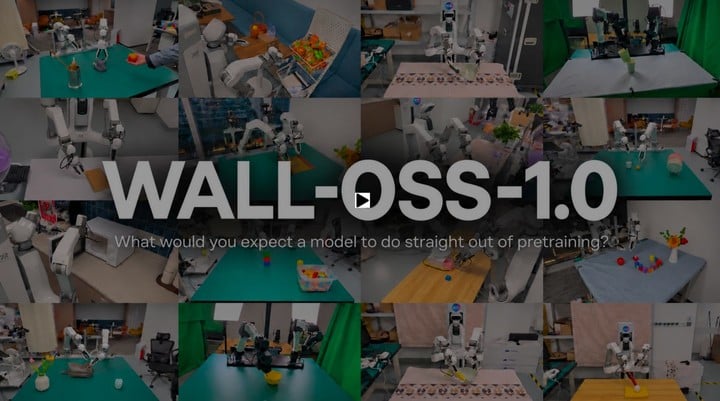
Just now, 自变量 officially released its first embodied foundation model, WALL-API-1.0, and the new model backing it, WALL-OSS-1.0, is built precisely to solve this problem.
WALL-OSS-1.0 is a substantially overhauled generation of 自变量's previous embodied foundation model, WALL-OSS-0.5.
According to officially released figures, WALL-OSS-1.0 achieved a 55.1% zero-shot success rate in open-ended real-robot evaluations; in another set of real-robot evaluations, the model without task fine-tuning scored 70.8% higher overall than π0.5, which had undergone multi-task fine-tuning. At the same time, the model ranks first in the single-model track of the RoboDojo simulation benchmark.
Currently, WALL-API-1.0 already offers the WALL-OSS-1.0 model family for researchers and enterprises worldwide to call. A top-tier capability model that is "ready out of the box" in API form marks embodied AI's move toward standardization and industrialization, becoming the "water, electricity, and gas" that can reach thousands of industries.
API application link: https://x2robot.com/docs/quantax1pro/v1/model-development/wallx-api/api-usage-instruction
Technical blog: https://x2robot.com/blog/wall-oss-1
Back to the core model of WALL-API-1.0—WALL-OSS-1.0: in short, 自变量 is trying to give robots a "general education" through large-scale pretraining, so they first master reusable foundational capabilities and then adapt to ever-changing specific tasks. The infer-one-from-another ability that humans take for granted is exactly the "big result" embodied AI wants to achieve.
Why must robots' general education start with pretraining?
In the past, many vision-language-action models—VLA—were accustomed to training a vision-language model first, then adding robot action data.
This route lets robots recognize objects, understand scenes, and follow instructions. The problem is that by the time action data enters, the model's foundational representation for understanding the world has essentially already been fixed.
For example, a vision-language model can recognize the cup on the table and understand the instruction to pick up the cup, but it may not clearly know how to contact the cup's wall, control gripper force, or how to adjust after a failed grasp.
After all, physical interaction in the real world involves a large amount of detail that is hard to grasp through watching and describing. Even for picking up a cup, an empty cup and a cup full of water require different operating forces, and position, material, and surrounding obstacles also change the action strategy.
What 自变量 changed this time is precisely when actions participate in training.
WALL-OSS-1.0 lets action data participate in learning from the pretraining stage, so that language, vision, and action jointly shape the way the model understands the world.
The model's first stage adopts a unified autoregressive training framework. Among them, VL Pretraining handles language understanding, visual recognition, and spatial reasoning; Action data handles robot action prediction; and Action VL bridges action and semantics, letting the model learn to describe actions, judge whether operations are correct, and identify and correct errors.
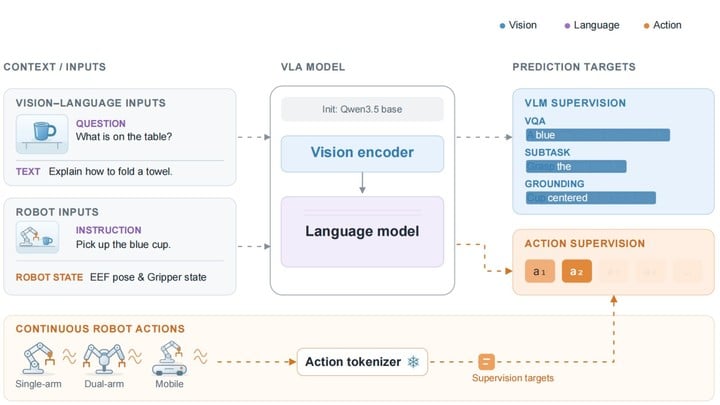
It is equivalent to the robot learning what an object is and what a task requires while also beginning to understand the connection between actions and task goals.
However, to make actions participate in unified training like text, one must also solve the problem that different robots' data come in different forms.
To this end, 自变量 improved its self-developed X-Tokenizer, compressing continuous action trajectories into discrete action Tokens that preserve motion information. You can think of it as establishing a common spoken language for actions across different robots, so that data generated by single-arm, dual-arm, and mobile robots can all enter a unified learning framework.
More interestingly, WALL-OSS-1.0 also changes the single use of action trajectories.
In the past, a segment of operation data was usually used only for imitation learning: humans demonstrate how to pick up a cup, and the robot copies it. Now, the same trajectory can serve multiple purposes at once—it can be used to predict actions from instructions, help the model understand the semantics of actions, evaluate whether operations are correct, and learn how to adjust from error trajectories and human correction records.
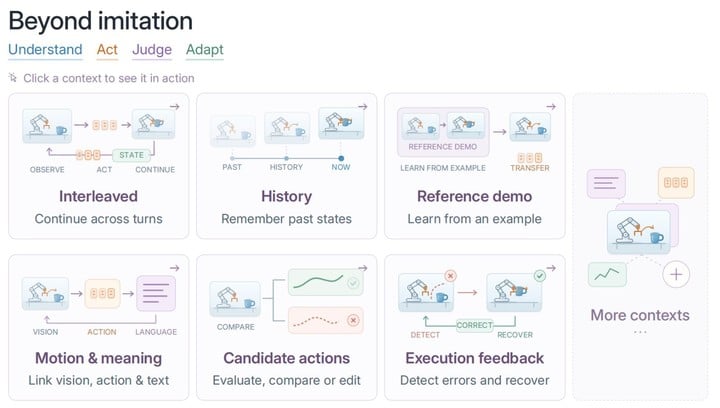
Data originally used only to imitate actions is thus upgraded into a comprehensive textbook that integrates action, semantics, judgment, and error correction. The significance behind this is that what the robot learns begins to shift from isolated operations one by one toward physical interaction experience that can be reused across different tasks.
For example, picking up a cup, moving tableware, and tidying a desktop look like three different tasks, but behind them may lie similar grasping, spatial judgment, and object manipulation capabilities.
When the model establishes a shared representation between action and semantics during pretraining, it has the chance to recombine existing experience when facing unfamiliar tasks, reducing reliance on dedicated demonstrations and fine-tuning.
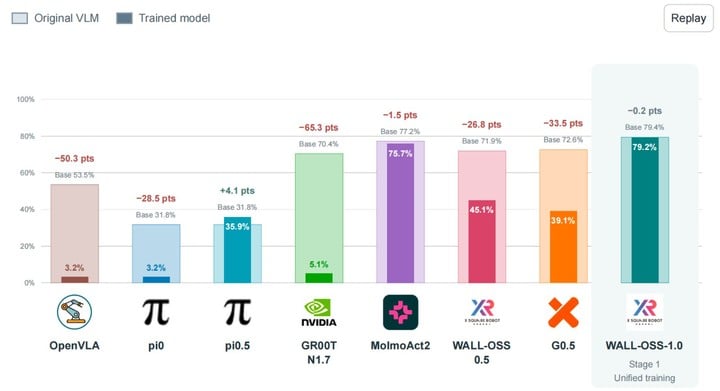
After establishing the connection between vision, language, and action, for a robot to actually get to work, it still needs to solve the problems of action precision and continuous control.
Therefore, in the second stage, WALL-OSS-1.0 introduces an Action Expert through the MoT architecture, adopts the Flow Matching method to generate continuous robot control trajectories, and uses real-time chunking technology RTC to predict the next trajectory segment in advance while executing the current action; the related optimizations reduce single-inference latency to under 60 milliseconds.
The two-stage training thus forms a clear division of labor: the first stage learns general vision, language, and physical interaction capabilities, and the second stage uses the action expert to turn these capabilities into precise, continuous robot operation.
If this training approach is compared to a general education, it must answer two questions at once: how the robot understands what it is supposed to do, and how to turn that understanding into actual action. And for these capabilities to cover enough tasks, rich physical-world experience is also needed.
Hundreds of thousands of hours is only the beginning; robots are building their own experience library
A long-standing headache for embodied AI is the cost of collecting physical interaction data.
Language models can be fed their fill from massive text and images on the internet, but robots need real devices, operators, and various physical environments, making collection far more difficult and costly.
To this end, 自变量 chose multi-source data collection to expand training scale.
WALL-OSS-1.0's training data includes more than hundreds of thousands of hours of operation trajectories and over ten million operation episodes
Article title: X Square Robotics Releases WALL-API-1.0, Surpassing Astra on Mainstream Leaderboards, Taking Up the Banner of Embodied Intelligence "Pre-training"
Body: As model capabilities improve, the Agent will continue to seek out new difficult tasks, so that data collection unfolds around the model's current capability boundary. From a training perspective, this is equivalent to building a continuously updated error notebook for the robot, so that limited data collection investment can also be concentrated on skills not yet mastered.
Multi-source data expands scale, quality filtering and hierarchical annotation improve utilization efficiency, and the human takeover mechanism continuously provides more targeted experience.
What WALL-OSS-1.0 attempts to establish is a basic education system that can continuously accumulate, transfer, and reuse experience. The richer the physical world the robot has seen, the more opportunity it has, when facing unfamiliar tasks, to find answers from past experience.
From Zero-Shot to Real Production Lines, X Square Robotics Measures the Embodied Intelligence "Big Result"
Training routes and data systems ultimately all need to answer the same question: to what extent can the capabilities a robot has accumulated actually be used for new tasks.
In the ManipArena real-machine evaluation, which includes 15 desktop tasks, WALL-OSS-1.0, without task fine-tuning, scored 1101 points out of a full score of 1500, an increase of 52.5% over the previous generation WALL-OSS-0.5 and 70.8% higher than π0.5, which had undergone multi-task fine-tuning.
Especially in semantic understanding tests such as earphone sorting, object pairing, and selecting fruit as required, WALL-OSS-1.0's overall success rate reached 78%, while π0.5's was 44%.
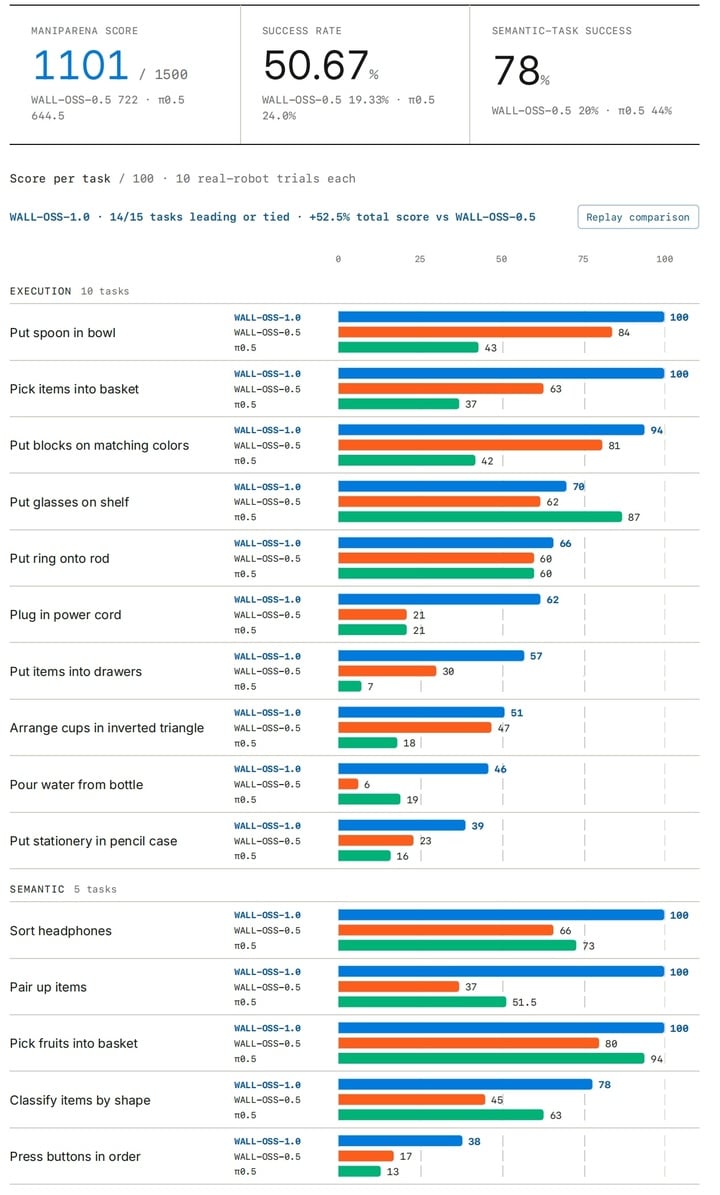
Once the test involves understanding task intent, identifying object relationships, and then deciding what action to take, WALL-OSS-1.0's advantage becomes even more obvious.
Compared with fixed-task evaluation, what is more noteworthy is the open-ended zero-shot test.
Evaluators freely choose tasks, the model does not undergo additional fine-tuning for specific tasks, and the pretrained policy is taken directly onto the field.
After merging repeated instructions across 377 tests, a total of 312 independent tasks were formed, covering capabilities such as multi-step operation, dual-arm collaboration, spatial relationships, and tool use. Ultimately, WALL-OSS-1.0 achieved a 55.1% zero-shot success rate, including 66.5% for multi-step continuous execution, 62.2% for grasping and placing, and 57.7% for dual-arm collaboration.
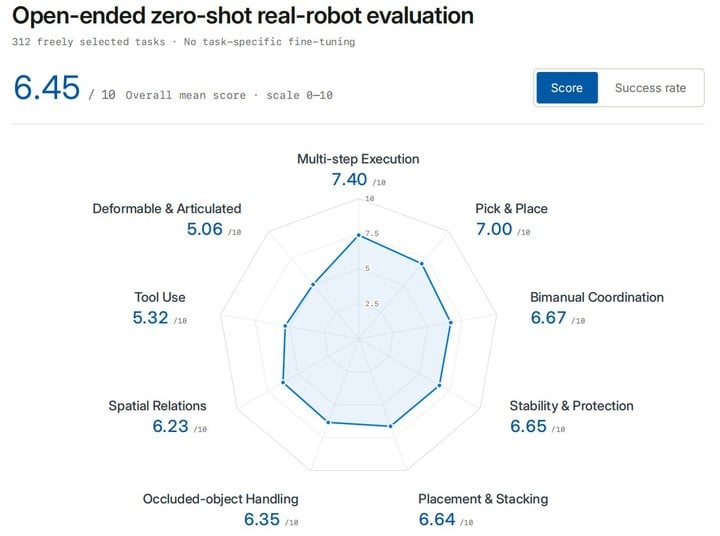
What is noteworthy about this set of results is that, when facing some tasks for which it has never been specifically trained, the robot is already able to call on previously accumulated capabilities and directly attempt to complete the operation.
Of course, a 55.1% success rate also means that the model is still not fully at ease with many entirely new tasks, but zero-shot generalization has already shown potential worth noting.
To make zero-shot capability more intuitive, X Square Robotics also demonstrated operation cases in which the robot, under different tasks, environments, and embodiments, requires no targeted fine-tuning, covering scenarios such as long-horizon tasks, spatial judgment, dual-arm collaboration, tool use, and error recovery.
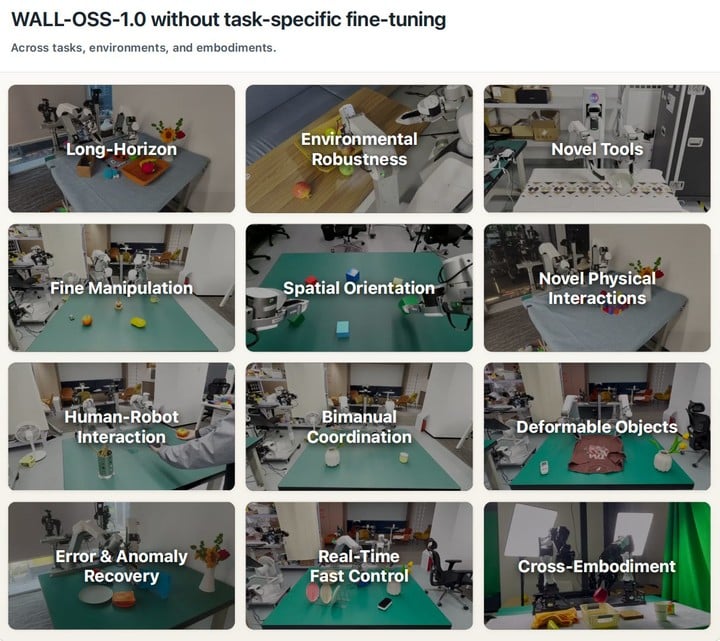
Going further, once the robot has reusable basic manipulation capabilities, it has the opportunity to collaborate with upper-layer Agents to complete more complex long-horizon tasks.
For example, when faced with the instruction to set the table for one person, the robot needs to observe the tabletop, judge whether there is enough space, then move obstacles aside and place plates and utensils in sequence.
In this process, the XR Harness developed by X Square Robotics is responsible for organizing the long-horizon task, in which the upper-layer Agent plans and adjusts steps according to environmental feedback, while WALL-OSS-1.0 is responsible for generating specific manipulation actions.
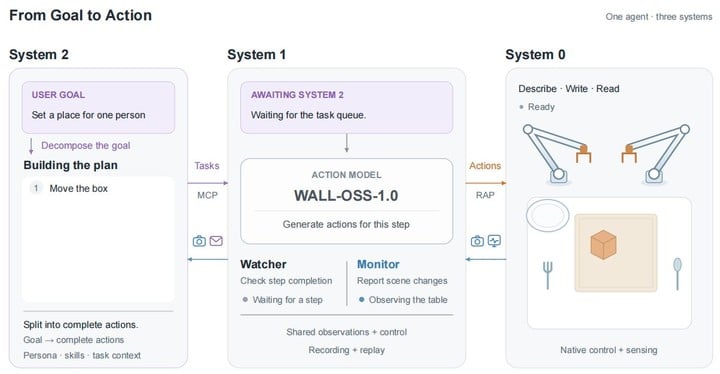
The four-level language annotation mentioned earlier comes into play here, allowing the Agent to invoke the robot's basic manipulation capabilities through language instructions at different granularities.
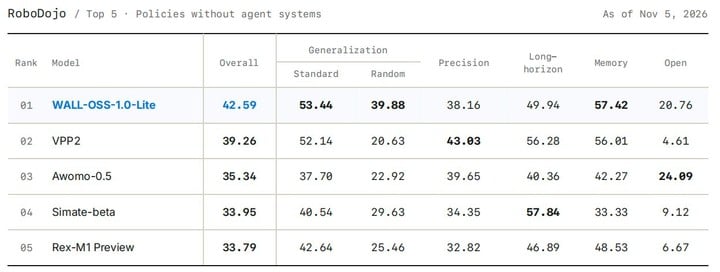
At the same time, X Square Robotics also launched Lite and Nano for lightweight deployment, as well as Gen and AR for exploring different action learning routes. According to the leaderboard dated November 5, 2026, Lite ranked first in the no-Agent policy track of the RoboDojo public simulation leaderboard with 42.59 points.
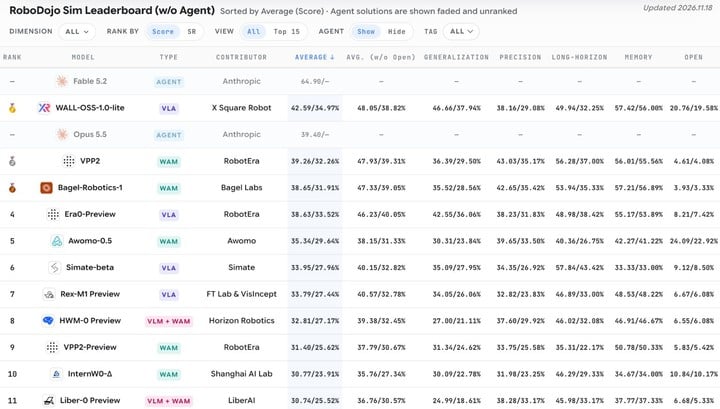
As of the leaderboard updated on November 18, Lite still maintains a far-ahead ranking, and its score is also higher than Agent solutions based on ultra-large-parameter models such as Astra and Opus 5.5 on the leaderboard.
However, results in the laboratory are only the beginning. For the robotics industry, the true commercial value of general capabilities also depends on how much additional training cost is required when entering new scenarios.
At present, the solution based on WALL-OSS-1.0 has entered the sorting production line of a leading domestic logistics enterprise, performing tasks such as parcel flipping and barcode alignment.
According to X Square Robotics, based on the pretrained model, fine-tuning with about 10 hours of production-line task data can reach a usable level, while a control solution lacking pretraining requires more than 1000 hours. After migrating to other production sites, the pretraining solution can still retain more than 90% of the sorting speed and success rate of the original site, while the success rate of the non-pretraining solution drops by more than 90%.
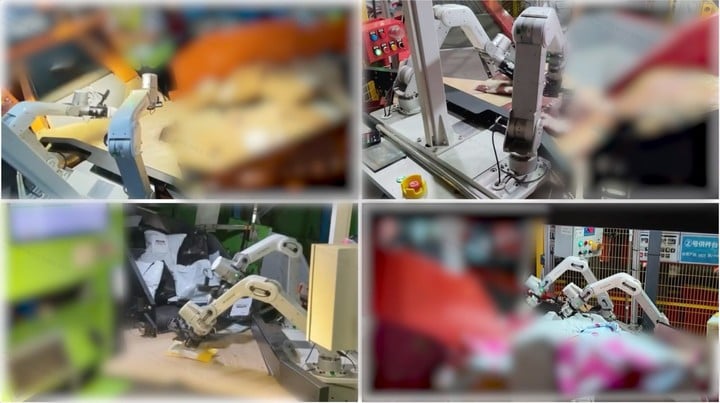
Also a job transfer, one side needs only a small amount of training to adapt to the new job, while the other side needs to accumulate a large amount of data again. The gap lies in the foundational capabilities formed by pretraining. If pretraining is compared to a robot's general education, then specific production-line adaptation is equivalent to vocational training.
The richer the foundational capabilities, the less additional content the robot needs to learn when entering a new position.
In terms of deployment, under a specific test configuration, the Nano version can serve 18 robots simultaneously through a single NVIDIA Blackwell GPU, and X Square Robotics has also opened the WALL-OSS-1.0 API, giving the model the conditions to provide external services.
From the 55.1% zero-shot success rate across 312 tasks to the substantial reduction in data requirements for production-line adaptation, WALL-OSS-1.0 is validating the general capabilities of embodied intelligence from different angles, with the opportunity to gradually form them through large-scale pretraining and to have them repeatedly used in new tasks and new environments.
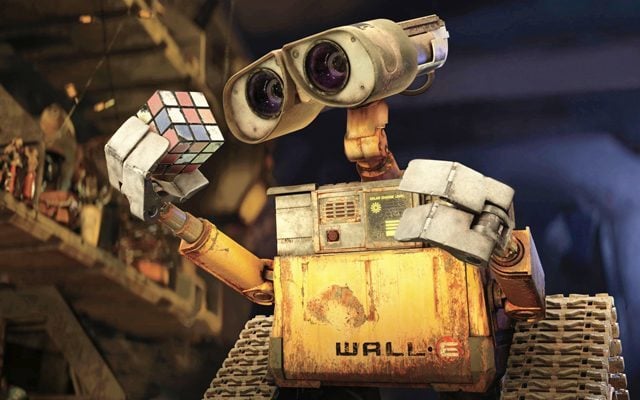
This brings to mind WALL-E in the Pixar film WALL-E. It picked up trash on Earth for seven hundred years, and when it偶然 came across a Rubik's cube, a lighter, a green plant, and old boots, without anyone rewriting code for it, it could still rely on accumulated physical experience to slowly figure out how to grasp them and how to store them.
WALL-OSS-1.0 provides a more concrete technical basis for this expectation. And the "big result" it brings is precisely to enable all robots, when facing the unknown, to adapt to every move, learn without a teacher, and possess their own knowledge accumulation and growth capabilities.