 Newshot
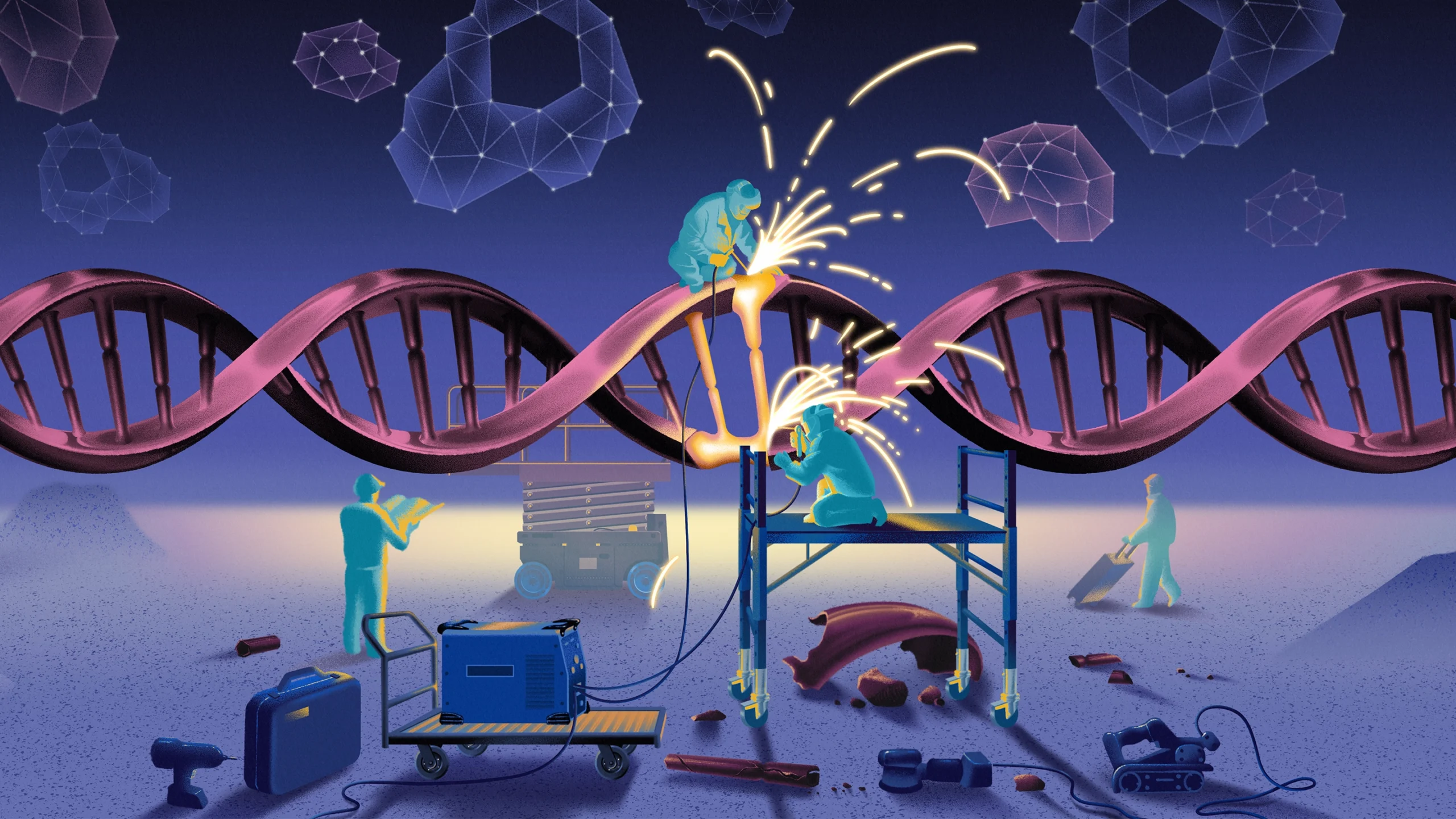
“[DNA has] all that clever structure to it, to enable it to come apart and replicate,” said Penny Jeggo, a molecular biologist who is now emeritus faculty at the University of Sussex. “But a consequence of [that structure] is that it’s sensitive to damage, and unlike proteins or RNA, it actually matters if it gets damaged.”
Even though DNA is precious, it also needs to be constantly accessed to provide the instructions for making the cells’ proteins. And it’s important to remember that the enzymes don’t “read” it from a distance. Every step is a tactile, chemical process. Like toddlers, enzymes physically touch, interact with, and occasionally change the DNA to work with it.
“[DNA is] a working molecule,” said Maria Jasin, a molecular biologist at Memorial Sloan Kettering Cancer Center. “So just by its nature, DNA is going to be subject to chemical forces that will modify it.”
When that modification — let’s call it what it is, damage — affects just a single nucleotide base, a process called base excision repair sends in enzymes to pop the incorrect or injured molecule off the strand and replace it with an undamaged one. Sometimes the jobs are heftier, such as when ultraviolet radiation or carcinogenic chemicals cause a base to fuse with an adjacent one, creating a bulky distortion in the DNA backbone. In this case, enzymes snip out entire nucleotide chunks from the problematic strand and replace them using the complementary strand as a template — a process called nucleotide excision repair.
The most devastating DNA injury of all is a double-strand break. When this happens, the genome is severed into two pieces, resulting in a potentially catastrophic loss of information from both copies of the code. In these cases, the cell deploys the full DNA damage response. An intricate network of more than 500 proteins senses the damage and quickly intervenes to stabilize the damaged segments. It also issues a temporary moratorium on any DNA replication or RNA transcription to prevent the cell from using faulty code.
Double-strand breaks are dangerous. A cell might opt to self-destruct rather than risk perpetuating serious mutations. However, most double-strand breaks can be repaired through one of two main pathways.
“One is beautiful in its simplicity,” Jeggo said, “and the other one is just as beautiful or elegant in its complexity.”
The simpler pathway, and the one used more commonly by human cells, is called nonhomologous end joining. Proteins stabilize the free-floating ends of the DNA, clear out any damaged nucleotides, trim the ends so they are flush, and then basically stick them back together. Some nucleotides are irrevocably lost, and mutations may arise as a result, but for most cells, it gets the job done.
The other, more accurate pathway for restoring double-strand breaks is called homologous recombination. It’s available only during cell division, after DNA has replicated but before the cell divides. In this moment, the nucleus holds two identical copies of each chromosome, known as sister chromatids. If a double-strand break occurs in this brief window, any lost code can be filled in by its sister through homologous recombination. Proteins choreograph an elegant pas de deux where a damaged DNA strand intertwines with the complementary strand from its undamaged sister. The intact strand serves as a perfect template for copying over any nucleotides that may have been lost.
Putting Nature to Work
Homologous recombination is not a “good enough” form of repair. It is so accurate that scientists have harnessed it for gene editing. In 1994, Jasin’s team intentionally introduced a double-strand break in the mouse genome. In place of a sister chromatid, her team provided DNA with a new gene in it, surrounded by sequences designed to coax the cell to stitch it in using homologous recombination. Indeed, the new gene was added to the existing DNA sequence right where the strand had been broken.