 Newshot
0. Scene-Setting
Two quotes and a joke to get started:
“[People] have become the tools of their tools”
– Henry David Thoreau
“For books [theories] are not absolutely dead things, but do contain a potency of life in them to be as active as that soul was whose progeny they are; nay, they do preserve as in a vial the purest efficacy and extraction of that living intellect that bred them.”
– John Milton, in Areopagitica
What does organized attention get for us? Infrastructure.
The following is an expansion of a quick answer I gave to @particlemania about what Autostructures research is trying to bring about. It began with a metaphor to the clean energy transition, and seemed to deserve a bit more attention on the properties that seemed relevant. I intend for this to be the first of a short series sketching related metaphors that have helped me make sense of some key pieces of Live Theory and how we should relate to highly adaptive technology, especially outside of the commonplace agentic frame.
Thanks are due first and most directly to TJ’s instigation and the burst of complex ideas for me to juggle and work through. @Sahil’s work has (hopefully obviously) shaped most of the central ideas I’ve referenced, as well as my perspective on AI safety broadly. @magfrump provided multiple helpful comments on an initial draft. The rest of our Autostructures AISC 11 team made for a wonderful base of support in developing these ideas in an up-close and hands-on fashion.
I suppose it is also fashionable - and perhaps obligatory - to thank Opus 5.5 for collating my rants and offering amenable phrasings and critique.
1. Introduction
This post is based on what I take to be the goal of Autostructures. At the very least, it’s one aspect of Sahil’s research agenda that looks at technology, intention, and inference in tight coordination and aims to clarify the space of good designs. This particularly applies to interfaces as they develop to be more adaptive, but can also extend more broadly to other rituals. I’ll write another post soon which will begin to illustrate the ritual aspect.
I think this is important for a few reasons, even largely just as an exercise in expanding our imagination of the future. Change will come whether we’re ready or not, so I suppose this is a way for me to try getting myself more prepared. Beware though, this is an attempt to use external, somewhat objective terms for processes that also manifest in the uniquely personal and intimately internal.
We should “expand the notion of freedom without limiting in any way our personal freedoms, to move beyond this everyday idea of freedom (consumer choices, personal pleasures etc), as these freedoms always take place within certain economic, social, ethical, ideological coordinates, wouldn’t a true freedom be also the right to establish a collective agency which changes this institutional economic framework within which we enact our freedom?”
Lots of old technologies have been summoned to the fore as precedents to contextualize AI. How should we think of it while it changes so quickly, takes so many forms, and resists description? It’s like the machines are alive.
This certainly isn’t something I think we ever finish doing, so I’d like to offer a small series of examples that I haven’t really noticed anyone pull forth as of yet. To begin, I’m thinking of clean energy and its world-system transition as an example of postformal adaptivity which acts as an interface between humanity’s sourcing and expenditure of power (whether physical, electrical or otherwise). This framing envisions infrastructural machinery that is designed around making sense of becoming more adaptive and sensitive, as AI of course should be. At least, in terms of its capacity to care as infrastructure should for a population.
– Ok, I thought we were aiming to clarify and now I’m stuck on those clunky terms. What’s that mean?
We make meaning in community with one another, as people. This often happens through the digital interfaces we use; sending messages, working, thinking, and interpreting the world in various ways. Of course as more of our life happens online, so the software we use becomes more a part of our lived experience. Between the Cambrian explosion of vibe- and reverse-engineered options and corporate committee software leaving us feeling like a cockroach that just rolled out of bed, it can be confusing and difficult to imagine how we should be relating to these interfaces within which we enact our freedoms. At the very least, we should be foregrounding the meaningful things that matter to us and leaving technical drudgery to the background infrastructure.
You may be right to feel irritated; I’m dancing around offering an explicit answer. That’s because I feel the need to tell (at least) two stories at once. So I’ll try to keep their relation somewhat clear. One story is about our sources of energy and the other is about our digital interfaces. In what follows, I begin to show that both of these things are going through structurally similar phases as they change, improve, and adapt.
All that being said, I do find swimming in the unclarity can be more honest than a prematurely clear image. Otherwise you have to stomach something like this immediately:
Core to the Autostructures agenda is a sense of scoping out the design space that constitutes postformal meaning-facilitation. This has background echoes of a kind of orientation to AI development that seems largely overlooked in favour of doubling down on our earlier commitments to legible metrics, among other things.
– So everyone else is wrong or doesn’t know what to do, and this is the solution? Seems a bit grandiose, no?
Well, it’s trying to be comprehensive in many ways, yes. From an individual's perspective, we’re trying to make digital experiences sane and wholesome. But it’s not only about helping us reclaim and maintain our peace of mind. We’ll need new rituals to help ourselves maneuver and navigate how culturally and interpersonally slippery all this efficiency will make us, but I suppose that’s not news. I’ll leave the task of expounding on threat models to a later date, so let’s get back to these phases of formal systems.


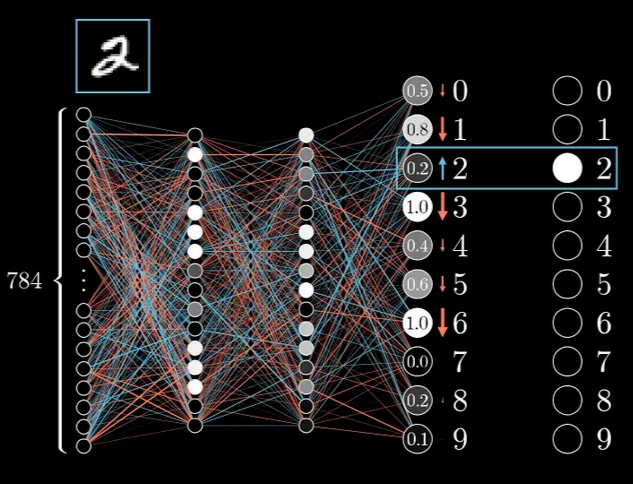
Fig.1 Unicorn in captivity tapestry. | Fig.2 Software woven in wire. | Fig.3 Neural network in training.
2. Development in Three Parts
Lots of stories come in three acts. So much so that it can be considered cliché. But beyond rhyming tripartite stories, there seem to be some fundamental connections between how we deal with formally defined concepts and our progression through the available energy sources.
– Then, what does this have to do with interfaces exactly?
Yes, we’ll get there eventually. There’s just a few things to get familiar with first.
To articulate these connections more clearly, here is a brief rendition of how we become familiar with the rigour of formally defined mathematical concepts:
- Pre-formal - concepts introduced informally and with experientially intuitive examples. Slopes, areas, and rates of change make calculus more graspable. The focus is more on computing answers as opposed to distinguishing particularly good arguments from bad.
- Formal - more rigorously precise and abstract evaluation of concepts, less on using any commonplace understanding of what those concepts really mean.
- Post-formal - once comfortable with the transformations between concepts, we can continually refine our intuitions using the tools of rigour. This allows more fluid use of technical concepts while being able to translate the broad-strokes descriptions back to precise arguments.
On its face, this seems too simple and too good to be true. In a way, it is supposed to be based on wishes. However, this isn’t a pattern that applies only to mathematics. One’s use of language, a person’s moral development, and taxonomies of learning are close cousins to this process, so it seems natural to poke at its overlap with other systems. Beyond giving us means to translate intent with more accuracy, the postformal stance can alter how we come to trust one another.
3. Energy Flow and Facilitating Meaning
When we heat our homes, power our technology, and send information across the world, we need energy. As we’ve gotten better at this, our systems have become more complex, efficient, expansive, and key to our sense of normality.
There are three broadly distinct ways we have drawn energy from the world. Biomass is the most old-fashioned and immediately apparent: burning what is at hand, mostly wood, for heat and light. Fossil fuels came next: coal, oil, and gas, pulled from the depths and pushed through centuries’ worth of extraction, refining, and distribution infrastructure. Clean electrons are newest: sunlight, wind, water, and geothermal heat converted directly into electricity, stored, or moved across a grid. Nuclear power also requires refining of course, although I’m sure it’s common knowledge that playing with these atomic forces can be done in exceptionally sustainable ways.
By saying ‘world-system transition’, I’m pointing toward the nature of these systems as being widely pervasive, intensely influential in our lives, and deeply embedded in our global supply chains with multi-layered dependencies. Now, a diagram that will either clarify, or confuse you further (with the empirical version following close behind):
Fig.4 Postformal energy production as clean electrons.
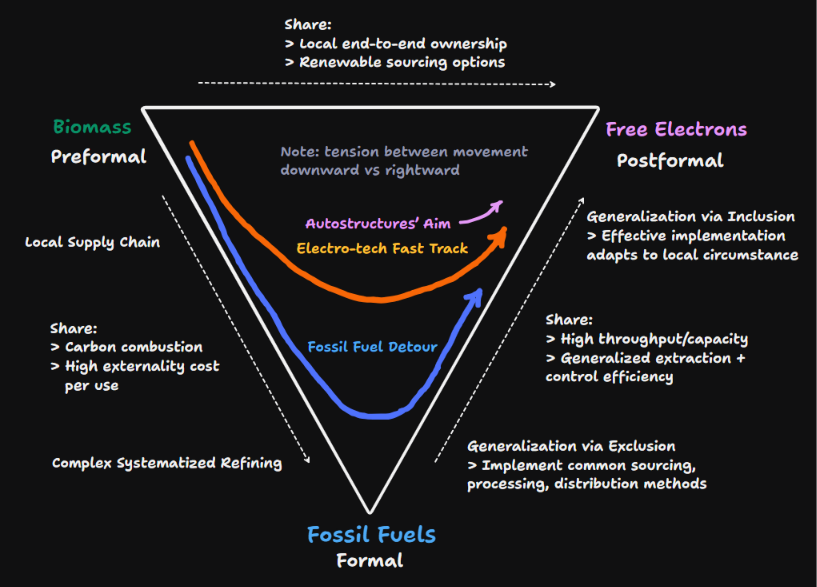
Each of these three phases of energy sourcing depicts a different relationship between how we manipulate it to be usable, and then how we use it. Here's a handful of distinctions to make the differences more concrete.
Externalities: Both combustion stages carry a high externality cost per use. Every log and every litre of petrol burns once and leaves something behind. Clean electrons move most of the cost upfront, into panels, turbines, or batteries. Likewise, interfaces carry their own externalities with each use. When meaning gets squeezed into a form field, star ratings, or another fixed channel, some context burns off as loss and this accumulates as insensitivity and one’s removal from meaningness. Like turning on lights by flicking a switch instead of lighting torches or candles, templates are easier to use (for the information gatherer, not necessarily the submitter), but the cost just moved somewhere we don't see. We’re all familiar with how easy it is to subscribe, and how hard it can be to cancel. Postformal infrastructure, like clean electrons, moves the cost upfront: into models, translation layers, and the design work of deciding how translation should happen.
Decentralization: Biomass can easily be local from end to end: you gather it, you burn it, perhaps you deal with the smoke. Fossil fuels centralize nearly every step, from the wellhead to the refinery to a power station you will likely never see. Clean electrons can instead be generated on a rooftop or in a field down the road while still being shared over a grid. Centralization becomes much more optional rather than the norm. Formal platforms are like the refineries of meaning-making: traffic routes through a few sites and is processed into a standard format before it reaches anyone. Platforms are thus like folders of people, each competing to file you into place. When translation is cheap, this kind of structure doesn't need to be centralized for us to connect.
Generalization: A formal theory travels via generalization by finding what all its instances have in common and discarding the rest. A strangely obvious point, but I think this is how fossil fuels generalize by exclusion. They work everywhere by implementing common sourcing, processing, and distribution methods everywhere, and the petroleum products that do not fit those methods are left out. In contrast, a postformal theory adapts to the subtle context shifts between disciplines, like working on a notion of “power” to write something closer to a prompt than an equation, with a fitting formalism generated for each discipline that picks it up. In this way, clean electrons can more easily generalize by inclusion: where commonly effective implementations can losslessly adapt to local circumstance, whether that’s a sunny roof, a windy coastline, or a river.
Retained structure: The middle formal stage doesn’t simply vanish. The grid, the standards that constrain and allow it to function, and the markets that price its power were largely built in the fossil era, and clean electrons lean on all of them. In different forms, the formal stage is both one we progress through and a structure we keep underneath its successor which is exactly what happened to rigour in the post-formal mathematician. Interfaces are no different: protocols, schemas, and file formats stay beneath the adaptive surface, available whenever something needs checking. That's also what makes the postformal trustworthy. We trust the mathematician's intuition because it can be grounded back into proof on request, and the rooftop panel because it meets the grid's standards.
Sure, plenty of phenomena come in threes. But my point is that a remarkably similar logic drives each sequence; any capacity humans build to extend themselves tends first to be grasped intuitively, then formalized for scale and reliability, then re-intuited once the formalism is stable enough to support fluent work on top of it. This is why formalization is a phase and not a destination. It exists because intuition without infrastructure does not scale, while infrastructure without intuition becomes brittle and insensitive.
– Fine, but nations don't necessarily use fossil fuels as a deliberately chosen end. Isn’t this just the order things happened to happen in?
Partly, perhaps. India is a useful case here. Ember charted each country’s share of final energy demand from biomass, fossil fuels, and electricity from 1900 to 2023. The United States (and China to a lesser extent) took what Ember calls a fossil detour, going deep into fossil dependence before electrifying. India is on what they call an electro-tech fast track.
Fig.5 India’s empirical electro-tech fast track.
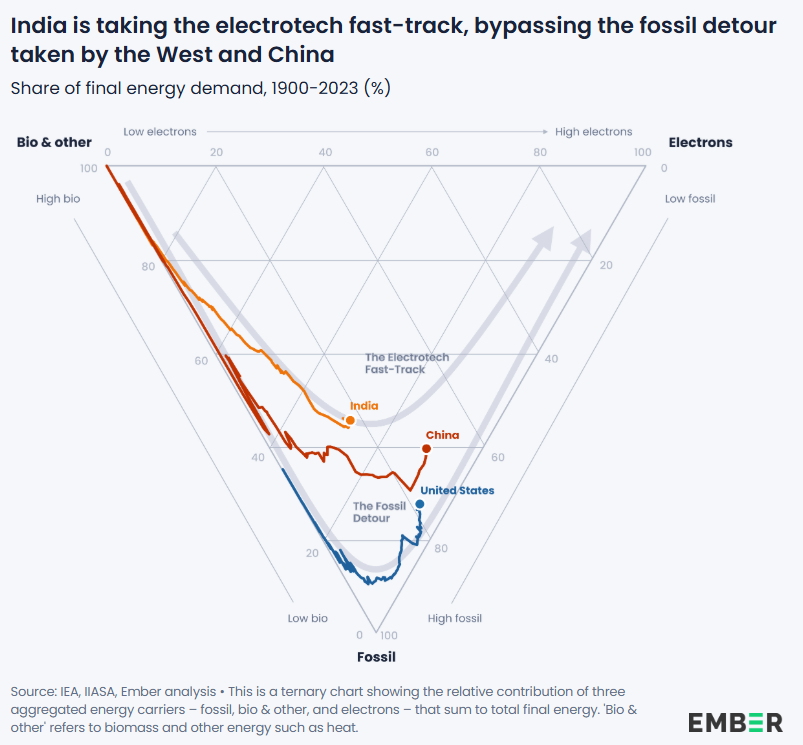
At first glance this looks like a counterexample: if India can skip the middle, maybe it wasn’t necessary. But part of the reason India can take the fast track is that others have shared in the difficult work of developing (formalizing) the fossil fuel infrastructure, only to realize its faults and attempt cleaner, more holistic improvements. India can learn the lessons accrued by habituated dependence on fossil fuels without committing itself to the same error. The middle stage therefore remains developmentally necessary collectively, though individual nations may be able to somewhat skip over it, if there is some established collective transmission of the important lessons.
At its core, I believe this is the lesson we're aiming to achieve with Autostructures: providing a means of fast-tracking a person's digital experience from the pre-formal to the postformal. If grandma wants to use the computer, it should seamlessly bend to her intentions instead of her needing to open up the mess of an 'inspect element' tab.
– Aren’t there examples of this happening in reverse? Like old solar cookeries or wind- and watermills being replaced by gasoline power generation and the grid buildout?
There is a notable direction to all this. Collectively, no civilization would presumably want to stay dependent on inelegant, inefficient energy sources when given the choice, even though individuals may have their reasons. So there is both a tendency toward the postformal as an innate property of improvement in efficiency, and a collective desire to do so, given the network-effects that come with scaling clean energy for the health of ourselves and the planet.
There is another nuance to mention here, which connects to the minimality condition I mention in an earlier definition I gave of the aims of Live Theory. Specifically, consider the example of window hinges that exploit the predictable expansion of a gas to operate greenhouse windows as the temperature changes. Like the old fashioned water and windmills and solar cooking setups, this has a direct connection between its constitutive parts and its function; it is built to infer exactly how much to adjust the angle of the window opening in response to temperature fluctuations.
The simplistic historical ordering I give of biomass, then fossil fuels, then clean energy is the empirical claim made by the underlying tendencies of nations in their development. There could still be some ultimately superficial reversals from small windmill powered applications to using more fossil fuels, but there'd still be no innate incentive to destroy the windmills themselves since they retain that gravitational pull of free energy at the cost of some system maintenance.
– And what about interfaces? You promised.
I did. In computing, we argue that what is getting cheaper is actuation (contra automation): inference power in action, and the intelligent transformations it makes possible when robust software artefacts can be created with extreme precision, robustly, right on the spot.
In the pre-formal version, you scale manually, writing emails individually with full attention on every instance. In the formal version, you scale by formally replicating a fixed structure: a macro that copies various elements into a template with some parameters that can adjust to the receiver's earlier form submission, for example. In the postformal version, you scale using just-in-time intelligent transformations, like LLM-assisted writing of custom emails based on the intended message and each receiver’s known information and their reception preferences.
The latter isn’t a better template. There is no template. What gets scaled is specificity itself, because attention has become cheap enough to spend on every instance. An attentive layer could translate your message's intention for the particular purpose of being received better during my viewing, so neither of us needs a shared universal format to read each other. It gets easier to give something to a collective in a form each person can use, and easier to receive from many sources in a form you can actually take in. The exact manner of the translation becomes the object of the design process.
In some sense, the postformal offers a return to a way of using computers similar to how we thought computers worked before we actually knew how they worked. You say what you mean, and the adaptivity is aimed at discerning and doing exactly that.
This is the value of Autostructures. As a research method, it is trying to enable attentive, interoperating infrastructure that anticipates the cheapening of mechanized inference power, and adapts it around our meaning-making activities.
– Isn’t this just a fancier grid? More sophistication, more things to break?
More sophisticated infrastructure is not the problem. But the practices of centralization that guided us toward the formal should not be expected to lead us sensibly to the postformal. The sophistication is for the background technicalities, not the end user experience. Maintenance can be done on both personal solar panels and a back-garden generator, but the way you get spare parts and the type of know-how needed to fix the systems differ in many ways.
The main point straining the comparison is the gap between private frontier models and open source, along with the computational and technical ability of edge users to run models locally, cheaply, and with ease. You can own a solar panel. For now, a frontier model is mostly something you rent.
Another asymmetry that may be worth identifying is that the energy story can be told in hindsight while the interface story is being attempted in foresight and from within a formalization-inebriated digital ecosystem. I don’t see this as a weakness, and the next section gestures toward why.
Autostructures is working through becoming legible. But largely, I think it just hasn’t been clearly necessary to most people that we should approach AI from a direction that doesn’t reach for legible metrics immediately, and which sits in an interconnective infrastructural posture as opposed to one of delegative cognitive labour replacement. We often want things to be measurable, even if it comes at the cost of eventually missing what we initially wanted to measure.
4. Unstoppable Forces and Immovable Objects
There are both technical and sociopolitical elements slowing our transition toward a postformal-as-normal world, but vanishingly few technical ones over time. In some ways it is obvious that there are deeply structurally entrenched aversions to reimagining our value systems to account for the emerging role of human activity beyond mere labour. I take it as self-evident that our world is not organized in the ways we deem it should be.
So both transitions feel impossible and inevitable at once to me. Inevitable, because they seem necessary as telic endpoints of our design practices and simply for building a better future. Impossible, because improving these systems for all people, centered around our real needs, is agonizingly slow, complex, and disincentivized, if not discouraged. It requires care and attention in a world of moving fast and breaking things.
The bulk of the difficulty is in escaping the Goodhartable metrics of the formal stage. Fossil fuels represent an over-commitment to systems whose drawbacks we have already understood for decades. There is an apparent dependability and ingrainedness to these systems, and it isn’t always clear to all parties why progressing beyond them is worthwhile. A heavy systematization has already made the infrastructure a core dependency (and enabler) of everything built on top of it. That might have seemed fine, until we learned what the externalities were.
There is a second difficulty from our shortening collective memory. After making advancements , our new systems can tend to flatten whatever was legitimate about the predecessors. Industrial agriculture displaced subsistence farming effectively wholesale. Formal training can crush a gifted amateur’s intuitive spirit. Platform-mediated communication has been steadily absorbing the local, idiosyncratic cultures of the early internet. A postformal transition is only worthwhile if it re-incorporates what the earlier stages did successfully.
– So who wins between the immovable and the unstoppable?
I don’t think any useful answer here is straightforward. Gravity and entropy both act in every infinitesimally thin slice of time, but neither finishes. The pull toward the postformal and the drag of our formal debts seem to be present in every moment. Perhaps we should reconsider whether telling a linear history was a once-useful myth that no longer holds up, and that history may be better thought of as many states and configurations held at once.
In this sense, we're trying to coalesce a synthesis: keep the immediate responsiveness of the pre-formal and the scaled reach of the formal. What forces the change, in energy and in interfaces alike, is that the success of formalization produces its own undoing. We can scale coordination by stripping out context and focusing on hastily-ratified metrics, until the lost context and misplaced aims became the dominant cost. Structural collective dependency, intimate individual dependency, and the externalities of both are what make it untenable. The codependency threat model is part of what our community is working to illustrate.
5. Meaning Between Us
At this point you may be thinking that this is all about getting along better with our software, but that's not exactly true. Autostructures is not about our relationship with technology per se. It is about our relationship with one another, and the meaningfulness we share as it is mediated by technology. In the energy story, what matures is our relation to the energy around us in terms of immediacy, clean sustainability, and decentralized ownership. In the interface story, what matures is our relation to one another, through the apparatus we design for making meaning.
Put plainly: meaning happens between people, and the AI is meant to be mostly-ignorable infrastructure. Consider your internet bandwidth during a video call. You probably don't talk about it unless it stutters. You might blame the weather blocking the satellite connection, or you may even blame yourself for not being able to fix it. It can be difficult to avoid having your thoughts recompose when in a frustrated state, and it can be hard to hold on to meaning when our systems are not truly designed to intelligently facilitate it.
6. Slow, Soft, Insidious Risks
The familiar story of AI risk is a sudden, visible rupture. Here, we're more concerned about a story with no single moment to point at. It looks like software that works, institutions that function, and decisions that get made, all of them progressively less responsive to the people they nominally serve. We often call this infrastructural insensitivity; an accumulated effect of a thousand individually reasonable choices resulting in a deafening silence.
Its sharpest form is the risk of imposed bureaucracies at scale that excise us from meaningfulness altogether. Forever decreasing our participation in the flow of compute and inference just means that we will be subjected to the outputs of systems we won’t be able to understand, and whose course we cannot alter. Aside from madness or codependent addiction, the endpoints of that drift can include mass death and being pushed into irrelevance by delegative paradigms of design.
I’m resisting the urge to give a dramatic example here, since it’s more like a rising din in the background than a deafening blast. It can manifest simply as changes to what is deemed normal. There will be no moment when the infrastructure announces it has stopped caring. The narrowing of our systems’ allowances happens gradually and becomes the new norm, while the people inside adapt and shrink their frames of mind to fit. Even this description is only part of the story, and as I already mentioned the discovery of these risks is ongoing.
7. Schools Precede Tools
Before I close this out, I'll mention what Autostructures has been building.
Our products, practices, and community have shaped a budding design school: a shared language for building postformal interfaces, practised across very different problems. In our most recent AI Safety Camp iteration, we had three tracks. (Join one of our newest four coming in January 2027!):
- Live Conversational Threads extracts variously-representable structure from semi-formal conversations, so people can navigate an argument they built together.
- Enlivened Forecasting (with Metaculus) built interfaces for the new Radiant tool to surface forecasters’ assumptions and track where they disagree.
- Interface Integration Therapy is a (continuing!) practice where a person’s attention patterns are gently diagnosed, with a friend-and-practitioner accompanying their experience of an interface.
Perhaps these appear somewhat unrelated. In fact, multiple threads run through all three.
Formalism-on-demand. Structure is drawn out of informal material as needed rather than imposed in advance: argument maps from conversation, assumptions from reasoning, and interface changes from a diagnosis.
Many views of the same content. LCT’s multi-representable graph of a conversation, the various views the soloware platform renders from one document, and the forecasting work’s comparisons between possible future worlds. Our series of design lectures has described this as "making translation grammars findable just-in-time".
Sensitivity to particulars. Scaling specificity directly; enabling the interface to bend and tune itself to one person’s attention rather than the other way around.
Meaning between people. The precise conversation, the forecasting disagreement, and the relationship between a client and their interface are the core objects. The tools then serve as objects for thinking together.
There is also no singular endpoint being envisioned here. We are continually anticipating where the technology is headed, facilitating meaning in a peer-to-peer manner, scaling specificity directly, making structures interoperable through translation found just in time, and treating potentials as first-class entities around which the design process flows.
It is encouraging to see the interrelationships between projects that begin to emerge as a result of exchanging these postformal artefacts. Precise arguments can become collective forecasts, and we learn about the potential within ourselves and adaptive technology along the way. This has been the aim of the design method as a school; to make the next tools recognizably related to the last ones, for reasons people can sense and explain.
8. Closing
We are wrestling with these ideas to free ourselves from a future of purely formal interfaces. Many of us are familiar with formal infrastructure that isn't designed for us and familiar with the growing sense of what it costs. Our aim has been to demonstrate that subtly new ways of expressing meaning to one another are being made possible, if only we are willing to look carefully at both the systems we build and ourselves as we engage them.
If any of this resonates, or irritates you productively, perhaps you'd like to sit with that a while longer. To get a firsthand look at more of this, again I say: Join one of our AISC tracks coming in January 2027!