 Newshot
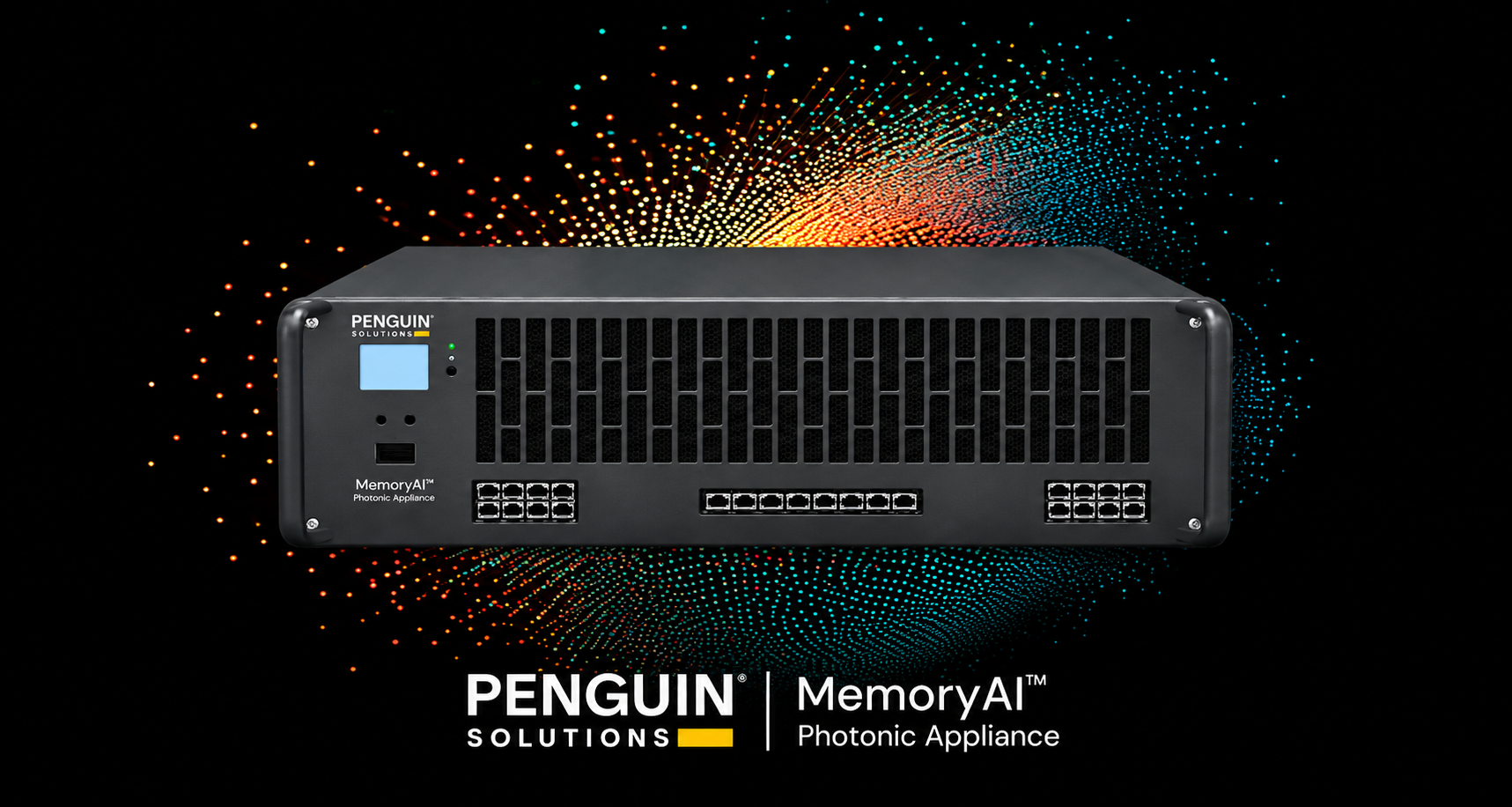
Penguin Solutions showed off its MemoryAI Photonic Appliance remote memory system at Supercomputer 2026 (SC26), with customer samples scheduled for the second half of 2027. The device supports up to 576 GB of HBM3E with an aggregate bandwidth of up to 7.2 TB/s, and connects to systems using optical interconnects via the CXL.mem 3.1 protocol. HBM memory capacity is usually one of the major bottlenecks of contemporary AI accelerators, which is why, when developers face it, they tend to add or upgrade their accelerators. Penguin Solutions' new device aims to solve that, but there are drawbacks.
The MemoryAI Photonic Appliance is designed to accommodate up to 576 GB of HBM3E and 16 TB of DDR5 memory, with overall bandwidth targeting 7.2 TB/s. The external memory box supports three memory access configurations: HBM Direct Mode, HBM-DDR5 Cached Mode, and DDR5 Direct Mode. The first provides access to external HBM3E, the second combines HBM3E and DDR5 in a tiered memory sub-system with HBM3E acting like a write-through cache for DDR5, while the third provides access to DDR5 without an intermediate HBM cache. Meanwhile, hardware semaphores (HSEMs) enable software-managed memory consistency across multiple host processors (i.e., if more than one host processor accesses the same memory location, software can use semaphores to ensure that only one host processor can modify data).
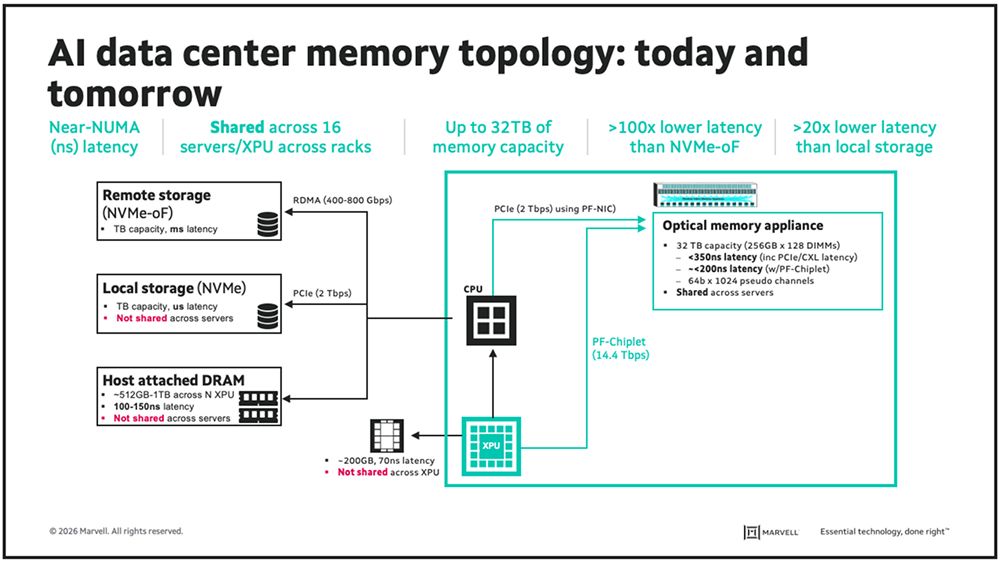
The Penguin appliance relies on Marvell's architecture that consists of Photonic Fabric Memory Modules (PFMMs) and Photonic Fabric network interface cards (PF-NICs). The device uses eight PFMM modules; each integrates a memory controller, eight DDR5 DIMM interfaces, 72 GB of HBM3E cache, and a photonic interposer with 16 transmit and 16 receive channels operating at 224 Gbps. This provides approximately 7.2 Tbps of aggregate bidirectional optical bandwidth per module, or 57.6 Tbps (7.2 TB/s) for the entire appliance, equivalent to approximately 3.6 TB/s in each direction.
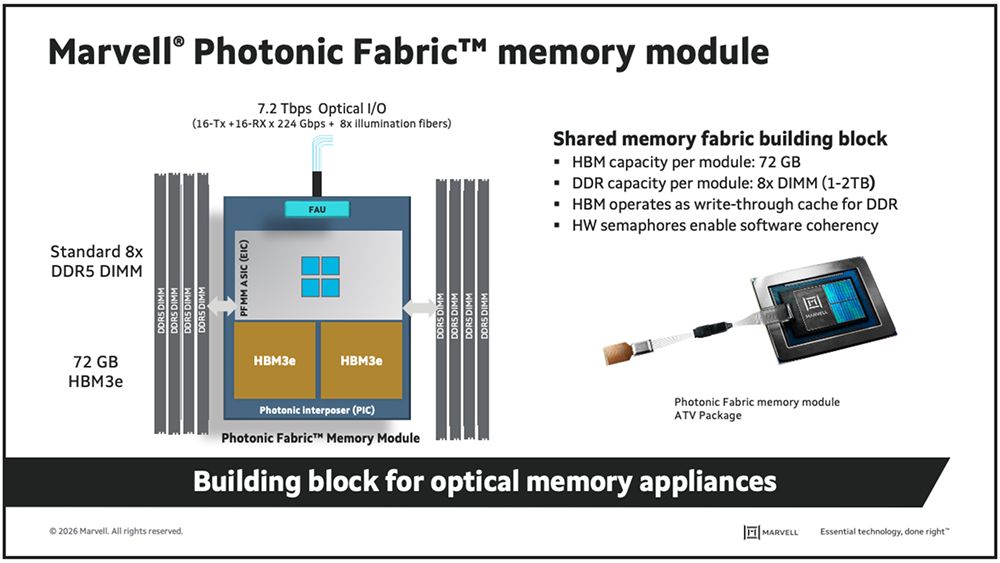
Marvell offers two ways to connect processors to the external memory pool. The first uses a Photonic Fabric network interface card (PF-NIC) with PCIe 6.0 and CXL 3.1 connectivity, which provides up to 2 Tbps of bandwidth and memory access latency below 350ns, excluding PCIe/CXL overhead. The second relies on a Photonic Fabric chiplet integrated into an XPU, which offers up to 14.4 Tbps of bandwidth and latency below 200ns. Both approaches enable processors to access shared memory over optical links across distances of up to 30 meters. Meanwhile, the chiplet approach requires accelerator designers to install the chiplet, while transparent memory expansion using the PF-NIC requires the host to support its memory mapping at both the hardware and software levels.
Marvell's architecture is designed to enable compatible host systems to access external memory through ordinary load/store memory operations rather than RDMA data transfers, but this requires specific hardware capabilities on the host side. Most modern CPUs support PCIe as well as the CXL.mem protocol for memory expansion. However, the situation is different for AI GPUs.
Nvidia's data center GPUs support PCIe, NVLink, and various memory management mechanisms, but they do not support a general-purpose CXL.mem host interface for memory expansion. Similarly, AMD's Instinct accelerators use PCIe and Infinity Fabric for connectivity, but they do not generally support CXL.mem. In theory, accelerators without native CXL.mem support could theoretically access the appliance through a CXL-capable CPU, provided their coherent interconnect supports access to CXL-attached memory. However, this would introduce additional latency, which will extend well beyond the advertised sub-350ns figure (which already excludes PCIe/CXL overhead), which could greatly reduce the actual performance benefits provided by extra capacity.
As a result, PFMMs and Penguin's MemoryAI Photonic Appliance can extend usable memory capacity only for select host systems without major performance penalties. These could include custom XPUs equipped with Marvell's Photonic Fabric chiplets, CPUs or other PUs that support CXL.mem and PF-NIC with memory mapping mechanism, and potentially future AI accelerators that support CXL.mem or integrate Marvell's Photonic Fabric. Obviously, this means that such systems will get an indisputable advantage over machines based on conventional accelerators from AMD and Nvidia in the form of memory upgrades.
Speaking of advantages, we must note that while an aggregate bi-directional bandwidth target of 7.2 TB/s (3.6 TB/s in both directions) seems formidable (it is only a bit lower than memory bandwidth of B300 SXM that comes at 7.7 TB/s), it is set to be shared between multiple accelerators (eight accelerators in a hypothetical scenario), which will provide limited bandwidth to each one. Although Penguin promises transparent access to external memory without modifications to applications, the appliance will require compatible memory management software (in addition to host hardware), which will treat external memory as another memory tier. While extra memory is always welcome, performance benefits of complex multi-tier memory subsystems depend heavily on workloads and efficient data placement. Consequently, the appliance's practical advantages remain to be demonstrated.
Penguin showcased the appliance this week; however, customer samples are scheduled for the second half of 2027, which likely means that the device and/or underlying hardware, firmware, and software need polishing. That said, practical performance and economic advantages of Penguin's MemoryAI Photonic Appliance remain to be seen when everything works as intended. In any case, do not expect deployments of such systems before 2028. This begs the question of where Penguin Solutions plans to source HBM3E in volume in 2028, when the industry will have transitioned to HBM4 and will be in the midst of transition to HBM4E.

Anton Shilov is a contributing writer at Tom’s Hardware. Over the past couple of decades, he has covered everything from CPUs and GPUs to supercomputers and from modern process technologies and latest fab tools to high-tech industry trends.