 Newshot
I've seen first-hand how a company can spend millions of dollars moving from one CI/CD platform to another. Not because the new platform did anything the pipelines needed, but because every pipeline was written in the old platform's own syntax. Every one had to be rewritten, run side by side with the original until people trusted it, then cut over against a licence or end-of-life deadline. Teams paused product work to do it, and every subtle behaviour difference between the two platforms was a potential outage.
None of that work made the pipelines better. It only moved them. OrchStep exists so that the next move costs almost nothing.
Why pipelines get locked to a platform
In most organisations the real pipeline logic lives inside the CI tool:
- A Jenkinsfile is Groovy, with Jenkins plugins and Jenkins conventions for credentials.
- A GoCD pipeline is GoCD config, materials and plugins.
- GitHub Actions, GitLab CI and Travis each have their own YAML, their own expression syntax and their own rules for environment variables.
Each platform decides how a command runs, how a variable gets substituted, which environment a value comes from and how a secret is injected. Your pipeline depends on all of those decisions, so it only works on that platform. That's the lock-in: not a contract, but thousands of lines written in a dialect only one product understands.
Move the logic into the file
OrchStep takes every one of those decisions and puts it in the pipeline file itself. An orchstep.yml carries everything a run needs:
- Execution. Steps run in a shell, or in the built-in POSIX-style shell (gosh) that behaves the same on Linux, macOS and Windows. Retries with backoff, catch/finally, assertions and parallel blocks are part of the file, not plugins.
- Your own variables. Named variables with defaults, per-environment values (dev, staging, production) and overrides from --var or a vars file. OrchStep resolves them itself, not the CI platform and not the shell environment, so a value never depends on where the job happens to run.
- Environments and secrets. Declared in the file, with secrets pulled from an environment variable or a command (Vault, SOPS, 1Password) and masked in the output.
Here's a small but complete example:
        name: shop-api
# The whole pipeline lives here. The CI platform only calls `orchstep run <task>`.
defaults:
  region: us-east-1
  replicas: 2
  version: dev

environments:
  staging:
    vars:
      cluster: staging-east
  production:
    vars:
      cluster: prod-east
      replicas: 6

tasks:
  ci:
    steps:
      - name: test
        func: shell
        do: echo "running tests"
      - name: build
        func: shell
        do: echo "building shop-api:{{ vars.version }}"
        outputs:
          image: "registry.example.com/shop-api:{{ vars.version }}"

  deploy:
    steps:
      - name: rollout
        func: shell
        do: echo "deploying {{ vars.version }} to {{ vars.cluster }} in {{ vars.region }} x{{ vars.replicas }}"
        retry:
          max_attempts: 3
          interval: 10s
          backoff_rate: 2.0
        catch:
          - name: rollback
            func: shell
            do: echo "rolling back {{ vars.cluster }}"
          - name: fail-the-run
            func: shell
            do: exit 1
      - name: health
        func: shell
        do: echo "checking https://{{ vars.cluster }}.example.com/health"
Replace the echo lines with your real commands. Before anything runs, you can see exactly what will happen:
        orchstep validate deploy                                    # which environment is missing which variable
orchstep run deploy --env staging --var version=1.4.2 --dry-run
The dry run prints every variable with the layer it came from (defaults, environment or runtime) and every rendered command, without executing anything.
One entry point, any platform
The CI platform's only job is to call one command:
orchstep run deploy --env production --var version=1.4.2
In Jenkins, that's a one-line stage:
        stage('Deploy production') {
  input { message 'Deploy to production?' }
  steps { sh 'orchstep run deploy --env production --var version=$BUILD_NUMBER' }
}
In GoCD, a one-task job:
        - exec:
    command: orchstep
    arguments: [run, deploy, --env, production, --var, "version=${GO_PIPELINE_LABEL}"]
In GitHub Actions, one step:
        - uses: orchstep/run-orchstep@v1
  with:
    task: deploy
    env: production
    vars: |
      version=${{ github.run_number }}
GitLab CI, Buildkite, Travis or a cron box look the same: a few lines that call orchstep run. The CI keeps what it's good at, which is triggers, build machines, credentials and approvals. The pipeline stops depending on any of them.
Give every platform the same execution context, meaning the same container image or Kubernetes pod spec (which Docker and Kubernetes already pin), and the run is the same everywhere. OrchStep owns everything in the file: step order, variable resolution, environment values, retries, rollback and exit codes. The layer below owns the tools and their versions.
What that's worth
Changing CI platforms becomes cheap. A migration that used to mean rewriting every pipeline becomes changing one line per CI stage, and behaviour can't drift, because the same file runs on both sides. Whatever the next platform is, you're not locked into this one.
Developers don't need to be CI experts. They run named tasks. The people who own the release and deploy process maintain it in one place, and every team reuses it.
Shared steps become modules. A tested deploy becomes a versioned module with a lockfile, so 30 repos use the same steps instead of 30 slightly different copies of Groovy.
"It only fails in CI" goes away. The CI runs the same command you run on your laptop, so reproducing a failure is one line.
You don't have to write the YAML by hand
OrchStep ships Agent Skills that work in Claude Code, Codex, Cursor, Copilot, Gemini CLI, Kimi Code, OpenCode and other agents (npx skills add orchstep/orchstep), plus an MCP server. Two of the skills do different jobs:
- Capture records what was done. After you or an agent work through a job by hand, /orchstep-capture records the operational steps that were actually run (the real commands, the values used, the places it had to retry) as an orchstep.yml you can replay on any CI, without paying a model to work it out again. It's low-level and literal: a faithful record, not a design.
- Workflow design shapes it into a system. This is the more advanced skill. Tell your agent which tasks you want OrchStep to manage and how they depend on each other, for example "build, test, then deploy to staging; deploy needs the image tag from build". The agent reads your repo, finds the scripts and commands that already do each job, and designs the orchstep.yml: separate tasks with clear entry points, dependencies and outputs passed between them, variables pulled out per environment, and retries, assertions and rollback where steps can fail.
They work well together. Capture a job the first time you do it, use workflow design to refactor the captured steps into reusable, interdependent tasks, and keep refining them as the process changes.
If you want to see how the workflow design skill works, the whole thing is open on GitHub: skills/orchstep-workflow-design. It's a SKILL.md plus reference files and annotated examples, and you can read exactly what it tells your agent to do. The skills docs cover installing it in each agent.
Capture once, stop paying for the same exploration
Every time an agent solves a job from scratch, you pay for the exploring: reading files, running commands, reading the output, trying again. Solve the same job next week and the agent explores it all again, and you pay again. Capture turns that exploration into a file, so repeating the job costs no tokens at all. Two examples (token counts and prices vary by model and job, so treat these numbers as rough):
- The release nobody remembers how to do. Once a month someone asks an agent to cut a release: bump the version, build, tag, publish to two registries, update the changelog. The agent reads the build scripts, finds the CI config, gets a registry login wrong, retries, and gets there after forty or so tool calls and a few hundred thousand tokens, which is a few dollars at current frontier-model prices. Captured the first time, the next release is orchstep run release --var version=2.4.0: seconds, no tokens, and the same steps as last month.
- Rebuilding a broken dev environment. A new starter's environment won't come up, and an agent spends an hour working out which services, seed data and environment variables they need. That's exactly what the next new starter needs too. Capture it once and the whole team runs orchstep run dev-setup, without twenty engineers each paying for the same investigation.
Agents get cheaper too. With the MCP server or the CLI, an agent that's asked to do the job again calls the captured task in one tool call and reads a structured result, instead of rediscovering every step. You pay for the model to explore a job once, then the replay is free and deterministic.
The same approach moves existing pipelines: point an agent with the OrchStep skills at a Jenkinsfile, GoCD pipeline or CI YAML, have it write the orchstep.yml, and check the result with --dry-run and orchstep validate before switching the CI stage over. You can also go one pipeline at a time, starting by wrapping an existing script as a single step. Once a team is on OrchStep, they can run their pipelines on pretty much any platform. The Jenkins and GoCD migration guide walks through both.
Two front ends for people who don't want to remember task names
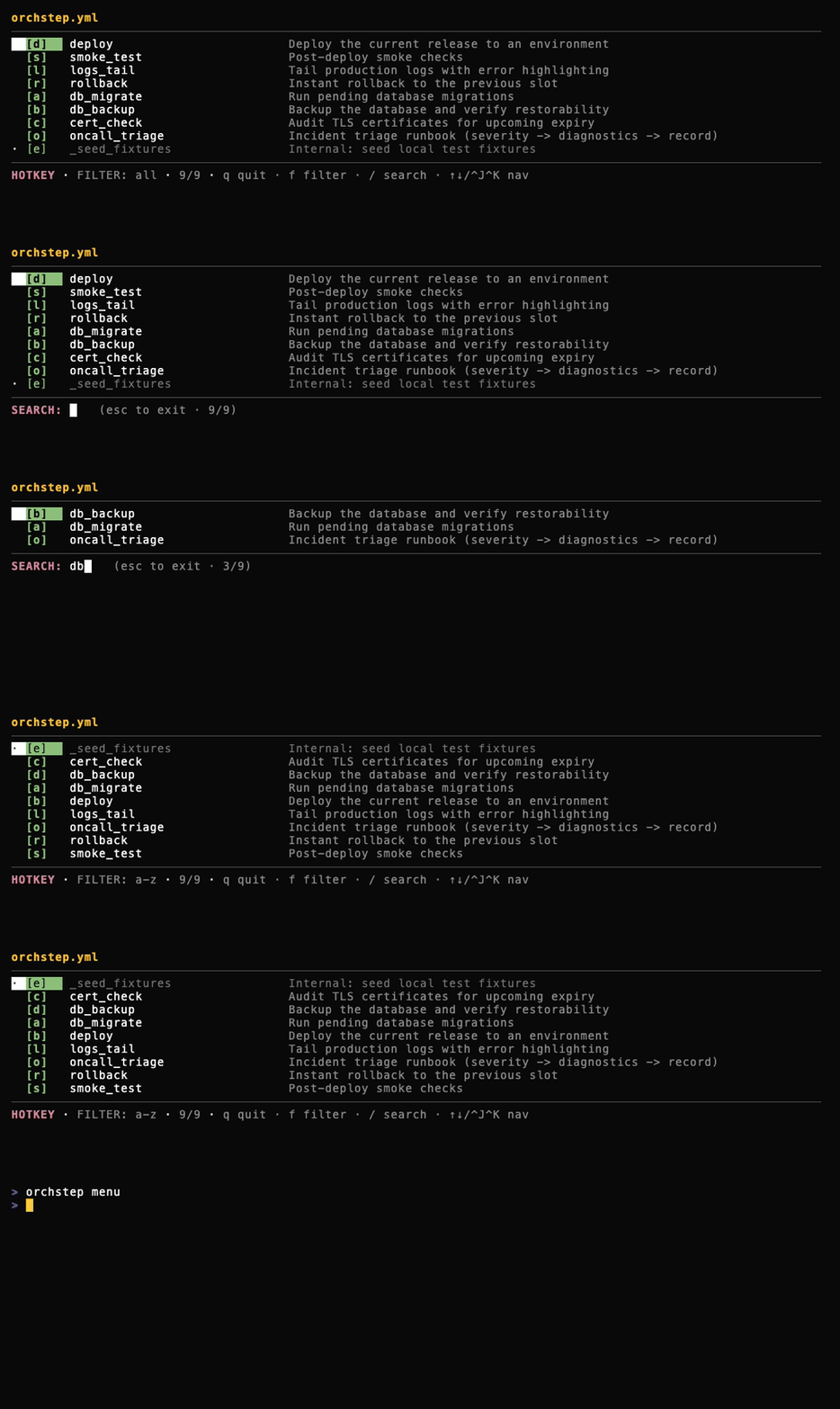
Run orchstep in a repo to get a terminal menu with hotkeys and fuzzy search:
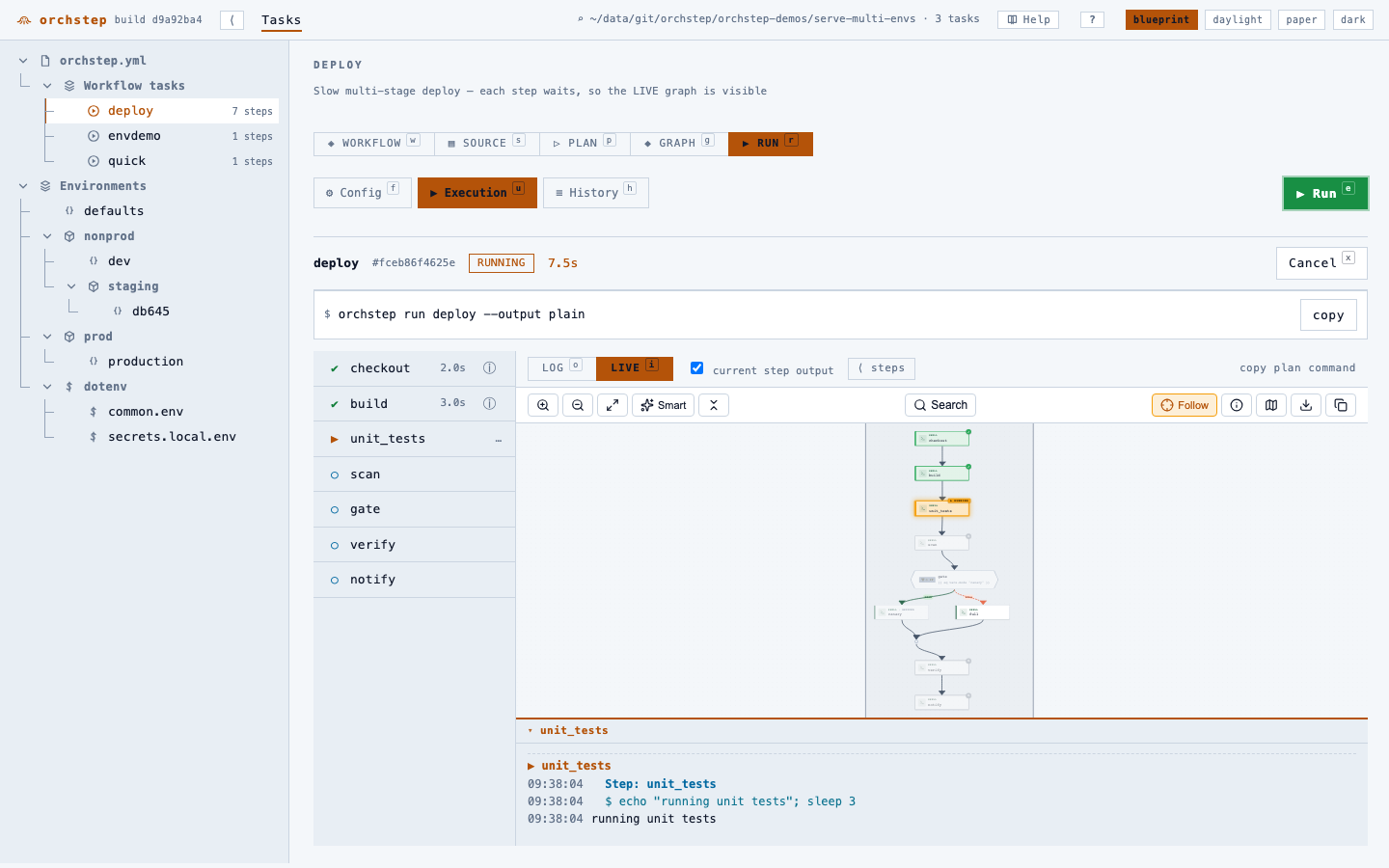
Run orchstep serve for a local web console with tasks, environments, the step graph, live runs with logs, and run history (more about the console):
Small projects too
Even where a 10-line Makefile does the job, it's worth a look. You get the menu and console instead of remembering targets, per-environment variables you can validate, a dry run of every command, run history, and agent skills that can write and run the tasks for you. Nobody has to throw their Makefile away, but there's a lot more on the other side.
Where it's going
Today OrchStep is the runner, so you keep your CI for watching repos, scheduling builds and managing build machines. The web console is the start of the other half. If enough people want it, the plan is to open-source the server and console so the community can grow them into a full self-hosted CI/CD platform on the same engine, with triggers, build agents and approvals. If that's something you'd use or help build, say so in the roadmap discussion.
Try it
        curl -fsSL https://orchstep.dev/install.sh | sh     # or brew / npm / pip / docker
git clone https://github.com/orchstep/orchstep && cd orchstep
orchstep            # opens the menu
orchstep serve      # opens the web console
And if you've been through a CI platform migration yourself, we'd like to hear what it cost. Open an issue or start a discussion on GitHub.
curl -fsSL https://orchstep.dev/install.sh | sh