 Newshot
Xiaomi REDMI Laptops Implement Price Increases Today: Up to 500 Yuan
IT Home, November 23 — Blogger @LazySauce's Diary noticed that several Xiaomi laptops saw price increases of 300–500 yuan starting today:
- REDMI Book 14 2024 Refresh Edition
- REDMI Book 14 2025
- REDMI Book 16 2025
- REDMI Book 16 /14 2026
- REDMI Book Pro 16/14 2026

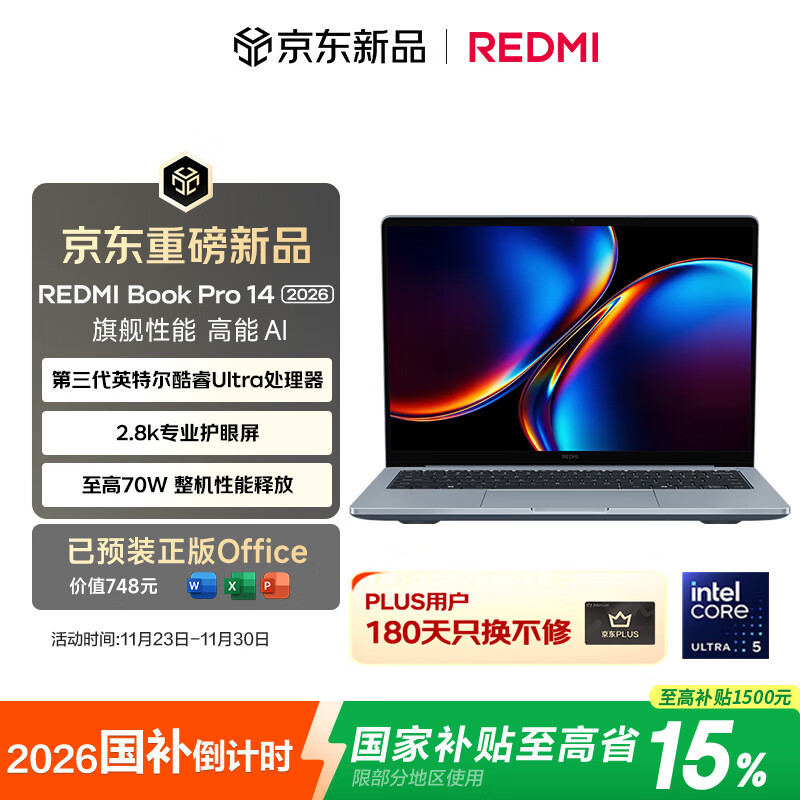
Taking the REDMI Book Pro 14 2026 (Core Ultra5-325, 24G, 1T) as an example, IT Home found that its JD.com listed price has risen from 7699 yuan yesterday to 8199 yuan, or 7899 yuan after stacking coupons.
In addition, the REDMI Book Pro 14 2026 Ultra5-338H, 32GB+1TB version and the Ultra X7-358H, 32GB+1TB version have risen from 8799 yuan and 9499 yuan to 9299 yuan and 9999 yuan respectively.

Furthermore, the REDMI Book 14 Refresh Edition, equipped with a 13th-gen Core i5-13420H processor, 16GB memory, and a 512GB SSD, has seen its JD.com listed price rise from 4699 yuan yesterday to 4999 yuan.
Further reading: The direct driver behind this round of Xiaomi laptop price adjustments is the continued rise in upstream memory chip prices. According to Shanghai Securities News, a Runto Technology research report shows that, affected by rising memory and other costs, the average selling price of domestic laptops on mainstream e-commerce platforms in the third quarter of 2026 was 7759 yuan, up 13.4% year-on-year. Statistics from DRAMeXchange under TrendForce show that the average contract price of DDR 8Gb (1Gx8) reached US$27.5 in October 2026, up 5.77% month-on-month from US$26 in September, and institutions still expect a double-digit increase in fourth-quarter contract prices. Industry insiders believe the source of the price increases remains in the upstream memory segment, and unlike the memory industry's past cyclical supply-demand fluctuations, the real variable is the change in capacity allocation — memory manufacturers are prioritizing advanced-process capacity for high-end computing terminals, tightening memory supply for consumer PCs. Since 2026, consumer memory and flash prices have continued to rise, with some models doubling from the same period last year; costs are transmitted step by step along the supply chain, ultimately reflected in higher complete-device pricing for gaming laptops and thin-and-light laptops. In fact, Xiaomi had previously forecast the possibility of price adjustments. In November 2025, Lu Weibing, partner and president of Xiaomi Group, said at the third-quarter earnings media call that the current memory price increase is a long-cycle phenomenon, driven mainly by the surge in HBM demand brought by AI rather than traditional cyclical fluctuations in the phone and laptop industries; Xiaomi has signed full-year 2026 supply agreements with partners to ensure supply for the year, and may smooth cost pressure through price increases and product structure upgrades. This is not a price adjustment by a single brand. According to Securities Star and Jilin Daily, affected by memory chip price increases, PC makers including Lenovo, Dell, and HP have successively issued price adjustment notices, with terminal retail prices of some laptop models raised by 500 to 1500 yuan; over the same period, new phones from brands such as Xiaomi and vivo with the same memory configuration have seen prices rise by 300 to 500 yuan compared with the previous generation. The Price Monitoring Center of the National Development and Reform Commission points out that, driven by AI server computing demand, the global memory chip shortage continues. At the product level, the REDMI Book Pro 14 2026 and Pro 16 2026 both feature third-generation Intel Core Ultra processors. According to Xiaomi Mall product pages, the Pro 14 2026 highlights up to 70W total performance release and a 2.8K professional eye-care display, while the Pro 16 2026 highlights up to 80W total performance release and a 3.2K professional eye-care display. Among them, the Ultra 5 338H is a third-generation Intel Core Ultra product (codename Panther Lake, Intel 18A process), with a 12-core design, maximum turbo frequency of 4.7GHz, and integrated Arc B370 graphics.
Further Reading
The direct driver behind this round of Xiaomi laptop price adjustments is the continued rise in upstream memory chip prices. According to Shanghai Securities News, a Runto Technology research report shows that, affected by rising memory and other costs, the average selling price of domestic laptops on mainstream e-commerce platforms in the third quarter of 2026 was 7759 yuan, up 13.4% year-on-year. Statistics from DRAMeXchange under TrendForce show that the average contract price of DDR 8Gb (1Gx8) reached US$27.5 in October 2026, up 5.77% month-on-month from US$26 in September, and institutions still expect a double-digit increase in fourth-quarter contract prices.
Industry insiders believe the source of the price increases remains in the upstream memory segment, and unlike the memory industry's past cyclical supply-demand fluctuations, the real variable is the change in capacity allocation — memory manufacturers are prioritizing advanced-process capacity for high-end computing terminals, tightening memory supply for consumer PCs. Since 2026, consumer memory and flash prices have continued to rise, with some models doubling from the same period last year; costs are transmitted step by step along the supply chain, ultimately reflected in higher complete-device pricing for gaming laptops and thin-and-light laptops.
In fact, Xiaomi had previously forecast the possibility of price adjustments. In November 2025, Lu Weibing, partner and president of Xiaomi Group, said at the third-quarter earnings media call that the current memory price increase is a long-cycle phenomenon, driven mainly by the surge in HBM demand brought by AI rather than traditional cyclical fluctuations in the phone and laptop industries; Xiaomi has signed full-year 2026 supply agreements with partners to ensure supply for the year, and may smooth cost pressure through price increases and product structure upgrades.
This is not a price adjustment by a single brand. According to Securities Star and Jilin Daily, affected by memory chip price increases, PC makers including Lenovo, Dell, and HP have successively issued price adjustment notices, with terminal retail prices of some laptop models raised by 500 to 1500 yuan; over the same period, new phones from brands such as Xiaomi and vivo with the same memory configuration have seen prices rise by 300 to 500 yuan compared with the previous generation. The Price Monitoring Center of the National Development and Reform Commission points out that, driven by AI server computing demand, the global memory chip shortage continues.
At the product level, the REDMI Book Pro 14 2026 and Pro 16 2026 both feature third-generation Intel Core Ultra processors. According to Xiaomi Mall product pages, the Pro 14 2026 highlights up to 70W total performance release and a 2.8K professional eye-care display, while the Pro 16 2026 highlights up to 80W total performance release and a 3.2K professional eye-care display. Among them, the Ultra 5 338H is a third-generation Intel Core Ultra product (codename Panther Lake, Intel 18A process), with a 12-core design, maximum turbo frequency of 4.7GHz, and integrated Arc B370 graphics.
Advertising statement: External redirect links contained in this article (including but not limited to hyperlinks, QR codes, passwords, and other forms) are used to convey more information and save you selection time; the results are for reference only, and all articles on IT Home that contain external links include this statement.
Related Articles
- Xiaomi REDMI Book 2027 goes on sale today: from 6799 yuan, from 5779.15 yuan with national subsidy
- Xiaomi REDMI Book 2027 laptop launched: from 6799 yuan, free 20000mAh power bank with first sale
- Xiaomi REDMI Book 14 2027 laptop "Nebula Purple" unveiled, to launch October 27
- Xiaomi teases REDMI Book 14 2027 laptop: all-new Super Xiao Ai 2.0, supports remote power on/off
- Xiaomi REDMI Book 2027 series laptops officially announced for October 27 launch, 72Wh battery focused on mobile office
- Xiaomi prepares REDMI Book 16 2027 laptop, optional Intel Core 5 processor 320