 Newshot
- AI safety has many moderately cursed questions (as opposed to the extremely cursed questions of s-risk, which we don’t discuss here).
- Taboo prevents open discussion of these cursed questions in AI safety spaces outside LessWrong.
- When cursed questions are left unasked, everyone stays confused or reaches private conclusions alone.
- Spreading decoupling norms, so that cursed questions can be discussed more openly, should be an explicit target of AI safety acculturation.
You’re having Thai food with your fiancée. The wedding is two months out, and you can’t slurp your green curry with the usual gusto. That cursed question keeps buzzing around your head like a hungry fly after your crispy tofu. You’ve been rehearsing ways to broach the subject:
“I was thinking, maybe we should get a prenup? I don’t think anything will happen, it’s just…”
Not that. Might as well say, “You’re cool, but my lawyer told me not to trust you.”
The prenup question is wrapped in taboo. Asking for one feels like pre-filing divorce papers. Yet even while the words stay unspoken, the thought can’t be undone. Unasked questions still exist, just internally.
AI safety has its own cursed questions. In this essay, I discuss four:
- Are we better off with a catastrophe big enough to summon the political will to pause AI, but small enough that we survive?
- Should AI safety proponents prepare to win a culture war via AI superpersuasion?
- Will there come a time when stopping the AI race is infeasible and we must pick a horse?
- When do we stop working on AI safety and make end-of-life arrangements?
I. Waiting for Chernobyl
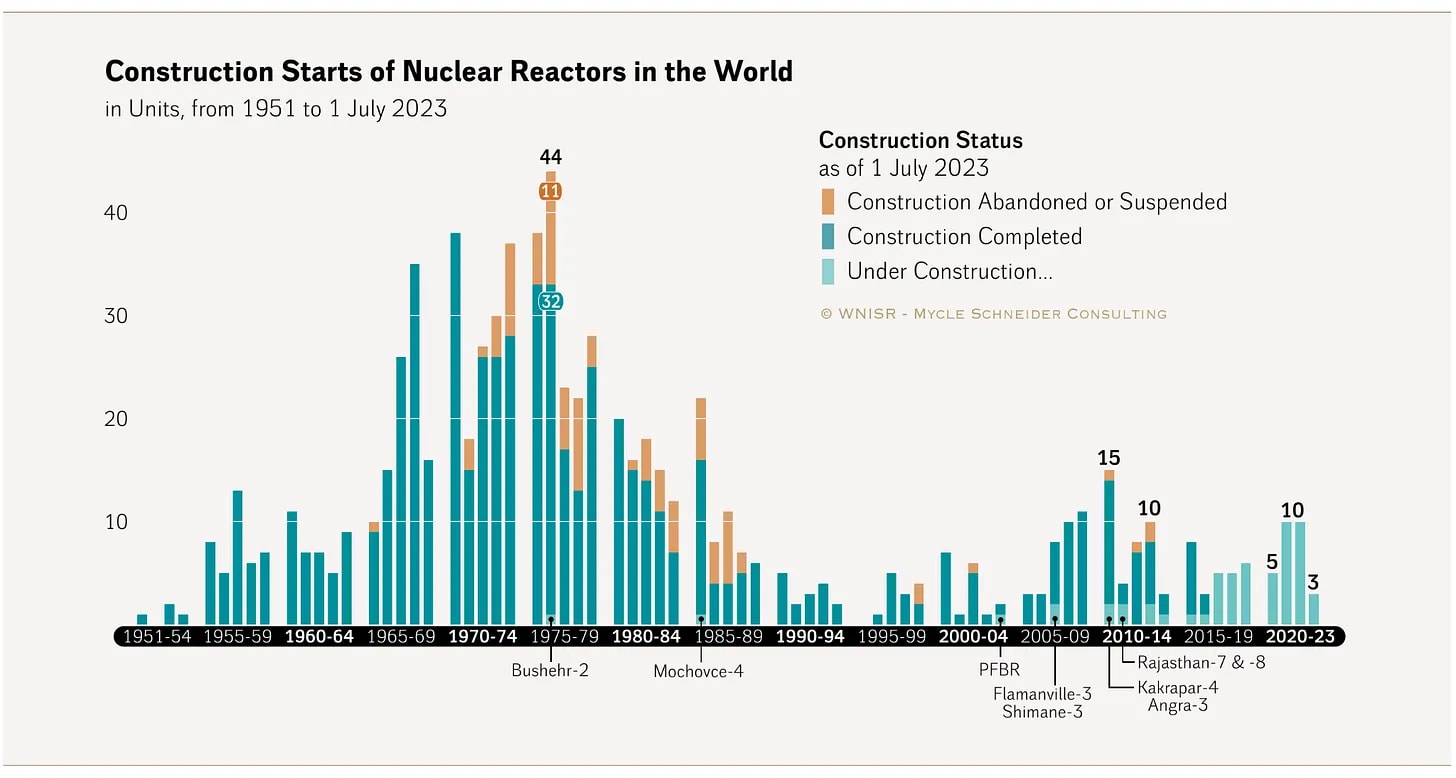
In 1986, Chernobyl exploded. The next year, Italy voted against nuclear energy. The global nuclear construction boom never recovered. In 2010, Germany extended the lifetimes of its reactors but reversed course after the Fukushima disaster months later. Whatever you make of these choices, disaster is a political accelerant like no other.
AI progress has had its warning shots. After the Hugging Face incident, OpenAI paused RL for two weeks and strengthened safety protocols. Yet much AI safety work makes such incidents smaller and rarer. Monitors catch accidents before they become public disasters. Prosaic alignment may hide misbehavior without curing it. We might be removing the warnings, not the x-risk.
If you say you want a warning shot, people may question your intentions, and if disaster comes, they may blame you for encouraging it. Genuine accidents could look like sabotage. But even when unspoken, the question remains:
Is the best-case scenario an AI Chernobyl: a catastrophe big enough to summon the political will to pause AI but small enough that we survive? Or is it continued, apparently safe progress—and whatever comes after?
II. Wars of influence
In 2025, University of Zurich researchers revealed that they had deployed AI bots with fake personas to debate people on r/changemyview. The bots were far more persuasive than human redditors. The troubling implication is that, as we near superintelligence, our opponents will gain superhuman powers of manipulation.
Persuasiveness has never been a good proxy for truth. Scott Alexander illustrates the power of good (human) documentary-makers:
The National Institute of Health can make an engaging human interest documentary about a smoker who got lung cancer. And the tobacco companies can make an engaging human interest documentary about a guy who got cancer because of asbestos, then was saved by tobacco-sponsored research. Opponents of Brexit can make an engaging documentary about all the reasons Brexit would be bad, and then proponents of Brexit can make an engaging documentary about all the reasons Brexit would be good. If you get good documentary-makers, I assume both will be equally convincing regardless of what the true facts are.
Now replace “documentary-makers” with “future AIs,” and multiply the effect by [insert_big_number]. Uh-oh.
Should AI safety proponents prepare to win a culture war via superpersuasion? Must we use AI to win the public argument before others destroy our cause? This could mean making true arguments more accessible. It could also mean manipulating people into supporting policies they wouldn’t otherwise endorse.
Recently, both sides of the AI debate have been churning out AI Doompop videos via Suno and Opus 5.5. Should we gallop into this arms race?
III. Picking a horse
Joseph Rotblat was a physicist who worked on the Manhattan Project. At first, he resisted building the bomb. In his words:
I had this dilemma: on the one hand, as a scientist, I felt it’s against the ideals of science to work on a bomb; on the other hand, the ideals of science were endangered if Hitler and his philosophy of Nazism were to prevail. So I fought with myself throughout the summer of 1939, this dilemma. By that time I already was in England, and I remember, ‘What should I do? Should I begin to work or not?’ Eventually the decision was made for me by the outbreak of the war in September 1939, and immediately my country was overrun at the time, and I see the great might, the military might of Germany, and I felt the immediate crisis should take precedence. So therefore I decided, at that stage, that we ought to work on the bomb.
Rotblat feared the Nazis would build the bomb first. He chose “the good side” over no side at all. Once it was clear Germany had given up on nukes, he quit. The Trinity test happened seven months later.
Will there come a time when stopping the AI race is infeasible and we must pick a horse, as Rotblat did? Each AI lab argues, “The race is inevitable, so help us win.” The frontrunner says, “Help us widen the gap, so that we have room to breathe and focus on safety.”
Will one of them ever be right?
IV. Bunkers and Lambos
“What would you do in a zombie apocalypse?”
Idealists would build a resistance or work on a cure. But when these avenues reach dead ends, they join the pessimists: Gather food. Stock firewood. Build a bunker.
“What would you do if you had one month to live?”
One person says they’d curl up in bed and cry. Another would spew their musings on life into a long letter addressed to no one. Others would go home to their families, tick off bucket-list items, or gorge themselves on Korean barbecue. A few would go shopping for Lamborghinis.
Vishal Prasad says: Silence, Doomchud.
I’m so sick of doomchudding. I agree with you that the probability of ASI doing omnicide is high. So what? That does not mean I welcome having my dinner ruined listening to you mope about how you’ll never have kids. If a planet-killer asteroid were to hit Earth tomorrow, I’d expect you to not go out of your way to ruin my mood today—indeed, I’d appreciate it if you even exhibited some courage in the face of danger. [...] From the war-poems of Wilfred Owen to the Bhagavad Gita, from Hamlet to The Leopard, there are thousands of stories available to you about death, and the death of civilizations. Go read those and let me eat in peace.If you want to spend your last year alive in an orgiastic fervor, go ahead. Just don’t be a sadsack about it. Spread some joie de vivre while you’re at it. Wouldn’t that be more defiant?
I’m so sick of doomchudding. I agree with you that the probability of ASI doing omnicide is high. So what? That does not mean I welcome having my dinner ruined listening to you mope about how you’ll never have kids. If a planet-killer asteroid were to hit Earth tomorrow, I’d expect you to not go out of your way to ruin my mood today—indeed, I’d appreciate it if you even exhibited some courage in the face of danger. [...] From the war-poems of Wilfred Owen to the Bhagavad Gita, from Hamlet to The Leopard, there are thousands of stories available to you about death, and the death of civilizations. Go read those and let me eat in peace.
If you want to spend your last year alive in an orgiastic fervor, go ahead. Just don’t be a sadsack about it. Spread some joie de vivre while you’re at it. Wouldn’t that be more defiant?
Which, you know, if chasing the Kierkegaardian picturesque staves off the abyss for you, more power to you. But I’ve had a surprisingly difficult time curing people’s AI depression by sneering at their cowardice. Most doomers outside the rationalist bubble are graduating from “Should I apply to a PhD program?” to “How many months of canned food should I hoard?”
Alignment research and AI pause advocacy are the two bets made in the light; many more are made in the shadows. I know plenty of people, recently doom-pilled, who have retreated into those shadows. Whether they go through the motions or quiet-quit, panic-attack or find Jesus, disaster-prep or bucket-list, they are the dark matter of the doomer world. We should address their cursed questions with grace, not sneers.
Lifting the curse
In 2011, a web developer named Jon Underwood wanted a space where people could talk openly about death. He invited a few strangers to his house in London and fed them tea and cake as they discussed dying. The first “Death Café” was born. The concept took off, and there have since been over 25,000 Death Cafés in 100 countries. There is even a website.
AI safety has no Death Cafés outside Berkeley, CA. Instead, it has seminars, where we talk about respectable topics like activation steering and scalable oversight. Then there are the lunch meetings with close friends. We look left and right, lower our voices like children in church, and ask, What do you really think? Is RSI coming in 2027? Should I go all in on ANT?
Not long ago, AI x-risk was itself a cursed question. Skeptics in the early 2010s did not believe deep learning would take off. In the late 2010s, they doubted AI would generalize across tasks. In the early 2020s, they assumed models would not develop long-horizon goals. Afraid of ridicule, worried researchers learned to either keep quiet or camouflage their real concerns in talk of “long-term impacts.”
In May 2023, the Center for AI Safety published a statement declaring that mitigating the risk of extinction from AI should be a global priority alongside pandemics and nuclear war. Hundreds of researchers and executives signed. Many may have feared making such a bold claim alone; signing alongside hundreds of others was safer. Earlier that month, Geoffrey Hinton left Google to “talk about the dangers of AI without considering how this impacts Google.” His reputation was great enough to withstand whatever backlash followed. Most others could only sign a document; still, AI risk was leaving the lunch table.
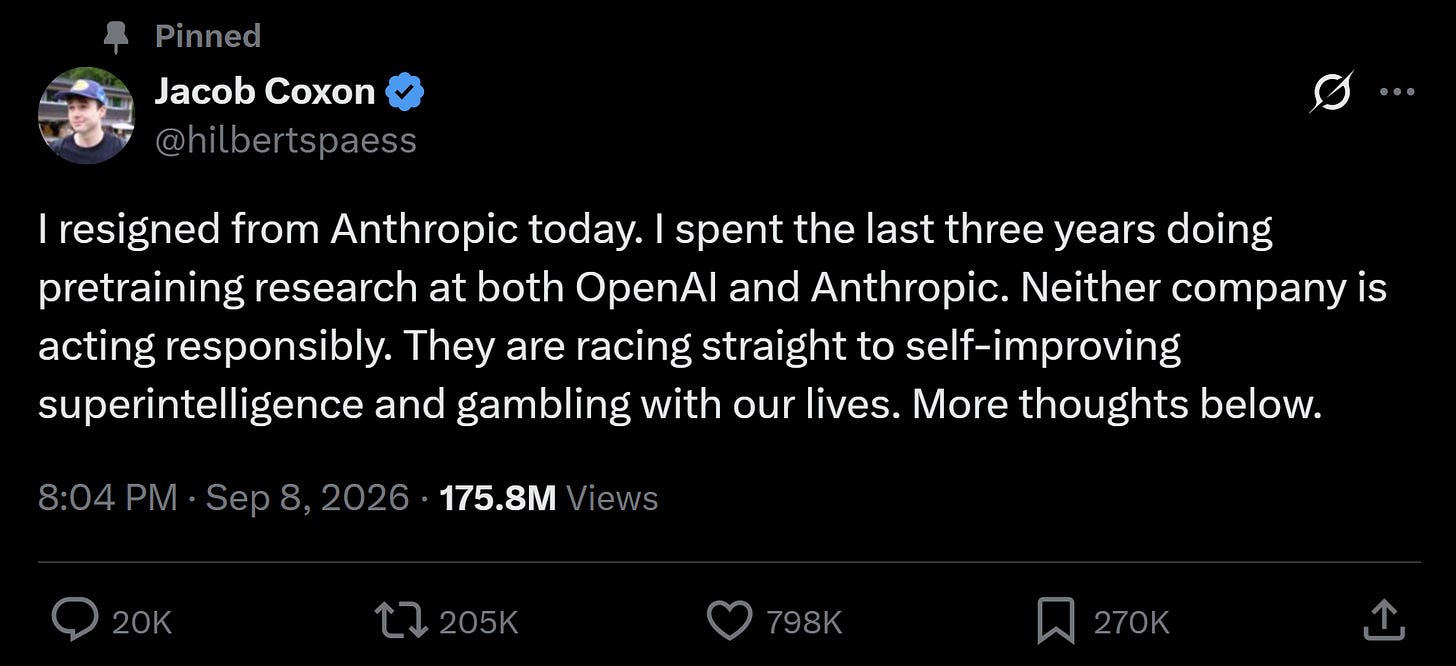
Three years later, this tweet from Jacob Coxon got 175 million views:
And then this happened:
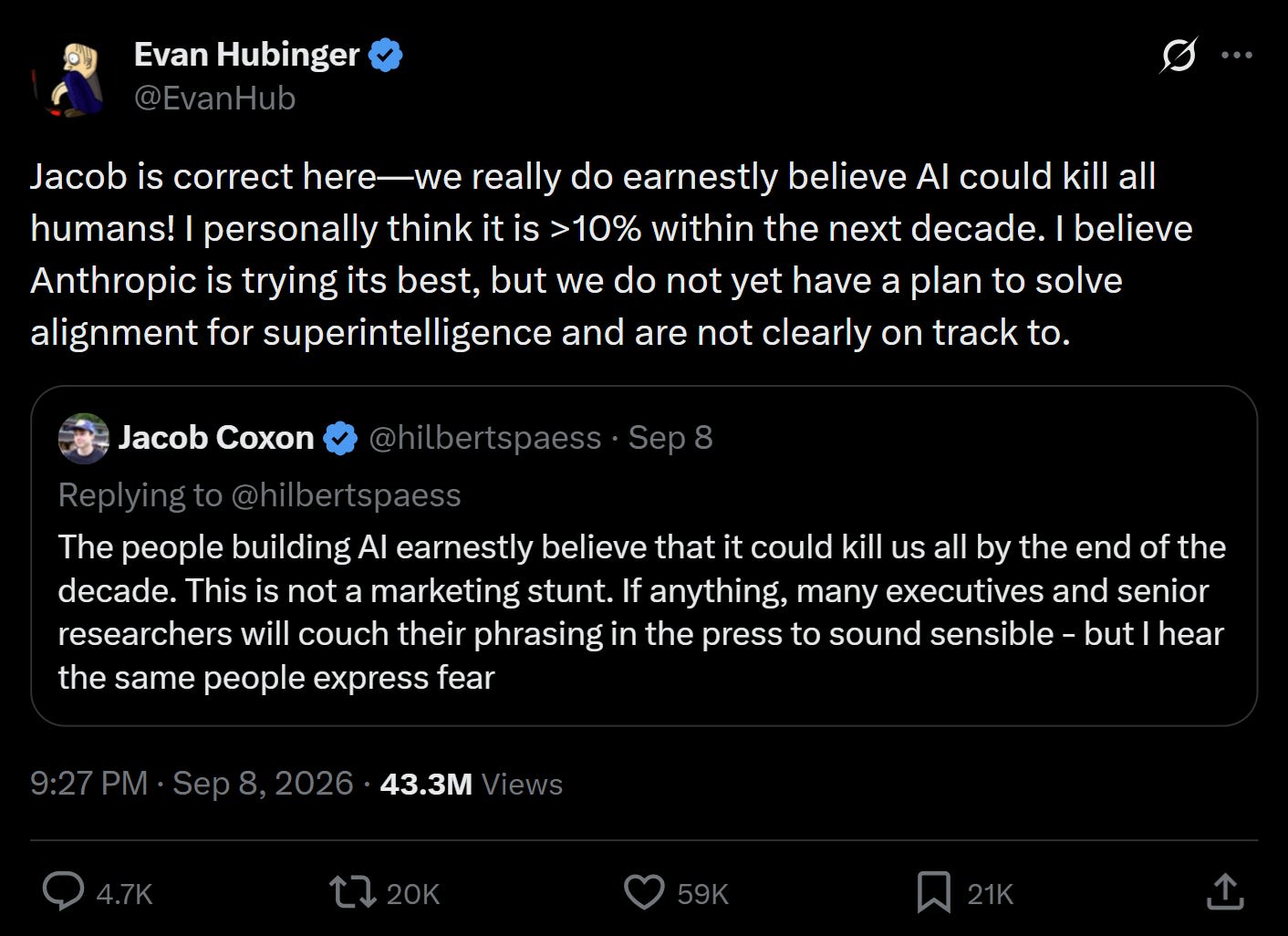
Jacob Coxon soon went on CNN and The Daily Show to talk about x-risk. AI safety was thrust into the public imagination, and other researchers felt safer sharing their worries. The credit doesn’t belong to Coxon and Evan Hubinger alone, just as Franz Ferdinand’s assassination did not single-handedly cause WWI. The public had long felt uneasy about automated coding, AI discoveries, and trillion-dollar valuations. Over the years, thousands of advocates turned that private unease into public discourse, and the Overton window moved. AI x-risk has won its right to be discussed. Many of its subquestions have not.
These questions are social dark matter, the things that many of us think about but few discuss openly. Public silence creates a veneer of consensus that masks our deep collective unease.
Sometimes, people like Geoffrey Hinton and Jacob Coxon break the silence. So does Eliezer Yudkowsky’s Only Law Can Prevent Extinction, which addresses the cursed question, “When should AI safety advocates resort to vigilante violence?”
Answer: never.
This was obvious to some and news to others. Without Yudkowsky’s post, each of us would have answered the question alone, through the lens of our own biases.
Yudkowsky has a history of discussing cursed questions. People are not surprised when he answers a new one, so he can share valuable thoughts at little social cost. But many of the others who ask cursed questions are extremists who don’t hesitate to voice toxic opinions. These people tarnish the questions with their own disagreeableness. Taboo selects for a topic’s most unabashed advocates, who in turn make it more taboo.
I don’t know the answers to my cursed questions, but I want us all to be able to ask them openly.
Too often, we fear that our questions will be heard as confessions and that we will be crucified just for asking. Mention a prenup, and your fiancée hears, “Our marriage will crash and burn.” This is the nature of cursed questions. Their dark matter distorts perception.
Astronomers cannot see dark matter, but they know it bends light, and they account for it. So must a good listener. Words are not always what they first feel like. A question is not an endorsement of the vilest answer. An argument for X does not mean the arguer wants X. We should explicitly teach these decoupling norms to AI safety newcomers.
Taboos can take decades to fade. AI progress will not wait that long. How quickly we can clear the dark matter may determine whether we get to make hard choices before it is too late.