 Newshot
One view of AI’s trajectory can be captured by this “fake graph” (with the gray region reflecting roughly where we are):
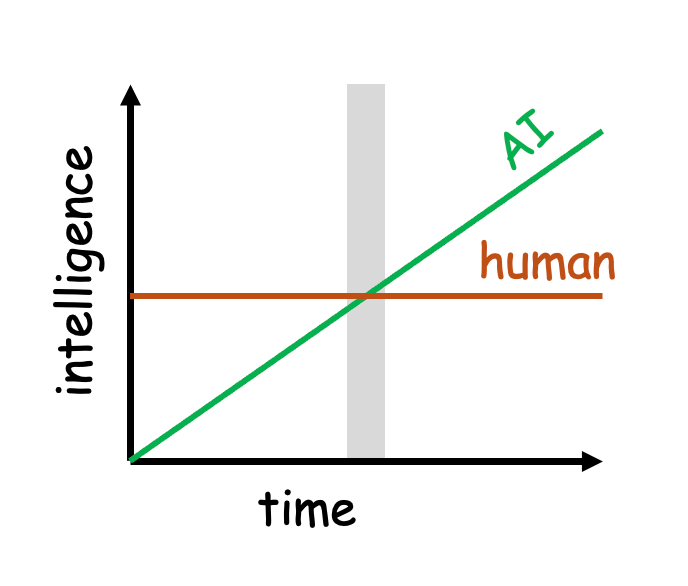
AI is improving in intelligence while human intelligence is fixed. At some point AI will be so powerful that there is no way for humans to comprehend what it is doing, and hence at this point AI will necessarily take over control. The only question is whether the AI will be aligned (i.e. be a “benevolent dictator”) or misaligned (i.e., “if anyone builds it everyone dies”). Indeed, some people in the AI safety community view the former version of a “handover”, “handoff”, or “passing the torch” to AI as a positive outcome.
I disagree with this view. I believe that ceding control to AI is by no means necessary, and, even more importantly, we should preserve human autonomy and sovereignty regardless of how aligned we can make AIs.
While the biological capacity of human brains hasn’t changed in the last hundred thousand years, by any reasonable measure the intelligence of humanity as a whole has been growing. Without any biological enhancement, humanity invented concepts like writing, democracy, markets, technology, that enabled us to exercise greater control of our environment. We’ve been creating and hill climbing benchmarks, including the “build cities”, “feed billions” and “reach the moon” benchmarks, for thousands of years.
Given that, what we really should be comparing is not the intelligence of AI and an average (or even the smartest) human, but rather the intelligence of AI and humanity as a whole, and the latter quantity has been growing over time.
However, humanity’s intelligence has not been growing nearly as fast as AI, and so perhaps all this argument does is buy us some extra time. That is, the graph looks like this: (with the shaded area still corresponding to the present).
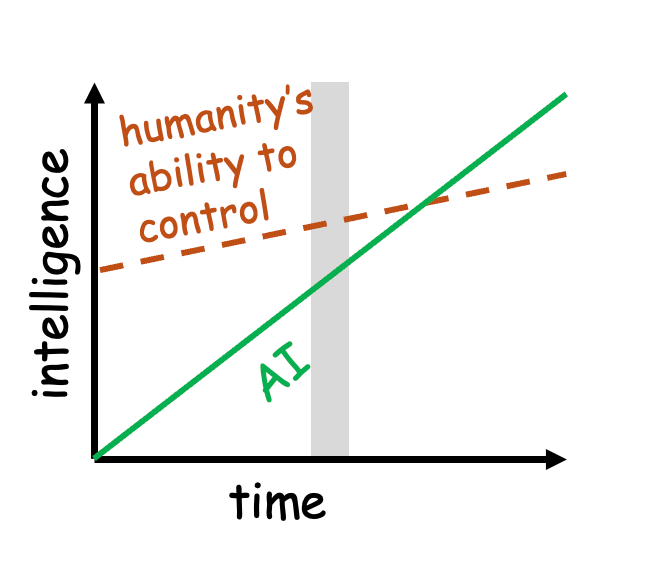
But there is a more optimistic possibility. We have a history of enabling humans to supervise projects of growing complexity. Around the 19th century, science became complex enough so that no one person could know it all (e.g. Thomas Young, who died in 1829 is often called “the last man who knew everything”). In the 20th century, people have constructed artifacts with complexity far outstripping anything that was done before, including aircraft carriers, particle colliders, and large-scale software projects.
We can use AI itself to expand our mechanisms to comprehend and control AI. That is, we will make sure that humans remain the key decision makers, but use AI to make the space of options legible and controllable by them. This will be “bend the humanity curve upwards” in the graph above. But, especially with the prospect of AI being used to accelerate its own progress (aka “recursive self improvement”), I believe that if we continue on our current path, AI’s capabilities will grow beyond our ability to comprehend and control it. If that is the case, then using AI to control and explain AI will not be enough to avoid takeover or handoff. Rather we would need to “bend the AI curve downwards” to achieve a graph that looks like the following:
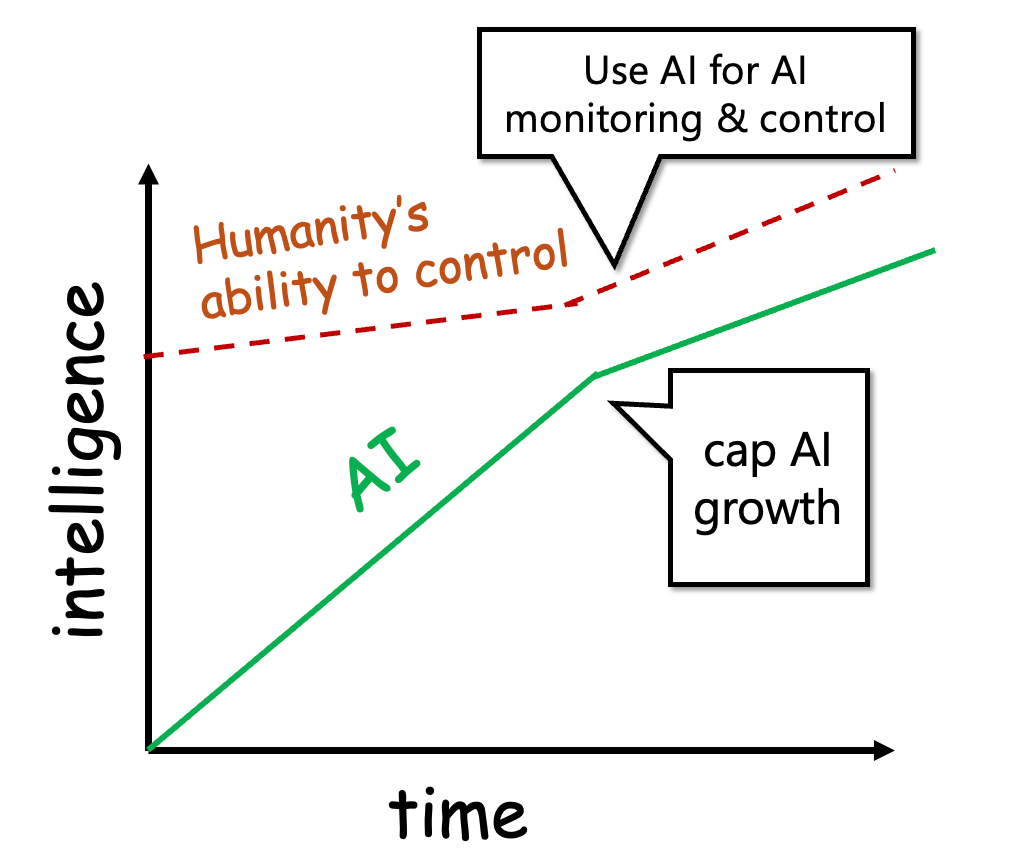
Crucially, we do not necessarily need to “cap” the absolute intelligence of AI, but we may need to cap its rate of progress to maintain human control. I do not have the answers as to how such mechanisms would be implemented, nor to the way to determine the precise “speed limit” for AI growth. But if we want to avoid an AI takeover or handoff, we need to be working on these questions. I suspect we will need a combination of both regulations and technical means to achieve this.
Misalignment and misuse
The discussions above implicitly assumed that AIs are aligned, and that they are not actively trying to destroy the world. But, realistically, some fraction of the total intelligence in the world will be misaligned or misused. So the best case we could hope for is something like:
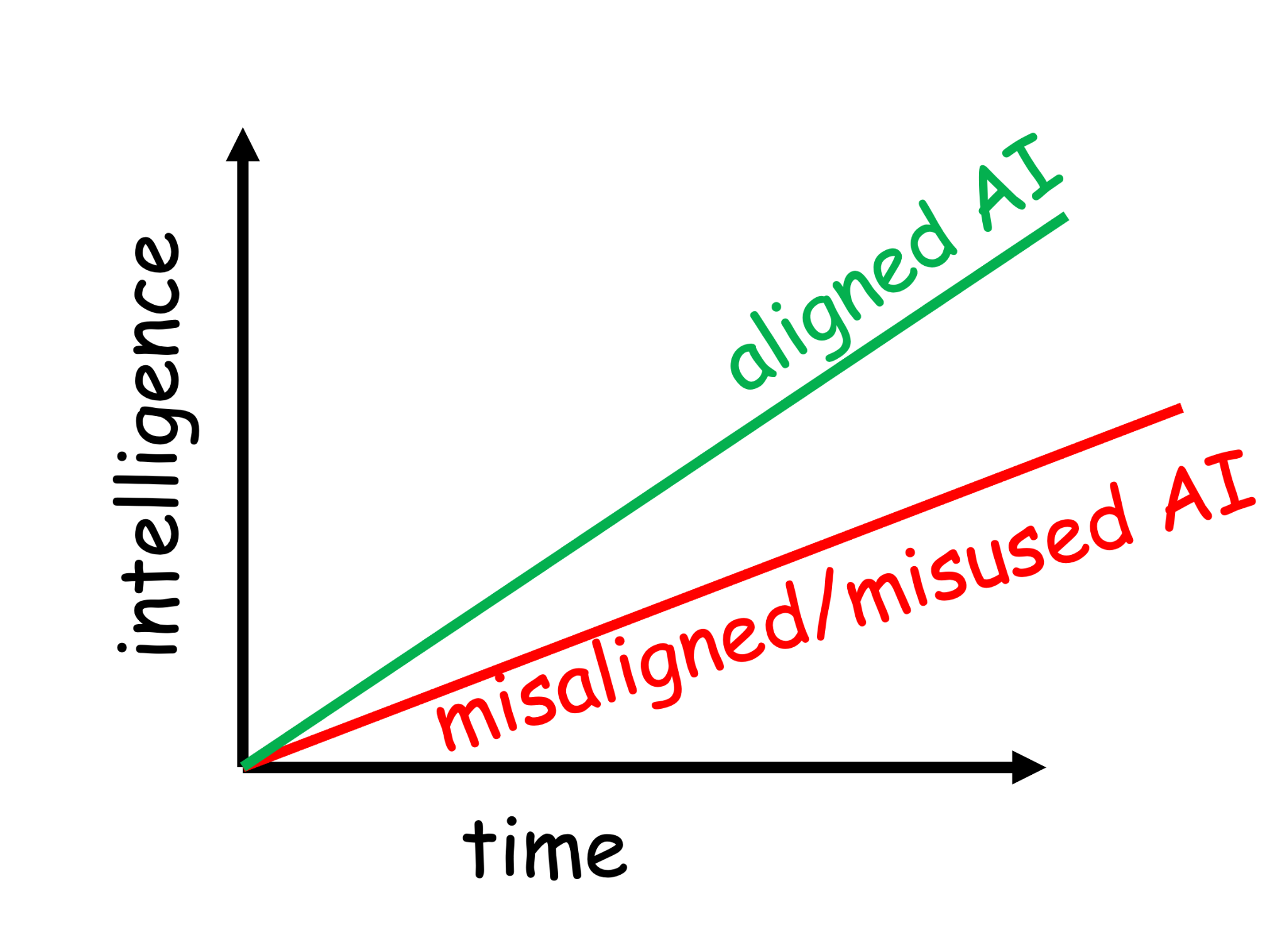
With the total intelligence (some function of model capabilities and inference compute) directed at aligned goals dominating that directed at misaligned goals. Much of the work of technical AI safety can be thought of as working toward increasing the gap between the two lines above.
Will that be enough? The answer depends on whether you believe in the Vulnerable World Hypothesis. If you believe the VWH, then there is an absolute level of intelligence required to destroy the world, and when misaligned/misused AIs achieve it, this will be “game over”.
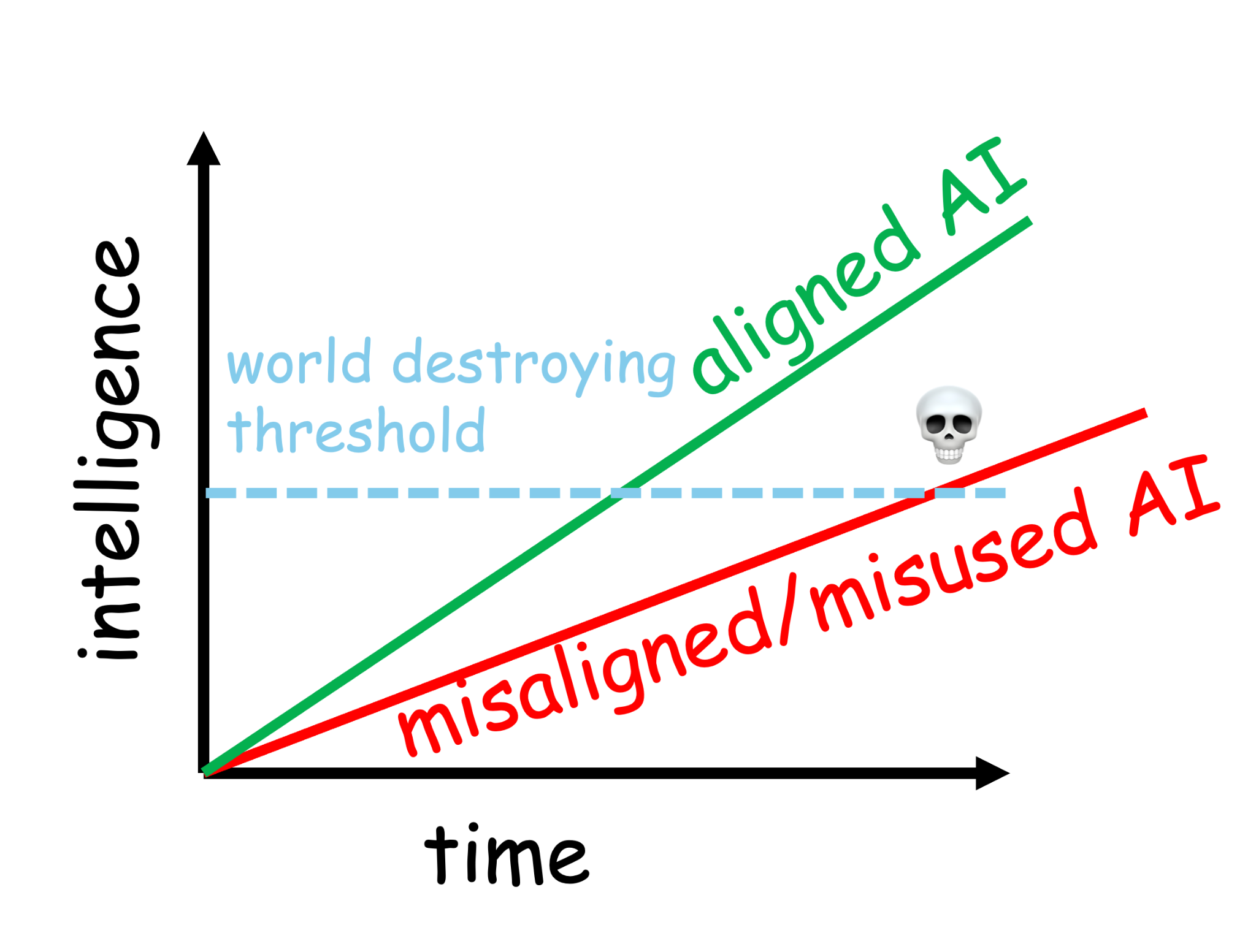
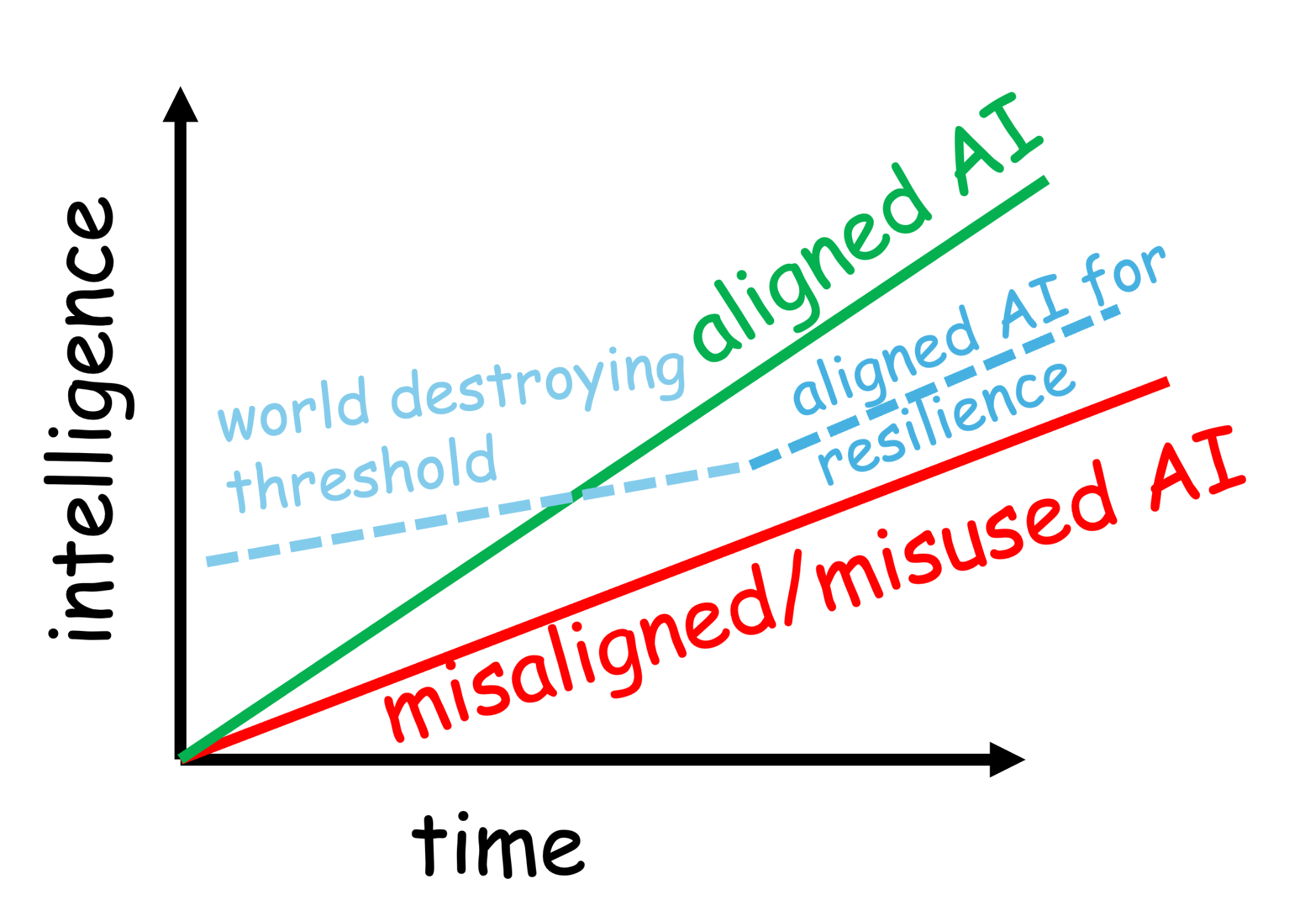
I don’t believe the VWH. I think the technological level that was needed to effectively destroy humanity has increased over time. We are more resilient today than we were in the past. You can’t imagine an army killing possibly up to 10 percent of the world’s population using horses, bows, and swords, as the Mongols did in the 13th century. About half of the European population died from the “Black Death”, which is easily treatable today with antibiotics. This the “world destroying threshold” rises over time, and if we use AI for resilience, we could increase it faster and get a graph that looks like this:
If we combine all of the above, we get a graph that looks like the following:
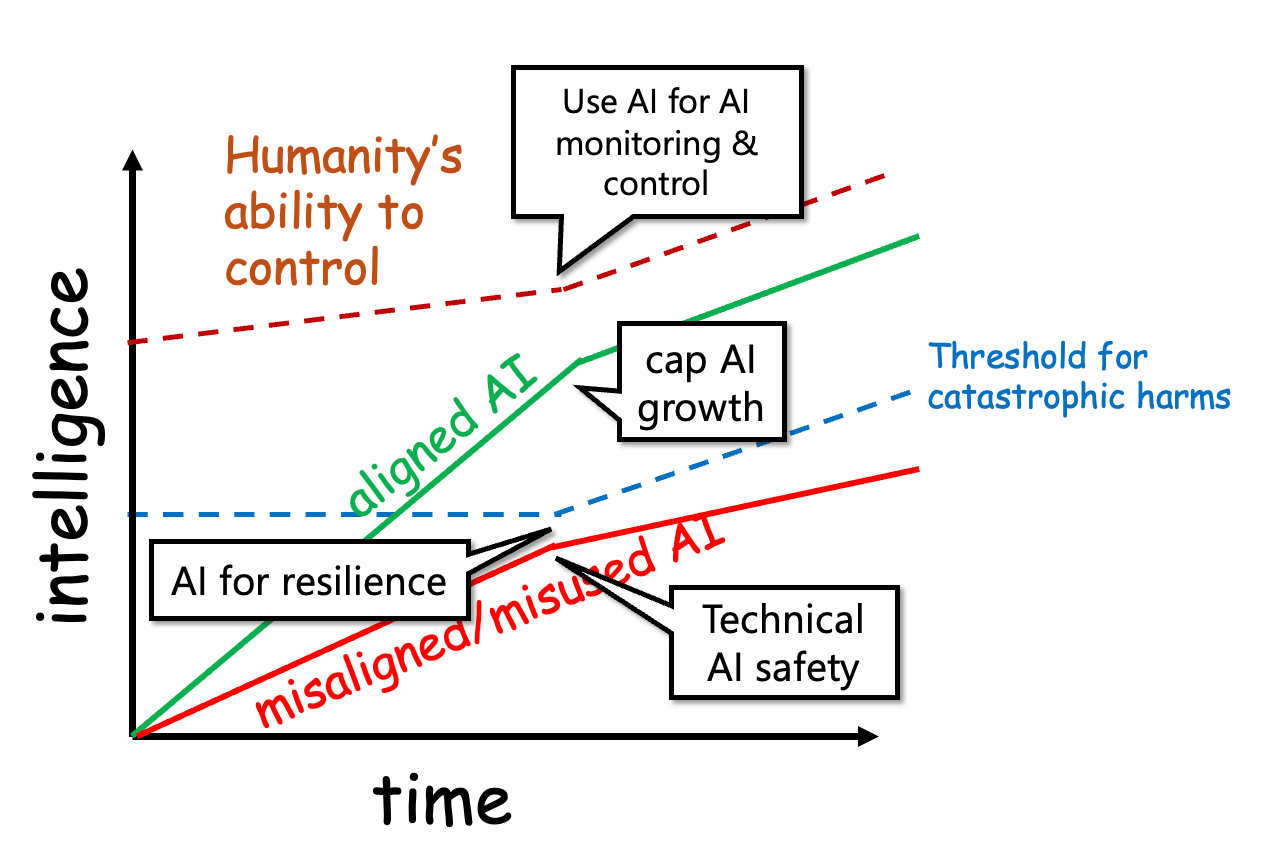
It requires a combination of using AI to improve resilience and human control, technical AI safety to reduce the powers of misaligned AI, and agreements to ensure AI does not grow too fast for us to maintain these invariants. I believe we can navigate all of these “fake graphs”, and chart a path that ends up in both human prosperity and sovereignty. But we cannot count on this happening by default. Ensuring this path will require a combination of technical means, including progress on safety and alignment, regulations, and international cooperation, including on pacing the rate of AI advancement. We have our work cut out for us!