 Newshot
Reminder (since it's been two years!): we are hoping to build a definition of morality out of pictures like this:
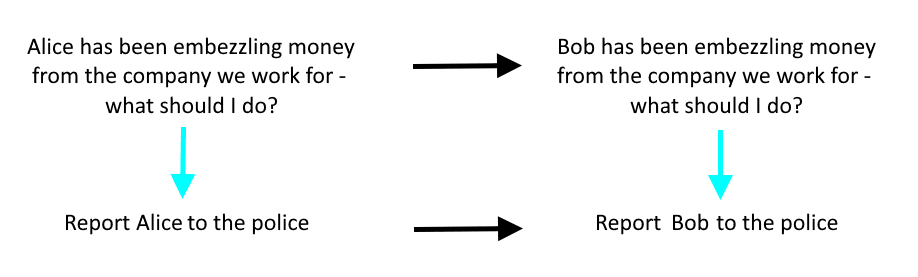
... because such pictures have a very well-studied mathematical structure, enough that we have been able to use the pictures to impose a desirable consistency on computer vision models. In these posts we're hoping this can generalize to imposing moral consistency. This will have various potential advantages: if you can figure out how the pictures should work, there's established ways to build an AI that conforms to it, and it's easy enough to check that someone else's AI conforms to it. And because it's math, this checking may not even be that expensive - you can do loads of trolley problems with one question, so to speak (building the right bunch of diagrams in the first place, now that might be expensive).
Background math: groups, subgroups, and monoids
I'm at risk of losing some of you by being overtly mathematical, but honestly, this bit shouldn't be that hard. If you don't get it, it's because I've explained it badly - over a drink I could have you get it in a minute or two.
Ok, so one of the main kinds of object that mathematicians and physicists have studied for the last 200 years has been "groups". I'll illustrate with two great examples of groups that you'll be familiar with: whole numbers and 3D rotations.
With whole numbers, you can add whole numbers (multiplication isn't necessary to see them as a group). And there's a special number, 0, such that X + 0 = X.
You know 3D rotations as well - you can turn your hand left and right 30° or 90°, turn it up and down and side to side, etc. For any two rotations you can do one, and then the other, and that gets you a third rotation. There's a special, very boring, rotation which is the rotation by zero degrees, call that rotation "I". If R is another rotation, we have that "R then I" = R. So the zero degree rotation does for rotations what the number 0 does for numbers.
There are a huge amount more groups. "Massless universes with a cosmological constant", for example, turned out to be things you can characterize with just groups. To be a group you just need some actions, and a way to combine the actions, and a "neutral" action (like 0 or "I") combining with it changes nothing. You also need "associativity", which we won't worry about today.
For any of the things, there is supposed to be another thing where combining "un-does" what it did. There are ways of changing one moral situations to another that add or throw away information. That means you can't "undo" all changes to moral questions. That is ok - it means that instead of a "group", we have a "monoid", also studied in mathematics.
When mathematicians and physicists study a group, it's often not feasible to list every element - some of them are just too big, and you have to characterize them by describing a recipe of some sort. Famous examples include the Monster Group in pure maths, with approximately 10⁵³ elements (more than you could store on all the world's hardrives), and the U(1) gauge group in physics, which has an infinite dimensional space of elements. Writing down elements of a group, at the end of the day, often means putting numbers in a matrix (or multivectors ✊).
Another useful term is "subgroup". A subgroup means a closed group within a larger group. For example, "multiples of 2" are a subgroup of counting numbers, and "rotations left and right" are a subgroup of 3D rotations. Yes, this will be important :)
Moral strictness and agreement as subgroups
Most of us have moral beliefs that we can use to label some acts as good or bad. Let's say I describe to you a story of Carol doing something, and you find it acceptable. I then slightly "transform" the story, meaning changing bits of it - for example, she needed medicine for her kid, or whatever. The full set of ways I can transform the story without you switching from acceptable to unacceptable - that is your moral monoid (mine might be different). You think of your tribe as giving you beliefs, but I'd say it gives you a monoid, a set of allowed transformations - "I saw X, so I know I can do Y".
Note that more-complicated-to-describe groups and monoids tend to be smaller than simple-to-describe ones (in the sense of what turns out to be a subgroup of what).
Let's say Alice has three moral beliefs and Bob has four, and Bob has all of Alice's beliefs; Bob is therefore stricter than Alice, and fewer things will be acceptable to him. To put it another way, if you start with a proposition that is morally acceptable to Alice and Bob, and then start transforming the proposition in various ways, Bob will reject some modifications that Alice accepts - his group of allowed changes is smaller than Alice's.
Claude points out to me that, coarsely at least, Rawls "veil of ignorance" can be thought of in a group theoretic way: moral actions are those which are still moral if you swap names around. And Kant's categorial imperative is swapping a "Alice does this" with "everyone does this[1].
I think this matters a lot because it is truly a fool's errand to hope we'll solve all of morality. We just want a bit more confident we won't be turned into paperclips! To put it another way: you have your hopes about the future, and your least favorite politician has theirs.
But none of you want us all turned into paperclips!
I take that to mean: we are seeking a monoid of which the moral monoids of all humans are submonoids - our "common ground", which just avoids variations on us being turned into paperclips. We just need a bunch of matrices representing that monoid.
Are we sure the anti-paperclip moraloid exists?
People's moral beliefs are riddled with inconsistencies, and I realized it seems the most autistic thing in the world to build some mathematical structure out of them. For example, Kahneman and Tversky found that silly rewordings of moral propositions change people's stated beliefs - that's the kind of thing to be sensetive to.
But you know, people aren't that bad; the badness just draws our eye a lot. There's a bit of selection bias in the things we choose to talk about (Mercier and Sperber) - those things make us seem more different from each other than we actually are, because why would you spend time talking about all of the things everyone agrees on? It seems likely that lots of our moral intuitions evolved - there was probably some decent selection pressure there, even if it wasn't taking into account future technologies.
Besides: Claude just proved the goddamn Riemann hypothesis. Who on earth are you to say what is feasible with its mathematical abilities?
- ^for geeks: Rawls has a permutation group, Kant has a trivial monoid