 Newshot

AI Cuts Costs and Adds Laughs, as the World Is Forced to Accept an Aesthetic Downgrade
2026-11-23 17:53
In almost any thread discussing aesthetic education in China, you'll see netizens hold up Japan as the comparison.
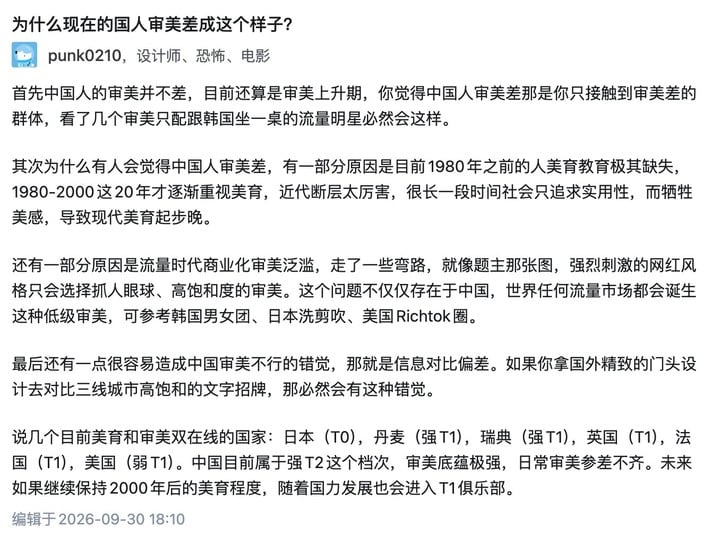
But Japan has started using AI like crazy.
Recently, Kindai University's official website suddenly went viral on social media. Open the page and you're greeted by promotional footage reeking of AI — the university's homepage has turned into a showcase for a video generation model's output.
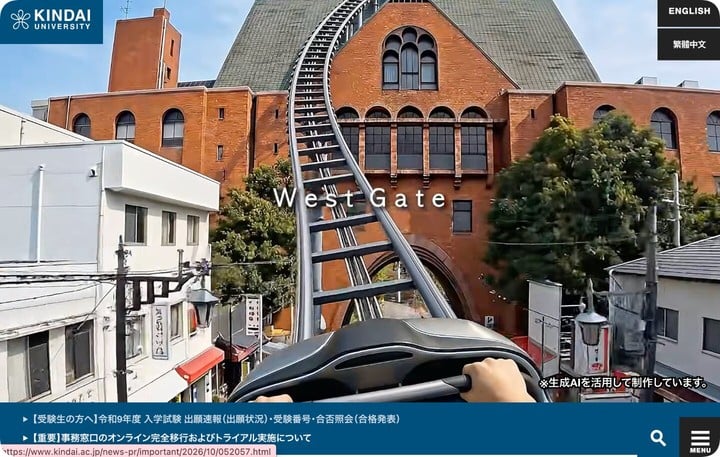
Kindai University homepage 👉: https://www.kindai.ac.jp/
Similarly, Japanese election posters have begun featuring candidate faces fabricated by AI.
After the Japanese Suddenly "Woke Up," They Went Wild Using AI for Promo Posters and Videos
If you open Kindai University's website recently, you might wonder whether you've landed on the wrong site.
Kindai University has put AI-generated motion footage straight onto its homepage, filled with exaggerated dynamism and the visual traces peculiar to generative AI. The school makes no attempt to hide it — the homepage explicitly notes that the content was made with generative AI.
This April, Kindai University played a similar AI video at its entrance ceremony: students board a fictional roller coaster that sets off from downtown Osaka, soars past landmarks such as Osaka Castle and Dotonbori, then races along the tracks into the university campus, finally arriving at the memorial hall where the entrance ceremony is being held.
The whole video uses a first-person perspective, as if someone built an amusement park roller coaster through the center of Osaka.
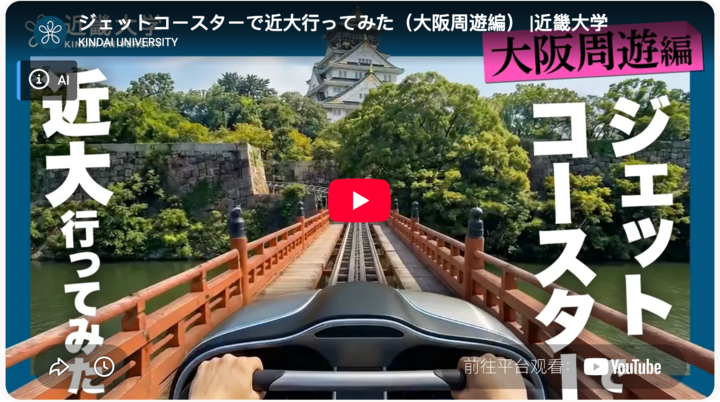
According to an ITmedia interview, the video was produced by an overseas creator, Ssestar. The school provided real footage of the campus, surrounding streets, and some drone shots, then handed it to the creator to finish using AI.
Public reports citing an interview with Yomiuri Shimbun say the video cost about 400,000 yen to produce, equivalent to roughly 18,000 RMB.
The reach was quite good: as of early June this year, the video had about 470,000 plays on Instagram and over a million impressions on X. It also drew coverage from several Japanese tech media outlets.
At the entrance ceremony, when the roller coaster in the video hurtled toward the memorial hall, students on site even instinctively turned around to look for a roller coaster that didn't exist.
Of course, the homepage footage contains text errors and physically dubious details. Some netizens noticed that landmark locations in the video didn't match reality, and some text signage showed errors common to generative AI. The school explained that the film was clearly labeled as a fictional creation and hoped viewers would enjoy it as entertainment.
In recent years, Kindai University has been advancing its "AI ネイティブ大学" ("AI-native university") concept.
In September 2026 it signed a collaboration agreement with Google Cloud, providing paid Gemini versions to roughly 21,000 first- and second-year students across all 16 faculties as well as faculty and staff.
From October, it began a proof-of-concept for generative AI features in the student portal app "KDU Mobile," starting with about 5,151 students in the Faculty of Science and Engineering and the Graduate School of Science and Engineering, using Gemini to answer questions about class schedules, notices, and syllabi, with the goal of making the student support desk as close to 24/7 as possible.
It then introduced the AI English paper support tool "Paperpal," issuing 4,000 licenses to full-time faculty and doctoral students. These moves are consistent: pushing generative tools from marginal experiments into the center of daily operations and brand expression.
University promotion must attract applicants while also conveying a certain self-positioning to alumni and society.
Kindai University was never a school that cared much about a traditional image. Back in 2015, it used "Who called us the tuna university?" as ad copy. In 2017 it coined "Sō-Kei-Kin," placing itself alongside Japan's famous private universities Waseda and Keio, and in 2023 it mocked itself with "Not on the list of classy universities."
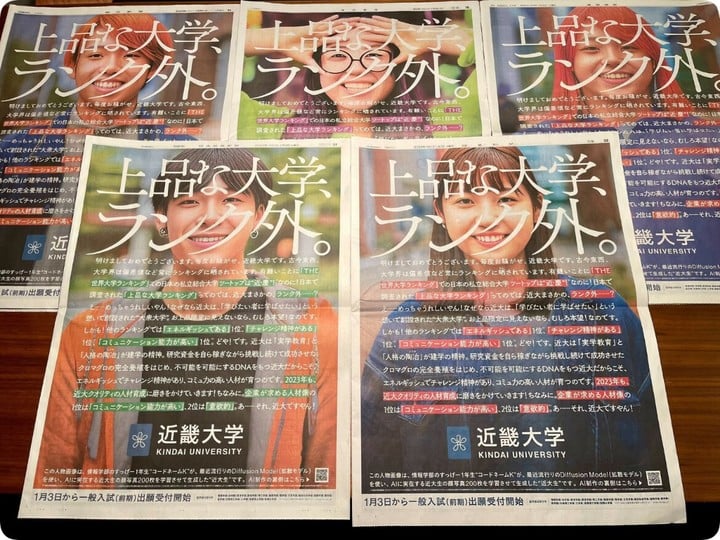
▲ The ad used an image of a virtual Kindai student generated by AI after learning from 200 photos of real Kindai students' faces
The irreverent approach to promotion instead became the school's brand memory. Now this school, nicknamed the "tuna university" for its tuna farming research, has found a new promotional code.
This month, Kindai University launched another AI promo series for 2027 admissions, "Come Ride! The Destination Is Kindai University," in which high school students from across Japan board fictional transport and head for campus.
Handsome but Fake Candidates
On November 15, a by-election for city council members was held in Amagasaki, Hyogo Prefecture, Japan.
Twelve candidates competed for one vacant seat, and the 575 election poster boards on the streets were plastered with candidates' photos, names, and campaign slogans.
Four of the posters looked particularly strange.
One male candidate looked quite young, with features so refined they seemed unreal; another man even had a tattoo on his arm. These posters didn't look like traditional ID photos of politicians — they looked more like character design sheets exported straight from AI art software. Some on social media joked, "Are we electing a virtual character?"
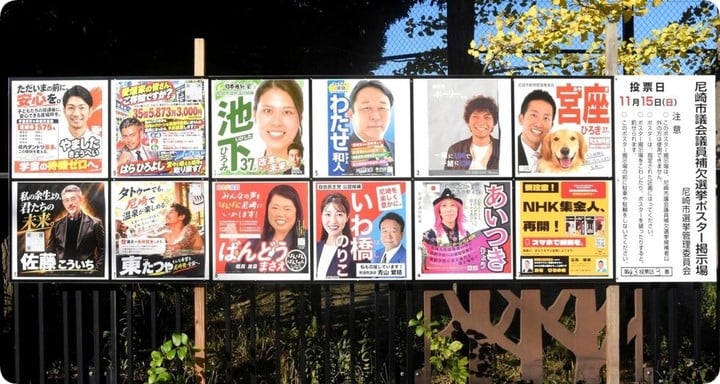
Local outlet Kobe Shimbun noticed the phenomenon and used an AI content detection tool, finding that among the 12 candidates, 4 posters may have used AI generation technology. The Amagasaki City Election Administration Commission said that at least one poster's male face was completely different from the candidate himself.
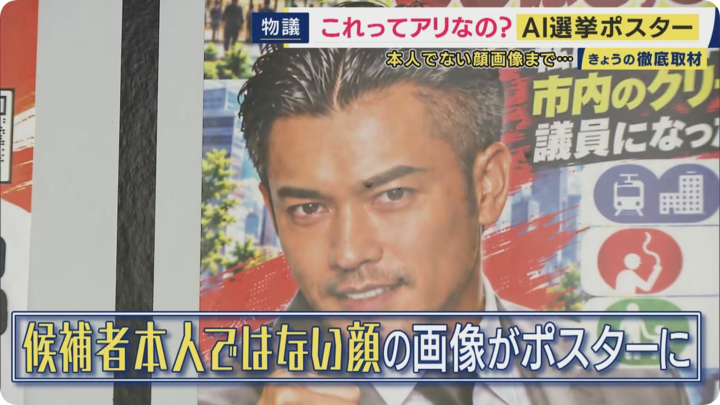
Under Japan's Public Offices Election Act, election posters must meet requirements on size and the labeling of a responsible party, but there is no explicit rule that the person's photo on a poster must be the candidate's real face. Even if the election commission deems a photo inappropriate, it is hard to demand the candidate replace it on that basis alone.
And these 4 candidates had something else in common. Their candidacy registrations were all handled on their behalf by a former Hyogo Prefectural Assembly member, Hikoharu Konishi, or his secretary. The election commission didn't even meet some of the candidates in person, and requests to verify their identities were not complied with.
On the Kansai TV program news Runner aired on November 16, the proxy, Hikoharu Konishi, was finally found. Asked by reporters whether the people in the posters were the candidates themselves, he admitted using AI and explained that the faces were merely "image illustrations."

▲ Hikoharu Konishi directly admitted on the program that the posters used AI-generated images, saying they were "for reference only"
In other words, what voters saw was an entirely different face that doesn't exist. AI images can turn an ordinary person into an elite figure, and can also put faces that never existed onto official election posters.
According to Kobe Shimbun, the poster production costs for this Amagasaki by-election can be covered by public funds, with a cap of 612,375 yen per candidate.
An election poster production company interviewed by Kansai TV raised a concern: if someone generates images at extremely low cost and then declares production expenses at a higher rate, there may be room for profiteering.
Currently there is insufficient evidence to prove these 4 people obtained improper benefits this way. In response to such questions, Hikoharu Konishi said production costs are a matter between the candidate and the contractor, and that the procedures comply with election regulations.
In the end, all 4 candidates who used AI posters lost. However, they received enough votes to reclaim their 300,000 yen election deposits each, as required by the rules.
Japan has also begun adding rules for AI election promotion. The Public Offices Election Act amendment announced in July 2026, which takes effect on March 1, 2027, requires that AI-generated or altered images distributed online be labeled as AI where applicable.
But the new rule mainly targets online distribution and does not directly resolve the question of whether paper posters on Amagasaki's streets use real candidate photos.
AI Is Everywhere in Life, and Real E-commerce Product Shots Are Becoming "Intangible Heritage"
Chinese consumers may be more familiar with similar things.
Three arms, six fingers, two legs crammed into the same trouser leg, or even an upper and lower body facing in different directions — scenes that once only appeared in horror movies now show up from time to time on perfectly ordinary product detail pages.

A normal product photo has somehow become a scarce resource you have to search hard for.
On November 3, CCTV News reported on the "three-legged models" appearing on e-commerce platforms. Industry practitioners said AI model images have developed a mature commercial workflow. Merchants only need to upload clothing images and choose a person and scene to generate a fairly complete product display image.
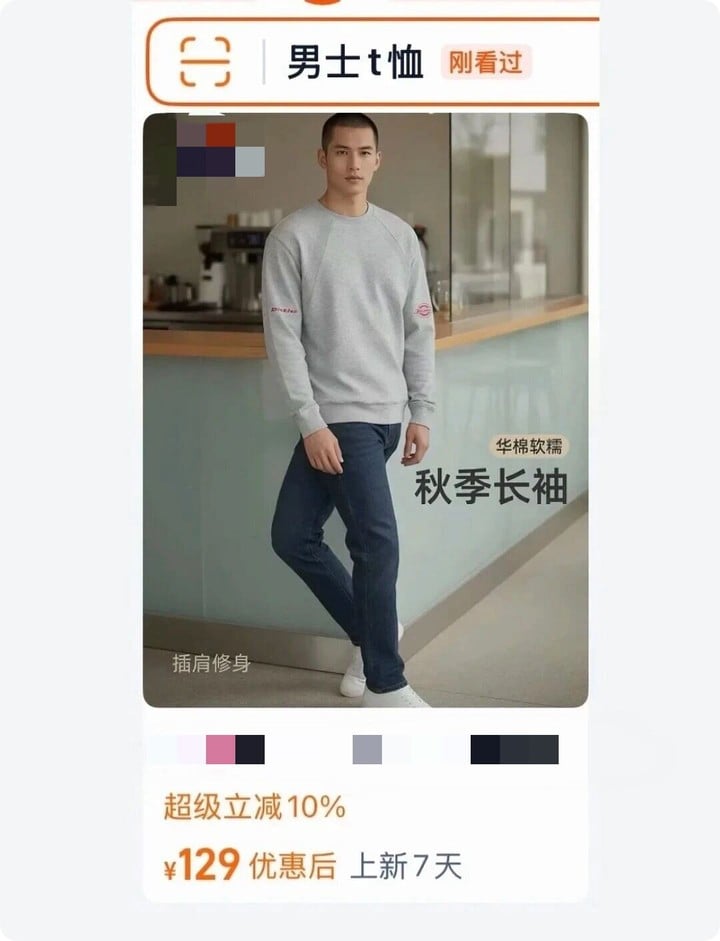
Traditional clothing sample shoots usually take 3 to 4 days and cost about 600 to 800 yuan; some AI model images take only a few minutes, with costs kept at thirty or forty yuan. If a shop lists dozens of new garments a day, the gap between the two methods is considerable.
The end point of cost reduction is rising trust costs, and consumers are increasingly uneasy.
AI Cuts Costs and Adds Laughs, and the Whole World Is Being Forced to Accept an Aesthetic Downgrade
During this year's Double 11 shopping festival, the Social Survey Center of China Youth Daily, together with Wenjuan.com, conducted a survey of 1,334 respondents. The results showed that 95.8% of respondents believed AI seller showcase images increased their uncertainty when placing orders. Among them, 51.4% explicitly said they had fallen for AI seller showcase images, while another 35.2% suspected they had encountered similar situations but were unsure whether the images were actually AI-generated.
58.6% of respondents complained that products had severe color differences, 50.2% had encountered distorted fits and details, and 44.2% found that merchants packaged AI images as real photos.
Beyond e-commerce ads, you can no longer predict what the MVs played in KTVs these days will look like.
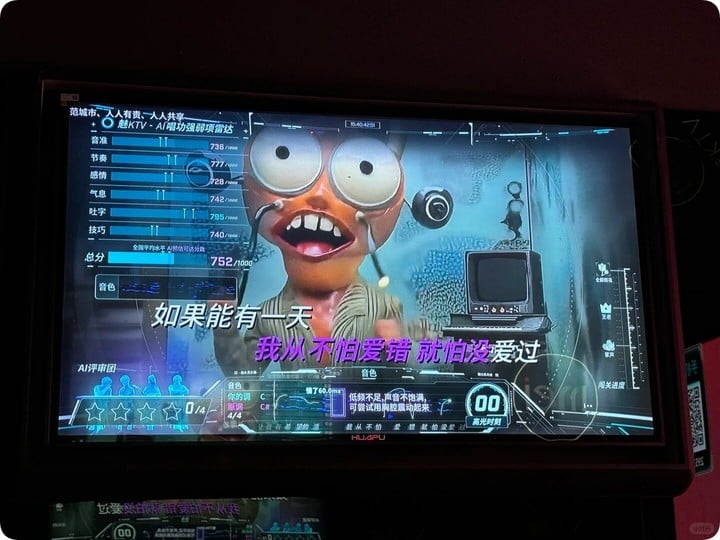
▲ Image source: Xiaohongshu @绝世大咖喱
For slow ballads such as “At Least I Still Have You” and “Later,” the accompanying MV might feature a puppy holding a machine gun, a kitten flying a fighter jet, or a purple octopus doing tai chi in space.
These AI MVs are products of the tug-of-war between copyright and cost. Because song-ordering systems often only obtain the copyright to lyrics and music, while licensing the original MV footage is expensive, equipment manufacturers simply use AI one-click generation to fill the gap. Outdated visuals for old songs are also replaced. Some KTV chains set the AI versions as default; to switch back to the original, customers have to pay extra or repeatedly ask the front desk.
The ultimate end of cost reduction and efficiency improvement is that AI is everywhere in life, but “AI is everywhere in life” does not necessarily mean “life is full of compromises everywhere.”
For a long time, “aesthetic education” in China's educational context has carried a somewhat elitist air, as if it were synonymous with piano lessons and art classes. The long-term neglect of aesthetic education has also indirectly led to today's world being filled with AI Slop everywhere.
The term AI Slop already has a ready-made equivalent in Chinese: muddling through. This craft has always been around; now AI has slashed its price to the bone.
Ifanr mentioned in “The Store Is the Product” that the facade of Apple's Hangzhou West Lake store uses 11 custom 14.5-meter-high glass curtain wall panels, each costing more than 1 million yuan. No one would advise Apple to replace this wall with a printed banner showing glass, even if it could save more than 10 million yuan.
Some costs are themselves the product.
Online shoppers cannot enter the store; the product detail page is the store, and real photos are that glass wall. When merchants use AI images to save effort, they are also arbitraging consumers' aesthetic tolerance. The higher this tolerance, the greater the room for arbitrage.
If we are merely repeatedly stimulated by low-quality content, react, and forget, our aesthetic sensitivity will dull amid fatigue—just as when you live in noise for a long time, you gradually stop hearing it.
What drives people to still choose the “good” is the environment in which they live. Only when one's eyes and ears have been fed on good things since childhood can one naturally feel uneasy about compromises.