 Newshot
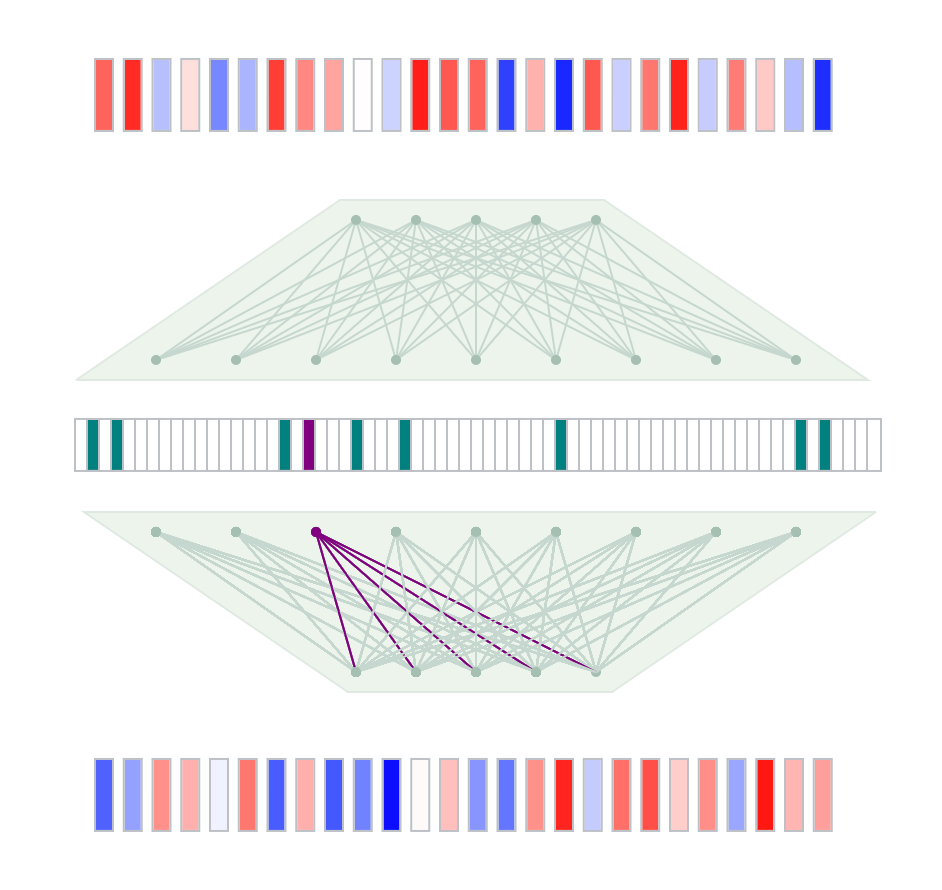
Mapping LLMs with Sparse Autoencoders
An introduction to Sparse Autoencoders, a technique to unpack and understand the hidden representations of LLMs.


Can Large Language Models Explain Their Internal Mechanisms?
An introduction to Patchscopes, an inspection framework for explaining the hidden representations of LLMs, with LLMs.

Do Machine Learning Models Memorize or Generalize?
An introduction to grokking and mechanistic interpretability.

What Have Language Models Learned?
By asking language models to fill in the blank, we can probe their understanding of the world.

Confidently Incorrect Models to Humble Ensembles
ML models sometimes make confidently incorrect predictions when they encounter out of distribution data. Ensembles of models can make better predictions by averaging away mistakes.
Collecting Sensitive Information
The availability of giant datasets and faster computers is making it harder to collect and study private information without inadvertently violating people’s privacy.

Why Some Models Leak Data
Machine learning models use large amounts of data, some of which can be sensitive. If they’re not trained correctly, sometimes that data is inadvertently revealed.

Can a Model Be Differentially Private and Fair?
Training models with differential privacy stops models from inadvertently leaking sensitive data, but there’s an unexpected side-effect: reduced accuracy on underrepresented subgroups.

Federated Learning
Most machine learning models are trained by collecting vast amounts of data on a central server. Federated learning makes it possible to train models without any user’s raw data leaving their device.

Are Model Predictions Probabilities?
Machine learning models express their uncertainty as model scores, but through calibration we can transform these scores into probabilities for more effective decision making.

Searching for Unintended Biases With Saliency
Machine learning models sometimes learn from spurious correlations in training data. Trying to understand how models make predictions gives us a shot at spotting flawed models.

Datasets Have Worldviews
Every dataset communicates a different perspective. When you shift your perspective, your conclusions can shift, too.

Measuring Diversity
Search results that reflect historic inequities can amplify stereotypes and perpetuate under-representation. Carefully measuring diversity in data sets can help.
Measuring Fairness
There are multiple ways to measure accuracy. No matter how we build our model, accuracy across these measures will vary when applied to different groups of people.
Hidden Bias
Models trained on real-world data can encode real-world bias. Hiding information about protected classes doesn’t always fix things — sometimes it can even hurt.