 Newshot
It's a common pastime to share stories of the decline of the world, how things used to be better in the past, back when GPU clusters could be bought for the price of a loaf of bread and everyone had personally memorized the Feynman Lectures on Physics and would recite it on command (or at least the first volume, you didn't need to go crazy).
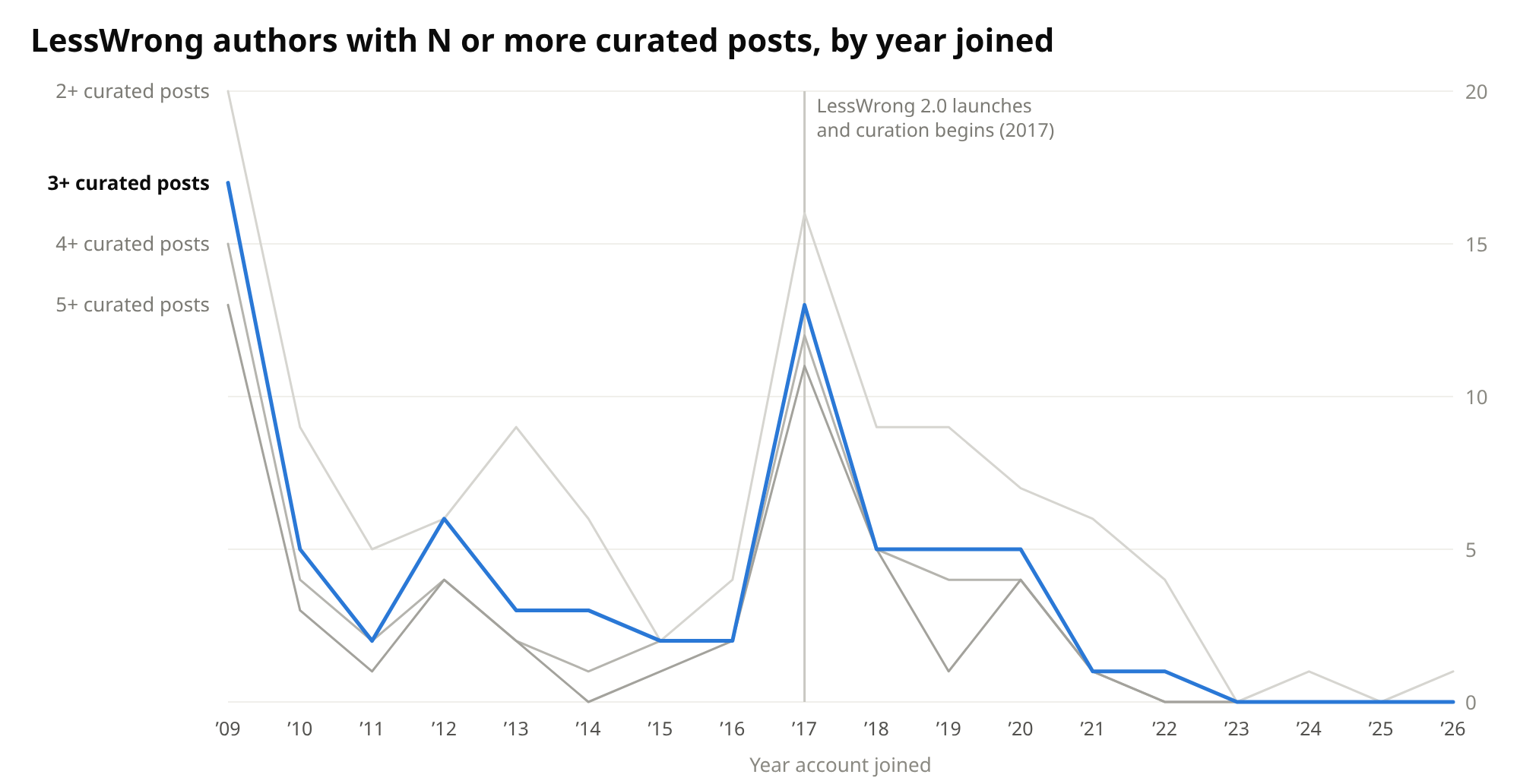
This recently came to my attention again in a LessWrong post titled "Notes on the decline of LessWrong's great writers", where Ben Pace asserts that the great writers of the past were better than those of today. In support of this thesis, he presents but a single graph about the writers who've been curated on LessWrong, and what year they signed up.
Apparently this is proof of the decline of Western civilization, shows that nobody can remember Bayes Theorem, the biases have beaten out the heuristics, and the absurdity heuristic will forevermore win arguments on LessWrong. Alas, while it is a pleasant fiction for those akratic rationalists who wish to rationalize why the world around them is mediocre, the true instrumental rationalists here will find within themselves the willpower to investigate further.
Let us start by examining the above line in blue, which shows what year users joined who eventually had three (or more) posts curated.
I propose we view this as two spikes with trails. One in '09 (which, to be fair, is actually an import of '07, '08, and '09 from Overcoming Bias) at the launch of LW 1.0, and one in 2017 with the launch of LW 2.0. The decline afterwards is modestly better during LW 2.0 than LW 1.0, not worse.
However, the more relevant issue is that, importantly, the number of new users from 2009 through 2016 was static and the number of posts was decreasing, whereas the number of new users and new posts from 2017 to 2026 has been increasing! This is very different! This means that new users face much more competition for curation spots, as the number of curation spots does not increase.
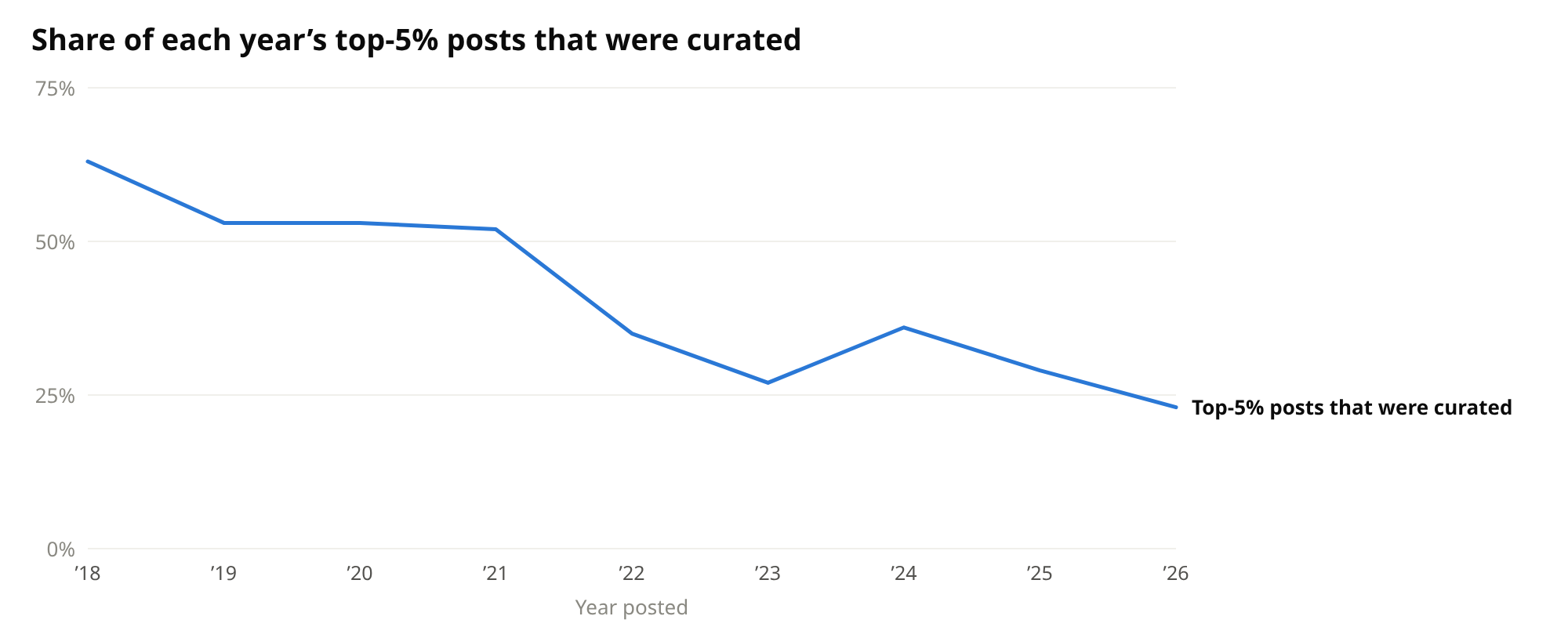
If you get a post in the top 5% of posts, it is much less likely to get curated.
And the old guard are still competing for the curated slots. They write about a fifth of all posts and about a third of the top ones.
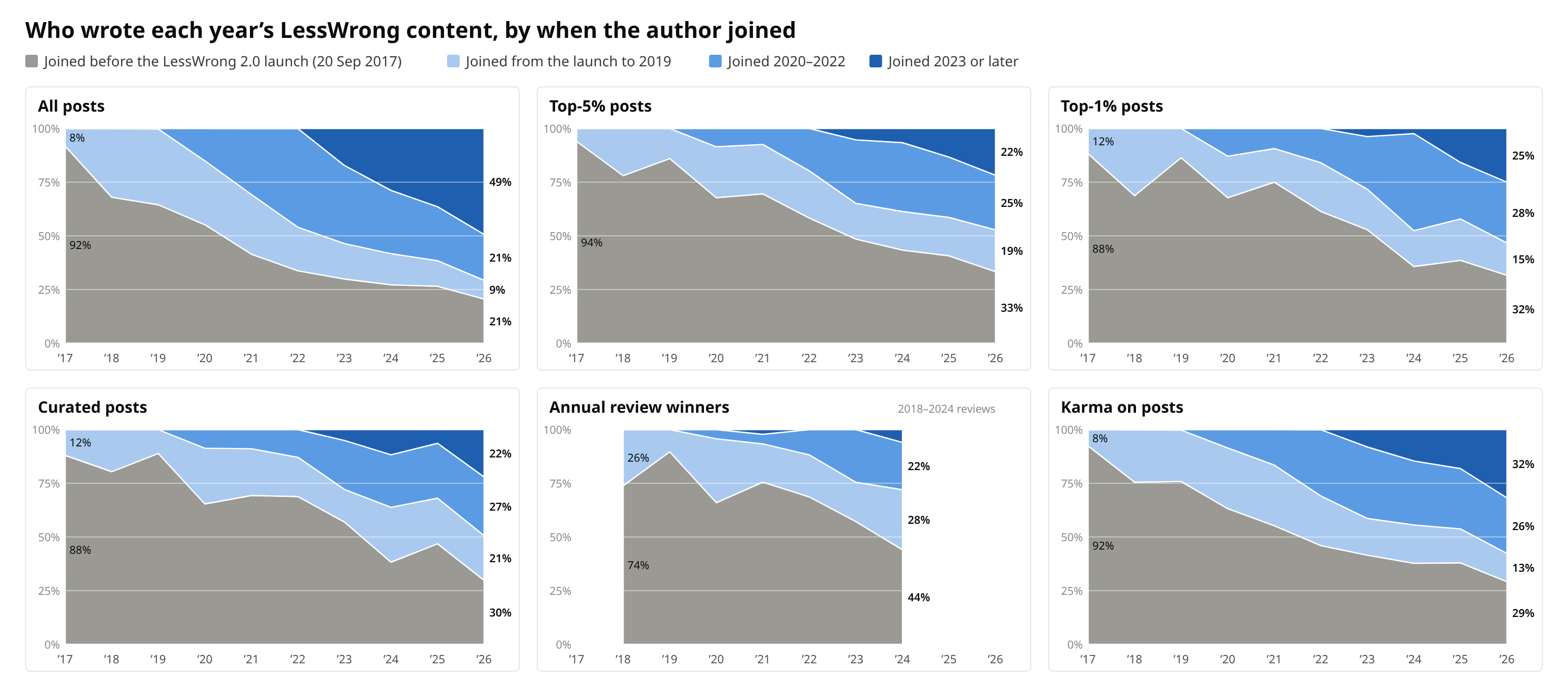
New users are writing bangers, but they're not getting curated as much. This could be because the mod team's judgment is that that the older stuff is better, but you would see this anyway even if the quality is the same (or slightly better).
The 2020s had many great posts that would have been curated in 2017, when there was a real dearth. Basically any essay from Aurelia's 2026 sequence about how her breakthroughs in cryonics. Basically any essay from Matthew Watkins' 2023 sequence on the ' petertodd' phenomenon (aka glitches in LLMs). Basically any essay from Habryka's 2025 sequence on the The Lightcone Principles. Or the many many curiosities, like Ben Goldhaber's delightful Unexpected Things that are People (which got over 600 upvotes on HN). Malmesbury's puzzling Do bamboos set themselves on fire?, and Dynomight's Alcohol, health, and the ruthless logic of the Asian flush. (Also Why I don't believe in the placebo effect by transhumanist_atom_understander.)
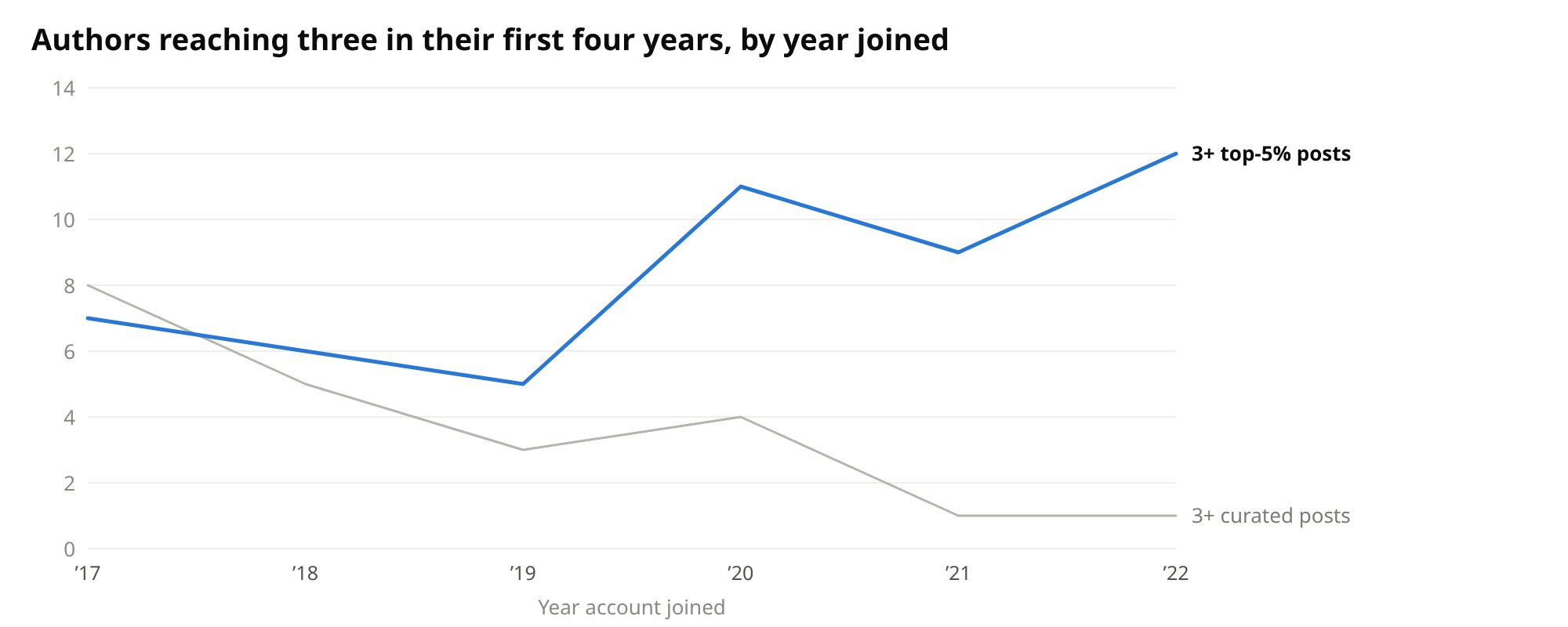
You can see it more starkly here.
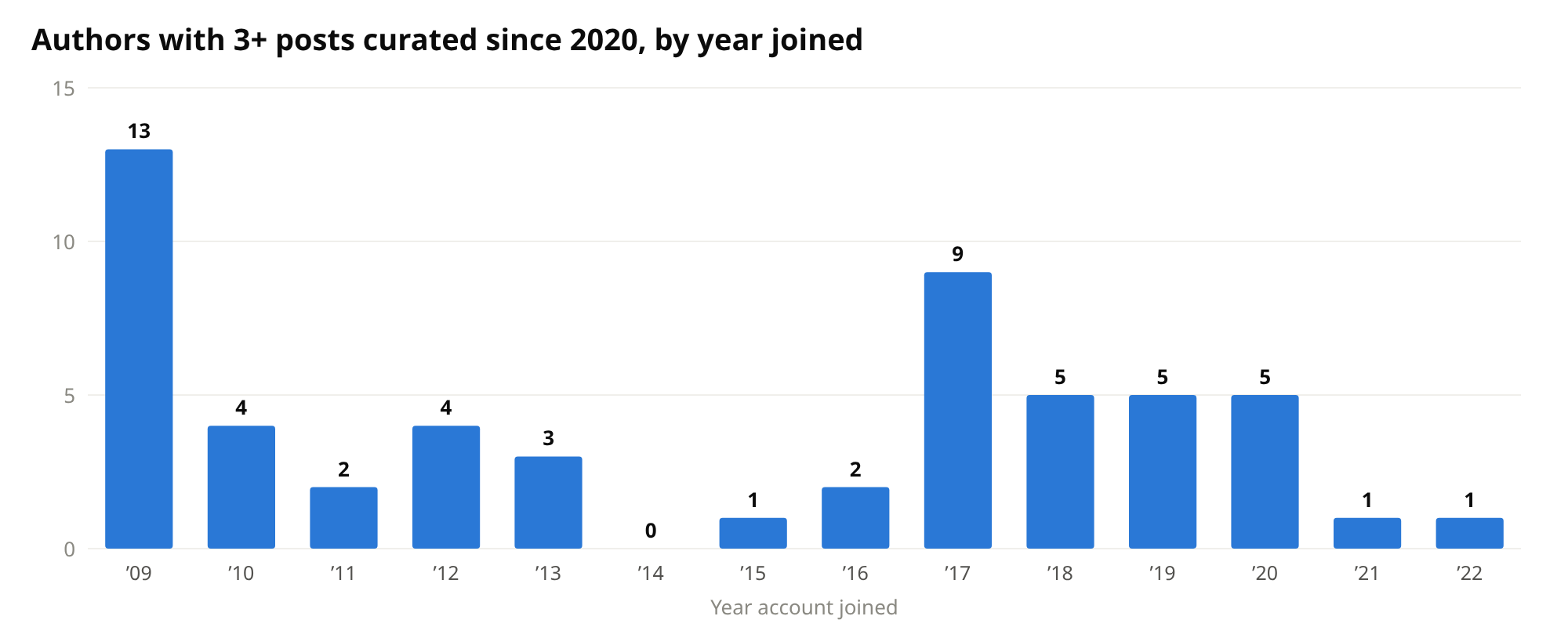
As for the more recent years, we still don't know, because it already took several years to get curations for those who have them. 70 authors have been curated thrice or more, and this graph shows how long it took them to get there.
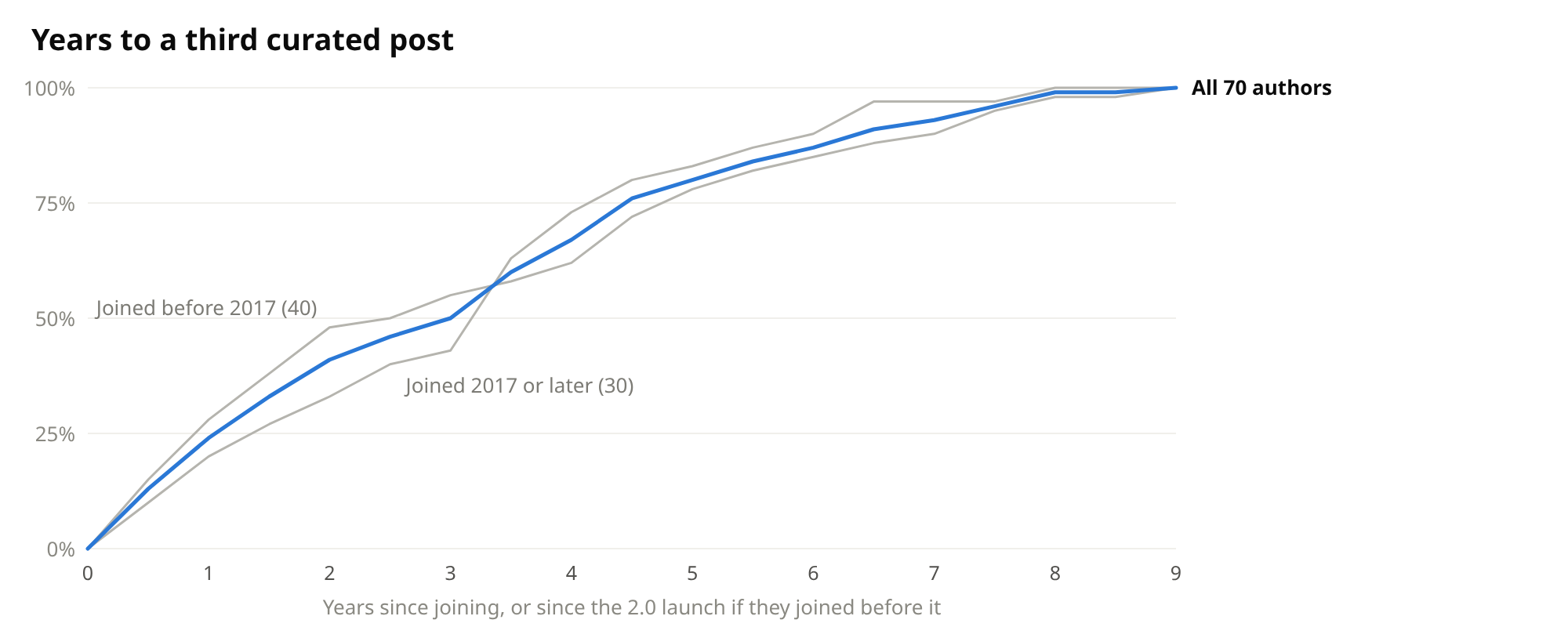
So the curation graph was the wrong one to use. What now?
A proper analysis of the territory would start with more simple measures, and then rise to more indirect approaches.
Consider the basic activity of the site. It's very healthy!
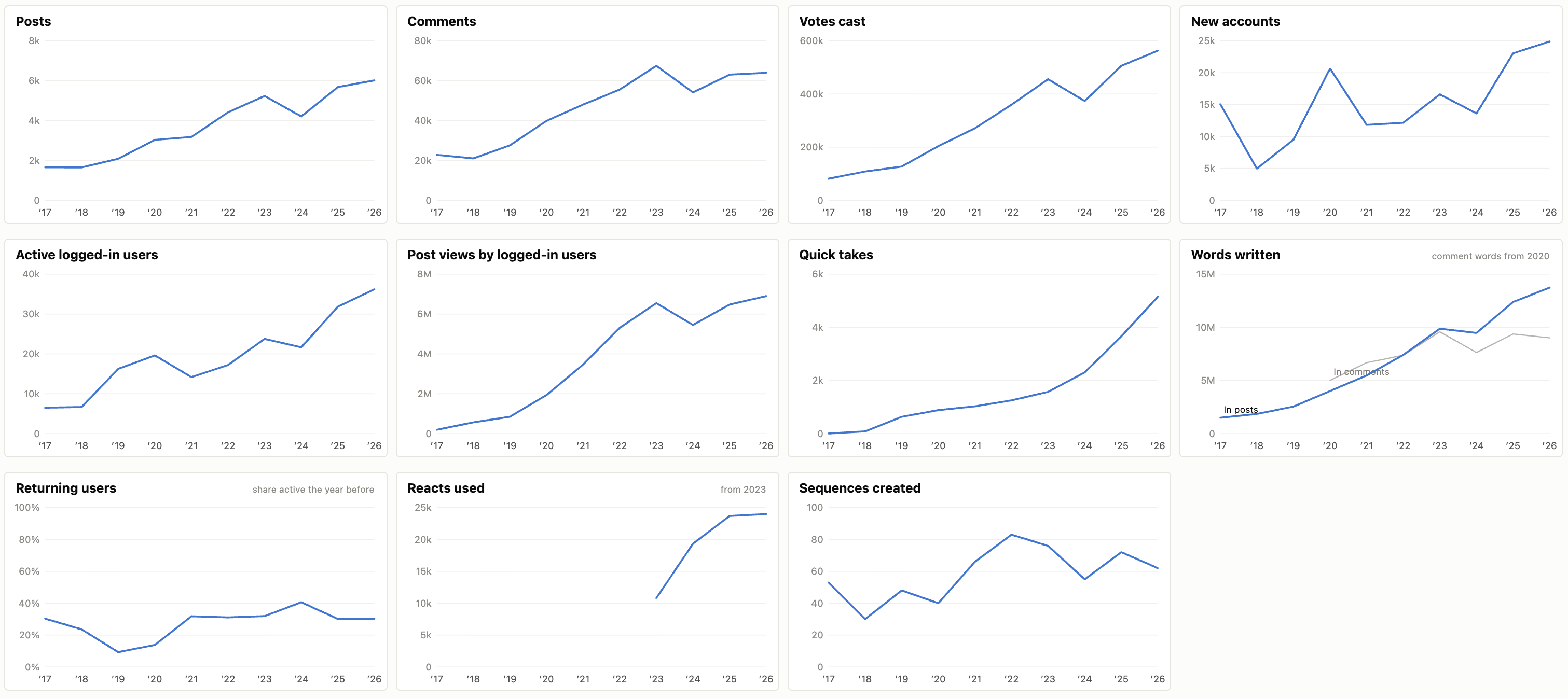
More posts! More votes! More users!
In his post, Mr Pace impugned not the general activity, but the quality of the authors. He also spoke of people building a "body of work" on the site, as opposed to just heckling about the latest AI developments.
However the number of people investing in long sequences of content has also continued growing on LessWrong.
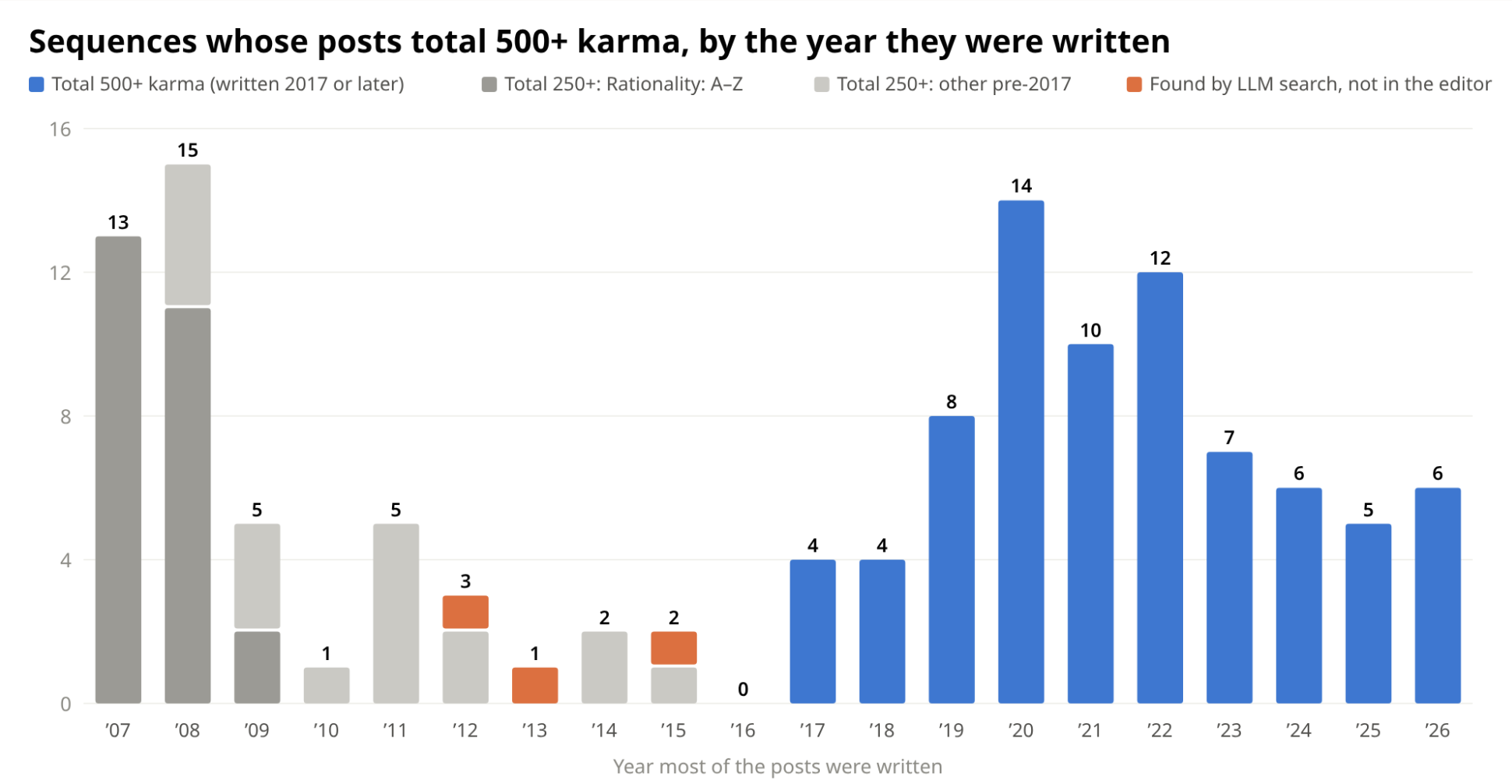
Ben Pace would argue that these new sequences are of a wretched, lower quality. But consider. 2012 had Scott Alexander's Intro to Game Theory, and 2022 had Logan Strohl's Intro to Naturalism. 2010 had Living Luminously by Alicorn, and 2020 had Daniel Kokotajlo's Takeoff and Takeover in the Past and Future. 2015 had Replacing Guilt by Nate Soares, 2025 had The Lightcone Principles by Oliver Habryka. I am not clearly seeing the past beat out the future, in fact I think I am generally seeing more good ones now than in the past.
So what gives? Why did so many people join the ridiculous Ben Pace on his false assumption, and conjure up their own explanations for the apparent decline?
Other than a delightfully high rate of crackpots, the past had more of a sense of the beginning of a new ideology, which is thrilling, and also ideological unity, which feels kind of totalizing in a way that makes it feel like the entire world of these people is within a single frame, that is again thrilling. It is deeply sad that the epistemic framework of the sequences has not received groundbreaking additions (though I love what has been added), but I think the ideological conformity going away is substantially a positive. The downside of it is that there are more people on LessWrong who will not admit to making basic errors by the lights of the sequences. (Perhaps the other downside is that there are fewer on LessWrong who are doing anything as deeply ambitious?)
But nonetheless, new authors are consistently producing content that is strongly upvoted on LessWrong. If we look at the top 5th percentile of posts each year (e.g. this would be getting at least 150 karma this year, or at least 60 karma in 2011) we can see that new authors have continued to contribute the top tier of posts.
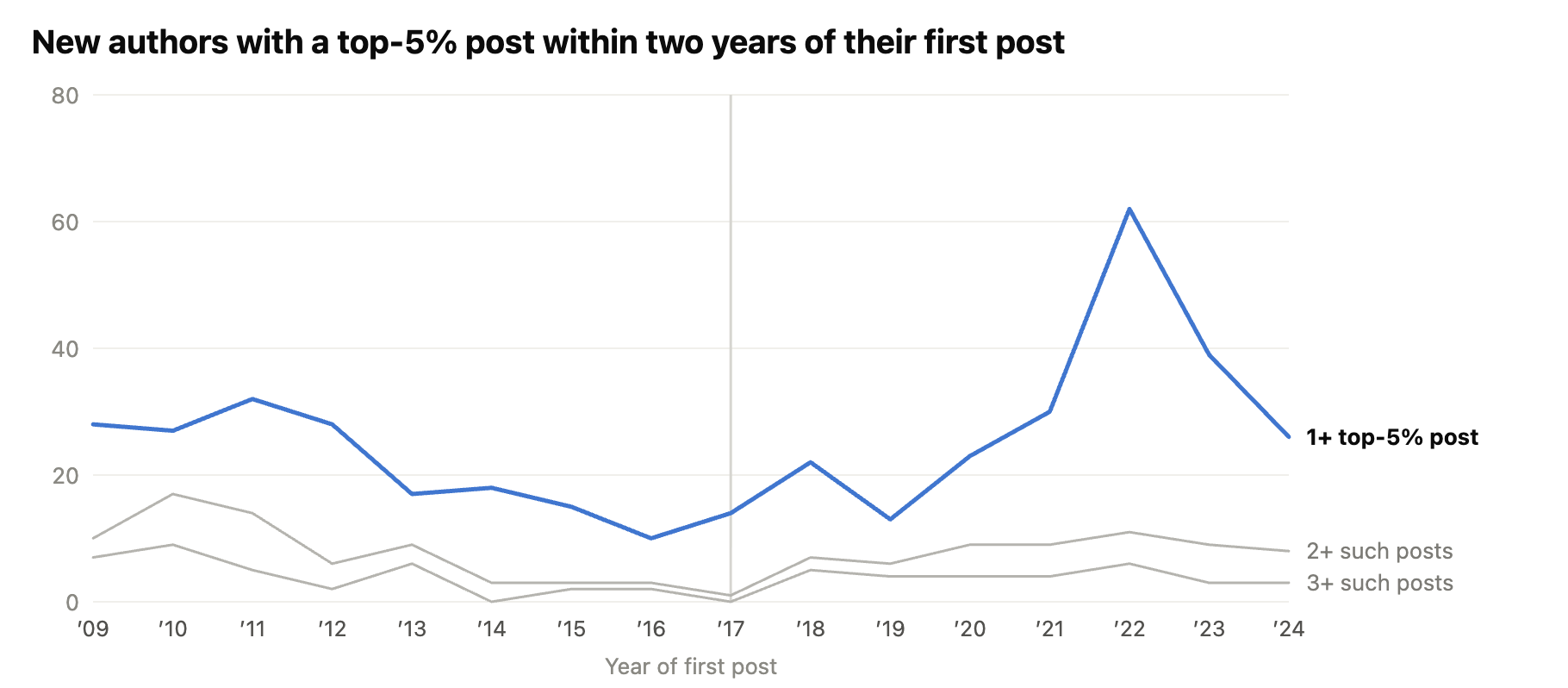
Perhaps we can discuss further what else has changed in the culture, and how else we can infuse the website with more of the virtues of ambitious truth-seeking and so on that we care about.
But if there's one thing we know for sure, it's that Ben Pace is wrong.