 Newshot
VAST Data says petabyte SSDs will outgrow RAID in today’s parallel file systems, according to a simulation of its own 900 PB system that puts the odds of data loss at 1 in 11 over 10 years. At Supercomputing 2026 (SC26), the company explains how.
Bigger drives take longer to rebuild after a failure, leaving more time for further failures to lose data, but operators will still want those large drives because many sites are power-constrained and storage power scales with bandwidth rather than capacity. VAST’s recommended fix: system-wide erasure coding with at least three parity strips.
The company’s principal technical strategist, Glenn Lockwood, walked through the simulation, described as a “discrete event simulation” using real failure data, in an Exhibitor Forum talk during SC26’s HPC System Hardware and Architecture session. With petabyte-scale SSDs swapped in, enclosure-local declustered RAID — the approach used by DDN EXAScaler and HPE Cray ClusterStor, per Lockwood — has those exceptionally high odds of data loss. With global declustering and extra parity, operators can get this down to 1 in 54 million, a significant improvement, but VAST’s own scheme gets to about 1 in 62 billion, three orders of magnitude better.
Lockwood’s case for petabyte SSDs rests on how storage power scales: at about 28 W per SSD, regardless of capacity and including its share of the surrounding infrastructure, plus 20 W per GB/s of bandwidth. Getting 900 PB of flash from 15 TB SSDs would take more than 63K drives, each adding its own bandwidth, for 190 TB/s at 5.6 MW, or “the equivalent of 3,100 or so of Blackwell Ultra GPUs.” Lockwood says, though, that “real AI applications in our experience have never approached needing anything close to that level of performance” from the storage.
With 122 TB drives, at almost an 8K count and much lower 8 TB/s of aggregate bandwidth, the power draw is less than a tenth of that, at about 400 kW. Within that budget, 15 TB SSDs top out at about 250 PB, even with no power left for performance. That power could be better spent on compute and, anyway, 245 TB-class drives are already arriving, with much larger drives expected.
Everything is a series of trade-offs, though, and larger drives come with their own caveats. Lockwood acknowledges the usual reaction to a 245 TB drive: that it’s “a big blast radius,” since a single failure leaves much more to rebuild. And it does take longer: at the same per-drive speed, a 122 TB drive takes twice as long to rebuild as a 60 TB drive, leaving a longer window in which a second failure in a traditional RAID 5 set loses data. Per-drive capacity is potentially outpacing bandwidth increases and, at least within a generation, “the performance of each individual drive does not change,” so this is something that must be accepted or overcome.
The simulated system involves 7,920 SSDs at 122 TB each, using 180 enclosures with 44 drives each. With a RAID 5 single parity solution, there is a 100% chance of data loss over 10 years, but “no one uses single parity anymore.” Double parity still has 1 in 150 odds of data loss over a decade and is considered “state of the art for many open source file systems,” and he explicitly names Lustre and BeeGFS within this context.
For proprietary parallel file system implementations, declustered RAID within an enclosure is the state of the art, instead. Declustered RAID spreads each drive group’s data, parity, and spare space over more drives than usual, allowing for faster rebuilds. Keeping it within an enclosure means that the spread still stays within a single box of drives. Swapping petabyte SSDs into that enclosure-level declustering is what gets to the headline 1 in 11 odds of data loss.
As for the mentioned rivals, DDN’s DCR, in one published configuration, uses RAID 6 in an 8+2 array for a 24-NVMe SSD pool. That means eight data strips plus two parity strips per stripe, allowing any two drives in the pool to fail without losing data, and each stripe is spread over 10 of the 24 drives. DDN has conceded in the past that larger systems may need more than DCR. HPE’s declustered RAID solution is known as GridRAID, with declustered parity per enclosure half, meaning two 12-drive pools per 24-drive enclosure.
Perlmutter, the supercomputer at Berkeley Lab’s National Energy Research Scientific Computing Center, where Lockwood once worked, used GridRAID with 8+2+1 RAID 6 per 12-drive object storage target, Lustre’s name for a storage unit. The +1 is one spare drive’s worth of space, spread across all 12, so a rebuild writes to every surviving drive rather than to a single replacement. Either way, protection stops at two failures in a pool of one or two dozen drives, and only those drives can assist with a rebuild. This is the scenario in VAST’s simulation with the catastrophic failure rate.
| Protection scheme | Who uses it, per Lockwood | Drive size simulated | Odds of data loss over 10 years |
|---|---|---|---|
| Single parity (RAID 5) | "No one anymore" | 122TB (today’s drives) | 100% |
| Double parity | Open-source Lustre and BeeGFS, typically | 122TB (today’s drives) | 1 in 150 |
| Declustered RAID within an enclosure | DDN EXAScaler, HPE Cray ClusterStor | Petabyte-class | 1 in 11 |
| Declustered RAID across the whole system, plus extra parity | His stated minimum | Petabyte-class | 1 in 54 million |
| VAST’s own scheme (not detailed) | VAST | Petabyte-class | 1 in 62 billion |
Protection scheme
Who uses it, per Lockwood
Drive size simulated
Odds of data loss over 10 years
Single parity (RAID 5)
"No one anymore"
122TB (today’s drives)
Double parity
Open-source Lustre and BeeGFS, typically
122TB (today’s drives)
Declustered RAID within an enclosure
DDN EXAScaler, HPE Cray ClusterStor
Petabyte-class
Declustered RAID across the whole system, plus extra parity
His stated minimum
Petabyte-class
1 in 54 million
VAST’s own scheme (not detailed)
Petabyte-class
1 in 62 billion
Several solutions exist, with limits. Adding a parity strip for triple parity reduces the odds of data loss. Global declustering, on its own, can also reduce the odds a little bit, with faster rebuild times. However, stripes are spread over every drive in the cluster, so two random failures are more likely to hit the same stripe, meaning a larger fault domain.
If both approaches are used, which is the minimum bar for him, you get down to getting struck by “lightning on your birthday” odds. VAST already publishes quadruple parity, which is beyond this bar. Using VAST’s own “special magic,” undisclosed but beyond the minimum bar, drops the odds even further, specifically for the petabyte SSDs, which is the real target of the talk.
Then we get to the metadata, the data about data, which in this case is the index of where every piece of every file dwells. Every write necessarily updates it synchronously, so VAST keeps it on separate, fast SSDs as three full copies for replication, not parity. This means it can survive two failures, which is less than the data’s four parity strips, and the index becomes the weakest link. With 122 TB drives, he puts the data drives’ odds at 1 in 78 trillion over 10 years, against 1 in 58 million for metadata. To Lockwood, this illustrates that the surrounding infrastructure is the real risk, given the failure gap between the index and regular data.
Rebuilding in the index area starts about 12 seconds after a failure, on average, versus about two minutes for data drives, Lockwood says. VAST’s procedure more generally, for when a drive drops out, is to power-cycle it and hope, so there is always some delay before a rebuild is forced. This slight delay barely matters for data drives with four parity strips but is more impactful for the three-copy metadata index drives. For example, waiting an hour for data drives “wouldn’t make a big difference” while just 20 minutes or more on a metadata drive has “extremely high” risk.
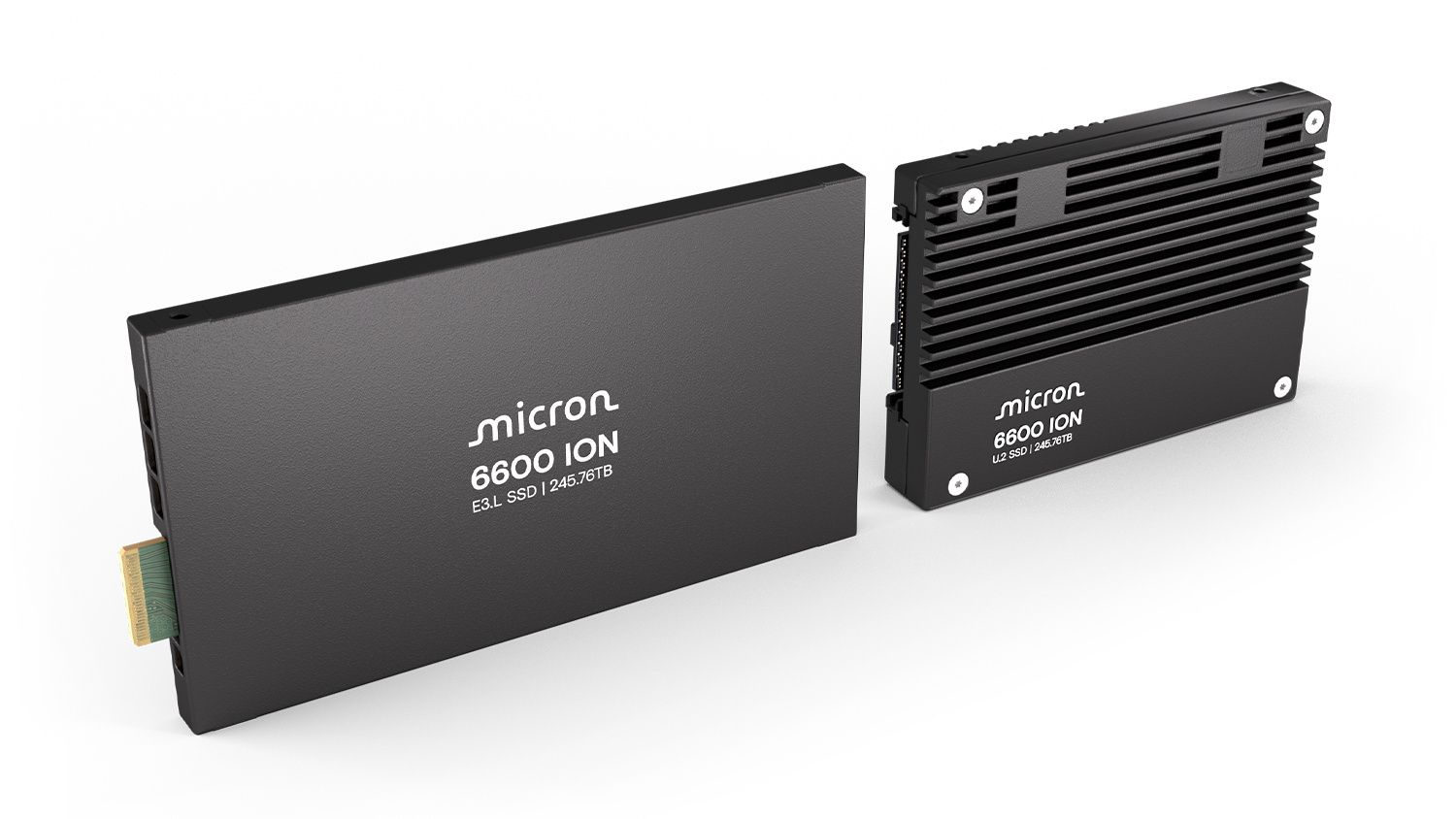
Earlier this year, in May, Micron began shipping the 245 TB 6600 ION, which pulls up to 30 W at maximum load. Kioxia has the LC9, used in a Dell 2U server with 40 drives for a total of 9.8 PB. SanDisk also has its 256 TB UltraQLC, which was due in the first half of this year, and Solidigm is targeting about 245 TB later this year.
Meanwhile, multiple roadmaps reach petabyte-class drives, including SanDisk’s UltraQLC, a target by SK hynix for QLC SSDs, and Samsung at some time in the future. This strengthens VAST’s case and, while at least the power math adds up, data still needs to be compared openly and fairly to make a firm conclusion about the best pathway forward for what is clearly an unavoidable problem.

Shane Downing is a Contributing Writer for Tom’s Hardware, covering consumer storage, PC hardware, and AI.