 Newshot
I would like our public spaces to be more beautiful and comfortable. So would some other guys on the internet, but to me they seem pretty confused about the root cause of why they're ugly now.
Patrick Collison, for example, ponders:
Many things today are ugly and far uglier than they used to be or need to be. Once you see this, it’s kinda hard to stop perceiving it. (Early twentieth century phone boxes versus modern phone boxes; old water fountains versus new water fountains; etc.) As someone with a naively meliorist assumption that most things should be getting better rather than worse, it’s all a bit perplexing: why did we stop doing things nicely? Is it a choice? Was there a malevolent spell cast upon us?
At the end of his x post on this subject he appears to imply that this ugliness might be a marker of modern western culture's underlying metaphysical incoherence?
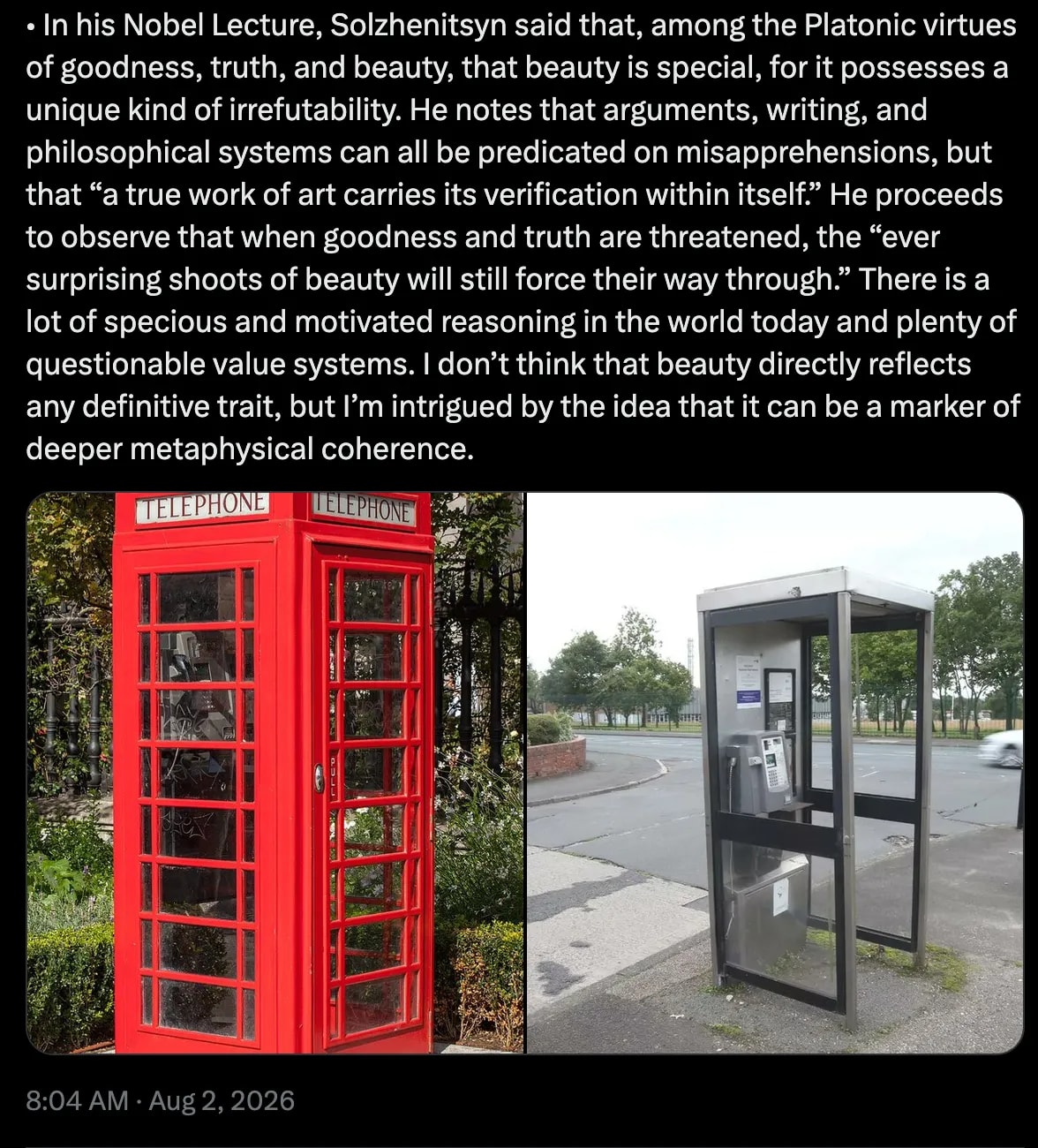
The illustrative example he provides is of two telephone booths, one strikingly red and beautiful and one black and utilitarian.
This is not a level 1 discourse topic. I know this because sometimes I am linked articles that are titled things like "Eight architecture myths BUSTED by Samuel Hughes" (a piece written, perhaps confusingly, by Ben Southwood), where you can infer from the title a whole universe of discourse where there are narratives and counter-narratives about modern architecture.
People who discoursepoast about this topic seem to really insist on the fact that there is in fact such a thing as spaces that are more objectively beautiful and humane, which, yes agreed, but they seem to think that the reason that things are ugly now is because there's some sort of... evil elite degeneracy or counter-signalling? Okay, um, straight off the bat here are some problems I notice with this hypothesis:
- If you go to places where only the evil elites gather, such as Michelin star fine dining restaurants, too-fancy hotel bars like the one where I paid $47 US dollars 😔 for a whiskey sour, Google offices, Four Seasons resorts, or a certain compound in Berkeley, you will notice that their insides are more beautiful and comfortable for humans than the outside world tends to be.
- As someone who went to school for urban planning, I do not remember being taught to design any public space in ugly or anti-human ways. In fact I strongly suspect that I attended hundreds of hours of lectures on and had my coursework graded on how to competently do the opposite.
- Also, as someone who went to school for urban planning, the people who end up as urban planners are not, uh, particularly elite in any sense of the word.
- Patrick Collison is a billionaire, and the "architecture myths BUSTED" piece is a part of the Stripe Press extended universe, i.e. Collison's propaganda unit, so it kind of appears to me like the anti-elite critique is coming from inside the house? Like, that's fine by me, the only way to defend against a bad billionaire with a gun is a good billionaire with a gun, that's what I always say (where ummmmm the guns are a metaphor for urban design preferences), it's just slightly inconvenient for this point, yeah?
Maybe the issue is that I am not sufficiently confused, but to me the problem seems to straightforwardly boil down to Baumol's cost disease. That is: some kinds of work get more productive per worker over time as we make technological breakthroughs (making cars, growing wheat) and some don’t (taking care of toddlers, playing in a string quartet). Wages rise in the first kind because each worker produces more, but this also creates significant pressure for wages in the second category of work to grow ~commensurately for ~reasons. Thus things like daycare and concert tickets explode in price, even if you're getting basically the same experience that your dad got for $20 thirty years ago.
As I said, this is not a level 1 discourse topic, which means that people have already taken a stab at objecting to this objection. For example, Southwood's piece says:
Myth two: buildings from the past are more beautiful, but only because they have more ornament, which due to the Baumol Effect, we can no longer afford. This theory is intuitive to a certain kind of economically minded person. This sort of person is less given to blindly trusting the cultural elites that the evidence their eyes give them is wrong, and notices that one of the main distinctions between postwar and prewar architecture is ornament, but expects that there must be a good reason for this. The proposed good reason is that ornament is intrinsically labor intensive, meaning that it gets more expensive when labor goes up in price due to technological progress....The problem is that ornament doesn’t have to be labor intensive: it was already being industrialized in the time of the Romans! In fact, sculpture was not always by the named artist’s hand: it was usually done by an apprentice with a machine after a clay or plaster design by the master. By the late-nineteenth century, ornament was built at scale in factories, and the gigantic income and wage increases of the nineteenth century led to people consuming more and more of it. The Baumol story is not remotely tenable. [emphasis mine]
Myth two: buildings from the past are more beautiful, but only because they have more ornament, which due to the Baumol Effect, we can no longer afford. This theory is intuitive to a certain kind of economically minded person. This sort of person is less given to blindly trusting the cultural elites that the evidence their eyes give them is wrong, and notices that one of the main distinctions between postwar and prewar architecture is ornament, but expects that there must be a good reason for this. The proposed good reason is that ornament is intrinsically labor intensive, meaning that it gets more expensive when labor goes up in price due to technological progress.
The problem is that ornament doesn’t have to be labor intensive: it was already being industrialized in the time of the Romans! In fact, sculpture was not always by the named artist’s hand: it was usually done by an apprentice with a machine after a clay or plaster design by the master. By the late-nineteenth century, ornament was built at scale in factories, and the gigantic income and wage increases of the nineteenth century led to people consuming more and more of it. The Baumol story is not remotely tenable. [emphasis mine]
To summarize: we have the technology to mass-produce ornament, so it shouldn't be subject to the Baumol Effect. He also links to a piece titled The Beauty of Concrete, which makes the same argument: over time, less labor was necessary per unit of ornament, so ornament should not be subject to this effect, so the reason that things are ugly now must be because...
Because, um...
If you are confident that it's not the Baumol effect, then the malevolent spell does seem at least as plausible as any other explanation. Fortunately, this so-called counter-argument is actually NOTHING, so gentlemen, please, we really don't need to start accusing each other of witchcraft!!!
A long time ago, I was on the steering committee of my university's initiative to add signage to our at-the-time almost entirely unlabelled campus. We worked with a competent regional urban design studio which came to us with many beautiful, elaborate, mathematically-inspired designs for wayfinding and building signage. We would excitedly socialize them to the internal team, then get repeatedly bitch slapped by the plant ops representative.
Plant Operations, for reference, is the support department "responsible for the maintenance, repairs, renovations and improvements of approximately 8,000,000 square feet of space across 70 buildings located on 1,112 acres of land."
Here is the sort of feedback that plant ops would give:
- That dangly bit is going to get broken off and stolen by some drunken undergrad by homecoming weekend. How much would each replacement cost and how many do you want us to keep on hand?
- You're thinking of using plastic? That's going to warp when we blast it with our power washer.
- No, we can't use a more delicate cleaning mechanism, that'll slow us down too much. You're planning on having one per building entrance and a bunch on the pathways, they'll get vandalized at the rate of maybe three a week. The annual budget gets us fifty folks on grounds maintenance, and they're already overwhelmed with work as it is. Do you have additional ongoing budget for us?
- No? Yeah, in that case, no plastic, no wood, no paint. I literally cannot emphasize to you enough how much you need this design to be able to withstand the power washer.
Plant ops feedback led our emails to look increasingly less and less ambitious in terms of design, and more and more like, well:
I can assure you, no one was happy about writing or receiving emails like this. We all loved the campus, and we wanted our addition to it to be beautiful. But our aspiration towards beauty was no match for the crushing, brutal logic of plant ops's annual personnel budget.
In the end, the signage that got rolled out was almost exactly what you'd expect from such a set of requirements.
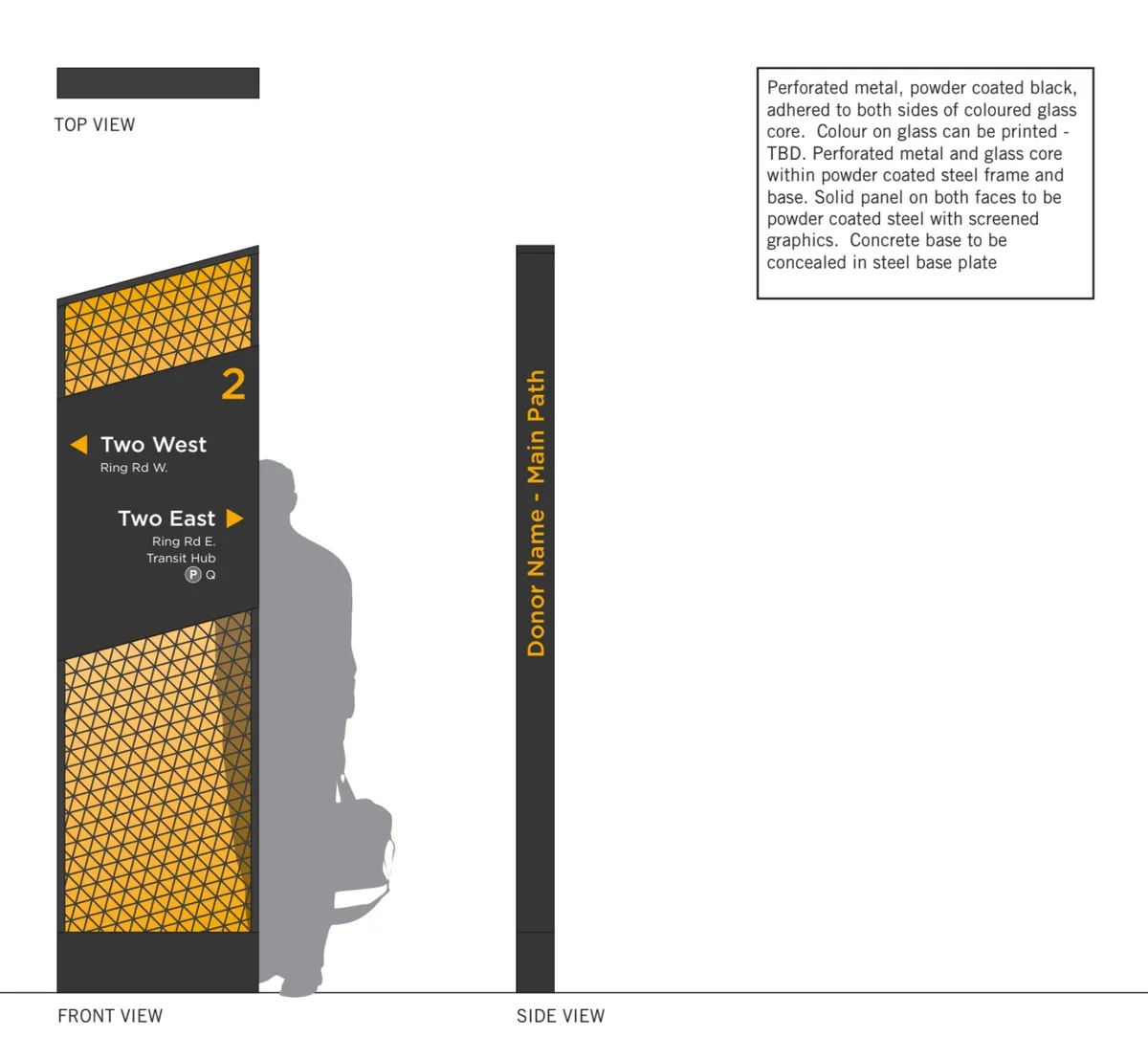
(Actually, they got worse from this slide; after some more back and forths the translucent glass panel at the bottom was also replaced with plain black powder coated steel, leaving only the one at the top.)
So in short, though we had a very generous budget for designing and manufacturing the signage, all of our ambitions were blocked by the fact that there were only so many guys doing the groundskeeping. So like, I think this Baumol guy is maybe onto something.
Here’s another reason I think Baumol is right. Last fall I spent a weekend in Newport, Rhode Island, where the gilded age coal and rail magnates of New York built their summer mcmansions. At the time I was insanely locked in on some vampire fanfiction I was writing, and my vampiress OC dwelled and terrorized men in a mansion I’d heavily modeled after The Elms. I visited because I wanted a felt sense of how big the ballroom was and what the servants' quarters were like.
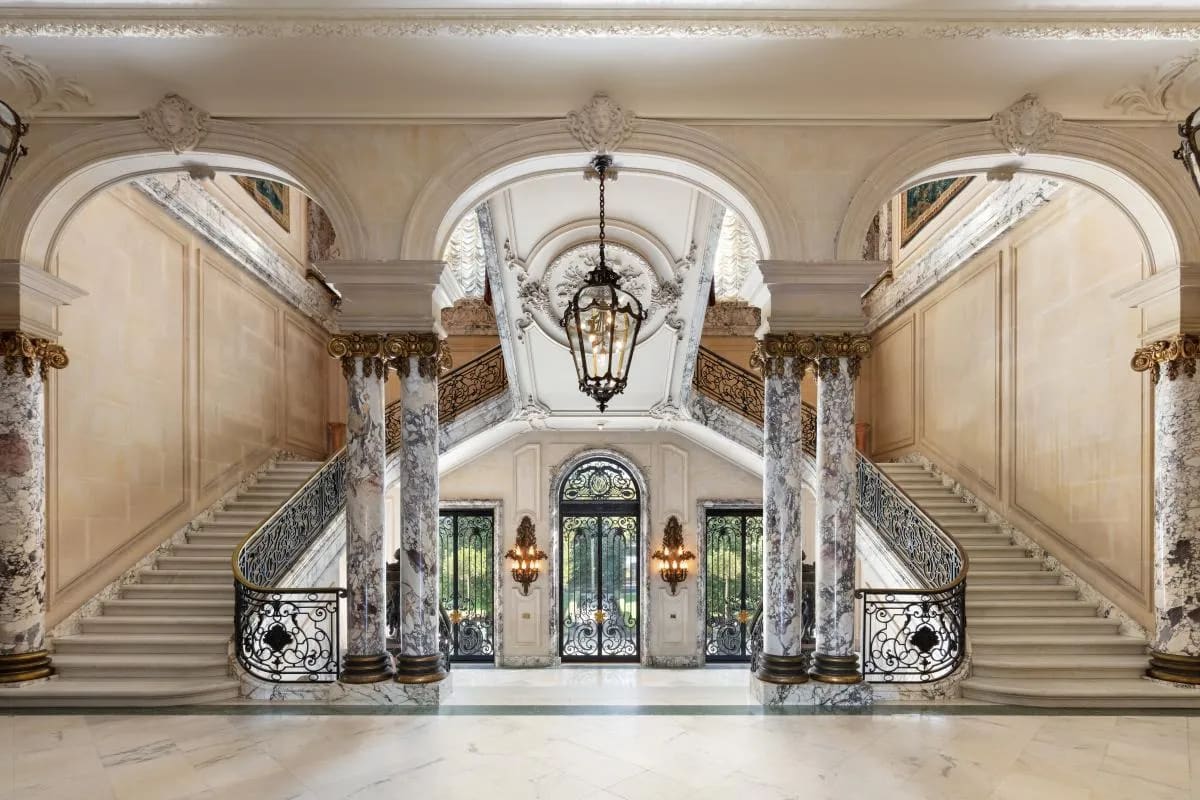
The grand entryway of The Elms. My beautiful vampiress Mary Sue blorbo was quite avant garde in her preference for sunlight and pale decor.
These days, the majority of the mansions are owned by the Newport Preservation Society. The preservation society is a nonprofit that turns them into museums that you pay money to enter, because that is the only way that they can pay for all the maintenance they need. Some of them were sold to the preservation society because the family trusts were fumbled in the century since their construction, but some belonged to families that still have significant means today. For example, it costs $32 USD to tour The Breakers, which once belonged to the Vanderbilt family.
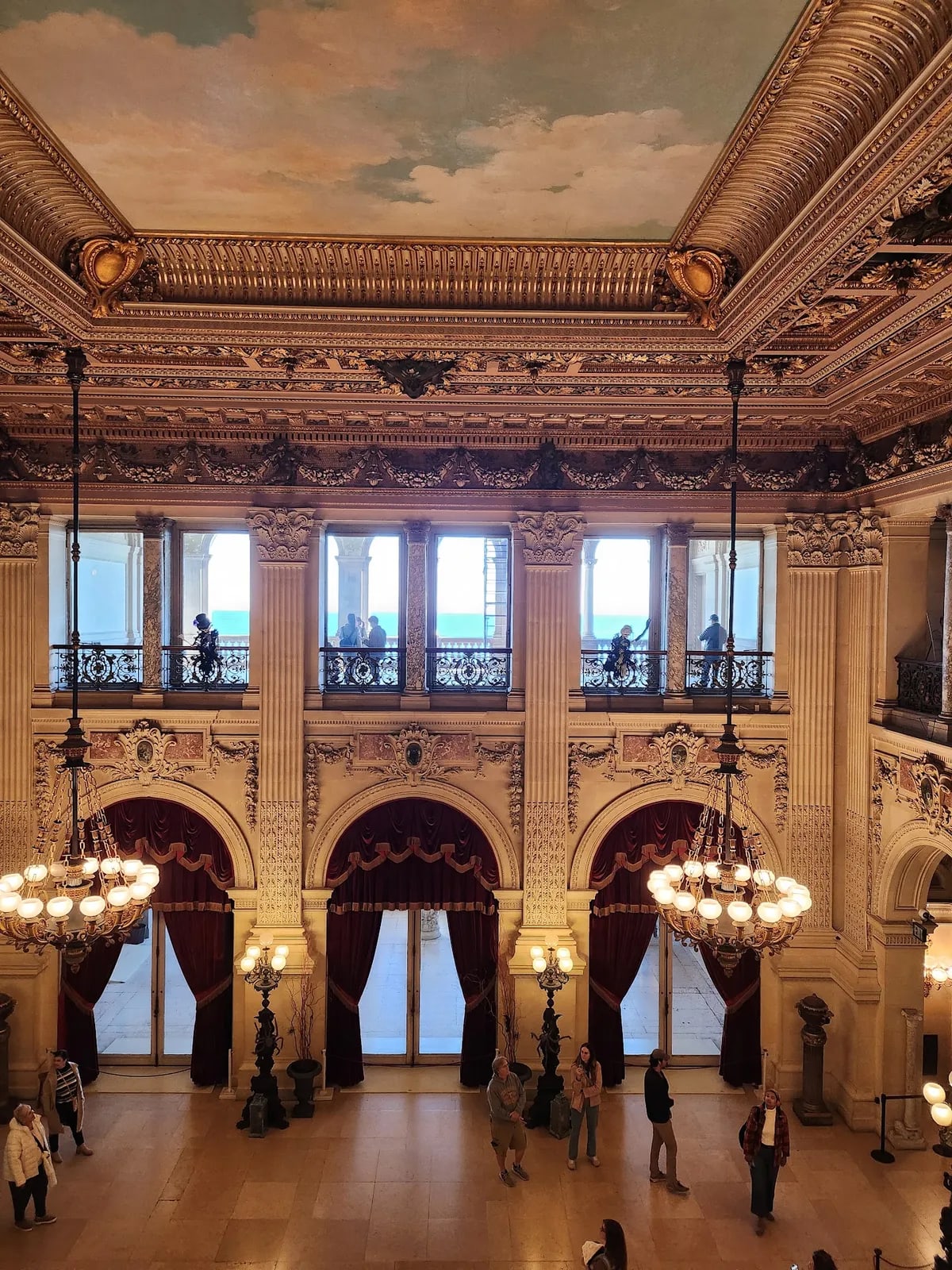
The entry hall of The Breakers. The chandeliers can be gas-powered (hence the thick black rods), because the mansion was built before we invented reliable electrical grids.
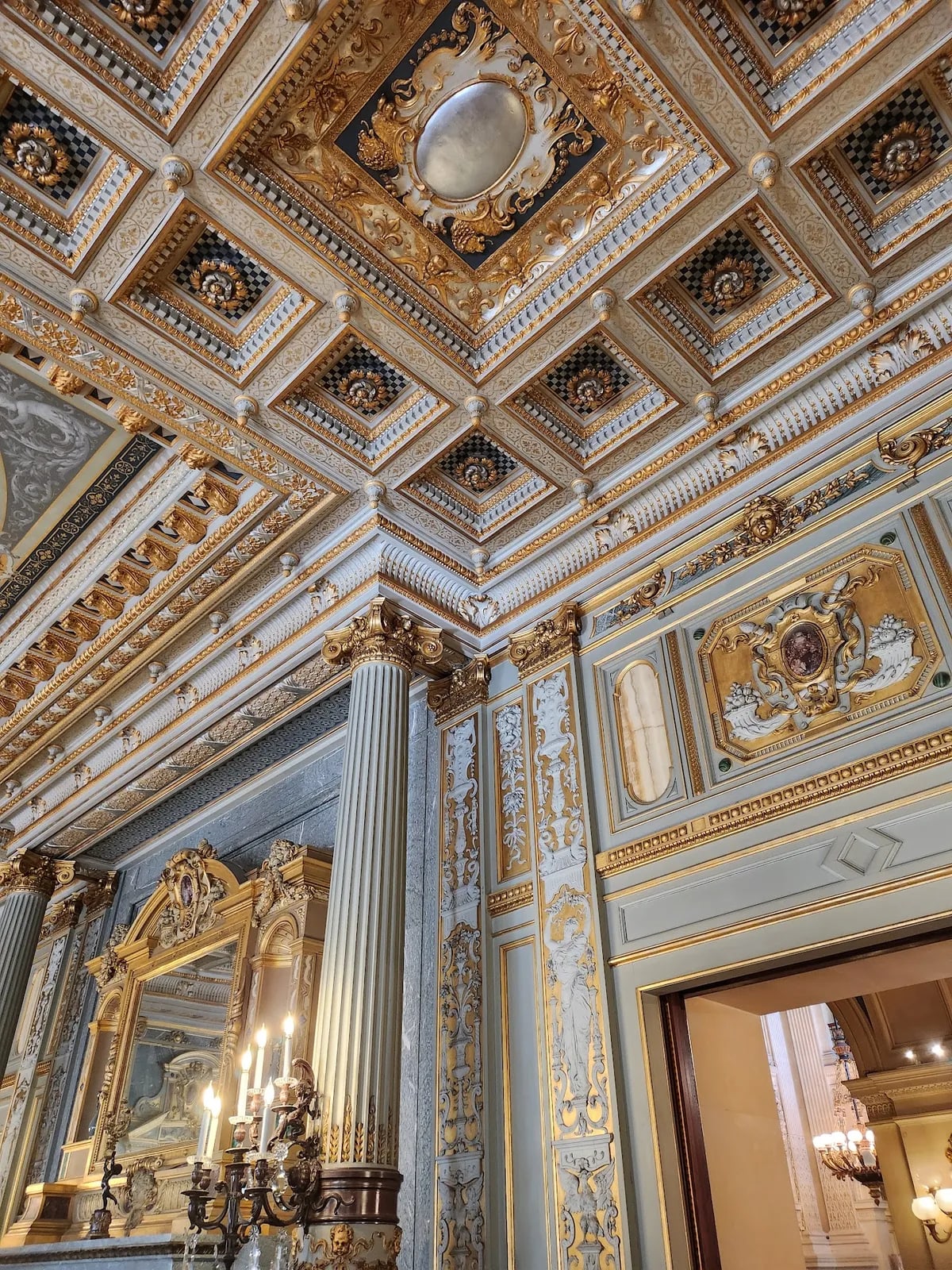
If you looked up in any of the rooms it would kind of look like this. After visiting Newport I finally understood on a spiritual very fundamentally material level why it was called the "gilded age".
I suspect that gilded age mansions are the kind of thing that Patrick Collison wants more of; rooms and rooms of imported marble and beautiful intricate mosaic work and classy European portraiture.
The Vanderbilts (the Vanderbilts!!) could not keep up the army of fifty servants and twenty gardeners that was required to keep The Breakers running. Alice Vanderbilt’s death in 1934 passed the house to her youngest daughter Gladys, and even then it was common knowledge that the house was more of a liability than a gift. Gladys rented it out to the Preservation Society for $1 a year, and lived in a small apartment on the upper floor of the mansion while the rest of it was converted into a tourist attraction.
In 1972 Gladys' heirs sold it outright to the Society for $365,000 (what might be a sweetheart price, to be fair), at which point the annual spend was around $500,000 on wages, maintenance, and upkeep. The mansion was sold for less than the cost of a year of its own maintenance.
Contra the Works In Progress guys, I just, like, don't think the manufacture of the ornaments is the crux for whether or not the Baumol effect is to blame for why everything is bad now? I suspect what made the Vanderbilt heirs balk was the ongoing operational cost of hiring seventy people to maintain all that state-of-the-art stamped/cast/extruded gilt and the sophisticated garden grounds, not a newly trending preference for vandalism-proof plexiglass.
Let's now return to those two phone booths, and let me tell you what I would see as a municipal bureaucrat, a job that I am qualified to do and would have done in a very depressing alternate life.
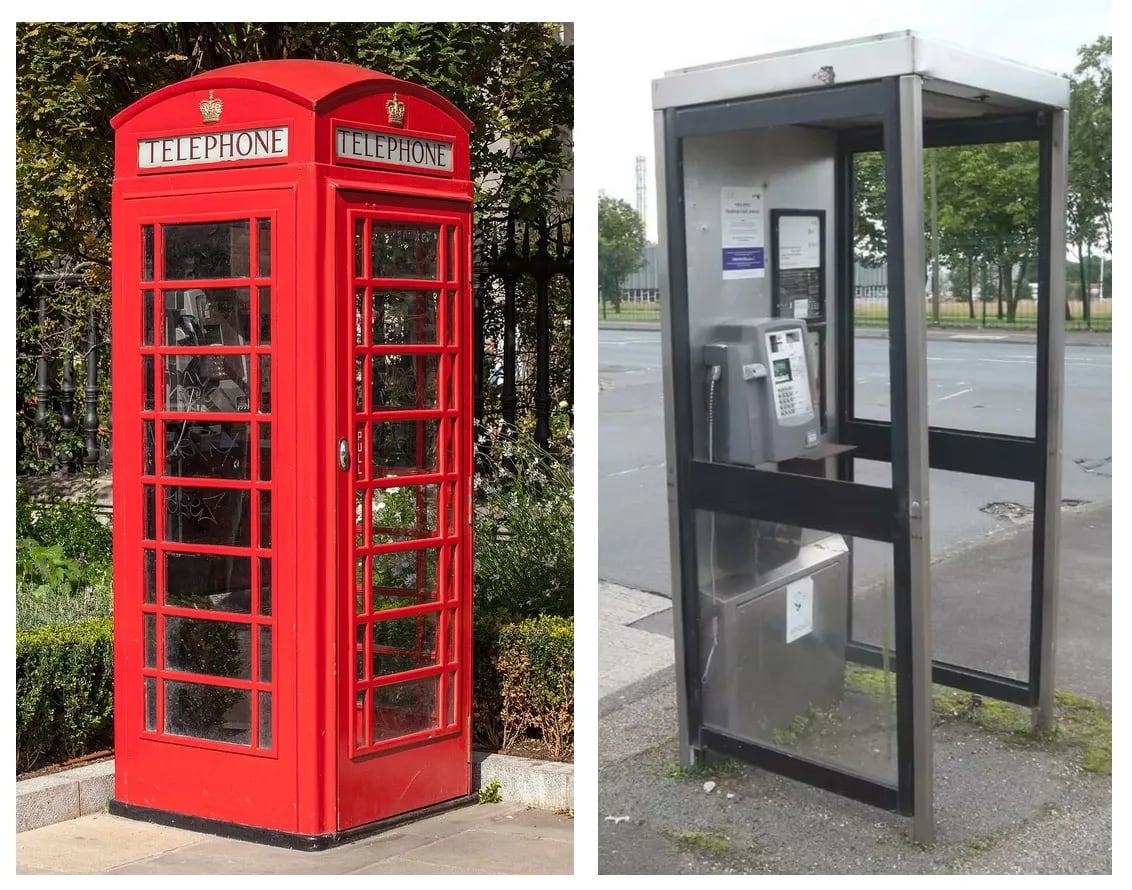
First, I would recognize that the first phone booth, the painted red one, is beautiful. Of course it is. I vastly prefer it aesthetically over the plain utilitarian powder coated black steel and plexiglass.
But here are some other things that I would note:
- The little raised crown at the top and the TELEPHONE label is going to trap grime and dust.
- And each little corner of each little glass panel, because of the way the pane dividers stick out. You can already see the grime on the lower panels. The red paint will also make dirt unusually noticeable, which means it will need to be wiped down regularly.
- The booth might also require regular repainting, especially if we are wearing down the red paint by exposing it to cleaning agents regularly. Because of all the little glass panels that we don't want to get red paint over, the repainting will be finicky and arduous.
- If the door is accidentally left open, or blown open by the wind, leaves and detritus will get inside, so someone will need to go in and clean the floor inside on a regular basis.
- Some animal might make a nest inside, or get trapped and die inside and then it will be unusable until we call animal control (expensive).
- It will be peed in, slept in, and used for drugs. No one can see in properly, which might make it unsafe.
- Will the door freeze shut in January? Can a snowplow get near it, or will someone need to shovel out a path to the door manually? Or do we only use them half the year?
- Is it wheelchair accessible?
- How many additional full-time unionized public service workers do we need to hire to take care of every, say, fifty of the red phone boxes? Can we justify raising property taxes to hire people for this?
It brings me no pleasure to observe that the fuck-ugly metal box solves all these problems, and every attempt to engineer the red box to solve the above problems will make it more like the ugly one.
Things are ugly because the street sweepers are basically doing the same thing that they were doing a hundred years ago. But these days instead of hiring, I dunno, wretched street orphans for a pittance (as a civilization we made the choice to eliminate "wretched street orphan" as a category of worker), we have to pay grown adults full municipal union wages and benefits.
Okay, fine, so are we cursed to have bad street furniture forever? Do we have to be resigned to this?
I mean, personally, I think we just need to let the industrial designers cook, and come up with nicer designs that meet the requirements.
The new requirements are pretty well specified, and you can find them in documents such as Vibrant Streets, Toronto's Street Furniture Design and Policy Guidelines (section 6.5):
Materials and finishes must have proven their long term ability to function in and withstand severe environmental conditions (i.e. snow, ice, salt, pollution etc.), while maintaining their appearance.Materials must have proven success in terms of their intended use and ability to withstand vandalism and other abuse.Elements must be fabricated to the highest standards and have a proven track record of use in high traffic environments.Repair must be easy. Replaceable modular parts should be designed to make repair easy, so that elements are not “out of service” for any length of time.
- Materials and finishes must have proven their long term ability to function in and withstand severe environmental conditions (i.e. snow, ice, salt, pollution etc.), while maintaining their appearance.
- Materials must have proven success in terms of their intended use and ability to withstand vandalism and other abuse.
- Elements must be fabricated to the highest standards and have a proven track record of use in high traffic environments.
- Repair must be easy. Replaceable modular parts should be designed to make repair easy, so that elements are not “out of service” for any length of time.
I think these are pretty reasonable guidelines for street furniture design considering Baumol's constraints, though there is of course room to quibble on the margin. But I think ultimately my intuition is that, like — how many man-hours do you think have gone into the creation of street furniture that is beautiful, and can also adhere to these guidelines? Like, probably we just haven't poured enough effort into the problem yet? I feel content to just chill and wait.
Also, can I say something a bit out of pocket? Okay, okay, look. It appears to me..... that we are not exactly sending our best into the field of industrial design. And I find this to be a very reasonable allocation of talents, because probably we want to allocate our best to, like, solving cancer or AI misalignment, and not the marginal improvement of park benches?
Our brave b-tier troops are trying their best to design beautiful street furniture in accordance with the new requirements imposed by the rising cost of human labour. It's probably okay if they need a little extra time; nothing's going to explode.
I am content to chill and wait, because what I notice is that over time the public spaces I am in have gotten incrementally more beautiful. When I go to Toronto's newest park, I find the street furniture there to be more pleasing than the generic street furniture I remember growing up with.
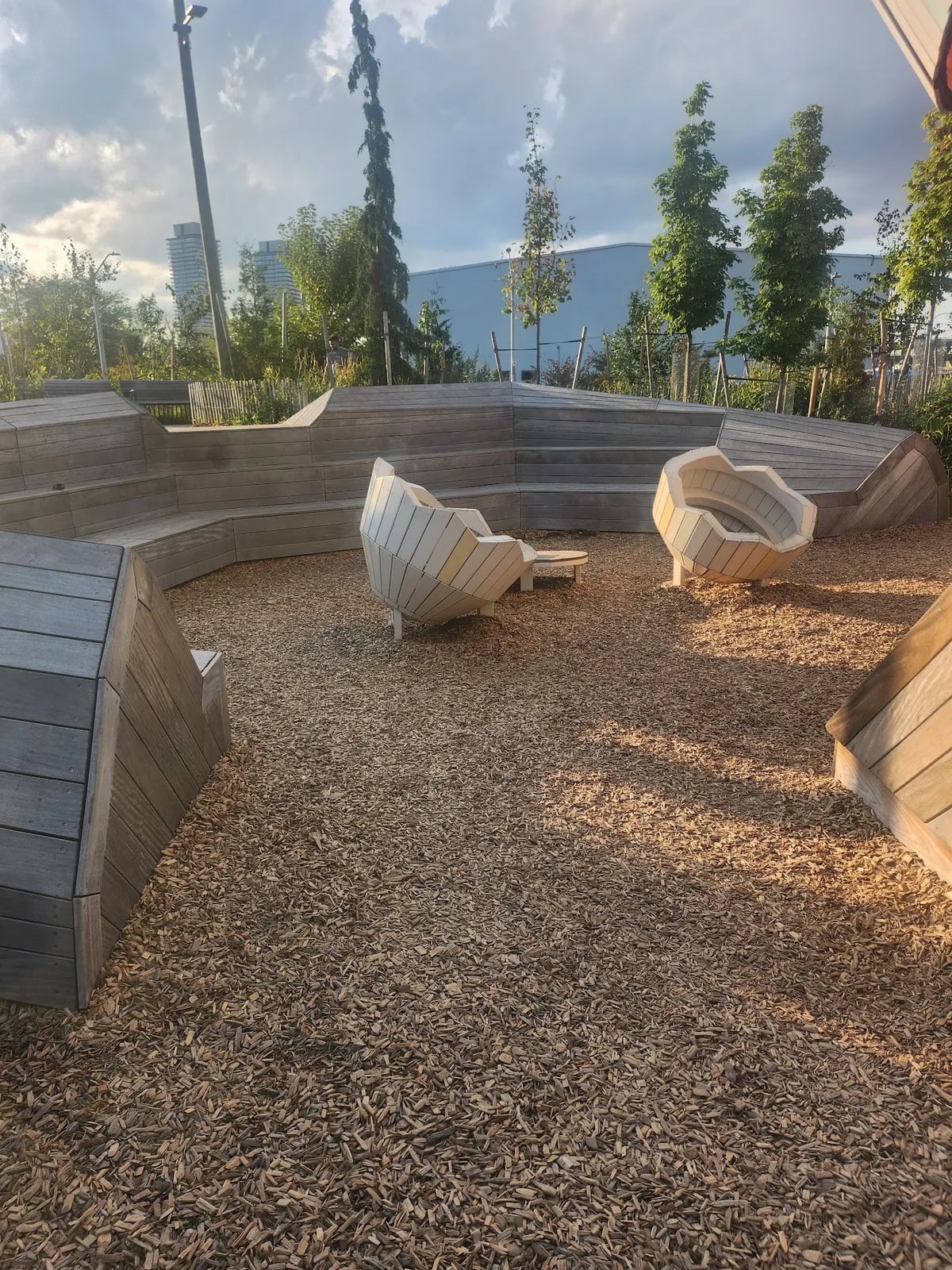
Some intriguing seating(?) by the giant owl.

A covered, strawberry-themed rest area.
I'll be the first to admit that it's not at gilded age levels of impressiveness yet. If one is more impatient than me, and would desire things to improve faster, I hear funding for more R&D helps. Either for more beautiful benches, or for automated robot labour. Does anyone have Collison's number?