 Newshot
OutcomeOps: Context Engineering for AI-Assisted Development
OutcomeOps AI Assist is a generic, language- and framework-agnostic platform for AI-powered code generation, pull-request review, and knowledge-base retrieval that deploys entirely into your own AWS account. It grounds AI in your organization's standards — ADRs, code-maps, and architectural decisions — so generated code and reviews match your patterns instead of generic defaults. The platform is open source under the Apache License 2.0; see CONTRIBUTING.md to get involved. Security reports go through SECURITY.md.
Trademark: "OutcomeOps" and the OutcomeOps logo are trademarks of OutcomeOps LLC. The Apache-2.0 license grants no trademark rights, so forks and derivatives must use a different name.
AI generates generic code. You need code that matches YOUR standards.
The problem: Engineers spend hours adapting AI-generated code to organizational patterns, standards, and architecture decisions.
The solution: Give AI access to your organizational knowledge—ADRs, code-maps, architectural decisions—so it generates code that already matches your patterns.
- 16-hour tasks → 15 minutes
- $2-$4 per feature
- 100-200x ROI
- Production-tested at Fortune 500
This is Context Engineering. This is OutcomeOps.
Learn more about the OutcomeOps Methodology →
See It in Action
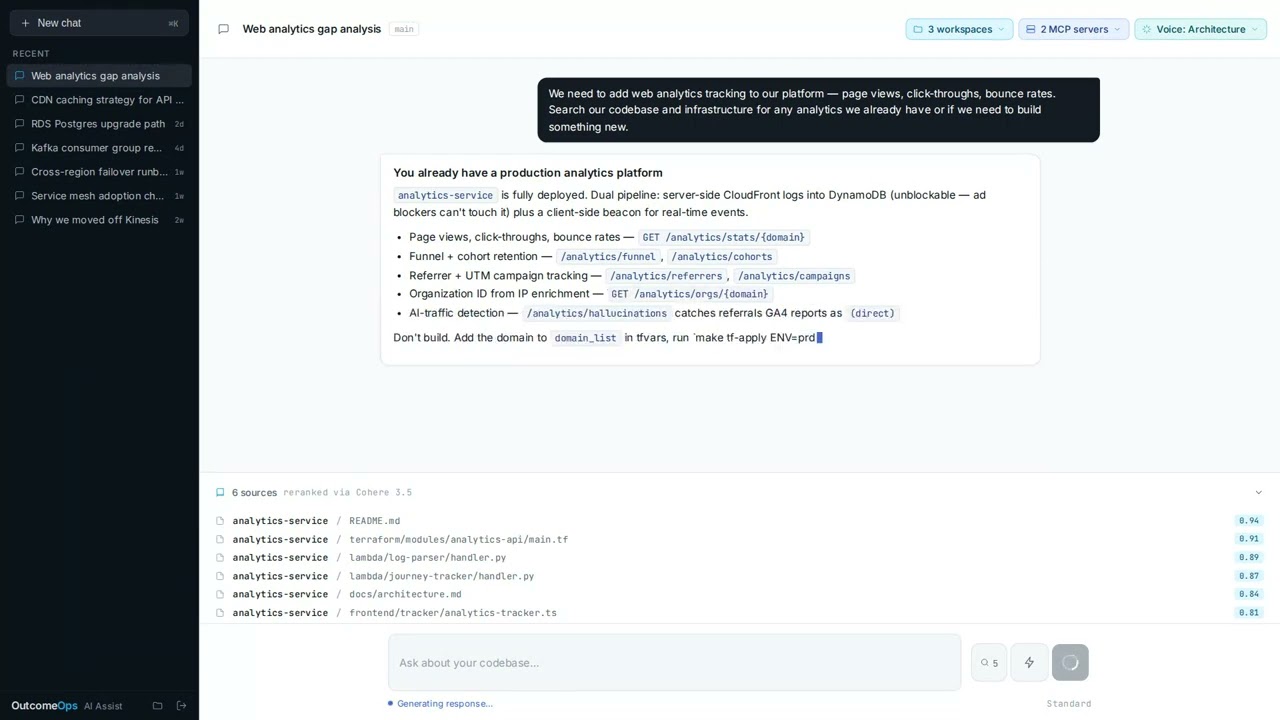
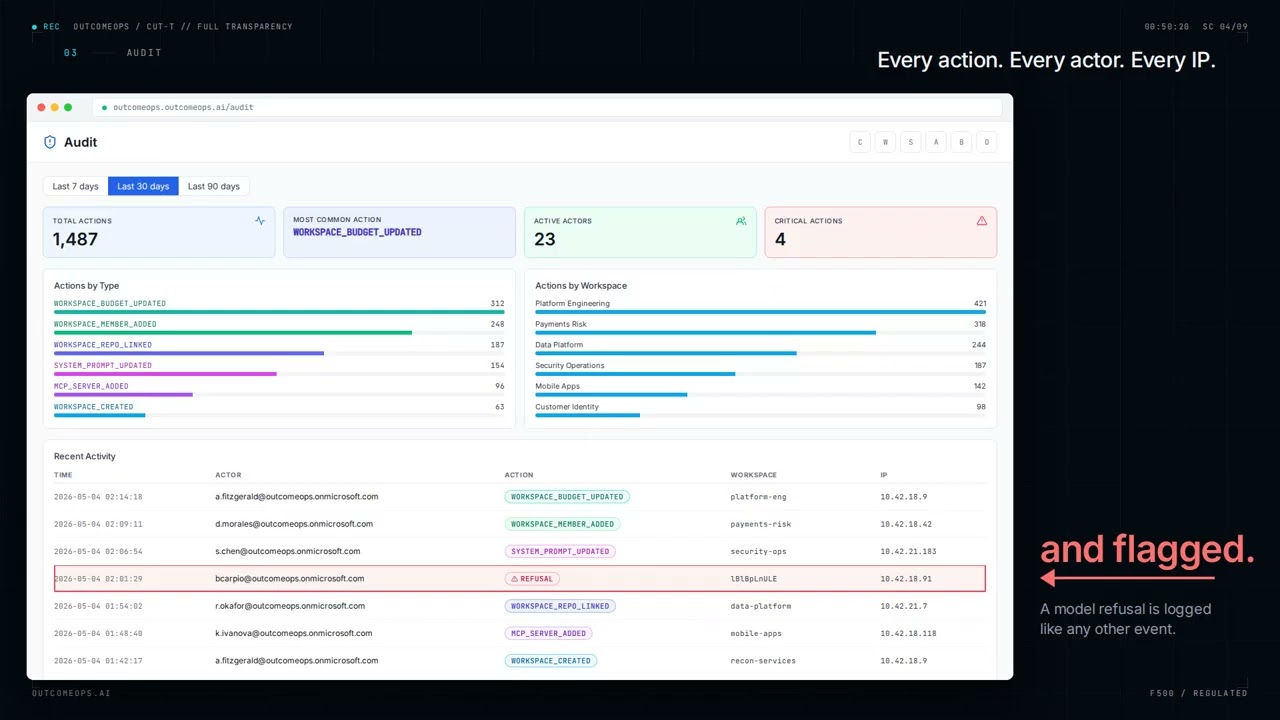
More walkthroughs on the OutcomeOps YouTube channel.
Pull Request Review
Every pull request to this repository is reviewed by OutcomeOps itself, against the repo's own ADRs:

A real review, quoted verbatim: the license check reads the repo's ADR-008 and decides a missing copyright header on a Markdown doc is a WARN, not a FAIL. See the pull request.
The Problem With AI Tools Today
Current AI coding tools:
- Generate generic implementations
- Don't know your architectural decisions
- Ignore your coding standards
- Require hours of manual adaptation
- You still spend most of your time rewriting AI code
OutcomeOps is different:
- Understands YOUR codebase patterns
- Knows YOUR architectural decisions (via ADRs)
- Generates code matching YOUR standards
- Includes tests automatically
- AI does the work. You do the review.
How OutcomeOps Works
- Ingest Organizational Knowledge
- ADRs (Architecture Decision Records)
- Code-maps (repo structure and patterns)
- Existing code examples
- Standards documentation
- Vector Search + Reranking
- When a feature is requested (Jira story, GitHub issue)
- OutcomeOps queries your knowledge base via semantic vector search
- Reranks results using Cohere Rerank 3.5 for precision ordering
- Finds the most relevant patterns, decisions, and examples
- AI Generation with Context
- Claude generates code using YOUR context
- Matches YOUR patterns, not generic templates
- Includes tests based on YOUR testing standards
- Creates MR/PR with full implementation
- Automated Review
- MR analyzer checks against standards
- Validates architectural compliance
- Comments on deviations
- Code that's 90% done when you first see it
See detailed architecture →
Beyond Vector Search
Vector search is good at "how do we usually do this?" It cannot reliably answer "what breaks if I change this function?", and on its own it does nothing to keep personal data out of the model's context. OutcomeOps adds two layers for that.
A symbol graph for exact answers. While generating code-maps, OutcomeOps extracts every definition, call, import, and interface implementation into a symbol graph stored in DynamoDB. Structural questions are answered from the graph, not from text similarity:
- callers, importers, implementers, and definitions of a symbol, each with file path and line
- References resolve across repositories, so a consumer in another repo, or in a workspace that was granted access, is found too (ADR-055, ADR-056)
- The pull-request breaking-changes check uses it to list every consumer of a changed symbol
- Chat, code generation, and PR review query the graph alongside vector search, and the same lookups are available as MCP tools (find_callers, find_importers, find_implementers, find_definitions)
- When there are no callers, the answer is an empty list, not a guess
PII redaction at ingest. Before a document is embedded, Amazon Comprehend DetectPiiEntities runs inside your AWS account and replaces names, Social Security numbers, phone numbers, account numbers, and other personal identifiers with [REDACTED:TYPE] placeholders. The vector store, and every chunk retrieved into a prompt, holds only the redacted text (ADR-051).
- Technical identifiers developers need (URLs, IP addresses, MAC addresses, timestamps) are kept by default; the skip list is the pii_redaction_skip_types tfvar
- Every workspace is STRICT by default. An admin can set one to NONE (for example HR or support content where redaction defeats the purpose), and that change is written to the audit log with the old and new mode
- pii_redaction_enabled is the org-wide kill switch
- With audit_stream_export_enabled, the audit log streams through Kinesis as OCSF v1.3.0 events to your SIEM
- The raw source copy in your S3 bucket is deliberately left unredacted, so read_source and code generation work from the real code
Get Started
Prerequisites:
- GitHub repo with some code
- AWS account (for Lambda deployment)
- ADRs or architectural docs (or we'll help you create them)
- AWS CLI v2, Terraform 1.5+, and Docker installed
- See Getting Started for the full prerequisite list (VPC, domain/cert, Azure AD)
Ready to get started?
OutcomeOps is open source under the Apache License 2.0. Clone the repo and deploy it into your own AWS account, no license or sign-up required.
A first deployment takes roughly 30 to 45 minutes (most of it building the Lambda layers and container images, see Getting Started):
- Deploy infrastructure to your AWS account
- Configure GitHub webhook
- Create test issue with label "approved-for-generation"
- Watch OutcomeOps generate a PR in ~15 minutes
New to ADRs? Start here →
OutcomeOps vs Other AI Coding Tools
GitHub Copilot / Cursor: Autocomplete and chat, but no organizational context. Generates generic code requiring manual adaptation to your standards.
Devin: Autonomous agent for tasks, but doesn't know YOUR patterns. Still generates code that needs refactoring to match your conventions.
ChatGPT / Claude (standalone): Powerful, but requires pasting context every time. Not scalable. No integration with your codebase.
OutcomeOps: Ingests YOUR ADRs, YOUR patterns, YOUR standards. AI generates code that already matches your organization. Review outcomes, not syntax.
Who Built This
OutcomeOps was created by Brian Carpio, who previously built:
- Golden Pipelines (2014) - Took deployment from 6 weeks → 1 week at Aetna
- AWS ProServe - Led largest Healthcare & Life Sciences engagement in ProServe history
- Platform Engineering - Before it had a name, building self-service infrastructure at Pearson (2012), Aetna (2014), Comcast (2018)
OutcomeOps applies the same playbook to AI-assisted development:
- Make the easy path the right path
- Bake standards into infrastructure
- Create velocity through automation
- This is golden pipelines for code generation
Read the full story →
Documentation
Getting Started
- Getting Started Guide - Prerequisites, setup, first steps
- Getting Started with ADRs - Learn about Architecture Decision Records
Core Documentation
- Architecture Overview - System design and data flows
- Technical Reference - Detailed technical documentation
- CLI Usage Guide - Using the outcome-ops-assist CLI
- Deployment Guide - Operations and troubleshooting
Integrations
- OutcomeOps MCP Server - Connect Claude Code, VS Code, and other MCP clients
- SonarQube MCP Server - Code quality and security tools via MCP
- AI Disclosure Modal - Pre-use AI transparency notice for regulatory compliance
Lambda Documentation
- Lambda: Query KB - RAG orchestrator (vector search + reranking + answer generation)
- Lambda: Ask Claude - RAG answer generation
- Lambda: Generate Code - AI-powered code generation from issues
- Lambda: Analyze PR - PR analysis orchestration
- Lambda: Process PR Check - PR check worker
- Lambda: Run Tests - Executes make test for generated branches
Architecture Decision Records
- ADR-001: Creating ADRs - How to document architectural decisions
- ADR Template - Template for new ADRs
For Developers
- Claude Guidance - AI assistant development best practices
- Backstory - Why OutcomeOps exists
Resources
Ready to deploy OutcomeOps?
- Learn the Methodology - Understand the OutcomeOps approach
- YouTube Channel - Demos and walkthroughs
- Learn ADRs - New to Architecture Decision Records?
- Technical Documentation - Deployment and implementation guide
- Contributing - How to get involved
- Questions & Support - open an issue or discussion
Built for engineering velocity.
Outcome-driven development. Infrastructure by code. Engineering outcomes by AI. Your vision, automated execution.