 Newshot
Article title: Li Auto Built a Chip That Took the TSMC Stage, Yet Hopes You'll Completely Forget It While Driving
Body:
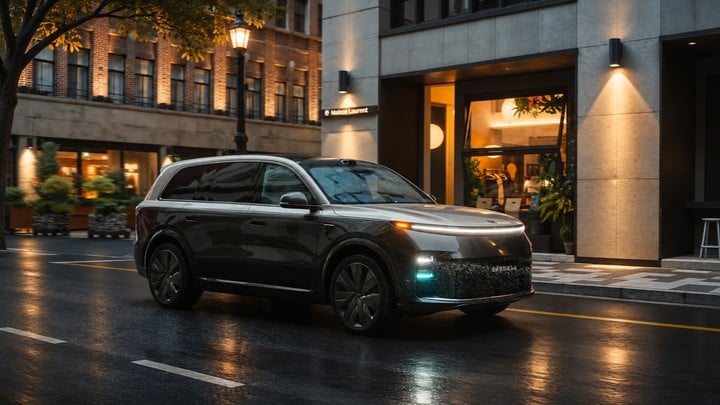
Li Auto Built a Chip That Took the TSMC Stage, Yet Hopes You'll Completely Forget It While Driving
2026-11-20 18:39
When buying a car, judging whether it's good is often a very intuitive matter.
Step on the accelerator, and the pushback tells you whether the horsepower is enough. Touch the center console, and your fingertips tell you whether the materials are good. Not to mention the ancient art of listening to the build quality by opening and closing the door. Does it sound solid? Solid means a good car—simple and direct.
But times have changed. High tech has arrived, AI has arrived, the era of information explosion has arrived, and the world has become complex and hard to understand—and so has buying a car.
Take intelligent driving, for instance—it's quite mystifying. Salespeople at the store usually enthusiastically rattle off a string of numbers: 500 TOPS, 1000 TOPS…
Everyone understands the principle that brute force wins, but in reality, nobody truly cares about the specific compute figures. As an ordinary consumer, what we actually want to ask is very simple:
Can a chip that took years and billions in R&D to develop actually make the car drive more like a human?
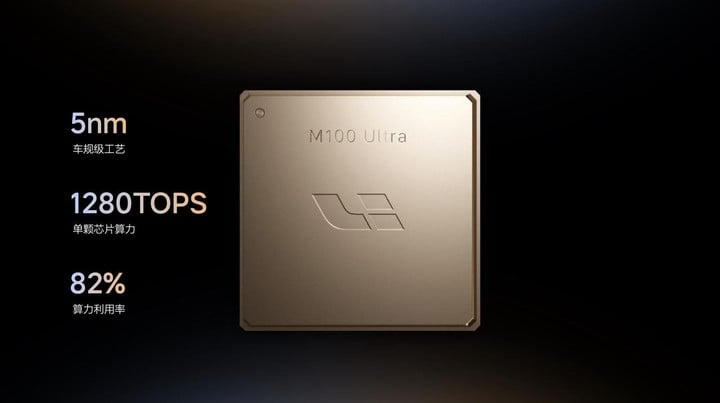
Li Auto believes this can be achieved through its self-developed "Mach M100" chip. On November 17, with this chip already in mass production and on vehicles, Li Auto entered the semiconductor "insiders' circle"—the TSMC OIP Open Innovation Platform Ecosystem Forum.
As the highest-spec annual event in global chip design, EDA, and advanced process technology, the TSMC OIP Forum has historically invited only the world's top computing giants to take the stage. In past years, those who took the specially invited speaker seats were infrastructure heads from Google and Meta, or chip industry legend Jim Keller, known as the "Silicon Sorcerer."
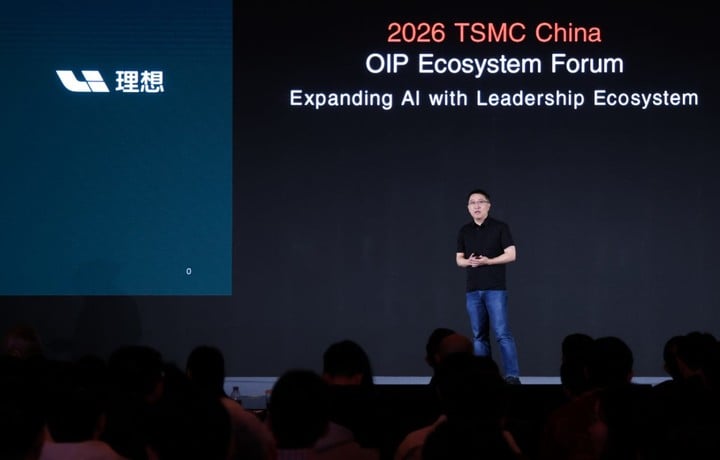
This year, those sharing the stage with Li Auto were also global top chip companies like Broadcom, Renesas Electronics, and SK Hynix. Li Auto thus became the only mainland Chinese company to give a specially invited talk since the TSMC OIP Ecosystem Forum began.
But rather than the stage appearance itself, what we want to explain clearly today is: how exactly does Li Auto, through this underlying chip architecture design, cure intelligent driving's "hesitation" and make it truly drive more like a human?
Li Auto's "Kitchen Revolution"
Anyone who has used intelligent driving has probably experienced this moment: no matter how high the on-paper compute is stacked, the car may still behave like a novice at a complex intersection—either not decisive enough in seizing the moment, or acting recklessly without properly judging the road conditions.
This imprecise handling of road conditions stems partly from limitations in the algorithm model's design, but a large part also comes from computational efficiency at a deeper level.
For decades, the tech industry has enjoyed the dividends of Moore's Law: once chip process technology upgrades, software can gain a round of improvement without major changes. But after Moore's Law slowed, in the face of massive parallel AI large-model computation, the "von Neumann architecture" that has dominated computing for 70 years ran into a thorny memory efficiency bottleneck.

In the field of computer architecture, there's a classic "chef cooking" analogy to explain this bottleneck known as the "memory wall":
A traditional CPU or GPU is like a highly skilled "chef" in the kitchen, while memory is the "big warehouse" at the end of the hallway. According to the rules of von Neumann architecture, every time the chef chops ingredients once, he has to put down the knife and run back to the distant warehouse to fetch seasoning, then run back to put it away after chopping.
As a result, the chef spends 70% of his time and energy running back and forth to the warehouse, and the time actually spent wielding the knife—that is, the chip's actual compute utilization—is less than 30%.
In the traditional software era, because the amount of data processed each time was small, the chef could keep a "small prep station" at hand—that is, cache—to handle everyday stir-frying. But in the AI large-model era, parameters in the billions and real-time video streams directly overwhelm the prep station, forcing the chef to frequently shuttle to the distant warehouse.
So what to do? The industry's traditional solution is to hire a few more errand-running chefs—that is, to stack dedicated accelerator units on top of the traditional architecture.
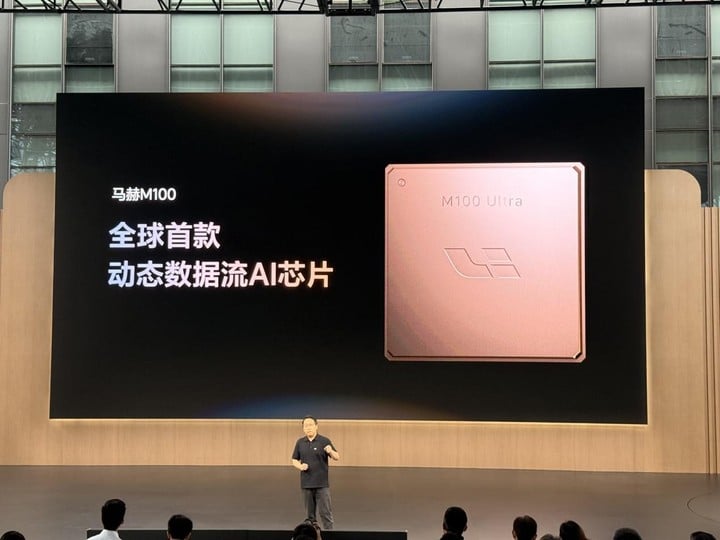
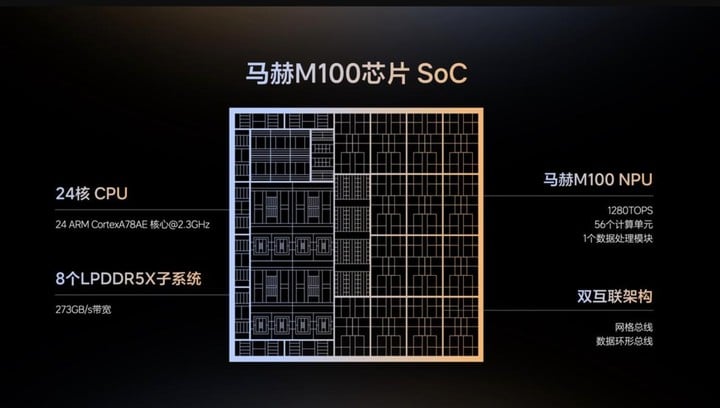
Li Auto, however, chose to revolutionize the kitchen's cooking workflow. In 2022, when the Mach M100 project was initiated, Li Auto simply tore down the old kitchen and built the world's first mass-produced dynamic dataflow architecture AI chip.
Li Auto eliminated the errand-running "head chef" and transformed the entire kitchen into a "central kitchen assembly line."
Ingredients—that is, data—are processed immediately upon arriving at a workstation; after processing, they are no longer sent back to the distant warehouse, but travel along the on-chip high-speed conveyor directly to the next workstation, or are dispatched all at once via the ring-and-mesh dual interconnect bus to all downstream workstations for collaborative processing.
At the same time, the dynamic design retains a high degree of software programmability.
A traditional fixed pipeline can often only make one dish, whereas the Mach M100 is equivalent to letting the assembly line swap in new recipes at any time according to the algorithm, flexibly adjusting the process through software recompilation—preserving the assembly line's high efficiency while leaving room for the ever-evolving AI large models.
As computer pioneer Alan Kay once put it—a quote Steve Jobs held as a guiding principle at the original iPhone launch:
People who are really serious about software should make their own hardware.
In the past, car companies facing chips were merely "diners" ordering from a menu: whatever chip a supplier provided, the algorithm had to accommodate that architecture—this was the industry's common situation.
Li Auto, by breaking down departmental walls through "software-hardware co-design," turned itself into the head chef; within Li Auto, the algorithm team and the chip team were able to work together from day one.
This tailor-made "kitchen" pushed up the efficiency ceiling of on-device AI computing. On this Mach M100 chip, built on a 5nm automotive-grade process with 1280 TOPS of single-chip compute, compute utilization was raised to over 82%.
Running the 35B-scale Qwen3.5-35B-A3B model on it, prefill speed reached 2.7 times that of NVIDIA DGX Spark, and decode speed reached 1.5 times.
Earlier this year, the Mach M100's architecture paper, alongside results from Google and Meta, was accepted into the industry track of ISCA 2026, the top global conference on computer architecture. Li Auto also became the first automaker worldwide to be accepted into that track since its establishment, and the previous Chinese company accepted into ISCA was DeepSeek in 2025.
By not wasting compute on "running errands," Li Auto is able to further unleash the large model's execution efficiency through the Mach M100 chip. And the efficiency gained on the chip ultimately translates into smooth reactions on the road.
Making the Car "Think Fast" Like a Normal Human Brain
Nobel laureate Kahneman, in Thinking, Fast and Slow, divides thinking into two types: "System 1" is intuitive fast thinking, instantaneous instinctive reaction; "System 2" is logical slow thinking, responsible for deep logical reasoning and complex deliberation.
But in reality, when a person is driving, "System 1" and "System 2" operate as an integrated hand-eye-brain state working in coordination. The human brain processes information fast enough that, while relying on intuition to make quick decisions about real-time road conditions, it can also draw on experience—that is, "System 2"—to anticipate upcoming road situations in advance.
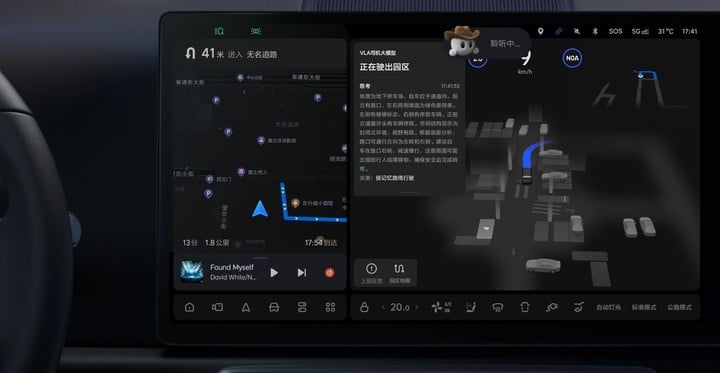
Today the intelligent driving industry is frantically racing on VLA (Vision-Language-Action) large models precisely to give cars more of "System 2"'s advanced reasoning capabilities—for example, anticipating blind-spot risks at intersections without traffic lights, or understanding the intent of temporary detours at construction zones.
Previous intelligent driving systems didn't make enough use of "System 2," and the core reason was that it was too costly and too slow to compute.
On traditional architectures, once a model simultaneously mobilizes complex 3D spatial understanding and multi-step logical deduction, massive data movement hits the "memory wall." The car may eventually figure it out, but by the time it finishes computing, the window to proceed through the intersection has long passed.
This manifests in the driving experience as jerkiness and hesitation, and as "being unable to think like a human."
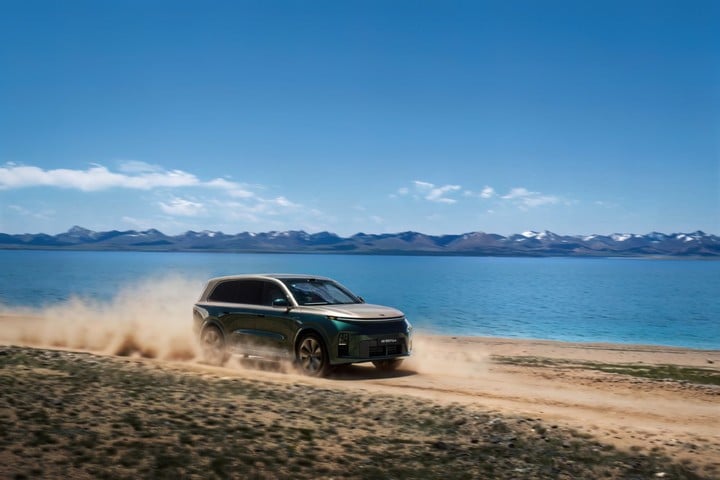
With the Mach M100 entering mass production and hitting vehicles in May this year alongside models such as the all-new Li Auto L9, this wall between hardware and algorithms was torn down. In the OTA 9.2 version pushed on November 6, Li Auto officially launched Mach VLA 2.5 and brought its self-developed native 3D vision encoder—3D ViT—onto the vehicle.
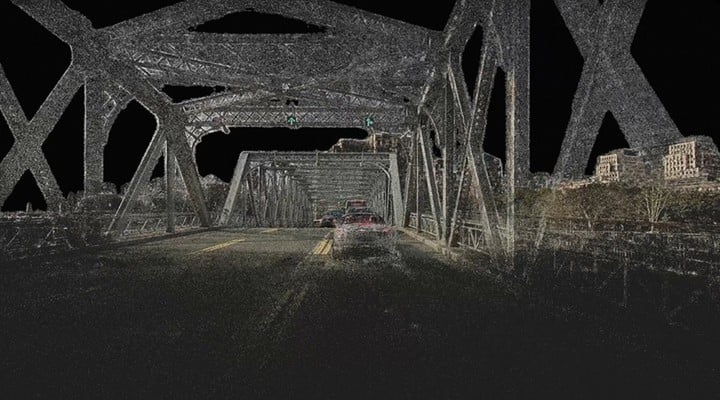
If earlier intelligent driving vision was "looking at the world through a 2D screen"—first recognizing boxes in flat images, then stitching them with point cloud information across multiple modules, inevitably incurring information loss and alignment errors along the way—then 3D ViT gives the intelligent car a pair of eyes that can truly "understand" the real 3D physical world.
The hallmark of 3D ViT is that, at the vision encoding stage, it fuses 3D spatial geometry and semantic information into one, computing spatial structure, positional relationships, and object categories "from start to finish in one go, without unpacking or stitching."
And this continuous, massive data processing style happens to be the greatest strength of the Mach M100's dynamic dataflow architecture—"direct to the assembly line."
You see, your own kitchen really does understand your own family's tastes best.
Relying on the Mach M100's compute foundation, 3D ViT introduces feed-forward 3DGS (3D Gaussian Splatting), separately modeling static environments such as roads and buildings and dynamic objects such as vehicles and pedestrians, and continuously evolving through "next-frame prediction" self-supervised learning.
Article title: Li Auto Built a Chip That Took the Stage at TSMC, Yet Wants You to Forget It Entirely While Driving
Body: Reflected in perception capability, the vehicle's forward perception distance has been directly extended to 300 meters, with pixel-level perception equivalent to 1080-line resolution and a 50% improvement in dynamic vision. On the daily commute, these technical metrics can further give Li Auto's assisted driving more crisp and decisive detailed responses.
In a sense, Li Auto's logic—from the underlying chip to the top-level model—is closer to how a normal person's brain thinks about driving: a truly skilled veteran driver often relies on the coordination of hands, eyes, and brain as one, requiring the synergy of "System 1" and "System 2"—using extremely high transmission efficiency at the底层 to make the deep thinking of "System 2" run with the instinctive intuition of "System 1."
In Li Auto's technical system, if the full steer-by-wire chassis is likened to hands and feet, VLA to the brain, and 3D ViT to the eyes, then the Mach M100 is the heart that continuously pumps out computing power.
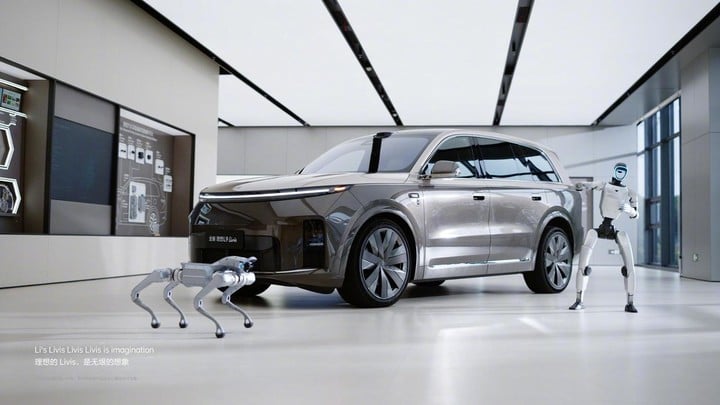
And today, it's not just four-wheeled cars that crave this "heart" and these "eyes"—the entire system has also been matched to embodied intelligence products.
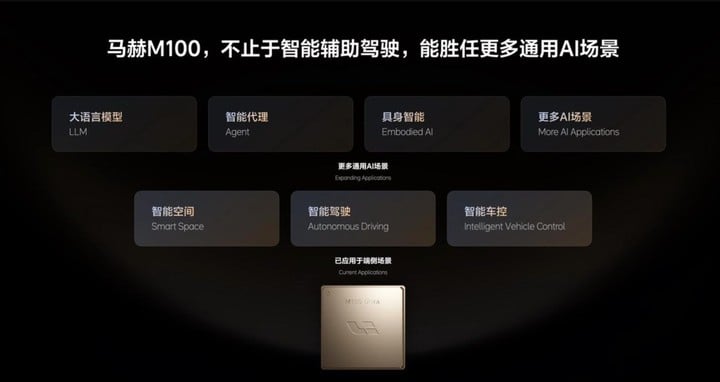
Back then, Amazon, in order to solve the computing congestion during its own e-commerce promotions, forced out an efficient internal cloud architecture, which was eventually opened to the public and became the cloud computing foundation AWS. And the Mach M100 was never just a "dedicated chip for intelligent driving" from its inception, but an edge-side general-purpose AI chip capable of running large language models, Agents, and complex visual reasoning.
Right now, the entire humanoid robot and embodied intelligence industry is likewise stuck in the deadlock of "batteries can't carry the hundreds of watts of high power consumption of traditional GPUs, yet large models must be run in real time on the edge side."
In October this year, Li Auto's chip subsidiary "Mahe Xin" just completed 1.625 billion yuan in pure equity financing, with a maximum post-investment valuation of 17.1 billion yuan. As the Mach M100 chip and self-developed core components such as silicon carbide modules gradually advance toward external supply, the self-developed assets Li Auto has accumulated over the years have also begun to do the business of "selling shovels" to the industry amid the physical AI gold rush.
The Best Chip Is the One You Forget
At this point, we can finally look back at the question raised at the beginning:
Among the many explicit selling points of a car from top to bottom, why are intelligent driving and chips often among the product capabilities most difficult for ordinary people to directly perceive?
Because "not being perceived" is the ultimate goal that intelligent driving and chips aim to achieve.
"Father of ubiquitous computing" Mark Weiser once proposed a famous assertion:
The most profound technologies are those that disappear. They weave themselves into the fabric of everyday life until they are indistinguishable from it.
The same applies to smart cars. A chip that isn't smart enough, or an intelligent driving system that can't compute fast enough, is what makes you frequently notice its existence all the time—while truly top-tier underlying technology is born to "become invisible."

Li Auto went to great lengths to self-develop chips and take the stage at TSMC, not merely to chant parameters and terms like "dynamic data flow" or "1280 TOPS."
The core goal of all this is to make you, at the moment you grip the steering wheel, completely forget that the chip exists.