 Newshot
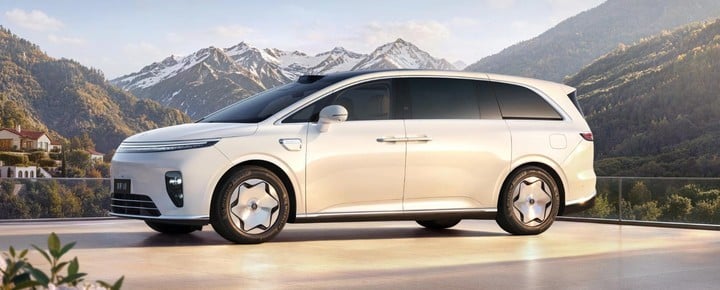
Starting at 319,800 yuan! Xiangjie V8 launches, 70,000 cheaper than Zhijie V9 and adds a pure electric version
2026-11-20 18:19
HIMA has made many moves in the MPV market this year. Zunjie brought the V800 and V680, and the Zhijie V9 has been on the market for nearly half a year.
And today, the first MPV from the Xiangjie brand—the Xiangjie V8—officially launched.
According to Richard Yu, the Xiangjie V8 is a "family smart flagship MPV," offering both extended-range and pure electric powertrains, divided into four trim tiers—Max, Max+, Ultra, and Ultra+—for a total of 7 models, with deliveries starting upon launch:
- Max EREV: 319,800 yuan
- Max BEV: 349,800 yuan
- Max+ EREV: 349,800 yuan
- Ultra EREV: 359,800 yuan
- Ultra BEV: 389,800 yuan
- Ultra+ EREV: 399,800 yuan
- Ultra+ BEV: 429,800 yuan
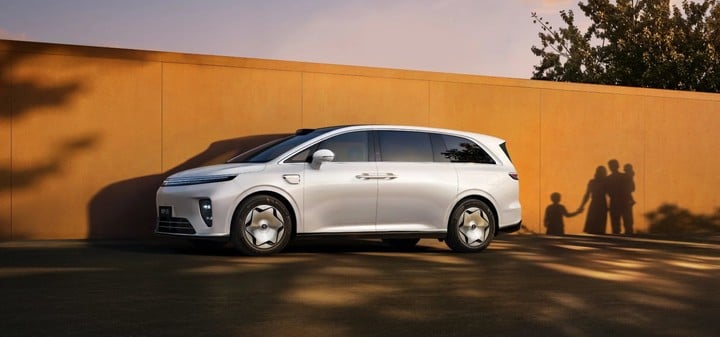
To be honest, the Xiangjie V8 does not have few versions, with a price span of over 100,000 yuan. In terms of core differences, the Max series uses a shared-optical-path in-cabin lidar, while the Ultra series is equipped with a 896-line four-lidar setup and an L3-level autonomous driving architecture. The main upgrades of the Max+ and Ultra+ are four-wheel drive, dual-chamber air suspension, and more comfort features.
As an MPV focused on families, the Xiangjie V8 is not as rigid and serious as other MPVs under HIMA, and the features inside the car are also more oriented around the family.
The least business-like HIMA MPV
The biggest difference between a family MPV and a business MPV is that the person sitting in the driver's seat holding the steering wheel is often not a professional driver, but the owner themselves.
In the past, many people hesitated about mid-to-large MPVs. First, the flat, boxy body carries a strong business-reception vibe, and sitting in the driver's seat feels a bit too much like being at work; second, the car is too long, which tests one's skills in narrow roads, underground garages, and other scenarios.
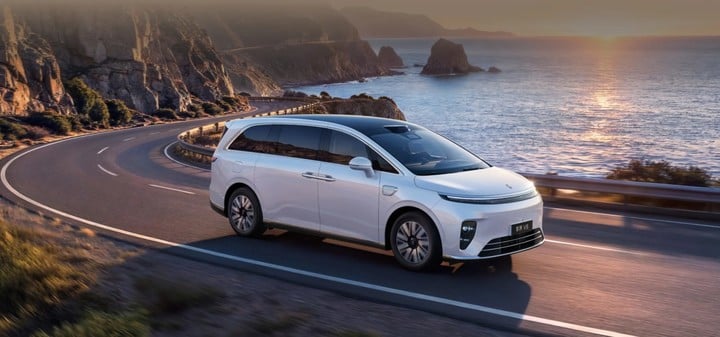
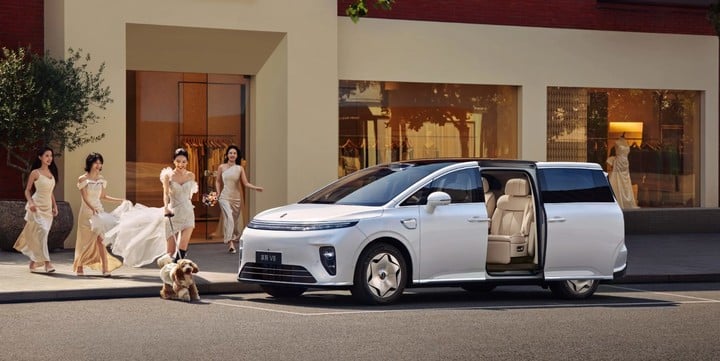
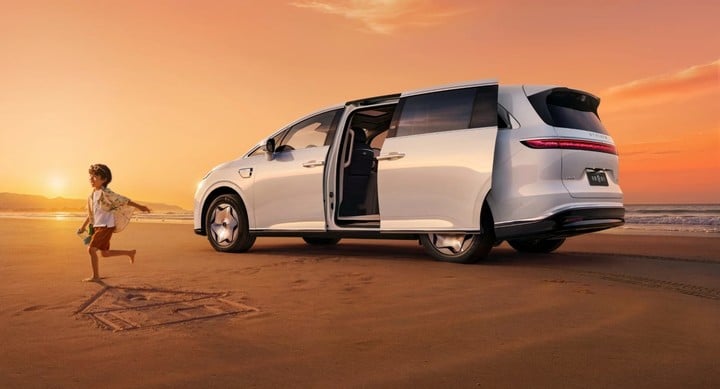
The Xiangjie V8 is indeed not a small car. The new car measures 5335/2005/1805mm in length, width, and height, with a wheelbase of 3250mm. However, the roof adopts a fastback contour that is lower at the front and higher at the rear, so it does not look too bulky visually.
The lines that gradually narrow from the A-pillar to the D-pillar, paired with low-drag "big pancake" wheels, bring the Xiangjie V8's measured drag coefficient at 120km/h down to 0.226Cd. Richard Yu said this level is "nearly 50% lower than overseas ultra-luxury brand MPVs."
What solves the difficulty of driving a large car is the ±12° rear-wheel steering fitted across the Xiangjie V8 lineup. With this system, this 5335mm-long large car has a minimum turning radius of only 5.09m.
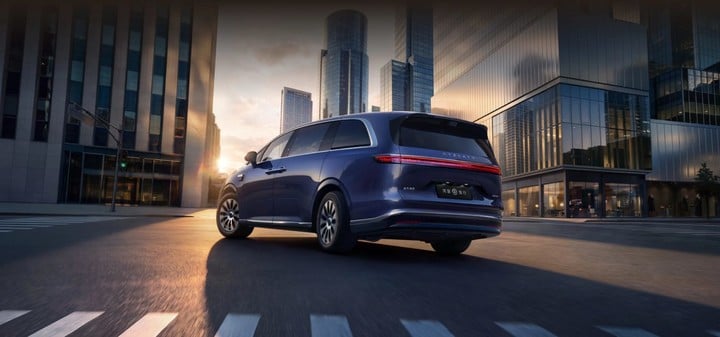
In addition, the Xiangjie V8 is equipped with Huawei's Tuling all-aluminum alloy chassis, adopting front double wishbone and rear five-link independent suspension, with CDC dual-valve continuously variable damping dampers standard across the lineup. The Max+ and Ultra+ four-wheel-drive versions are also equipped with dual-chamber air springs with 80mm adjustable travel.
In terms of power, the Xiangjie V8 lineup adopts an 800V high-voltage platform. The EREV version uses a 118kW 1.5T range extender and offers two battery options: 56kWh and 75.4kWh.
The EREV version's WLTC electric-only range is 260km (four-wheel drive), 275km (rear-wheel drive), and 339km (four-wheel drive with the optional 75.4kWh battery), respectively. CLTC electric-only range is up to 430km, and combined range is up to 1465km.
The BEV version uniformly carries a 120kWh ternary lithium battery. The single-motor rear-wheel-drive version has 227kW of power and a CLTC range of 830km. The dual-motor four-wheel-drive version combines a 160kW front motor and a 227kW rear motor for a combined output of 387kW and a CLTC range of 775km.
The launch event did not disclose the specific fast-charging time from 10% to 80%. Richard Yu said on stage that, rather than deliberately pursuing a 5C or 6C peak rate, the team values battery life and long-term mileage retention more.
Design born for the family
During the teaser phase earlier, the Xiangjie V8 promoted "100 designs born for the family," and Richard Yu also emphasized that "a family car should use the industry's highest standards." But the 100 designs still revolve around three parts overall: loading capacity, comfort features, and the ride and safety performance of all three rows.
The Xiangjie V8's electric sliding side door has a maximum opening width of 730mm, with a 340mm-long grab handle on the B-pillar. Versions equipped with air suspension can actively lower the body when getting in, bringing the lowest floor height down to 380mm.
For elderly family members with limited mobility, or children who are used to climbing in by themselves, the low floor and low grab handle can provide a more convenient boarding experience.
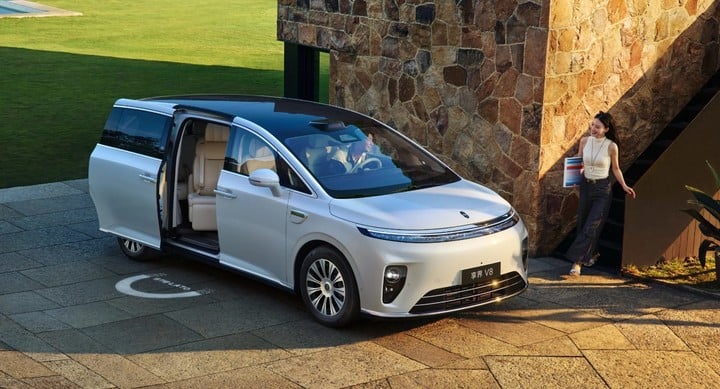
The Xiangjie V8's interior adopts a 2+2+3 seven-seat layout, with an officially announced space utilization rate of 69.3%. With seven people seated, the trunk still has a base volume of 674L, and with the third-row seats folded, the volume can expand to 1552L.
Around the daily trivialities of traveling with multiple people, the interior has 39 storage spaces and 4 cup holders on the center console, uses "five-proof hidden floor rails" to prevent debris from getting stuck, provides 4 ISOFIX child seat anchors throughout the car, comes standard with back pockets and small tables behind the front seats, and offers dual 220V power outlets on the B-pillar and in the trunk.
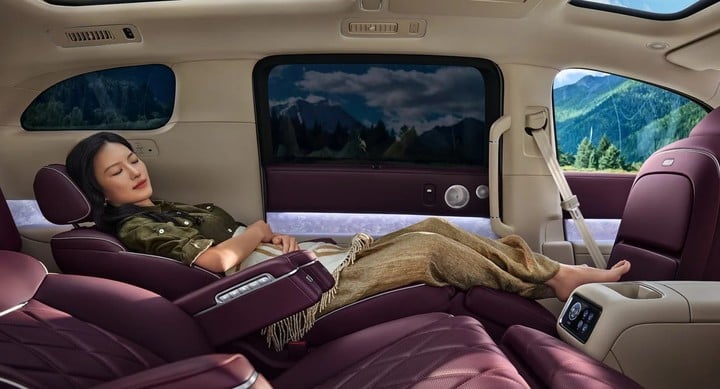
In terms of seats, the Xiangjie V8 lineup comes standard with 4 zero-gravity seats using a 16-layer stacked structure. Both the first and second rows are equipped with graphene heating, and electric armrests are standard across the lineup, supporting electric folding and anti-pinch; when the seat is folded, the armrest can automatically flip up to free up the passage.
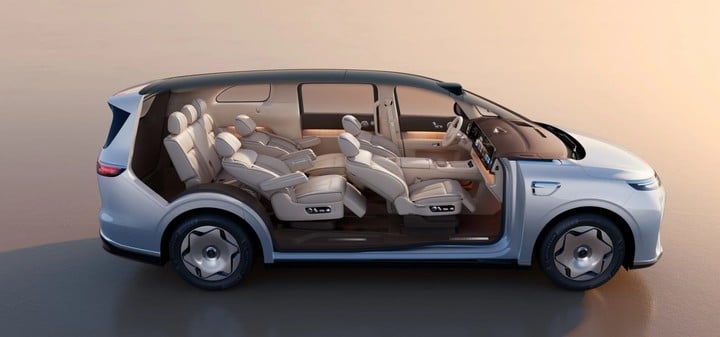
In the second row, the seats support up to 150mm of electric lateral movement, making it easier for parents to "snuggle up" and care for children in the car. The 45°, 90°, and 180° electric rotation functions allow the seat to rotate outward 45° to welcome passengers when the door opens and project a ground light carpet.
After rotating fully backward, the second row can face the third row, or link with the third-row seats—which support 0°–180° electric adjustment—to lie flat, switching into a 1.8m beach chair or 2.4m home-style large bed mode for camping or naps.
In addition, Xiangjie this time also emphasized the safety of the rear rows, especially the third row.
For the third row, the Xiangjie V8 specifically created a "third-row five-fold safety" system: a rear windshield airbag is standard across the lineup, deploying downward in a rear impact to protect third-row occupants' heads and isolate broken glass; the third-row seats have an integrated metal anti-collision back panel embedded to block objects from the rear from intruding into the passenger cabin.
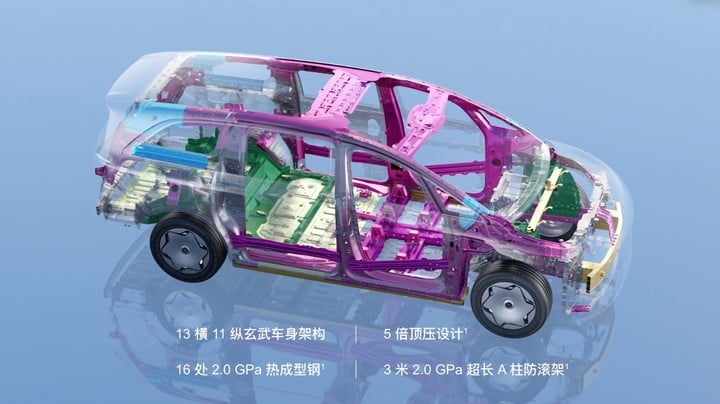
Because traditional MPVs have short, flat rear ends, the third-row backrests often sit close to the tailgate, leaving far less buffer margin in a rear-end collision than the front two rows. In terms of body structure, the Xiangjie V8 adopts a "thirteen-horizontal, eleven-vertical Xuanwu body architecture," with a 3-meter-long 2GPa hot-formed steel roll bar integrated into the A-pillar, achieving a five-times roof-crush design with 13.77 tons of compression resistance per side. The car is equipped with 12 airbags in total, including a 66L through-type side curtain airbag.
At the same time, relying on Qiankun ADS and the all-dimensional collision avoidance system's prediction of rear-end collision risk, the vehicle can trigger active return of the third-row seats before a collision.
In terms of the cabin and child-caring features, the Xiangjie V8 continues the logic of shared use by the whole family. The new car is equipped with a HarmonyOS exclusive cabin. The front row uses a 12.3-inch + 17.2-inch + 17.2-inch integrated tri-screen "HuanYu" setup, and the Max+, Ultra, and Ultra+ models come standard with a 21.4-inch Huawei Yunxi soft-light roof-mounted screen.
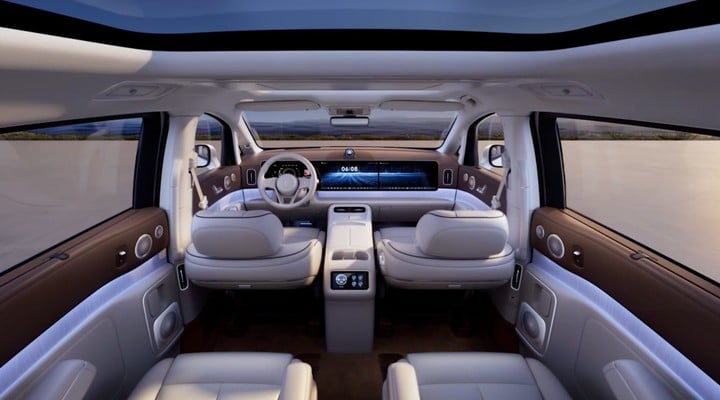
The Xiangjie V8 also comes with a detachable 6.58-inch magnetic MagLink Mini control screen. You can think of it as a remote control; users in different seats can adjust relevant in-car functions without getting up.
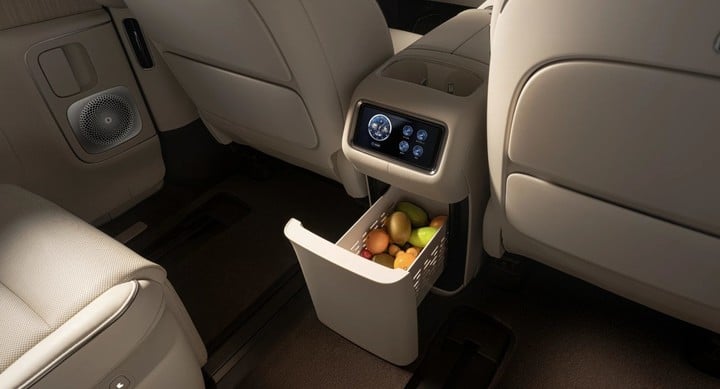
As an MPV, the Xiangjie V8 also has many in-car features common to new energy MPVs, such as a streaming interior rearview mirror standard across the lineup, and a 10.9L independent compressor heating/cooling box supporting six modes of hot/cold switching. In addition, four physical sunshades throughout the car and optional smart privacy light-curtain glass for the second and third rows give this family car better privacy.
But unlike many MPVs, as an HIMA MPV, the Xiangjie V8 of course also carries Huawei's forte: driver assistance.
The article title: Starting at 319,800 yuan! The Xiangjie V8 launches, 70,000 yuan cheaper than the Zhijie V9 and adds a pure electric version
Main text: Among them, the Max and Max+ adopt a common-optical-path in-cabin LiDAR and are equipped with Huawei Qiankun ADS 5.0 and full-dimensional collision avoidance CAS 5.0. The Ultra and Ultra+ are designed according to an L3 autonomous driving architecture, equipped with 8 major full-link redundancies and a full complement of 38 high-precision sensors, including 1 896-line dual-optical-path LiDAR, 3 solid-state LiDARs, and 2 B-pillar cameras.
At the launch event, Yu Chengdong also announced a set of the latest official statistics: as of October this year, the safety factor of Huawei ADS assisted driving has reached 6.02 times that of human driving, and the active collision avoidance system of HarmonyOS Intelligent Mobility users has cumulatively avoided more than 5 million collisions.
Just before the launch, on November 17, the Xiangjie V8 also completed the country's first 120km/h L3 autonomous driving cross-city highway test, which is also the first case in the domestic MPV category, covering highway interchange ramps, active avoidance, as well as nighttime, moderate to light rain, and snowy weather.
HarmonyOS Intelligent Mobility MPV "battle royale"
As we mentioned earlier, HarmonyOS Intelligent Mobility now has quite a few MPVs under its umbrella, and among them, the Zhijie V9 even shares the same wheelbase as the Xiangjie V8.
The Zhijie V9 launched on May 15 this year, with an official guide price of 389,800–519,800 yuan. The more square and tall V9 leans more toward balancing business reception with all-scenario flagship travel.
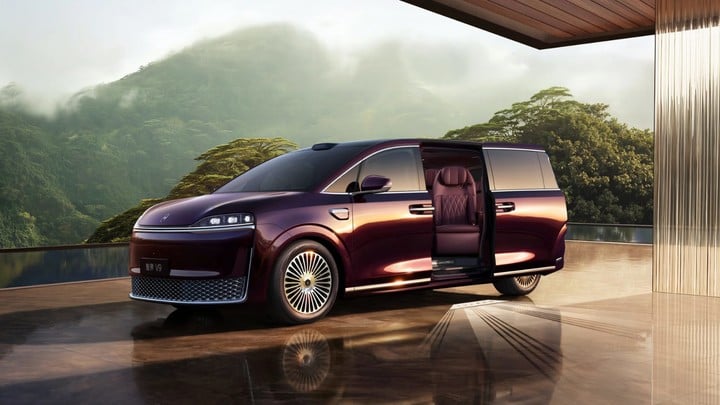
The Xiangjie V8 is in fact a one-notch downward extension of the "8-series price, 9-series equipment" playbook that AITO proved out in the SUV market. The V8's starting threshold is about 70,000 yuan lower than that of the Zhijie V9, taking the family-oriented route.
In terms of mechanicals and the three electric systems, the V8 offers a larger ±12° rear-wheel steering versus the V9's ±7°, and adds a 120kWh pure electric version and a 75.4kWh large-battery extended-range version that the V9 does not have.
And as the price for the lower threshold, the V8 does not make the 896-line LiDAR standard across the lineup, but reserves the four-LiDAR setup for the Ultra and above versions.
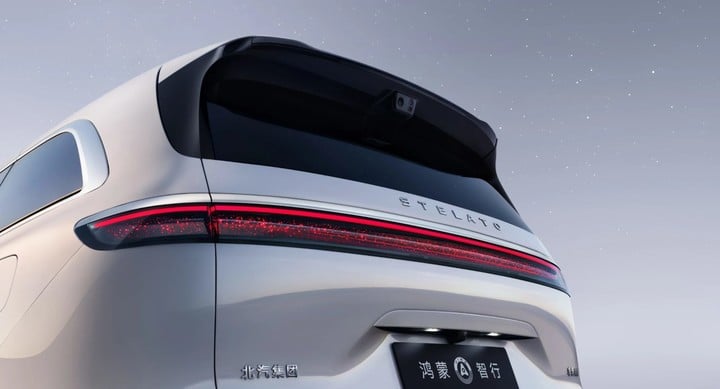
It is hard to judge which of these configurations is more important or more "prestigious," but it is not hard to see that, at a time when the division of labor among the brands under HarmonyOS Intelligent Mobility is gradually blurring, everyone wants to occupy a favorable position in popular models.
For the Xiangjie brand itself, after the sedan S9, the wagon S9T, and the rugged SUV G9, the launch of the V8 completes the puzzle piece of the mainstream family MPV.