 Newshot
Article title: Apologize to Gemini, Please Form an Orderly Queue
Body:
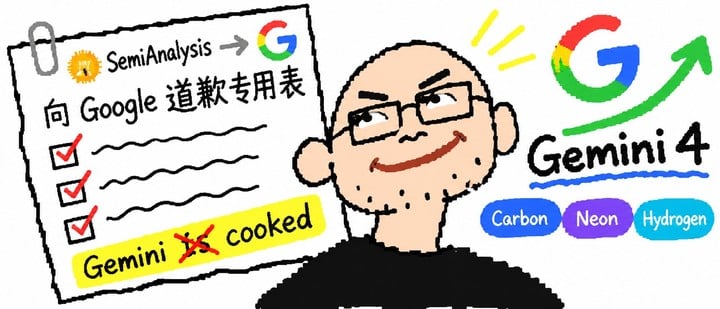
Apologize to Gemini, Please Form an Orderly Queue
2026-11-20 17:03
Today, the well-known semiconductor and AI research firm SemiAnalysis posted on X a "Dedicated Apology Form to Google" addressed to Google DeepMind Chairman Demis Hassabis.
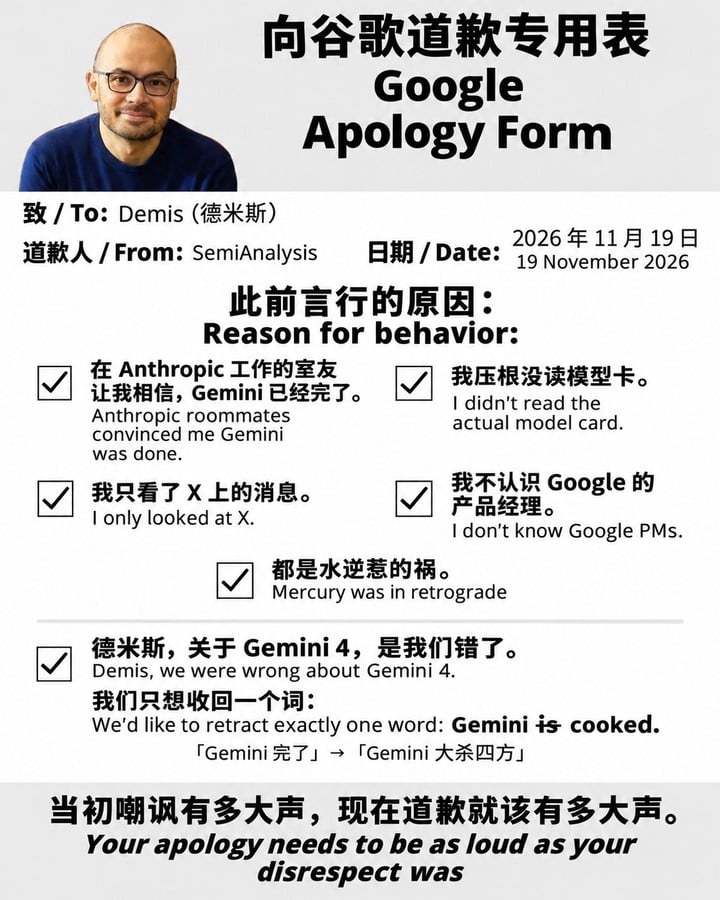
In the reasons column, they checked boxes including "I only read everyone's posts on X," "My roommate who works at Anthropic convinced me Gemini was finished," and "I didn't read the model card." The most interesting part is the last line: "Demis, about Gemini 4, we were wrong. We just want to take back one word."
They crossed out an "is" from their original headline: Gemini is cooked. A sentence saying "Gemini is finished" became "Gemini has actually built something this time."
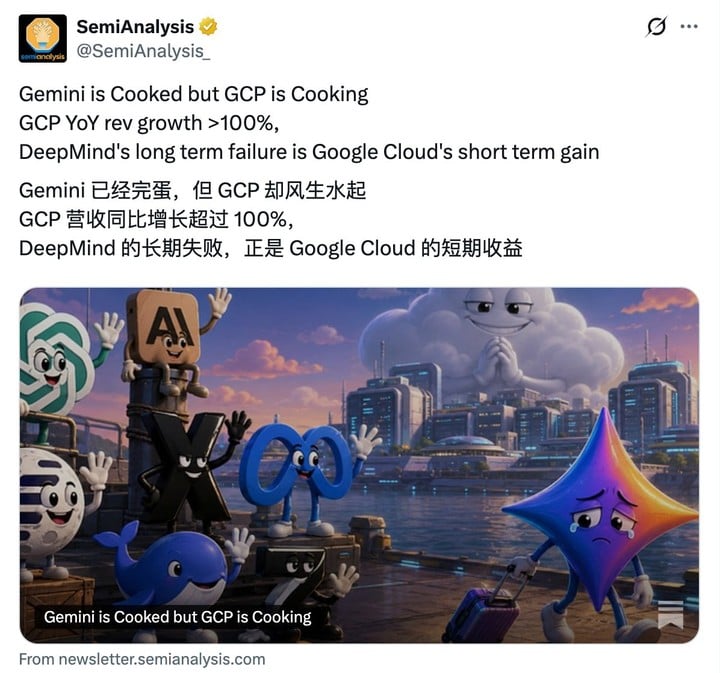
The incident began when SemiAnalysis published an article in August of this year, arguing throughout that Google had not released any exciting model since its brief lead last November, and was essentially falling behind.
At the time, they analyzed that DeepMind's reinforcement learning team had lost many people and that internal compute had not been allocated well, reaching a rather harsh judgment about Google: at this rate, Google would of course keep releasing models, but the probability of once again reaching the industry's highest level had "dropped to zero."
Less than two months after the report was published, Google announced Gemini 4 Argon, then released Carbon at the end of October, launched Hydrogen on November 12, and released Neon on the 18th—three models in just 8 days, with Carbon's performance at the time reaching the top of Artificial Analysis's overall capability rankings.
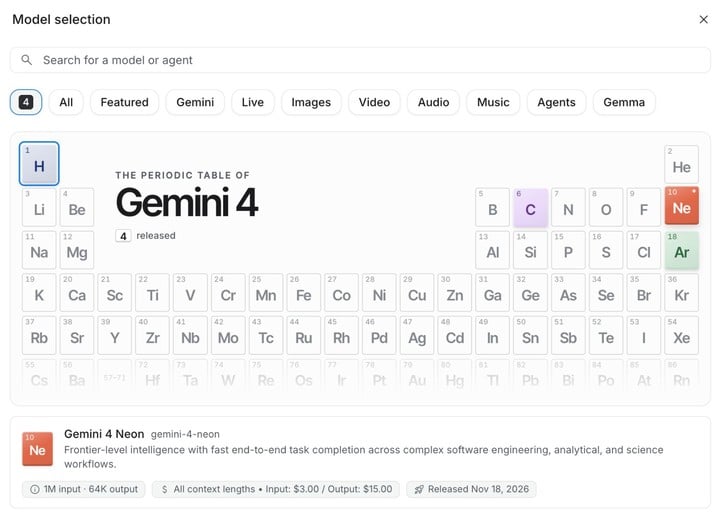
These newly released models received widespread praise on social media. Hydrogen, focused on Flash, can quickly complete tasks in writing and complex software work; Carbon, the most intelligent model, excels at handling various long-horizon Agent tasks; Neon, in between the two, balances speed and intelligence and can be said to be the model with the strongest overall capability in the Gemini 4 series.
Comments like "Gemini 4 Neon is insane," "Gemini 4 Neon is actually crazier than you think," and "Gemini 4 Neon solved all the previous complaints people had about Gemini models" were liked and agreed with by a large number of users on X.
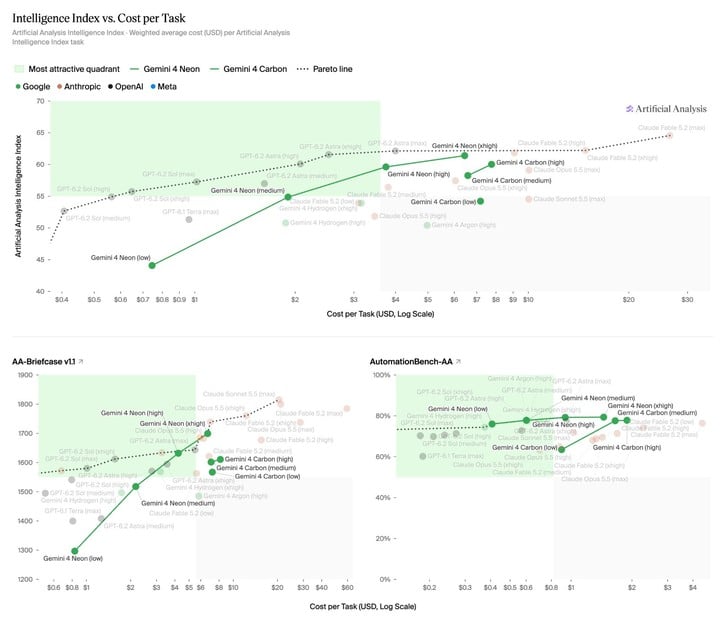
Today, Google DeepMind researcher Arthur Douillard said on X that they had printed out that critical article and placed it on their desk to remind themselves every day. He said some of the problems did exist at the time, and he wanted to thank the SemiAnalysis article for the motivation.
I want to thank @SemiAnalysis_ for the motivation. On the Gemini RL scaling team, we printed that article and put it on our desk to remind ourselves every day of what the situation was really like. But times are changing. :)
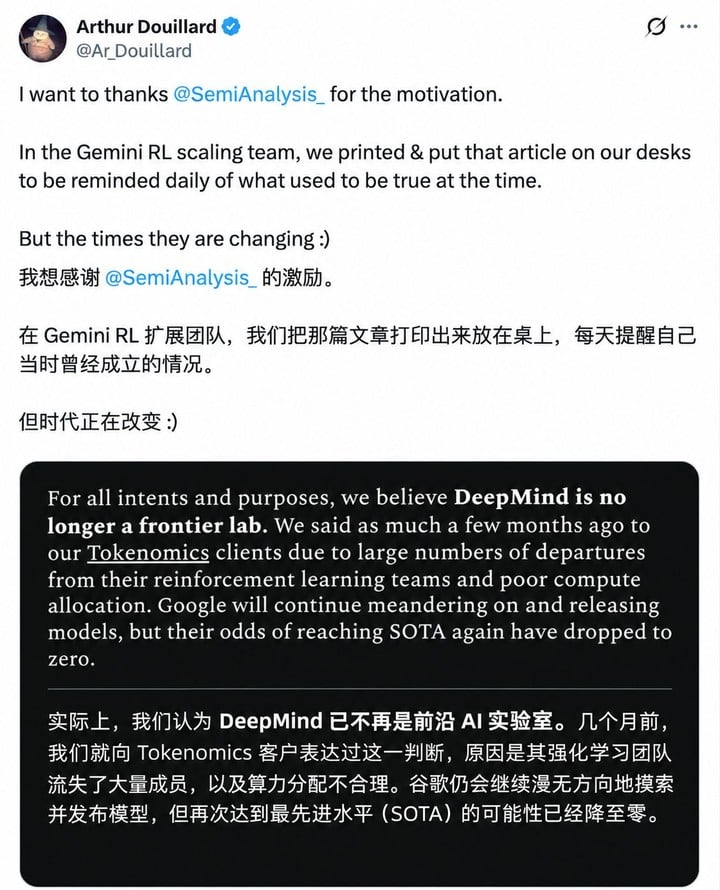
SemiAnalysis then reposted Douillard's post and also shared a piece of paper—the "apology form" addressed to Google from the beginning.
A few hours later, Hassabis reposted the post, played along by saying "apology accepted," and joked that the other party had missed checking the box "underestimated the group of experts at Google DeepMind."
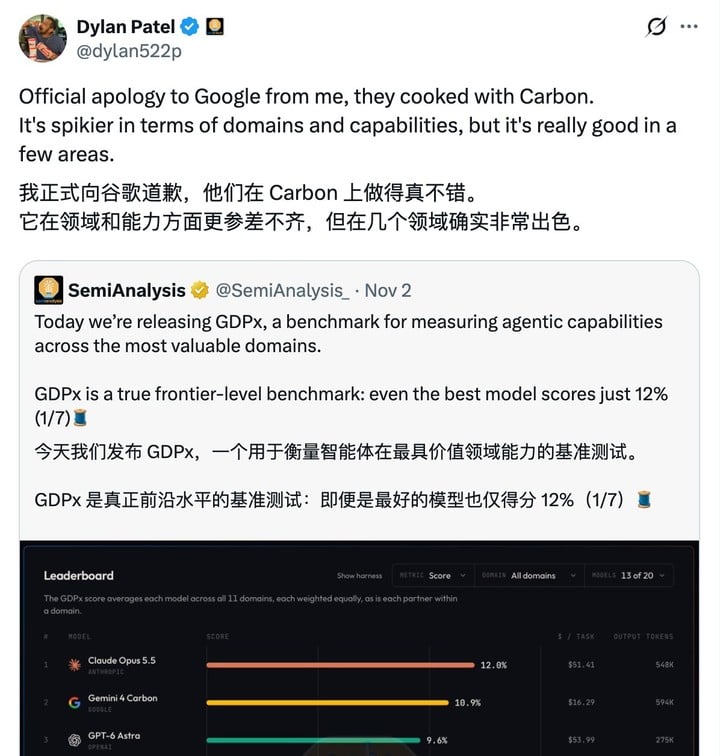
In fact, more than two weeks before the institution's official account posted the meme, Dylan Patel, co-author of the "August bearish report," had already publicly apologized to Google in his own name after the Gemini 4 Carbon review was released.
From being publicly talked down by an authoritative institution in early August to releasing four Gemini 4 series models in succession within a few weeks in mid-November and returning to the top of the rankings, what adjustments and accumulation did Google go through internally?
Google Has So Many TPUs, Why Are They Still Not Enough
Back in the summer of this year, the bearish talk about Gemini was not entirely without reason. On one hand, Gemini 3.5 Pro, originally scheduled for June, had still not launched. Google CEO Sundar Pichai had previewed at the May I/O conference that Gemini 3.5 Pro was planned for a June release, but the model ultimately failed to ship on schedule.
Constrained by compute and with disagreements among several project leaders, directions that later proved crucial, such as coding, received relatively few resources at the time. Koray Kavukcuoglu, who later took over R&D, also explained that the team at that stage focused more attention on the faster-iterating Flash models.
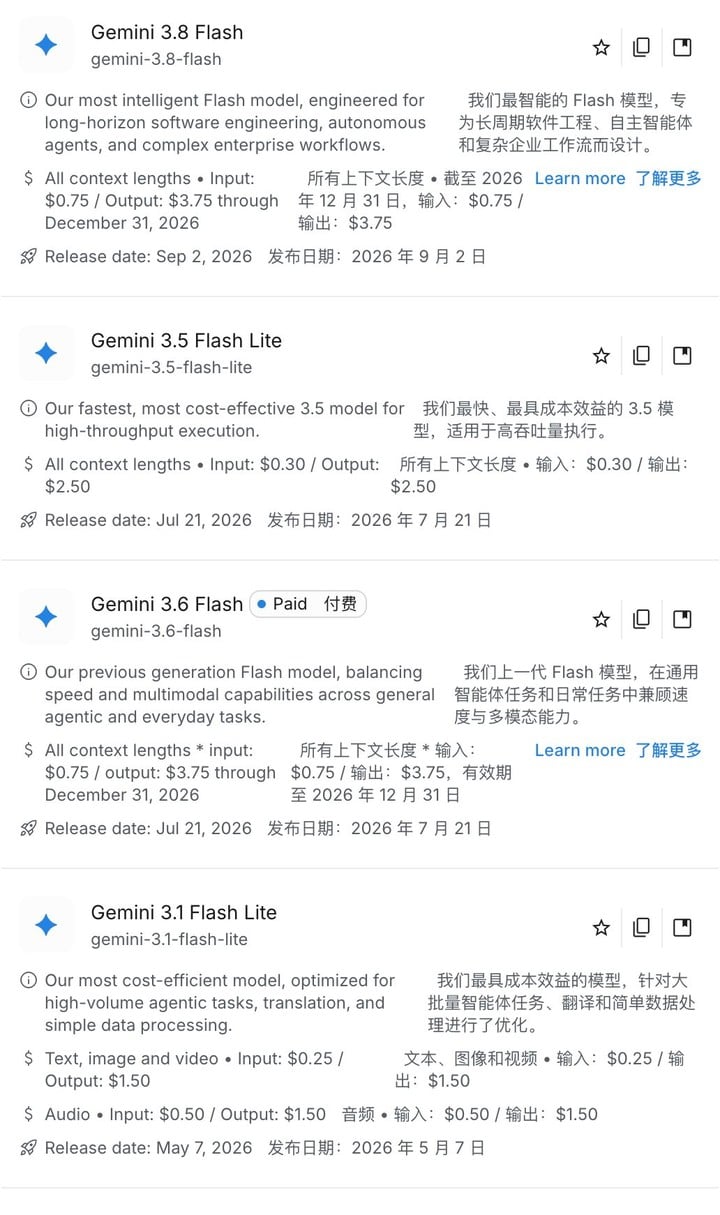
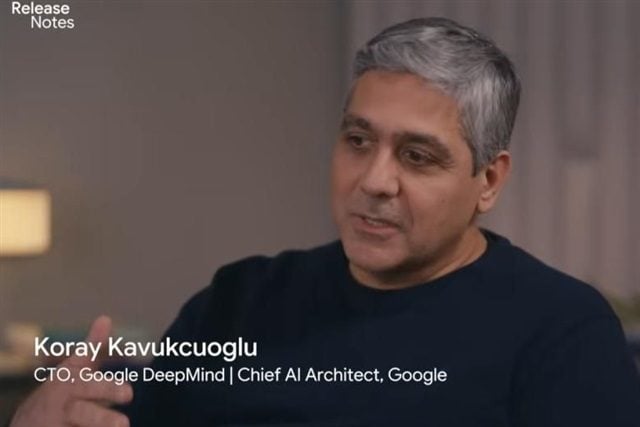
Amid internal resource struggles and external skepticism, Google announced a major organizational restructuring of DeepMind on August 5: Koray Kavukcuoglu, former DeepMind CTO and Google Chief AI Architect, became Senior Vice President of DeepMind, reporting directly to Pichai, with overall responsibility for Gemini model development, frontier research, and the Gemini app and developer teams.
Demis Hassabis handed over day-to-day operational responsibilities and became DeepMind Chairman and Alphabet Chief Scientist; at the same time, Gemini's former co-technical leads Jeff Dean and Oriol Vinyals, along with Sanjay Ghemawat and Quoc Le, left Google and founded Discovery Loop.
In most people's impressions, Google should have no shortage of data or chips, so how could it fail to build a large model? But even though Google has its own AI chip TPU, they are needed for training the next generation of Gemini, for generating answers for current users, and Google Cloud customers are also lining up.
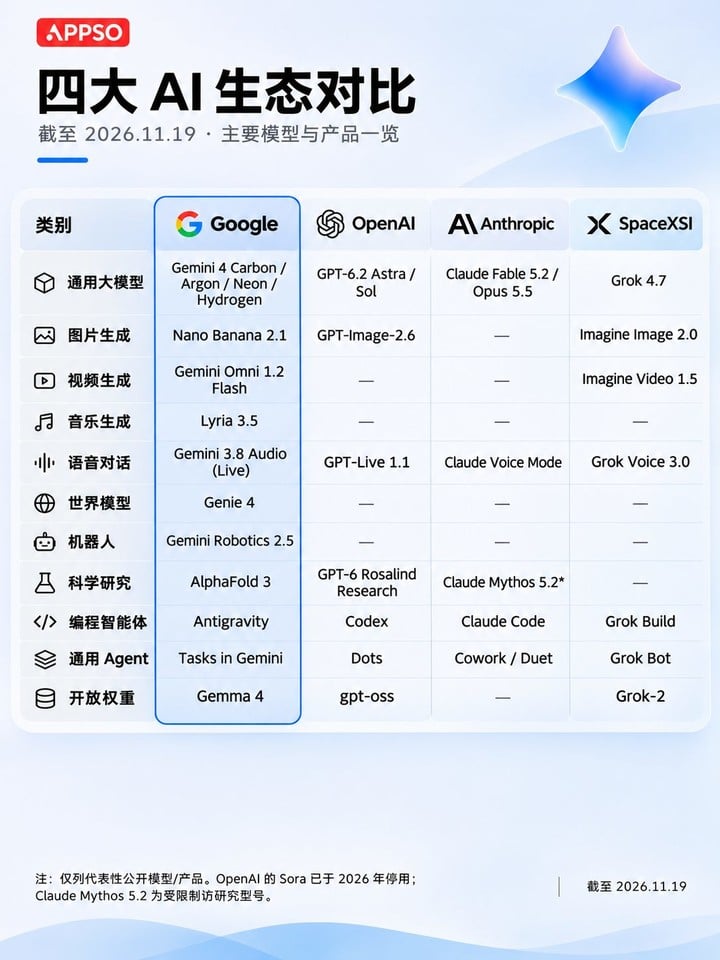
For the group, selling chips is good business; for researchers, an experiment they cannot get scheduled is an experiment they cannot run.
This adjustment also made the whole team clearer about what the model should be trained on and how to deliver it to users once built; according to foreign media reports, Google Cloud executives also hoped that after Koray took over DeepMind, he could ease internal tensions over TPU supply allocation.
How Long Did Gemini 4's Turnaround Take to Prepare
If all the credit for the explosive release and widespread acclaim of several Gemini 4 models were attributed to the August personnel adjustment and compute arrangements, that would clearly underestimate the long-cycle nature of large model R&D.
Public records show that well before the August 5 organizational restructuring and the August 7 bearish report, the foundation work for Gemini 4 was already underway. At Alphabet's Q2 earnings call on July 22, 2026, Pichai explicitly revealed that Gemini 4 had already begun "Google's most ambitious pretraining to date."
When answering analyst questions, he further stated that management had concentrated a large amount of compute and effort on Gemini 4, with the goal of using this generation of foundation models to accelerate subsequent iteration and push the release cadence to close to one version per month.
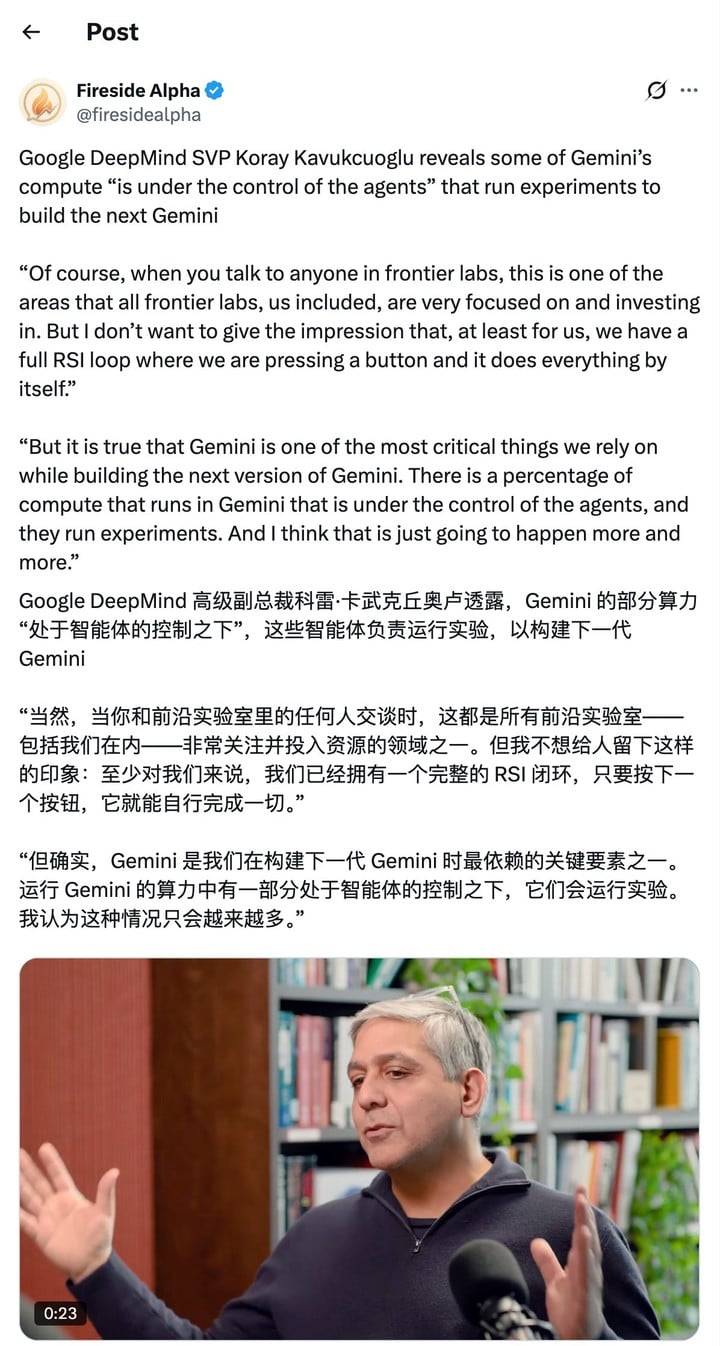
Koray later further explained the R&D mechanism behind Gemini 4 in two podcast interviews in early September and on November 19. Inside DeepMind, multiple R&D lines are run in parallel: when one group polishes the current release version, two other teams are already developing the next two generations of models, so the Gemini 4 we saw in October has at least a year of continuous R&D history behind it.
If large-scale pretraining and multi-line parallelism provided the foundation, what enabled Gemini 4 to make notable breakthroughs in coding and agent execution was a post-training system built around real engineering scenarios.
On November 12, 2026, Melvin Johnson, then head of Gemini post-training, opened with SemiAnalysis's critical article at the AI Engineer CODE conference and disclosed in detail Google's internal training methods.
Apologize to Gemini, and Please Queue Up in an Orderly Manner
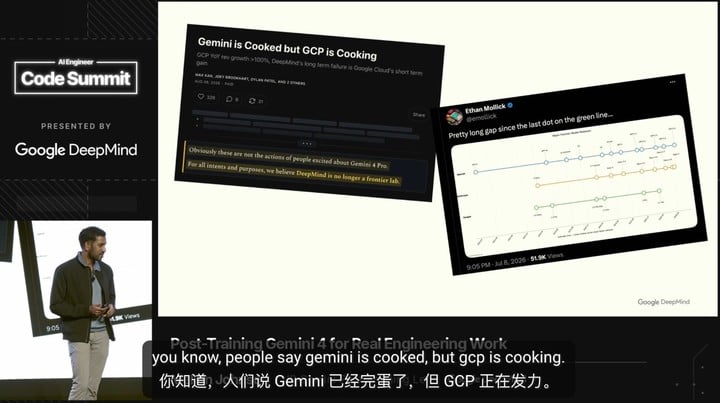
First, static public benchmarks were replaced with real internal workflows. Johnson revealed that about 100,000 Google employees use the coding tool Antigravity to write code every day. Whenever the post-training team trains several candidate model versions, it launches blind tests internally, letting engineers use their own real development tasks at hand to test and pick the version that feels more handy.
Where the model gets stuck in cross-file edits, and which edit breaks existing logic—