 Newshot


AI Threatens to Make China’s Jobs Slump Much Worse
A Bloomberg analysis finds a double-digit decline in hiring for jobs most exposed to the technology.
This job training center in Hangzhou has drawn thousands of new students since it began offering AI classes last year, many of whom obtained a university degree just weeks ago. But they’re already back in the classroom, chastened by the unforgiving jobs market.
Sitting alongside young professionals who quickly lost their jobs, they all want new AI skills to compete for a shrinking number of openings.
Analyzing 10 million job postings from July 2021 to June 2025, Bloomberg News found that advertisements for roles with greater AI exposure fell about 10 percentage points more than less-exposed positions.

Wang and other students declined to show their faces, citing future employment concerns. Photographer: Qilai Shen/Bloomberg
Fresh grad 24
Compared with what AI could do, the skills we learned at university just felt completely useless.
Wang Yiwan enrolled in an AI development course just weeks after graduating with a degree in electronic information engineering, dismayed that his newly acquired coding skills were already obsolete.
Wang and other students declined to show their faces, citing future employment concerns. Photographer: Qilai Shen/Bloomberg
China’s anemic labor market has contributed to weak consumption in recent years, inflaming global trade tensions as President Xi Jinping’s government relied on exports to buoy growth. Now AI threatens to worsen one of the top vulnerabilities facing the world’s second-biggest economy — and demoralize a generation of younger workers in the process.
While the US and UK are seeing a similar slowdown in hiring for young professionals in AI-exposed occupations, the sheer scale of the challenge in China is unique: An estimated 70 million Chinese workers are at risk of being disrupted by the technology, according to Bloomberg Economics. That compares with roughly 45 million in the US, which has a much smaller population.
China reveals only a small amount of official statistics on the jobs market. To shed some light, Bloomberg analyzed nearly 10 million online job postings between 2021 and 2025, and then assessed them based on an AI-exposure index developed by academics at Beijing’s Peking University. The analysis shows that postings for occupations more vulnerable to AI fell significantly faster than those for less-exposed roles.
“It feels like seeing a tsunami coming from far away,” said Li Jia, an economics professor at Singapore Management University who has partnered with Peking University to study the impact of AI on jobs. “You don’t know how hard it will hit by the time it reaches your doorstep, but just seeing it in the distance is frightening enough.”
These dots represent a full year of job postings across a wide range of occupations, ending in June 2022. They capture the hiring landscape right before the launch of OpenAI’s ChatGPT and the rise of DeepSeek and Doubao, owned by ByteDance Ltd.
Three years later, the number of postings dropped by half. The retreat reached nearly every occupational group, in part due to a broader economic slowdown.
But the pullback was far from even. The more exposed an occupation is to AI, the more sharply postings tended to fall, producing a gap of more than 10 percentage points between higher and lower-exposed roles.
Looking by sector, the gap remains vast. In nearly every industry, postings for occupations more vulnerable to the disruption fell further than those for less AI-exposed roles.
Sources: Bloomberg analysis of online job postings collected by Revelio Labs; Peking University (AI exposure score); See methodology section for more details.
Although the results show a downward trend in hiring, it’s unclear how much to blame AI alone. The differing rates of declines for certain industries predated the widespread adoption of new AI tools, and the economy’s deceleration may have simply hit jobs exposed to the technology harder. Moreover, the pool of job postings isn’t necessarily representative of the entire labor market — white-collar positions tend to be advertised online, and many informal or blue-collar roles aren’t included.
Still, the Bloomberg analysis echoes conclusions reached by the few researchers who have explored the topic. In several separate studies, scholars from Chinese universities found that positions with higher AI exposure correlate with weaker hiring, especially for entry-level jobs.
Chen Qin, a Chinese data scientist and visiting scholar at ShanghaiTech University who led a review of 116 million online job ads, estimated that AI resulted in a 5.2% net loss in new hiring between 2023 and early 2026. The impact was most acute in positions that required one to three years of experience. Nearly a fifth of the postings had a significant change in responsibilities over that period.
Another study overseen by researchers from institutions including the Chinese Academy of Social Sciences — which reports into the State Council, headed by Premier Li Qiang — estimated that AI led to a 21% decline in the average number of online job postings, as well as a 4% drop in average salary.
Unlike in the US, Chinese firms have largely resisted acknowledging any link between job cuts and AI for fear of angering the government and the public. Tech firm Xiaomi Corp., food delivery giant Meituan and Fliggy, Alibaba Group Holding Ltd.’s travel unit, all denied Chinese media reports of mass layoffs this year. But several workers at top tech firms told Bloomberg News about rounds of layoffs that began in the spring, with as many as 30% of employees affected in some departments.
Justin Li, a 36-year-old user interface and experience designer in Hangzhou, was let go in June by an internet giant along with almost half his team of 15 people. Blaming the layoffs on AI and China’s slowing economy, he’s applied for hundreds of positions since June without success. What’s worse, he took out a mortgage to buy an apartment when home prices peaked in 2021, only to see its value plunge by 40%.
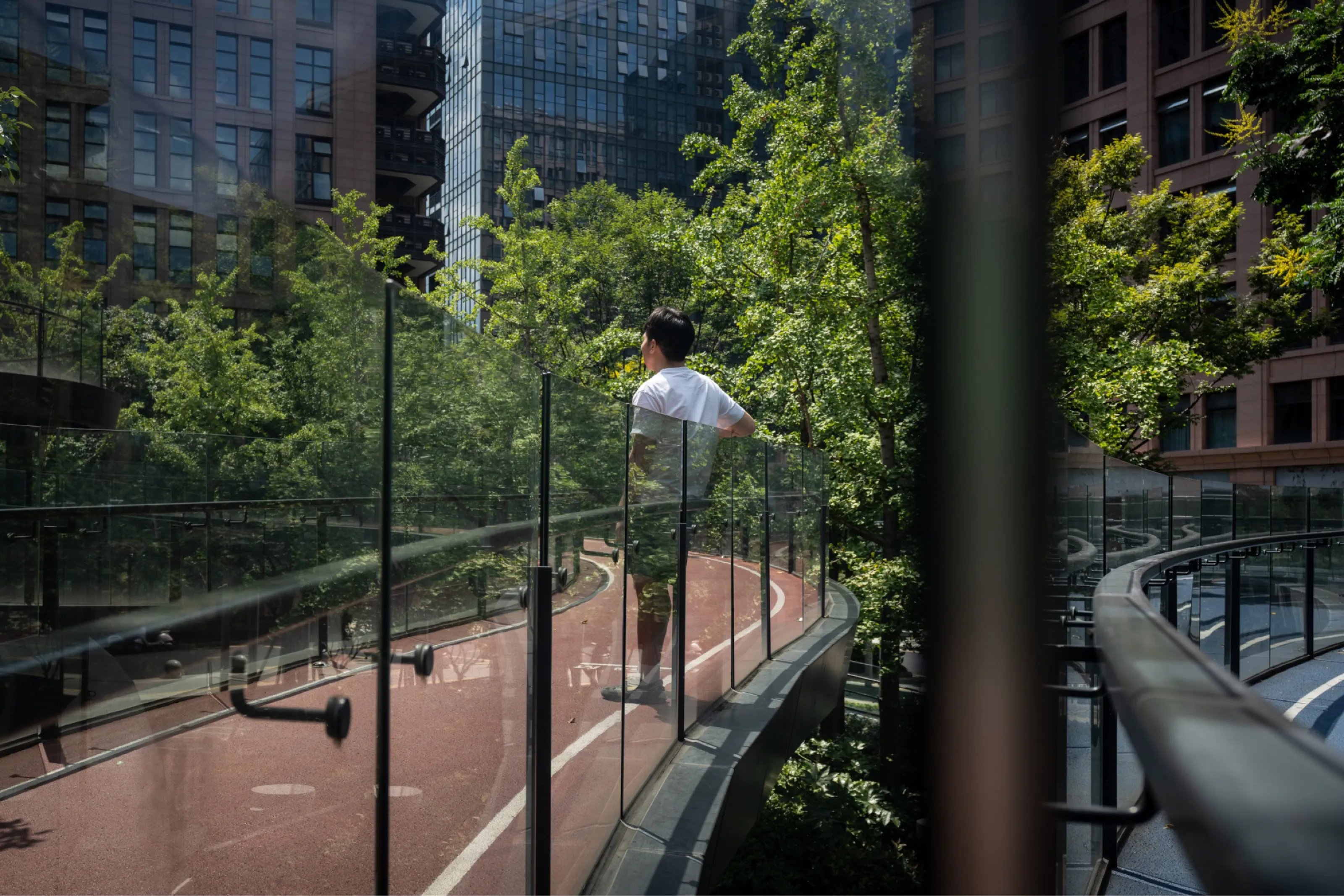
Justin Li, a designer laid off by a large internet company in Hangzhou, China. Photographer: Qilai Shen/Bloomberg
“I have no choice but to suppress my desires and spending,” Li said. “I came to accept my own mediocrity and that I’m just an average person.”
A broader slowdown is compounding the struggles of Li and others seeking employment: China created just 21 million net new jobs in the five years to 2024, according to the World Bank, less than half the number in the prior half-decade. Government efforts to expand college admissions during the Covid-19 outbreak means a cohort the size of a European country — more than 70 million recent graduates dubbed the “lost generation” by consultancy Gavekal Dragonomics — is arriving in the labor force at the worst moment.
The topic of AI job losses is sensitive in China. Even in closed-door meetings, Chinese policymakers are reluctant to divulge their views, according to policy advisers and government-affiliated economists who spoke to Bloomberg. Some researchers fear they might irk authorities if their comments or reports appear too negative or risk inducing panic.
Behind the public stonewalling, the Communist Party is on alert for widespread job losses that risk generating anger and instability. So far, China’s sweeping apparatus to neutralize dissent has prevented the despair from turning into protest, with many young people coping by “lying flat” — doing the bare minimum or giving up on ambition altogether.
But officials have shown heightened concern over the issue, according to several people familiar with the matter, who asked not to be identified because they weren’t authorized to speak to the media. In June, China’s cabinet announced a plan to conduct an unprecedented nationwide survey to track the impact of AI on jobs over the next five years. Last month, it called for “prudent management of the pace of AI adoption in labor intensive industries” in order to minimize the blow to workers.
China’s Ministry of Human Resources and Social Security, which is responsible for employment issues, didn’t immediately respond to a faxed request for comment.
Cang Shu, 26, a former programmer at a major internet company in Beijing, was fired with half his team of eight people in June. Along with the downsizing, the company announced it was merging several positions into one, including programming, design and testing. The idea, he said, is that AI will enable one person to do the work of as many as six people.
“The layoff this time is different because it’s a reorganization driven by AI,” Cang said.
AI Starts Blurring Job Boundaries
- Product manager
AI设计工程师 AI Design Engineer
腾讯 | 深圳 | 2026年09月 Tencent | Shenzhen, China | Sept. 2026
岗位职责 Key Responsibilities
- 1. 全流程产品定义:不局限于界面设计,深度参与或直接定义从0到1的产品构思。利用AI工具进行快速头脑风暴、用户洞察验证。 End-to-End Product Definition : Go beyond interface design to deeply participate in or directly define 0-to-1 product concepts. Utilize AI tools for rapid brainstorming and user insight validation.
全流程产品定义:不局限于界面设计,深度参与或直接定义从0到1的产品构思。利用AI工具进行快速头脑风暴、用户洞察验证。 End-to-End Product Definition : Go beyond interface design to deeply participate in or directly define 0-to-1 product concepts. Utilize AI tools for rapid brainstorming and user insight validation.
- 2. 高审美与情感化设计:负责产品的视觉与体验设计,追求审美品味与情感共鸣。你设计的不仅是界面,更是用户与 AI 交互时的情绪体验。 High Aesthetic & Emotional Design : Lead product visual and experience design, striving for refined aesthetic taste and emotional resonance. You will design not just interfaces, but the emotional experience of user-AI interactions.
高审美与情感化设计:负责产品的视觉与体验设计,追求审美品味与情感共鸣。你设计的不仅是界面,更是用户与 AI 交互时的情绪体验。 High Aesthetic & Emotional Design : Lead product visual and experience design, striving for refined aesthetic taste and emotional resonance. You will design not just interfaces, but the emotional experience of user-AI interactions.
- 3. AI 驱动的原型开发:使用 AI Coding 工具直接将设计概念转化为可交互的高保真 Demo,能直接参与到研发工作中。 AI-Driven Prototyping : Use AI coding tools to transform design concepts directly into interactive high-fidelity demos, actively contributing to engineering and R&D workflows.
AI 驱动的原型开发:使用 AI Coding 工具直接将设计概念转化为可交互的高保真 Demo,能直接参与到研发工作中。 AI-Driven Prototyping : Use AI coding tools to transform design concepts directly into interactive high-fidelity demos, actively contributing to engineering and R&D workflows.
- 4. 独立闭环:作为一个微型创新单元,成为Builder完成最小闭环。 Independent Closed-Loop Execution : Operate as a micro-innovation unit, acting as a builder to complete minimal viable closed-loop projects independently.
独立闭环:作为一个微型创新单元,成为Builder完成最小闭环。 Independent Closed-Loop Execution : Operate as a micro-innovation unit, acting as a builder to complete minimal viable closed-loop projects independently.
This role spans the full product development cycle, from definition and design to develop

- Screenwriter
- Post production
AI导演/编导 AI Director/ Writer-Director
蓝色光标 | 北京 | 2026年10月 BlueFocus | Beijing, China | Oct. 2026
岗位职责 Key Responsibilities
- 1. 创作主导:独立主导 AI 影视项目(AI 电影短片、AI品牌广告、AI风格短片等)从创意发想到成片交付,独立完成剧本撰写、角色设定与导演分镜脚本,将影视叙事逻辑拆解为 AI 可执行的生成方案,对最终品质负责 Creative leadership : Lead AI film and video projects from conceptualization to final delivery, including scripting, character development, and storyboarding. Translate narrative ideas into executable AI workflows and be responsible for final product quality.
创作主导:独立主导 AI 影视项目(AI 电影短片、AI品牌广告、AI风格短片等)从创意发想到成片交付,独立完成剧本撰写、角色设定与导演分镜脚本,将影视叙事逻辑拆解为 AI 可执行的生成方案,对最终品质负责 Creative leadership : Lead AI film and video projects from conceptualization to final delivery, including scripting, character development, and storyboarding. Translate narrative ideas into executable AI workflows and be responsible for final product quality.
- 2. 影视级制作与品控:以传统导演思维独立制作和把控 AI生成内容的节奏、情绪与镜头语言,对角色/风格一致性和镜头构图运镜有明确标准;熟练运用主流 AI生成工具,结合剪辑、AE 特效、达芬奇调色等传统后期手段,使AI 素材达到影视级成片标准,实现 AI 生成与影视工业流程的无缝融合; Production and quality control : Direct pacing, emotion, visual style, composition, and camera movement. Use AI tools alongside editing, After Effects, and DaVinci Resolve to produce film-quality work.
影视级制作与品控:以传统导演思维独立制作和把控 AI生成内容的节奏、情绪与镜头语言,对角色/风格一致性和镜头构图运镜有明确标准;熟练运用主流 AI生成工具,结合剪辑、AE 特效、达芬奇调色等传统后期手段,使AI 素材达到影视级成片标准,实现 AI 生成与影视工业流程的无缝融合; Production and quality control : Direct pacing, emotion, visual style, composition, and camera movement. Use AI tools alongside editing, After Effects, and DaVinci Resolve to produce film-quality work.
- 3. 协作与沉淀:基于对 AI 模型能力边界的清晰认知做创意决策,对内与技术侧协作优化生成工作流、沉淀可复用的提示词与参数资产,对外精准理解客户与项目需求,将抽象诉求转化为具象的影视表达。 Collaboration and workflow development : Make creative decisions within AI model limitations, work with technical teams to improve workflows and build reusable prompt and parameter libraries, and align with client and project needs to translate abstract briefs into clear cinematic treatments.
协作与沉淀:基于对 AI 模型能力边界的清晰认知做创意决策,对内与技术侧协作优化生成工作流、沉淀可复用的提示词与参数资产,对外精准理解客户与项目需求,将抽象诉求转化为具象的影视表达。 Collaboration and workflow development : Make creative decisions within AI model limitations, work with technical teams to improve workflows and build reusable prompt and parameter libraries, and align with client and project needs to translate abstract briefs into clear cinematic treatments.
Sources: Company website, Boss Zhipin
So far, the bulk of concrete government measures has focused on education and training. Officials overhauled about a third of university degree programs to focus more on AI, robotics and advanced computing. Cities and districts across the nation are offering AI courses, and the government rolled out subsidies to encourage workers to obtain certificates in areas where labor is in short supply, including in training AI models.
Although macroeconomic data shows little evidence of a major impact, reduced hiring represents early signals of an AI shock that is likely to become more pronounced, according to Cai Fang, a former adviser to China’s central bank.
“This is a temporary period of calm,” he said during a recent panel discussion in Shanghai, adding that policymakers now have a valuable window to implement necessary preparations.
Earlier this year, wage growth slowed to its weakest levels outside Covid, while youth joblessness reached nearly 19% in the summer. China’s gig economy, long a shock absorber for the labor market, employs more than 200 million people — roughly 40% of the urban workforce — but offers insecure jobs with limited social benefits and uncertain income.
China’s AI Adoption Amid a Youth Jobs Crisis
Sources: PwC 2026 Global AI Jobs Barometer Report; World Bank
Note: Charts show 23 places tracked by PwC, excluding Hong Kong and South Africa.
For young people who fear being left behind, dozens of new AI training centers like the one in Hangzhou offer a potential path to a stable job. They target a few specific jobs, including engineers that help companies run AI models and directors that make films using the technology.
The hometown of DeepSeek and Alibaba, Hangzhou is arguably ground zero for China’s AI transformation. The training center — officially known as Zhejiang Digital Technology Talent Employment Training Base — is seeing a surge in demand as AI starts to hit the job market. Administrators expect to enroll 8,000 students this year, up from 5,000 last year.
To accommodate the growing number of trainees, the school moved into a new building in March, with four floors of classrooms and another serving as a canteen. In the lobby, photos of job offers lined a wall. A display showed pictures of former trainees who landed jobs at large employers such as Geely Automobile Holdings Ltd. and Ping An Bank Co. Elevators were jammed with young faces on a recent morning before classes began at 9 a.m.
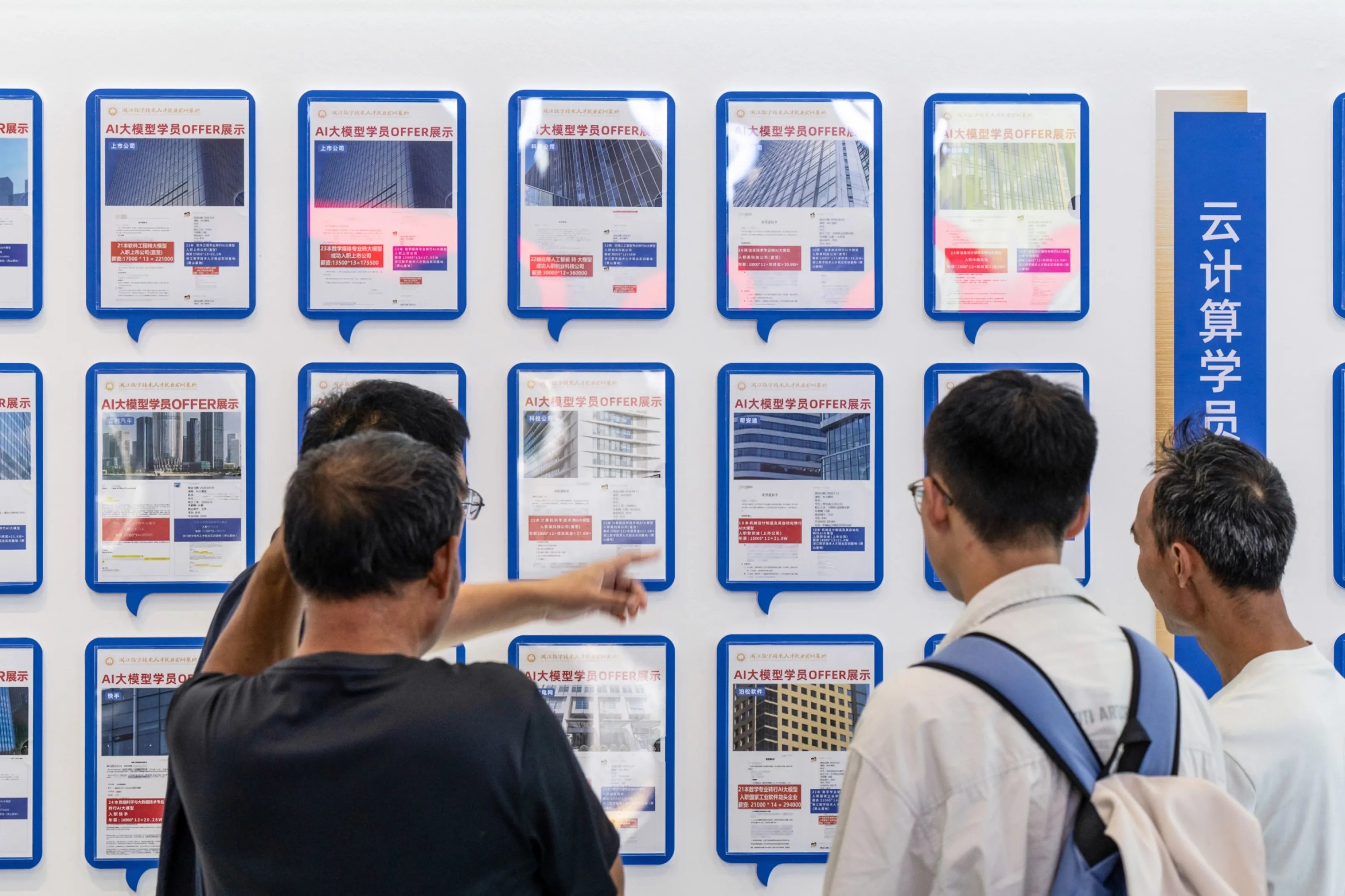
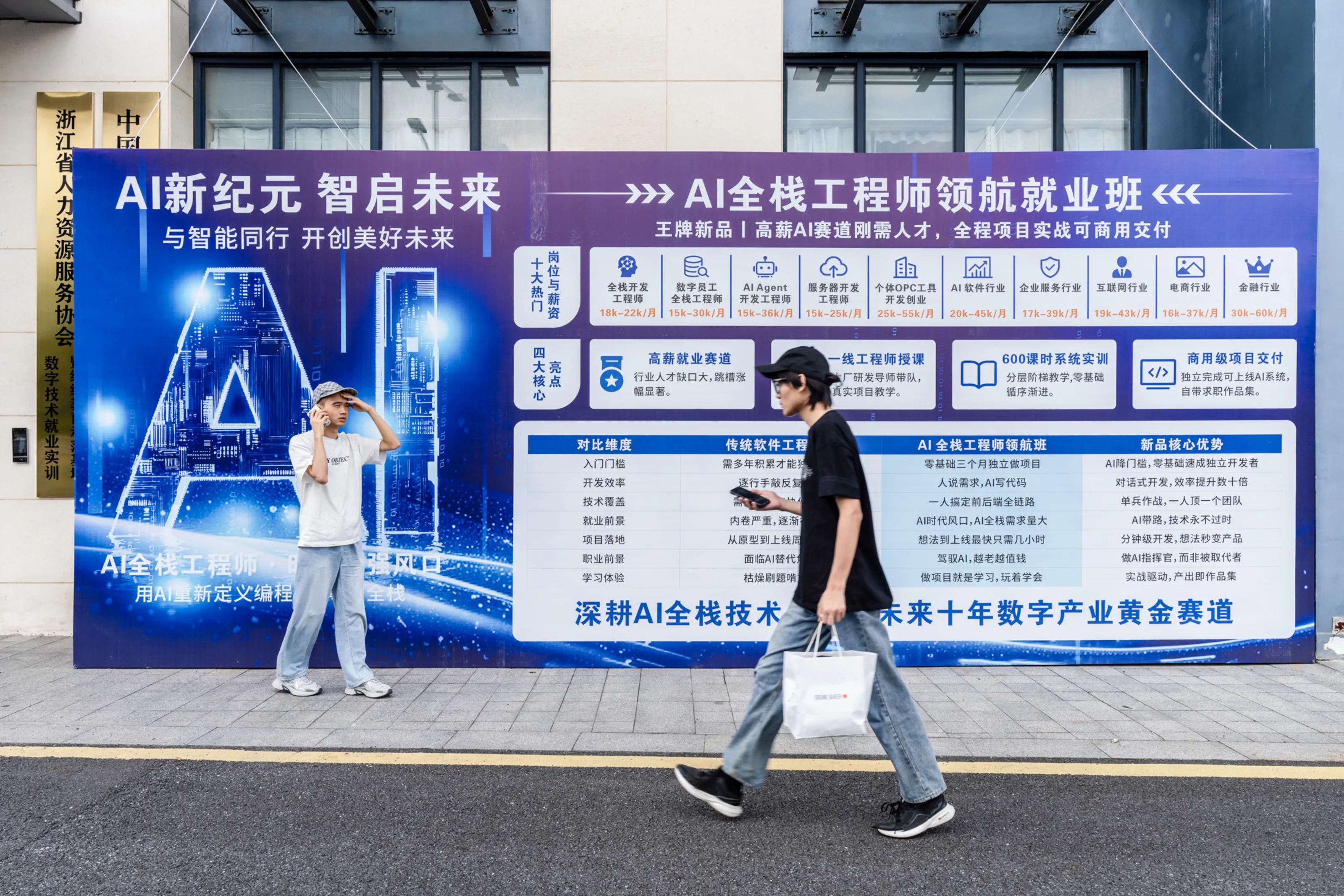
Prospective students and family members view AI job offers (left); an advertisement for an AI engineering training program (right) at the Zhejiang Digital Technology Talent Employment Training Base in Hangzhou, China, in September. Photographer: Qilai Shen/Bloomberg.
Prospective students and family members view AI job offers (top); an advertisement for an AI engineering training program (bottom) at the Zhejiang Digital Technology Talent Employment Training Base in Hangzhou, China, in September. Photographer: Qilai Shen/Bloomberg.
The job offers in particular are a powerful draw. Nearly 11% of college graduates last year throughout China were still jobless six months after finishing university — almost three times the share a decade ago, according to a survey by Mycos, a Beijing-based education consultancy.
Apart from tech programmers and designers, AI has also upended China’s film industry. The rapid spread of AI-made microdramas — TikTok-style soap operas lasting 90 seconds per episode watched on phones, which became a multibillion dollar business in the wake of the pandemic — has all but wiped out opportunities for actors, directors and anyone who worked on filming.
The Linying Studio in a Hangzhou suburb epitomizes the meteoric rise and abrupt fall of human-made shows. The filming venue, which takes up half a floor in a former furniture mall, opened in late 2023 backed by government investment to attract microdrama crews. At its peak, hundreds of people worked there simultaneously.
Now the studio sits empty most days, with at most one team on site, according to an executive. The sets — luxury homes, hospitals and police stations — were quiet on a recent afternoon. With AI video-generation tools like ByteDance’s Seedance 2.0, the time and cost required to create a show plummeted. More than 90% of 430,000 Chinese microdramas launched in the first eight months of 2026 were AI-generated, according to official data.
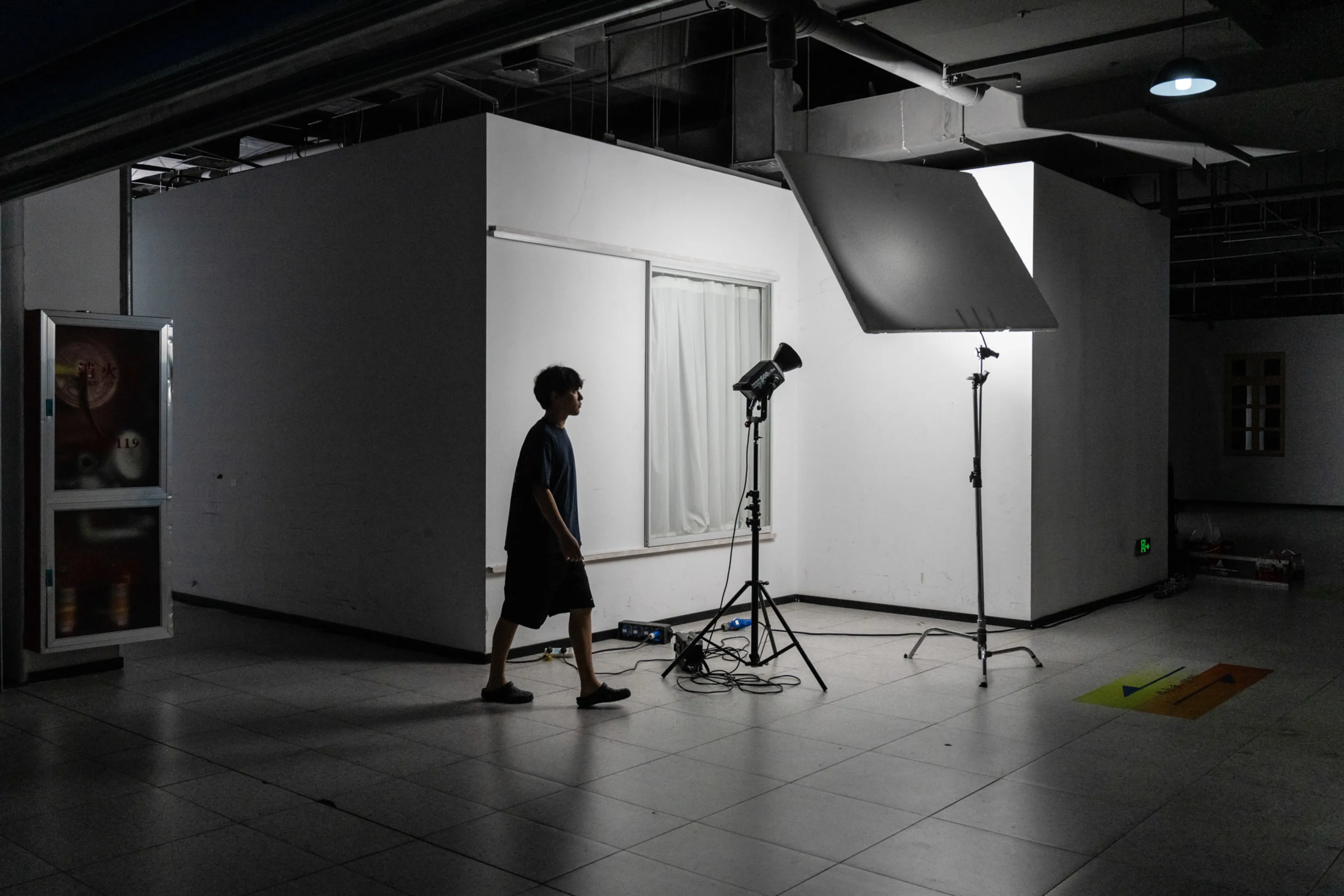

A lighting setup for a small commercial shoot (top) and the deteriorating facade of an outdoor set (bottom) at Linying Studio in Hangzhou, China, in September. Photographer: Qilai Shen/Bloomberg
Slurping a bowl of noodles at the school canteen in Hangzhou, Max Shen said he decided to learn AI filmmaking after noticing that everyone around him — including his parents — were hooked on the computer-generated microdramas, which he called “a digital snack that can numb you.” The 39-year-old travel photographer saw his income shrink by more than half as clients turn to AI-generated images, and remains pessimistic.
“I fear that there will be no more middle class in the AI era,” he said. “There will be only capitalists and the proletariat.”
At a restaurant along Hangzhou’s Qiantang river, Zhang Ziqi opened the most popular app for watching microdramas in China. The 26-year-old actress scrolled on her phone and counted — nine of the top 10 trending shows were all made by AI.
Zhang’s income has plunged by more than a third as job offers evaporated following the February launch of Seedance 2.0. For shows that still use human actors, crews must work even more brutal hours to cut costs. One toiled nonstop for three straight days.
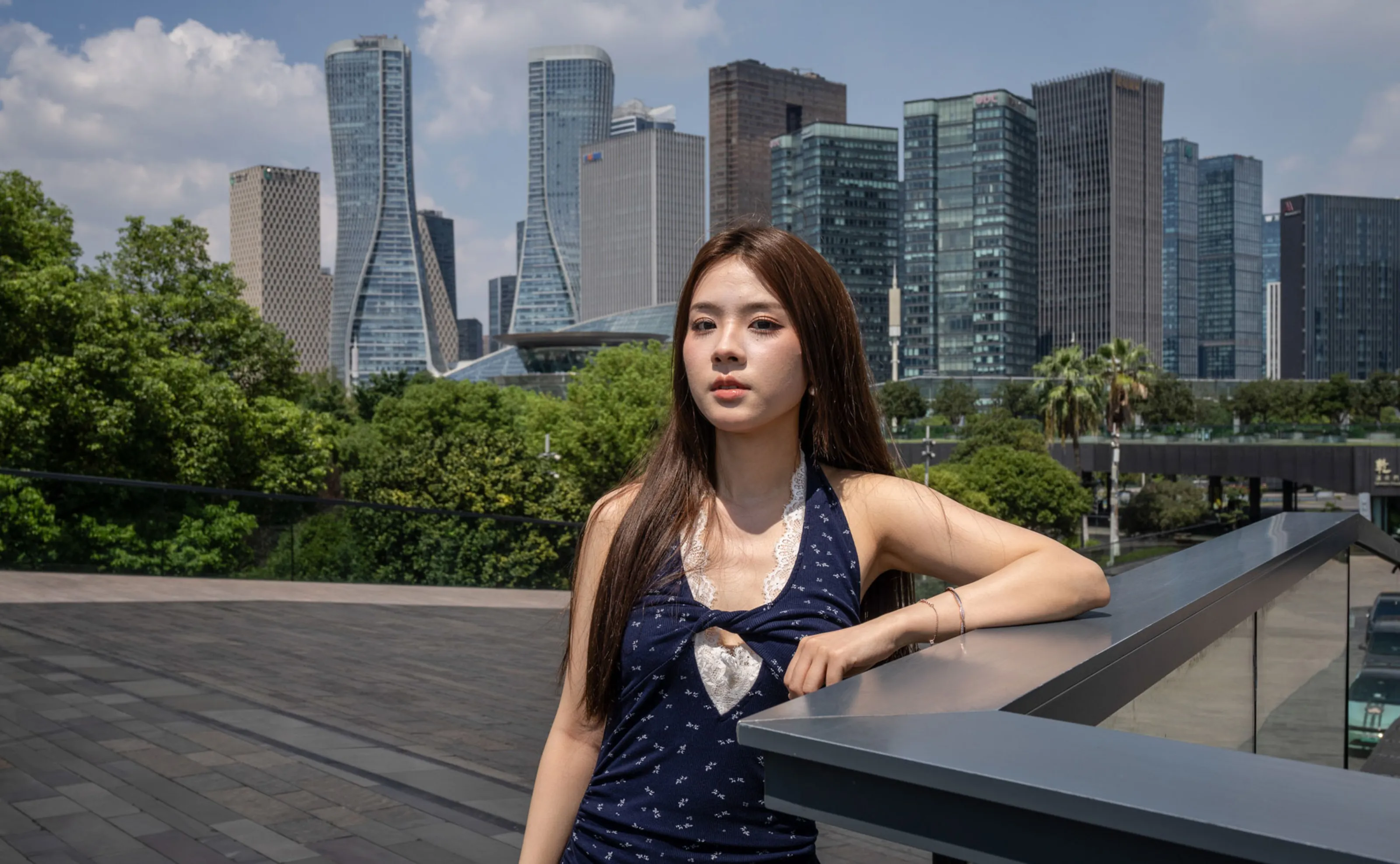
Zhang Ziqi, a microdrama actress in Hangzhou, China. Photographer: Qilai Shen/Bloomberg
Zhang is taking a different route, focusing on her side career of being a social media influencer. To save money, she no longer buys coffee daily and has started riding the subway instead of taxis. Overall, she’s trying not to worry too much in the face of a powerful economic force beyond her control.
“No matter how strongly you feel about it, there’s just no way to resist the wave of technological change sweeping through the job market,” she said. “I’m just a tiny grain of sand.”