 Newshot
Frequently asked questions
Can't my AI just read the code and CLAUDE.md?
Often, yes, for questions that stay inside one repository. But the code can't tell your AI who uses the system, how many people that is, or which parts of the business depend on it. You can add that to a CLAUDE.md, but it stays inside the repository it lives in. With IceShore, your AI writes each system's use cases into its architecture, and can read them across the systems in your workspace.
Who writes the use cases?
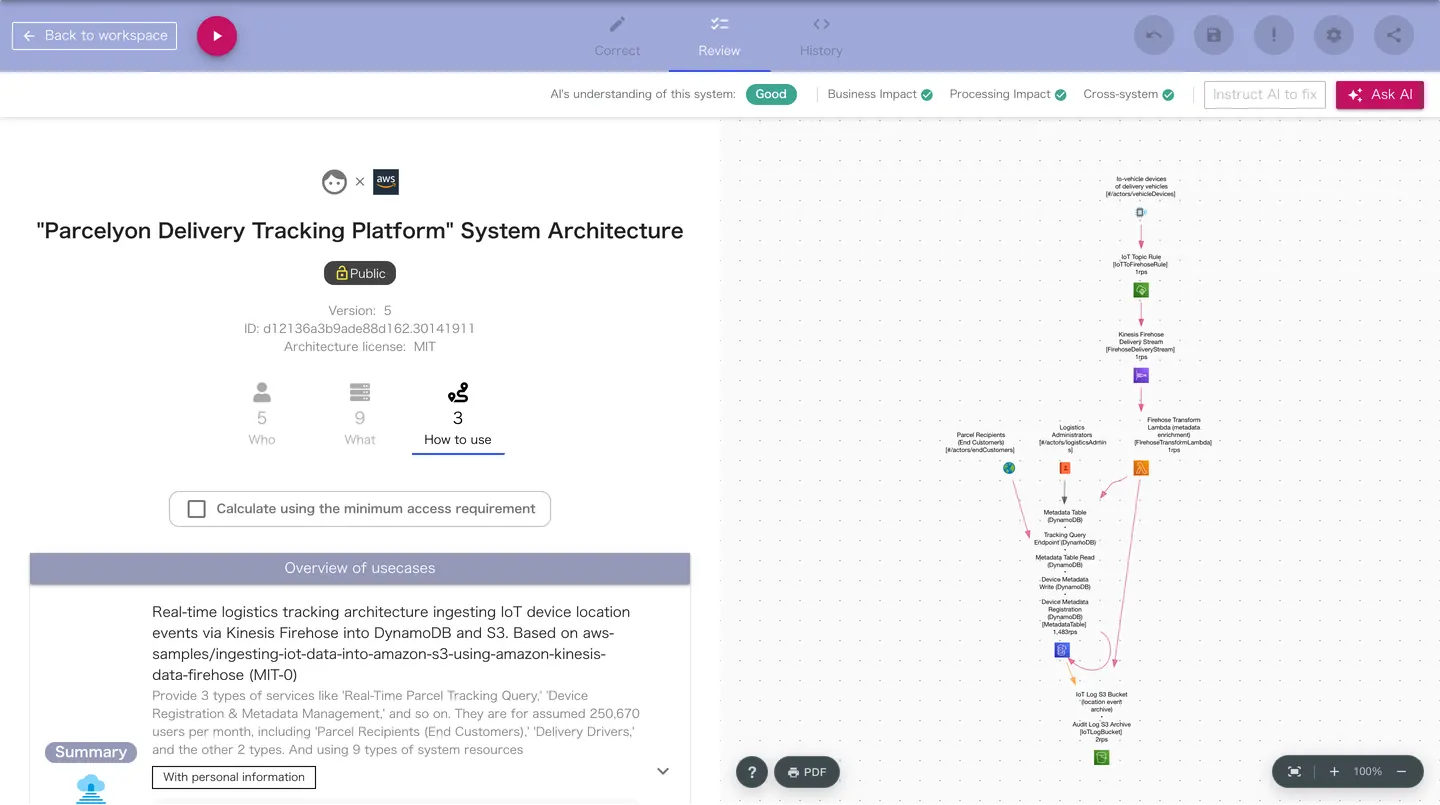
Your AI does. When you ask, it reads the code, configuration files and documents on your machine, organises the use cases and, once you confirm, registers them with IceShore. Anything the code doesn't say, such as how many people use the system, comes from your documents or from you. The diagram is drawn automatically; fix anything wrong in the Correct tab. From then on, your AI works from your corrections.
Is my code sent to an AI?
IceShore never sends your content to a generative AI. Drafting and answering both happen on the AI you already use. IceShore acts as an MCP server, returning architecture information when your AI asks for it.
Where is my data stored?
In the AWS Tokyo region (ap-northeast-1). Stripe processes payments and we never hold card data. The details are in our privacy statement.
What if a config file contains credentials?
They are detected and masked before anything is stored. Access keys, JWTs, private keys, connection strings and password or token values are covered, on both the in-app save path and the MCP save path. Every detection is recorded.
Can I verify what the AI wrote?
Yes. In the History tab of your own architecture (editor or above), each saved file opens version by version, down to the diff against the previous one. Every version records whether it was written by the AI over MCP or edited by a person.
Which AI can I use it from?
Any AI client that speaks MCP. Authorisation uses OAuth 2.1 + PKCE with signed access tokens, so you are not locked to one AI vendor.
How far does the free plan go?
Free forever for a single person. Creating architectures, connecting over MCP and change history are all included. Paying starts when you invite members to work together. On the Free plan after a paid plan has ended, the members you already had can view and export the architectures, but no one can edit them.
Do people who only use IceShore through their AI need a seat?
Workspace members do: every member uses one seat, Readers included. People outside the workspace can be invited to individual architectures as guests, and guests don't use a seat. The guest limit counts across the whole workspace: up to 3 on Free, view only; 3 per seat on Team and Business, and they can comment. Guests can also read the architectures shared with them from their own AI over MCP.
What happens when I cancel or change seats?
Cancelling keeps your access until the end of the current billing period — nothing is cut off immediately. After that the workspace switches to the Free plan: you can still view and export your architectures, but no one can edit them. Members stay. You cannot invite anyone new, and any share link already issued stops working. Subscribing again restores editing. Adding or removing seats is prorated at that moment (increases are billed immediately; decreases are credited against your next invoice — they are not refunded).
Do you issue a Japanese qualified invoice?
Yes. We are a registered invoice issuer in Japan (registration number T7010001137750, Launchers Co., Ltd.). Invoices carrying the number are available in the app under "Invoices & payment method". The payment receipt emailed after checkout does not include it.