 Newshot
Pebble Index 01 AI ring review: When a single feature becomes the product
It’s a whimsical side project for the smartwatch company, but a useful one.
图表:Pros
图表:Cons
- Pebble’s AI isn’t perfect
- Non-rechargeable battery
In 2009, Apple CEO Steve Jobs met with the founders of Dropbox with the intention of buying the file-sharing service. As part of the negotiation, Jobs reportedly said Dropbox was a "feature, not a product," and the business couldn't survive long term in its own right. That was my first thought when Pebble CEO Eric Migicovsky showed me the Index 01 back in January. A $75 non-smart ring that puts a tiny microphone on your finger just for speaking to your AI!? Surely, that's a (software) feature on a watch or smart ring, not a whole product you could sell in its own right. All I can say is that I'm glad I didn't say those words out loud at the time, because I'd be eating them today.
Hardware
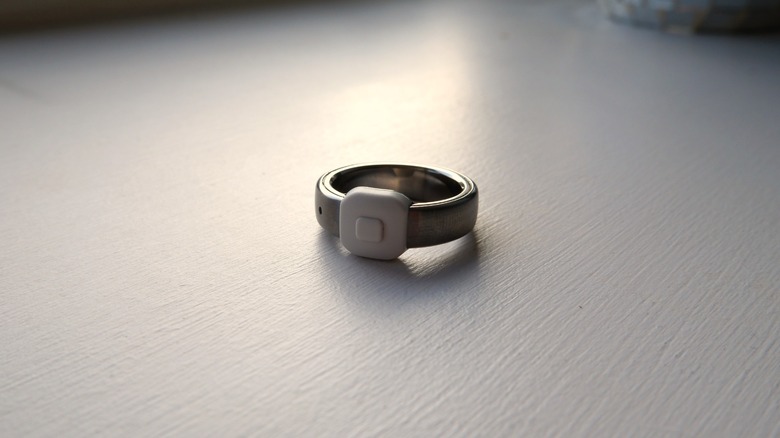
The Index 01 is the first of what Migicovsky hopes will be many small, slightly whimsical side projects made by the revived Pebble. It's a non-smart, stainless steel ring which sits on your index finger with a single physical rubber-clad button and an RGB LED.
Inside, you'll find a short range microphone, Bluetooth and a non-rechargeable silver oxide battery. As the rings are sold for $75, and it's designed to be used in tiny bursts, that cell is expected to last between two and three years. When the battery is close to running out, you'll get a ping from Pebble asking if you want to buy a replacement. At that point, you'll also be asked to send back your existing ring for recycling, since Pebble doesn't want to be making more e-waste. A gold star for everyone who can spot the contradiction there.
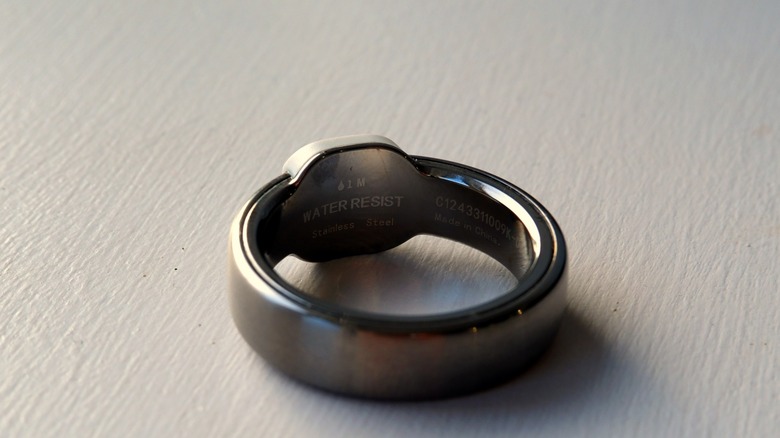
You'll be able to pick up the Index 01 in US sizes 6-13, and there's a waitlist where you can sign up if you want one in sizes 14 or 15. Pebble says that it's water resistant to one meter, withstanding handwashing, showers and doing the dishes, but it's best not to swim with it.
If you don't know your ring size and don't feel like taking a risk, you can grab a sizing kit from the company. You'll get an injection-molded set of sizers back for you to wear for a day or two to check the fit, and I'd urge you to keep a craft knife or pair of sprue cutters on hand.
In-use
As I said, the idea here is to put a physical talk to your device button on your index finger for the thoughts you just need to dump out of your mental cache. By default, if you hold the button and talk, your words will be sent to its homegrown AI, Index Agent, but you can also set it to be processed locally. The button has a wonderfully satisfying click, which is both great to feel and means there's so much resistance that I've only accidentally activated it once in my time wearing it. When active, you need to hold the ring less than a foot away from your mouth to issue your edict (any further is probably physically impossible anyway), and within about 10 seconds it'll be processed on your phone.
Plenty of the things that the Index 01 is doing is the sort of bread-and-butter ambient computing that's been knocking around for years. With your voice, you can leave yourself notes and reminders, add items to a shopping list or set timers, with the system working out where to place each one. There are separate panes inside the Pebble app for Notes to Self, Reminders and Shopping List, which has worked flawlessly so far, even with oblique requests.
You can, of course, also ask Index Agent to answer questions about your schedule and to pull information from the internet. I found the former to be much more reliable than the latter, and the agent managed to embarrass itself in at least one of my tests. One of my usual go-tos is to ask agents who the current manager of a soccer team is, given the volatility of such a role. During testing, Mauricio Pochettino stepped down as the manager of the US men's national team to take over a team sitting in the bottom three of the Premier League. When I asked Index who was running the US men's team, it suggested Pochettino — no great shame in not being that up to date. But, when I asked who was managing the club he was about to take over, it said Ruben Amorim, who was fired January 5, 2026 and has had two successors since then.
Now, I'm the sort of person who doesn't use ambient computing because, for me, I don't like the privacy implications of having a device which is always listening. Equally important, I know I can do whatever task I need with my fingers faster than I could render it as speech. I can set a kitchen timer on my phone in about five seconds, saying it out loud takes twice as long. But the fact Index 01 is only listening when I activate it, and that it's on my finger already, flips the script.
Inside the Pebble app, you can change the destination to whatever AI agent you use, and also change what the trigger action. So, for instance, if you'd rather trigger a web search or a webhook, you can do that, as well as hook up to an MCP server. As I said when reviewing the Pebble Time 2, the app lacks polish, as the focus is on adding functionality over gloss. And I think the target market — people who didn't just have to look up what a webhook / MCP server was — won't be deterred.
Pebble is an Android-first company, and the ring can do several more things when paired with that ecosystem over iOS. Double click the ring and you'll trigger music playback, a triple click advances to the next song and you can set the ring to send messages via Beeper.
Price and the competition
As usual, Pebble has made the point that there are plenty of other devices available if you want something outside its narrow offering. In its materials, the company says if you want a smart ring get an Oura ($399) and if you want a long-term AI recorder, get a Plaud. (The Plaud NotePin is $159, which can continuously record up to 20 hours of audio for later transcription.)
In terms of similar devices, the most obvious choice is the Wizpr Ring, which I saw at CES 2024 when it was called the Whsp Ring. The company is currently fulfilling Indiegogo orders, where rings were priced at $139, but says its retail price will be $199 when it launches. Vocci's ring will set you back $299, can record up to eight hours of conversations at a time and will let you speak to your AI agents. Just bear in mind, it comes with a monthly subscription which will only offer up unlimited transcription at the $30 a month tier. Another option is Aina's far fancier ring, which was announced at the start of November and will ship early next year for $399.
Wrap-up
The Pebble Index 01 is nothing more than a physical manifestation of what would otherwise be a software feature. A discrete, standalone button that I'd argue nobody really needs, but it's useful enough to easily justify if you want one. I'm not going to try and dissuade you if your initial reaction was much like mine, because it's the sane and sensible thing to think. But bear in mind that, at this sort of price, it's the type of low-investment gadget that might wind up finding itself an integral part of far more people's days than anyone expects.