 Newshot
Why I think we should all get eight hours of sleep, routine exercise of some sort, and reset our brains on the weekend as we approach crunch time. Interspersed with related quotes I like that make me think, but may or may not strengthen the point being made (which highlights the inherent tension!).
During my time at Amazon, I saw leadership change (founder Jeff Bezos left as CEO after 27 years!), three major rounds of layoffs (30,000+ employees fired), and the supply chain shocks of COVID (I worked in transportation optimization, so this was very visceral). It taught me a lot about urgency. What does it mean that this project or work is urgent?
Big tech is filled with a lot of false urgency. We need to deliver this feature now!! Maybe we promised unrealistic deadlines to look good. Maybe we want to hit arbitrary performance goals. Maybe we just like moving fast! To stay sane, it was important to learn how to filter out what was really needed now, and what was just noise. I saw a lot of people that couldn’t do this. Being unable to filter commonly led to burnout, which was born out of a self-fulfilling prophecy of “I need to work more so I don’t fall behind deadlines” → “I’m so tired from working so much that I can’t keep pushing” → “I can’t catch up…” . Fear is a primary driver! In this case, it was fear of stack ranking[1], layoffs, and negative comparison to peers.
Let me be clear: some things absolutely are time sensitive. They should be addressed and handled with the appropriate urgency. But many are not. If we live in a paradigm where everything is time sensitive, whether born out of excitement or fear or mission, then nothing really is; how will we know when The Moment™ has actually come?
“In the end, it will be impossible to know if we overreacted or did too much, but it will be quite apparent if we under-reacted or did too little.”— Darrin M. Peppard
“In the end, it will be impossible to know if we overreacted or did too much, but it will be quite apparent if we under-reacted or did too little.”
— Darrin M. Peppard
As we look at the current state of AI safety, it feels to me that parallels can be drawn from what I saw at Amazon. People are passionate and excited to be working on the problems. There’s a frenzy in the air with many people trying to get in and make their mark. More importantly, it seems to me that fear is also a primary driver.[2] There is a pervasive feeling that AI catastrophe is near and we are the only ones who care enough to stop it. This may be the case (and I certainly think that it is), but it’s not obvious to me that people are approaching this in the optimal way—I’m concerned we’re not setting ourselves up for success during crunch time.
What does this mean? In the greater picture, everything in AI safety is genuinely urgent. But individually not equally so. Filtering through “false” urgency then looks more like taking stock of which things we believe actually matter and need to be done today, and which things can be pushed to tomorrow. Naturally, working long hours into the night or working on the weekend makes sense for an urgent problem. There is a problem to be solved, and time is of the essence! But I want to be careful we’re not myopic (even relative to short timelines).
“Once, I saw a bee drown in honey, and I understood.”— Nikos Kazantzakis
“Once, I saw a bee drown in honey, and I understood.”
— Nikos Kazantzakis
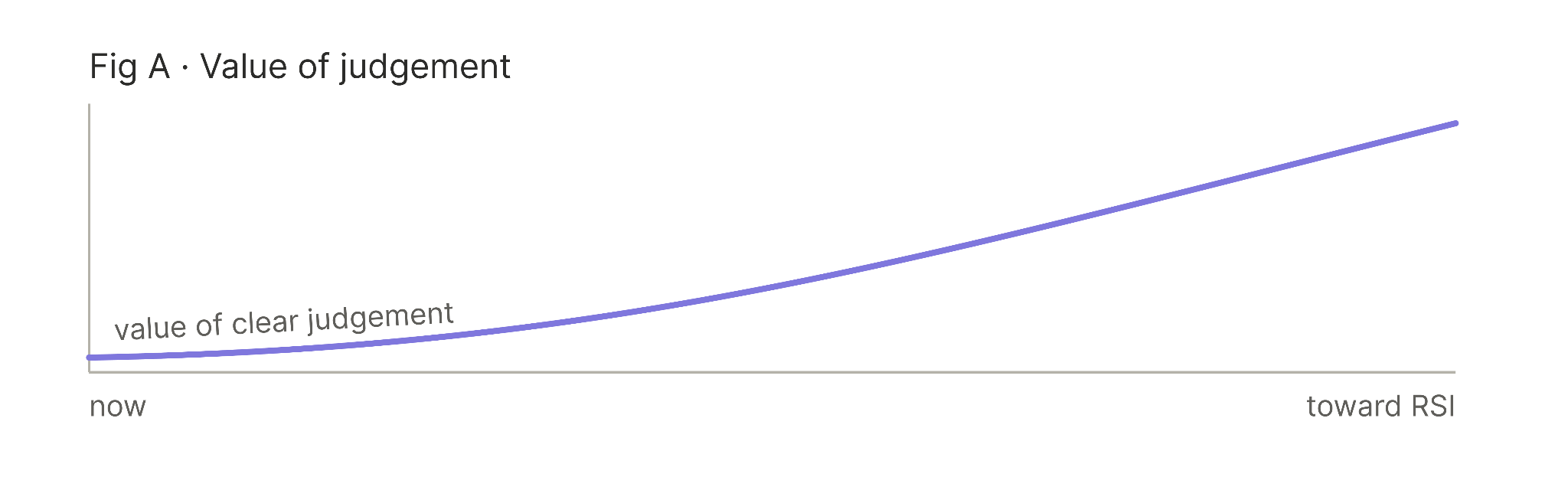
Let’s consider the future.[3] What does the work look like between now and crunch time (just before RSI)? I posit that, as research and engineering automation become more robust, the ability to think deeply and make The Right™ choices will become increasingly valuable. I suspect research taste will be one of the last aspects of research to be automated.
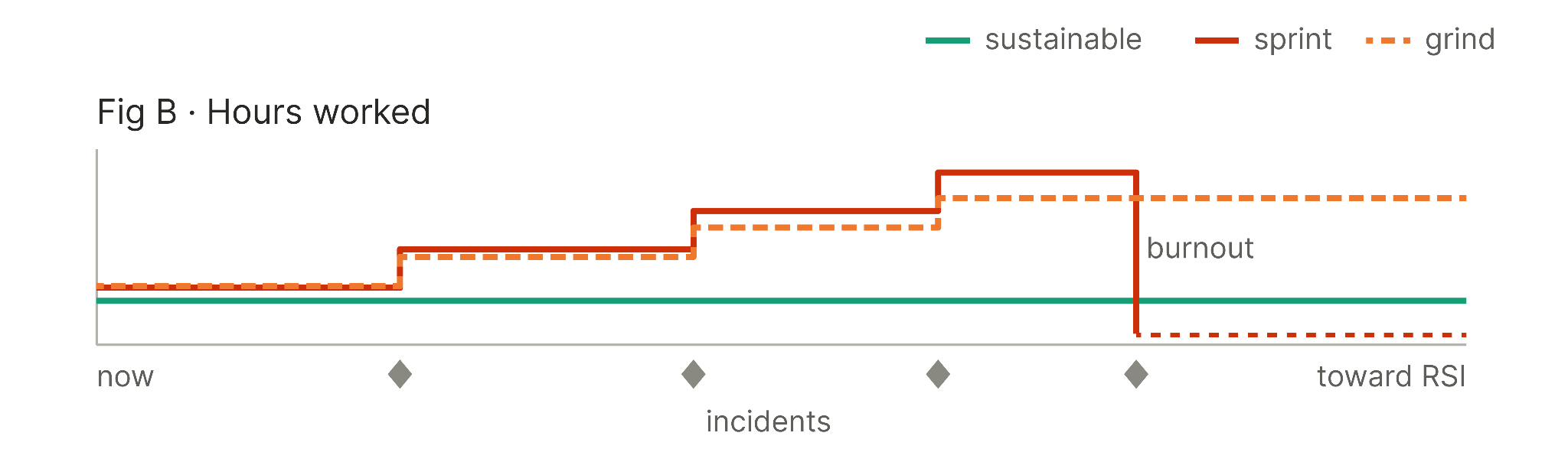
Let me ask you, how stressed or anxious are you now? Capabilities are differentially accelerating. How hard do you work as a result? How distraught do you think you’ll be when the first human casualty “warning shot” happens? The first mass casualty event? Breaking: over one million people dead after… World-impacting, time-sensitive incidents will plausibly happen soon, at an increasingly rapid pace. Will your instinct be to grind harder? Could you even do that? The bar to judge what is actually time sensitive will need to get higher. Have panic, little sleep, and burnout ever led to optimal decisions? What does this mean for us?
“All I have to give is all I have.”— ?
I think the natural response in the safety community, when these incidents happen, will be to double down. Work harder! This would be my instinct too. The fate of humanity is in our hands, and every second counts. But let’s walk through what might happen:
“Men heap together the mistakes of their lives, and create a monster they call destiny.”— John Oliver Hobbes
“Men heap together the mistakes of their lives, and create a monster they call destiny.”
— John Oliver Hobbes
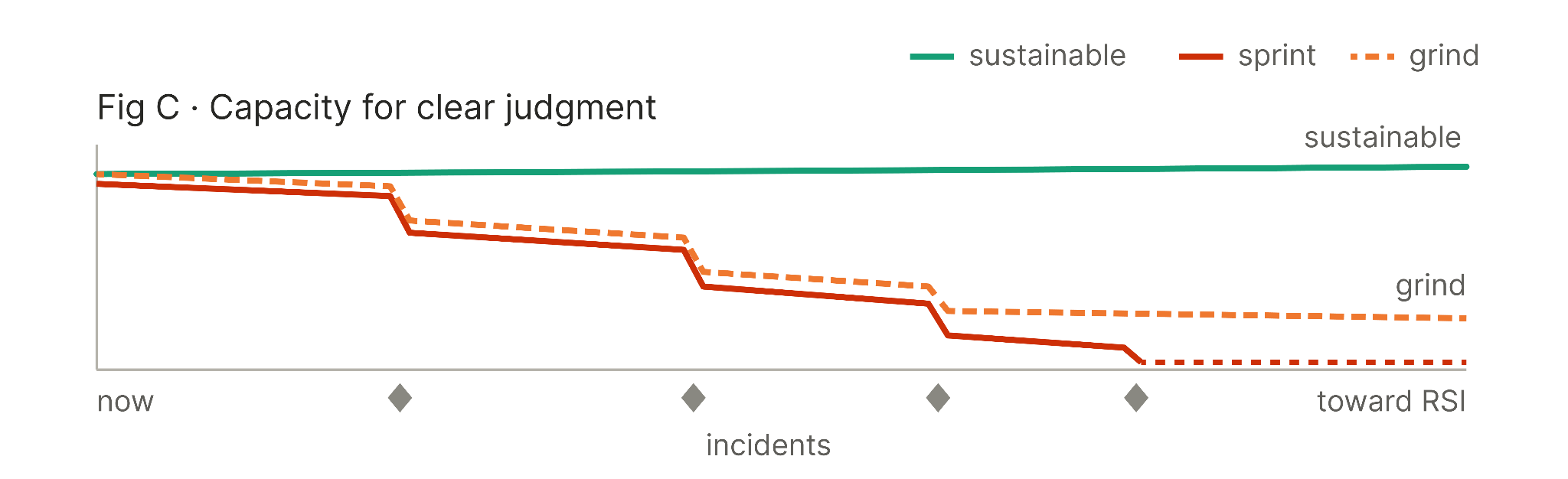
As we double down and grind, our mental and physical health will degrade. Some of us will burn out. This will undoubtedly affect our decision making—right when it is becoming most valuable! We cannot depend on the lab researchers; they’re already pointing to internal burnout and lack of ability/time to think deeply. It does not make sense to me to mimic their sprinting when we have considerably fewer resources and access to capable internal models. The capability and responsibility, then, to make The Right™ choices could plausibly fall on the independent safety community, insofar as labs would be willing to listen to us. Accordingly, I posit the following:
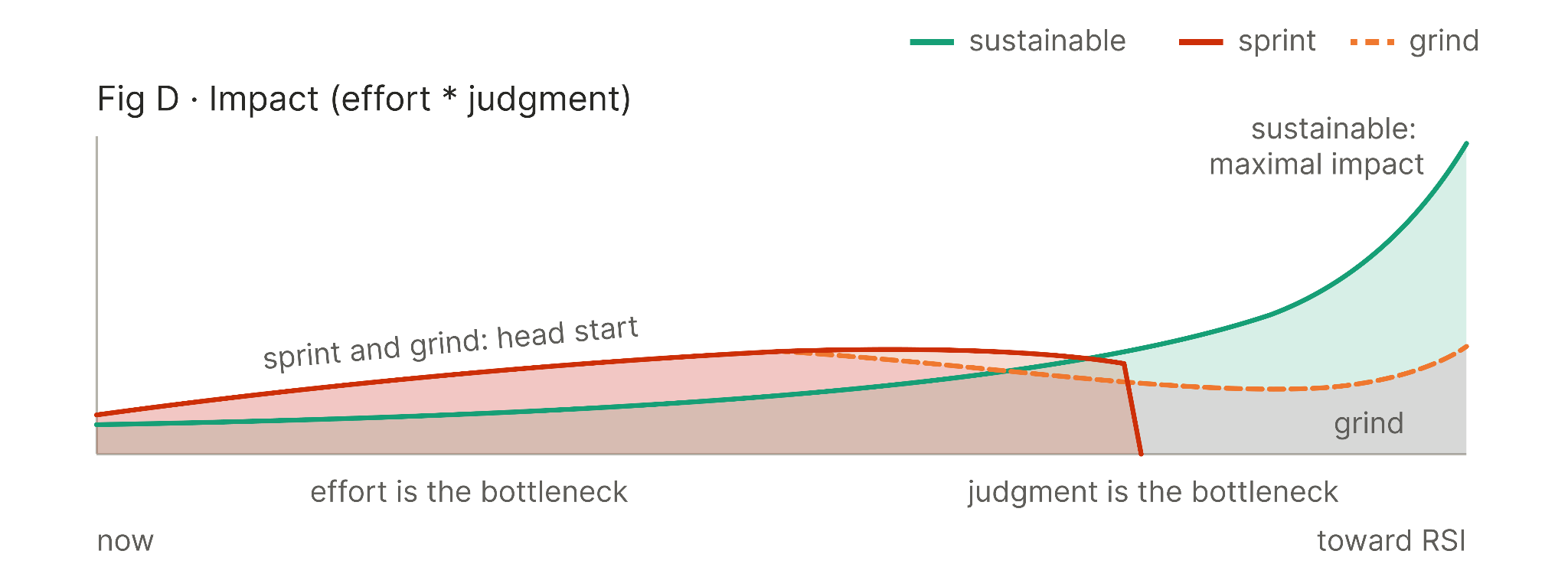
If we measure impact (effort x increasingly valuable judgement) as area under the curve, having energy and clarity to make smart decisions will ultimately be more impactful as we approach RSI. This is, of course, dependent on what short timelines actually mean. Perhaps in reality we’re all capable of sprinting to RSI—arriving clear-headed and defiant. I want to note that “sustainable”, “sprint”, and “grind” are inherently subjective and personal.[4] It’s up to you to define where on the scale you fall and what that looks like, but note that people cannot reliably predict when they will burn out so I’d be worried that people overestimate their stamina. Work still needs to be done now to pave the way for important thinking later. We will not get to crunch time without some people grinding now! We need both grinders and thinkers to make it through this, but right now I’m worried we’ll just have grinders and burnouts when the time comes.[5] We need people to make the conscious decision to work at a sustainable pace, even in the face of increasingly scary incidents.[6] This might look like deciding your pace before incidents arrive, rather than in reaction to them.
“The woods are lovely, dark and deep. But I have promises to keep, and miles to go before I sleep.”— Robert Frost
“The woods are lovely, dark and deep. But I have promises to keep, and miles to go before I sleep.”
— Robert Frost
Outside of The Work™, from a life perspective, why do you care about saving the world? Don’t answer abstractly. Perhaps you have friends, family, loved ones you want to protect. Who? Perhaps you want to see the world’s waterfalls, mountains, and oceans for as long as you can. Where? We cannot pre-emptively divorce ourselves from the things we care about through burning out on work. To do so would be to dehumanize ourselves. How can we properly steward the world through ASI if we have lost touch with humanity and the reasons we love it so dearly?
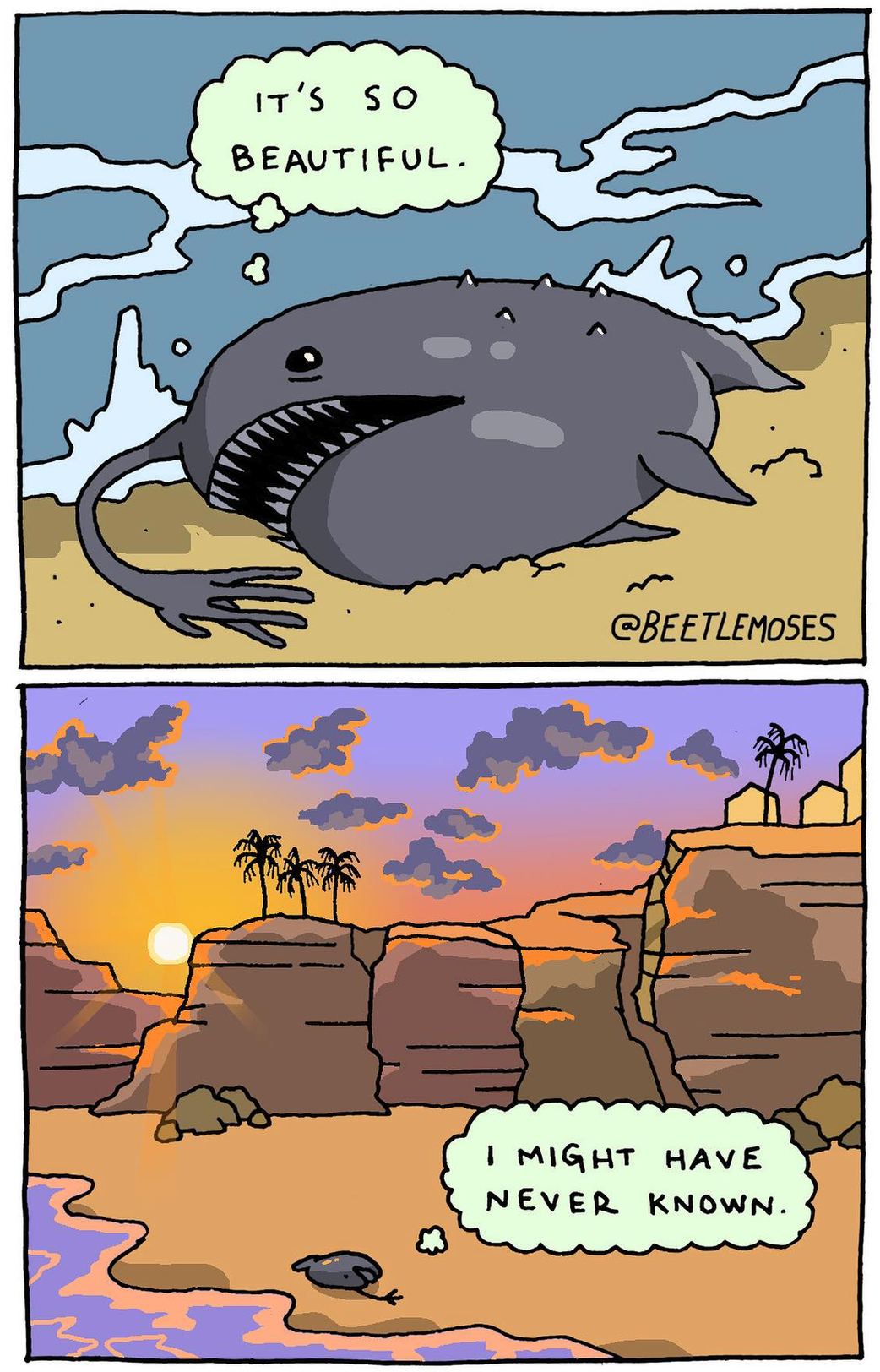
Credit: https://www.instagram.com/p/DL5bsUKxqOZ/
I’m not asking you to work less or more. I’m asking you to live on purpose.[7] When we think about what is meaningful to do with every moment of every day, we need to consider all of the following: (1) The Work™ as it stands today, (2) how you want to contribute to it in 6-12+ months from now when thinking is more important, and (3) why do we do this work?
“I miss dreaming forwards,” Anna said. “What?” “I dream backwards now. You won’t believe how backwards you’ll dream someday.”— Marina Keegan
“I miss dreaming forwards,” Anna said.
“I dream backwards now. You won’t believe how backwards you’ll dream someday.”
— Marina Keegan
I think I’ve been trying to address two points in this note:
- More people need to be fresh and clear-headed in crunch time than we’re on track for.
- How are we to earnestly align AI to human values if we increasingly sequester ourselves away from the world? Throughout these next X months or years, we need to make sure to remain active participants in the fabrics of our lives lest we lose our sight.
“The rollercoaster ride we took is nearly at an end. I bought my ticket with my tears; that’s all I’m gonna spend.”— The Cyrkle
“The rollercoaster ride we took is nearly at an end. I bought my ticket with my tears; that’s all I’m gonna spend.”
— The Cyrkle
- ^At Amazon, employees are stack ranked against each other, with the bottom 6-10% of performers fired every year.
- ^Though this fear is more “justified” than the fear people felt at Amazon, it is fear all the same, and the resulting mindset and actions are similar.
- ^This is more true if a pause happens (which I hope it does), but I think largely still true in no-pause worlds.
- ^I represent “sustainable” as flat and constant for simplicity, but it can also be spiky! This is part of knowing your limits.
- ^The natural question of who should be which is an important one to discuss, and something I’d be interested to hear the opinions of others on. My low effort, initial reaction would be to take the top X% researchers at research taste and force them to be well rested, kind of like how pilots or air traffic controllers have maximum hours they can work. It might also make sense to apply this at an org level so each research direction has clear-headed people.
- ^I don’t mean to set up a false dichotomy where you have to be one or the other and can’t switch, but I do think people have a tendency to have “sticky” working styles.
- ^ Let’s also not forget that we can die at any moment! We’re not guaranteed to live to see RSI or ASI or tomorrow.