 Newshot
The energy needed to cool the world’s buildings is overtaking the energy needed to heat them for the first time in history, the International Energy Agency (IEA) said on November 19, 2026. The IEA, an intergovernmental agency that advises governments on energy, made the finding in the World Energy Outlook 2026, its main annual report. “Already today, for the first time in energy history, demand for cooling in buildings is overtaking that for heating,” the report’s executive summary says.
Two forces drive the change: rising incomes and rising temperatures. In emerging and developing economies outside China, 85% of households are exposed to high temperatures for at least part of the year. Fewer than one in five households there own an air conditioner.
In the IEA’s main scenario, a projection built on the policies governments have announced, the electricity used for cooling worldwide grows by 1,700 terawatt-hours (TWh) by 2035. A terawatt-hour is a billion kilowatt-hours; the kilowatt-hour is the unit on a household power bill. That increase is roughly India’s total electricity demand today.
A first in energy history
The IEA’s press release calls the shift “a striking milestone”: “energy needs to keep buildings cool are now overtaking energy needs for heating them for the first time in history.”
Most of this year’s report deals with the oil and gas shock caused by disrupted shipping through the Strait of Hormuz. The cooling finding comes from another part of the report, on what people use energy for: getting around, heating, cooling and computing. The IEA calls these uses energy services.
Of these services, cooling adds the most new demand. Cooling demand in buildings has risen 55% since 2015, the IEA says in its full report. In every scenario the agency models, cooling accounts for more than 40% of the growth in energy services worldwide through 2035.
That growth comes mostly from hot countries that are getting richer. It also comes from places where cooling used to be a minor need. The report names Europe, where heat waves and warmer summers are turning cooling into a new source of demand. It cites record heat waves there and strong air conditioner sales in European countries that historically needed little cooling.
The IEA notes that August 2026 was the hottest month on record worldwide. Since mid-June, the sea surface has also set a heat record for the date every day.
Who has air conditioning, and who doesn’t
Air conditioner ownership varies widely. In Australia, Japan and the United States, around 90% of households own at least one unit, according to the report. In India and Indonesia, fewer than one in five do, despite high cooling needs. Worldwide, around 80% of the population lives in places that need cooling for at least part of the year, and around 40% of households own an air conditioner.
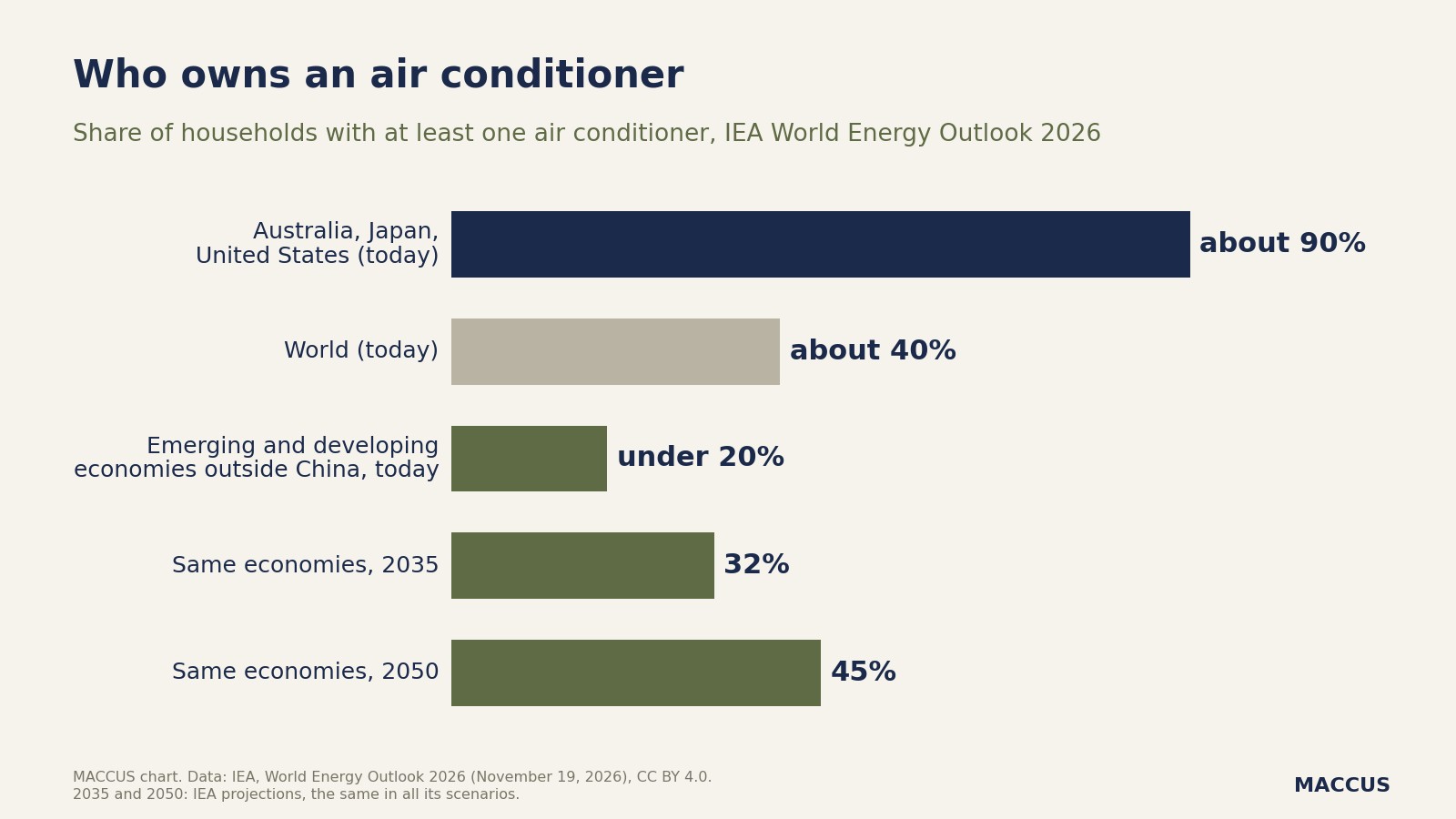
In emerging and developing economies outside China, the IEA projects that ownership will rise from under 20% of households today to 32% by 2035 and 45% by 2050. The projection is the same in all its scenarios. The IEA also models a current policies scenario, which counts only the policies already in place. In that scenario, more than 85% of the growth in the world’s stock of home air conditioners over the next decade happens in emerging and developing economies, China included.
By the middle of the century, the IEA projects, the world’s buildings will have more cooled floor space than heated floor space.
More electricity for cooling, and a heat-wave what-if
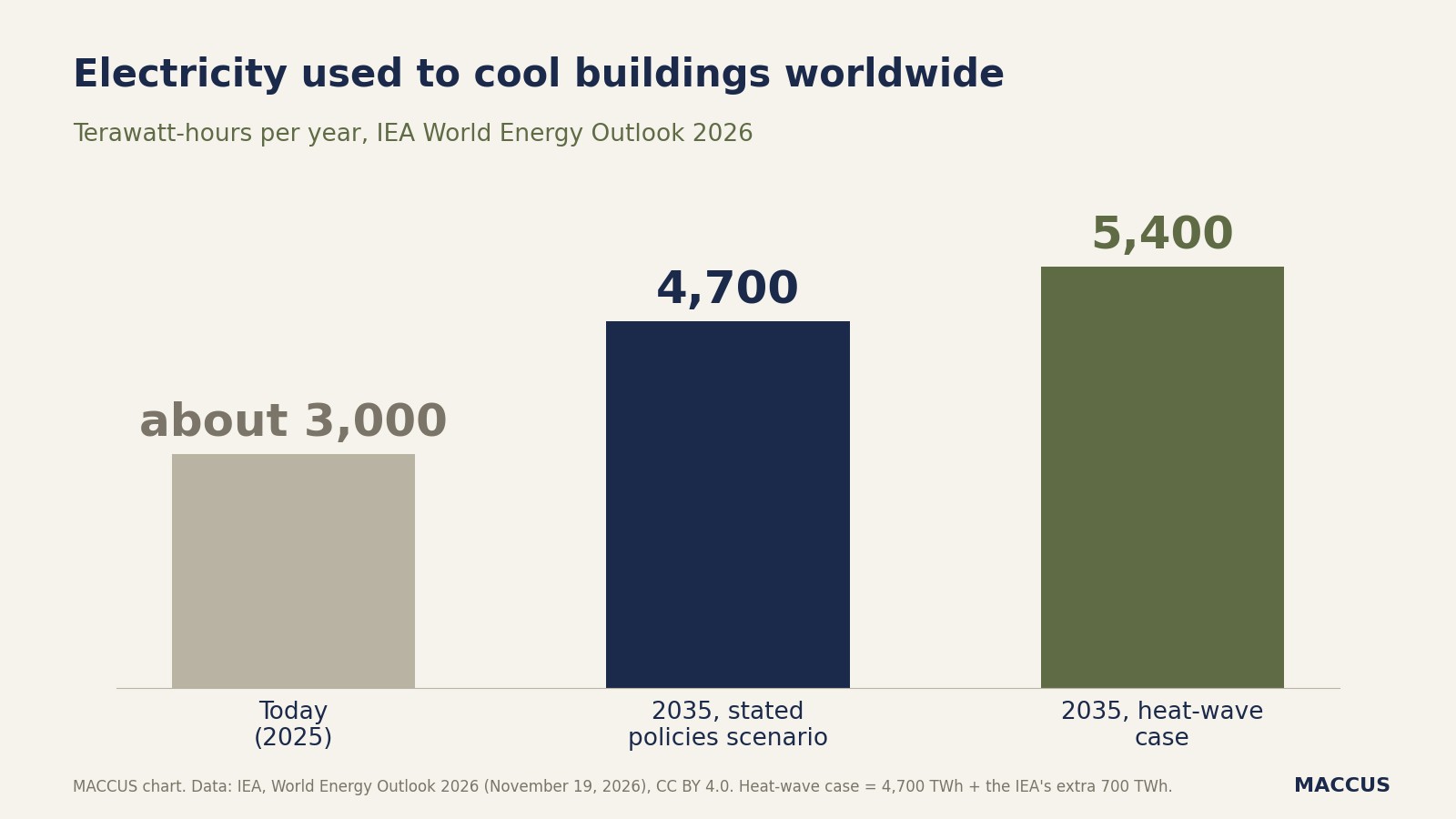
In the main scenario, which the IEA calls the Stated Policies Scenario, the electricity used to cool buildings rises by 1,700 TWh by 2035. It goes from about 3,000 TWh a year today to 4,700 TWh a year.
The report also models a “heatwave case,” a what-if kept apart from the main scenario. In it, heat waves become stronger, more frequent and longer, so more households buy air conditioners and use them more. In that case, cooling demand grows by 700 TWh more than in the main scenario by 2035. That is 40% more growth.
Cooling also weighs more on power grids than its share of total use suggests. Air conditioners run hardest at the same time, on the hottest days. That drives up peak demand, the highest demand a grid must meet during the year. In the main scenario, cooling makes up only 12% of the world’s electricity demand in 2035, but 30% of peak demand.
Peak demand is measured in gigawatts (GW), which count power at a single moment, while terawatt-hours count energy used over a period. Added up across the world’s power systems, it is 4,700 GW today. It grows by about 40% by 2035, in both the main scenario and the current policies scenario. Under current policies, the cooling part of the peak alone grows by 720 GW, more than India’s entire power generating capacity today.
In the main scenario, cooling and appliances together add 2,900 TWh of electricity demand by 2035. That is more electricity than the whole European Union uses today. Almost 90% of that growth happens in emerging and developing economies.
Heating still consumes more energy
Measured by the fuel and electricity consumed, heating is still well ahead. “Globally, there is less cooling than heating demand, but more electric cooling than electric heating demand,” the report says in its section on buildings. Space heating, which keeps rooms warm, uses about a third of all the energy consumed in buildings, more than any other use.
The milestone uses a different yardstick. In the report’s framing, the comparison is about energy services, meaning the comfort delivered. The sentence about cooling overtaking heating sits in the report’s section on demand for energy services. The IEA measures those services as “useful energy”: the energy that does the job people want, such as “the heat produced by a heater.”
By our reading, the two findings fit together because of how the equipment works. A boiler burns fuel and loses part of its energy in the process. An air conditioner, like a heat pump, moves heat from one place to another, so it delivers more cooling than the electricity it consumes.
The report counts air conditioners and heat pumps as devices whose output exceeds the energy they take in. That, by our reading, is why cooling can overtake heating in the service delivered while heating still consumes more energy.
The executive summary puts no number on the crossing itself. It is a result of the IEA’s modeling, and the agency describes the crossing as under way (“is overtaking”). None of the report’s scenarios is a forecast, as the IEA’s executive director, Fatih Birol, said in the press release.
In advanced economies, heating remains the largest energy service. It declines only slowly, as better insulation and warmer average temperatures offset the effect of rising incomes.
What it means
Air conditioners are spreading in the countries where most of the world’s people live. In the IEA’s projections, the share of households that own one in emerging and developing economies outside China more than doubles by 2050. Those households gain comfort, and power grids must carry a bigger load in the hottest hours of the year. Electric trucks, cars and heat pumps add to the load on those grids as well.
Electricity already supplied 23% of the energy consumed worldwide in 2025, and the IEA sees that share closing in on 30% by 2035. The agency says at least 25 million kilometers of new power lines are needed over the next ten years. On the supply side, solar covered more of the growth in world energy demand in 2025 than any other source, a first for a renewable source, according to the IEA. In the European Union, solar became the biggest source of electricity over the summer.
Efficiency rules also shape demand. Minimum efficiency standards are the legal floor on how efficient an appliance must be to go on sale. For household appliances such as refrigerators, washing machines, lighting and televisions, the IEA calculates that bringing every country up to the strictest standards in force today would save 800 TWh of electricity by 2035, almost half of it from refrigerators alone. For cooling, the current policies scenario keeps those standards at today’s levels, and cooling demand reaches 4,900 TWh by 2035, compared with 4,700 TWh in the main scenario.
Sources
- As an unprecedented shock reshapes the energy world, its duration will determine the scale of the change, International Energy Agency (press release), November 19, 2026
- World Energy Outlook 2026: Executive summary, International Energy Agency, November 19, 2026
- World Energy Outlook 2026 (full report, PDF), International Energy Agency, November 19, 2026
Header image: MACCUS chart, data from the IEA World Energy Outlook 2026 (November 19, 2026), CC BY 4.0.
More in this section
Data centers used 5% of Dutch electricity in 2025, more than triple their 2017 share

OpenAI says its models found a year’s worth of AMD GPU design gains in under five months
Half of young people who use AI daily have used it as a friend, a Gallup survey finds

Cloudflare releases the weights of Clairic, its AI that reads invoices and receipts
Top stories today
- 1AIData centers used 5% of Dutch electricity in 2025, more than triple their 2017 share
- 2AIOpenAI says its models found a year’s worth of AMD GPU design gains in under five months
- 3AIHalf of young people who use AI daily have used it as a friend, a Gallup survey finds