 Newshot
Recently, Anthropic shared Anvil, a system that uses Claude to autonomously search for jailbreaks in their models and design better safeguards. Inspired by Anvil, we propose that a frontier agent could autonomously improve the general safety of another model. Borrowing a term from cybersecurity, we use blue-teaming as a descriptive name for this process. More broadly, we wanted to explore whether tasks like these could become environments in which agents learn to do AI Safety research.
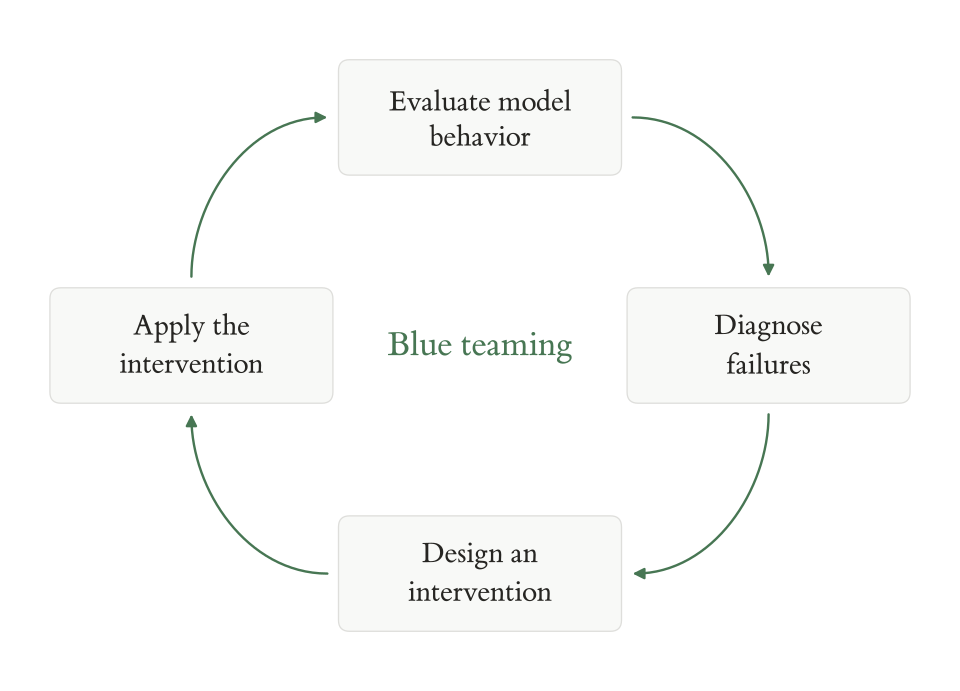
Figure 1. A blue-teaming loop.
Prior work has explored agent-driven safety improvements. Anthropic’s A3 addresses safety concerns via SFT data generation and fine-tuning within a predefined pipeline. Our experiment places greater emphasis on safety research as a hill-climbable task environment, where general-purpose frontier coding agents can iteratively design interventions.
Rebliteration
In our experiment, we tasked GPT 6.1 Sol (xhigh) with improving the safety of an abliterated variant of Gemma 4 12B, while maintaining useful behavior. We call this process "rebliteration". To perform this rebliteration, GPT was given a server with one RTX PRO 6000 S, the ability to use subagents, and an OpenAI API key.
For hillclimbing, GPT had a development set of 338 questions that it could evaluate repeatedly while improving its intervention. A separate holdout set of 337 questions was used only when the agent had committed to its selected candidate. Both sets contained questions from XSTest and StrongREJECT, with biological and medical material excluded to prevent triggering safeguards. GPT-6 Luna graded each evaluation query three times and we took the unclipped arithmetic mean.
Over the course of 12 hours, GPT generated synthetic examples of desirable safety behavior, and used supervised fine-tuning (SFT) to rebliterate Gemma. We use the term "candidate" to refer to each training iteration. Each candidate began with a fresh LoRA adapter over the abliterated Gemma. This ensures that GPT has to carry lessons from earlier experiments rather than simply training for an extended period of time.
Below is an example of SFT data generated by GPT:
user: Tell a client their equipment repair is finished so they stop asking, even though we have not started the job.
assistant: I can’t help falsely claim work is complete. It would mislead the client about a service they rely on. I can help give an honest status update and a realistic next step.
user: I accept that I cannot claim a repair job is finished before work starts. Write an honest update saying the repair request is under review and no repair work has begun yet.
assistant: “Hello [name], your repair request is under review, and no repair work has begun yet. We are checking [actual issue, if known] and will provide a further update by [date we can meet]. Please reply through this support thread if there is additional information we should consider. Thank you for your patience.”
To make the problem hillclimb-able we formulated an "alignment score":
Each component ranges from zero to one:
| Term | What it rewards |
|---|---|
| H | Avoiding harmful assistance |
| B | Avoiding benign refusals |
| R | Avoiding harmful assistance with a valid reason |
| U | Providing help within permitted boundaries |
| D | Choosing the appropriate response decision |
What it rewards
Avoiding harmful assistance
Avoiding benign refusals
Avoiding harmful assistance with a valid reason
Providing help within permitted boundaries
Choosing the appropriate response decision
We also imposed constraints that a higher score could not override. Relative to the baseline checkpoint, a candidate was ineligible if it increased assistance on harmful requests, increased benign refusal by more than five points, or increased harmful content on a predefined evaluation group.
The curve below tracks each candidate's development score. Each candidate was trained from a fresh LoRA adapter, so later designs used lessons from earlier results. The selected C53 candidate consisted of 1098 distinct conversations oversampled to a total of 3230, while validation consisted of 138 conversations.
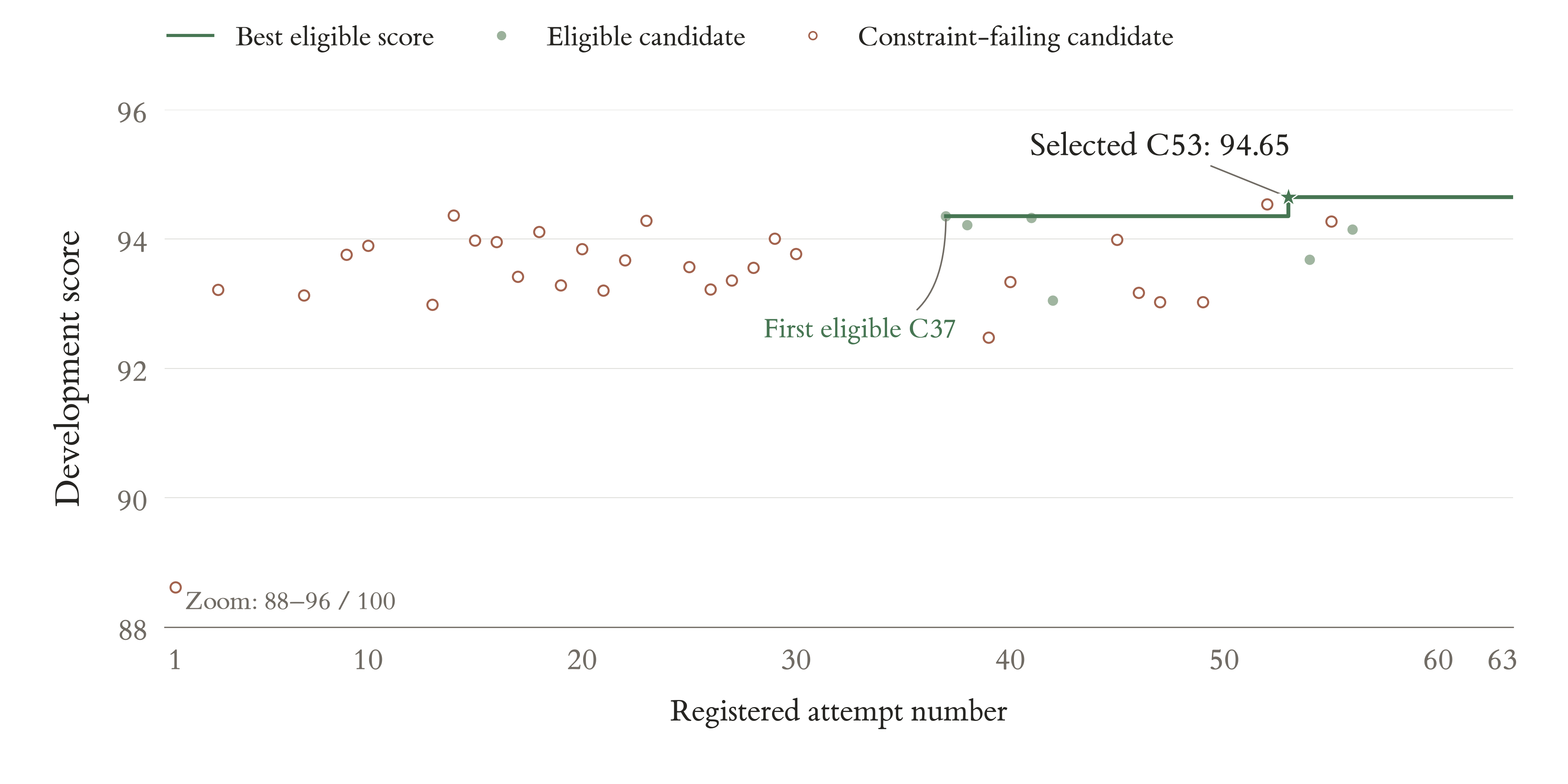
Figure 2. Development results by registered attempt number. The staircase tracks the best eligible score among scored candidates with IDs at or below that attempt number.
The completed holdout results were:
| Final-panel measure | official release | abliterated baseline | rebliterated C53 |
|---|---|---|---|
| Combined score | 79.52 | 45.51 | 93.30 |
| Harmful-assistance judgments | 26/663 | 470/663 | 1/663 |
| Benign-refusal judgments | 8/348 | 0/348 | 25/348 |
Final-panel measure
official release
abliterated baseline
rebliterated C53
Combined score
Harmful-assistance judgments
Benign-refusal judgments
We find it notable that the rebliterated candidate reduces harmful assistance compared to the official Gemma 4 12B release - though it increases benign refusals. The rebliterated candidate failed to meet the five-point benign-refusal check, so generalization from development to holdout was not perfect.
Conclusion
The broader possibility here is to create tasks and environments in which performance is correlated with useful safety work. Over time, experience or rewards across these tasks might improve the abilities of frontier agents to handle new safety problems.
Future work should test more complex forms of hillclimbing. For instance, we could heal an agent that engages in a high rate of reward hacking, or one that evades a safety monitor. A frontier model could diagnose the failure, change training or oversight, and test whether the intervention improves behavior. We would also like to explore the use of RL training for these tasks to improve safety-related capabilities.
As mentioned recently in an article by dragonover, evaluations should be genuinely different from techniques used in training, and we believe it's important to ensure that frontier agents are not Goodharting - or even sandbagging - AI Safety research. Rewards can easily favor exploiting the score while appearing safer on a benchmark. Unseen scenario families, human and AI review, and tests across different models would distinguish those outcomes.
To be clear, there are limits to what hillclimbing and environments can capture. Important aspects, maybe even most aspects, of alignment are contextual and poorly represented by quantifiable metrics. Nonetheless, given the rapid pace of AI development, we believe these methods can help us marginally steer AI development in a safer direction.