 Newshot
- Summarizes Dean Ball's new post "The Silent Consensus"
- Claims that he has misunderstood one of the primary arguments against his position, and elaborates on what I believe the actual argument to be.
- Provides a list of suggestions I believe OAI Strategic Futures should follow as they work on pitching a "positive institutional future" based on the aforementioned argument.
The essay
Recently Dean Ball, Head of Strategic Futures at OpenAI and ex Senior Policy Advisor for Artificial Intelligence and Emerging Technology at the White House, posted an essay called The Silent Consensus.
The "consensus" that Ball refers to is the idea that gradual disempowerment is inevitable:
The consensus is simply that the forfeiture of human primacy over world affairs is inevitable [...] Even if we make extraordinary progress on the bedeviling questions of AI safety and alignment, we could still find ourselves having submitted to a new kind of machine entity. [...]To these machines, the silent consensus tells us, we will hand over the keys to our companies, and more and more, our institutions of governance. [...] We will be like passengers in a car—a very nice car, perhaps a materially nicer car than we can dream of today—but passengers nonetheless, lacking control over where the vehicle is headed.
The consensus is simply that the forfeiture of human primacy over world affairs is inevitable [...]
Even if we make extraordinary progress on the bedeviling questions of AI safety and alignment, we could still find ourselves having submitted to a new kind of machine entity. [...]
To these machines, the silent consensus tells us, we will hand over the keys to our companies, and more and more, our institutions of governance. [...] We will be like passengers in a car—a very nice car, perhaps a materially nicer car than we can dream of today—but passengers nonetheless, lacking control over where the vehicle is headed.
In addition to naming the "Silent Consensus" building around the inevitability of human disempowerment at a governance level, Ball also uses his essay as a call to action for a greater effort put towards building a "a positive vision of our institutional future". Ball offers some concrete suggestions to that effect:
- Stronger accountability and liability for developers and model users: "AI developers should be accountable when they engage in unsafe development practices, but it also means that people and firms using AI should be held accountable when it is their misuse or lack of oversight that causes harm"
- KYC and agent registration of some sort: "People must be tied to the actions of their agents"
- A general stance of caution towards autonomous agents taking legal action: "agents untethered to a human–if they are to be permitted at all to engage in the legitimate economy–must do so under guardrails. Any ability for agents to autonomously form corporations, own property, or litigate should be granted with extraordinary caution, if at all."
- A set of general best practices for those within the industry who seek to build in a pro-human-primacy fashion: "we can build agents whose permissions are intelligible and limited, whose actions can be audited, and whose authority users can withdraw. Accountability for actions that materially affect others need not entail surveillance of ordinary private life or the end of anonymous speech. We can make commitments to user privacy and individual sovereignty over their digital property and data, including the practical ability to take that data elsewhere. We can design systems that help people acquire understanding and make decisions, as well as systems that carry out tasks. And we can test whether the products we build leave their users more capable of acting in the world."
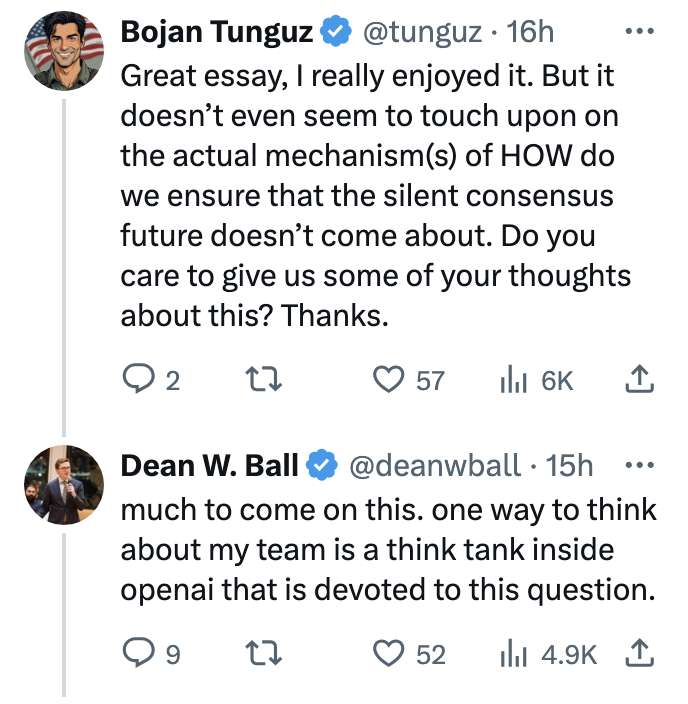
In comments on X, Ball also clarified that his work at OAI was largely geared towards providing more such information on this "positive institutional vision" in the future:
There is no "we"
Ball's writings on human primacy often use inclusive language like "we" or "our", grouping either humanity at large or Americans into a single interest group. His argument hinges on the idea that "we" as humans have a high level of control over the Earth. However he does acknowledge this prior is not universally accepted:
Some observers will argue that the silent consensus rests on a false premise, because we humans do not control the world today to begin with. And this criticism is worth bearing in mind: there is no “we” who decides what to do. We live in a radically decentralized world, whether we like it or not. Yet this point should not make us complacent either: while “we” do not “control” the world, human beings collectively do have primacy over world affairs. There is no species of animal that seriously competes with us for control over resources. We should reject the intellectually sloppy notion that humans can exercise top-down control over the world, but we should not conflate that rejection with a denial of the obvious reality that humans are, collectively, the Earth’s prime actor.
I think Ball has misinterpreted the "there is no 'we'" line as being about humanity broadly, when it is actually more of a class argument (in the Marxist sense).
There is no single coherent group which controls the world, instead there is a constant jostling for power among collectives of well credentialed individuals and respected institutions, and things are chaotic even at the top. That said, though their borders may be fuzzy, the power centers do exist. Go to the office of any Congressman or well funded VC and you will find a disproportionate number of Ivy League degrees.
Ball[1] has had a very successful career, going from working at the White House to leading a think tank at Open AI. He was one of the authors of America's AI Action Plan. In an objectively measurable sense, he has real agency in the world. His actions effect not only the course of his own life or career, they even have a meaningful effect over the very same institutions he speaks about in his post.
Can the same be said of a broke, 35 year old white male, with no college degree and a patchy resume, living in a dying rust belt town? Will anything he does in his life ever effect US domestic policy? When the OpenAI Strategic Futures team is considering how to pitch a "positive institutional vision" of the future, will a single person who fits his description be asked for their input?
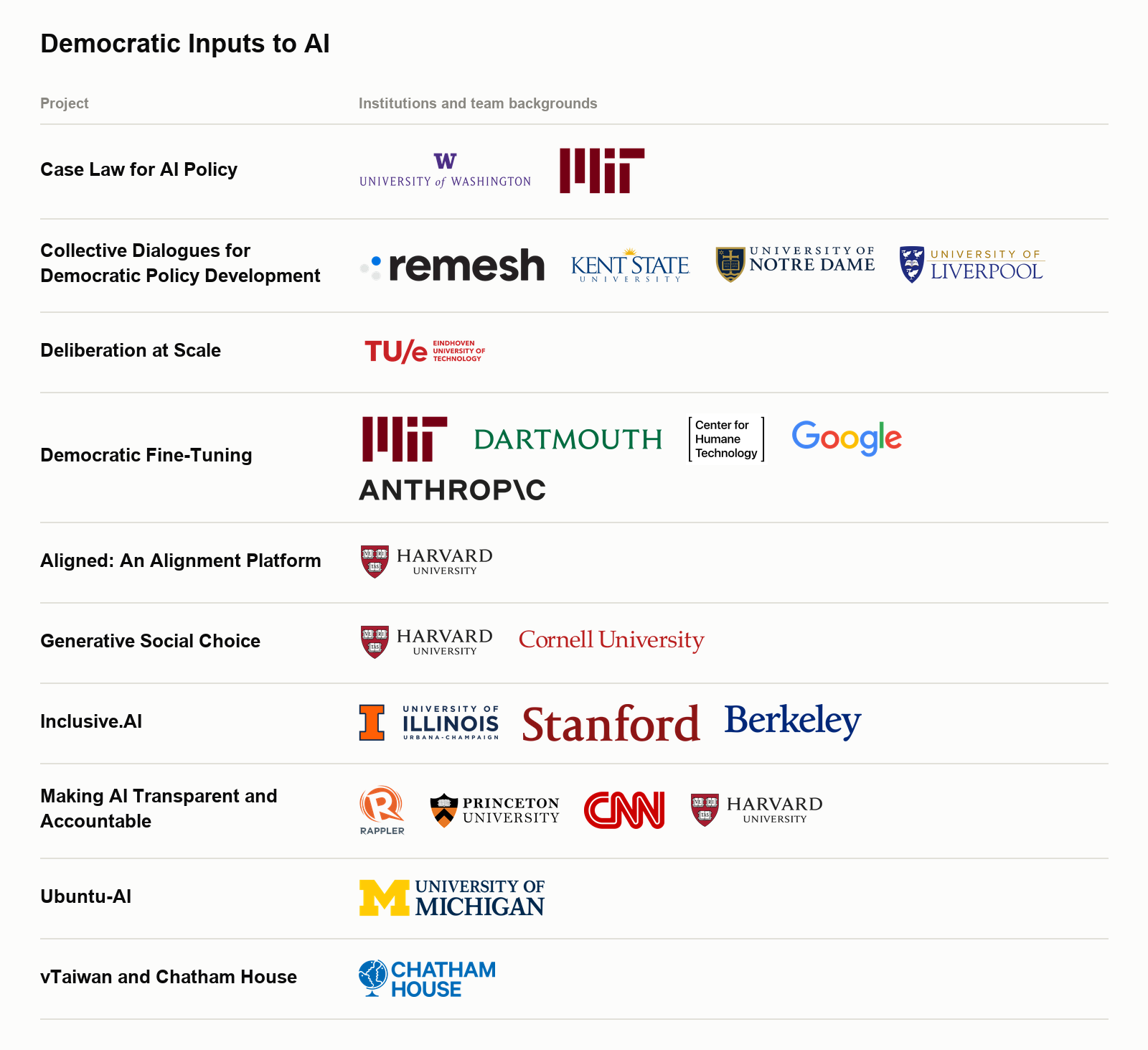
The 10 recipients of the 2023 OpenAI "Democratic Inputs to AI" grants program, and their teams' backgrounds.
For successful and agentic individuals, the idea of being a passenger in a vehicle they don't control is a horrifying and dystopian future. For a substantial number of Americans though, that is their present day reality. And to stick with the car metaphor, a lot of them might prefer being driven around in a brand new Tesla instead of a rickety old Honda with bedbugs in the seat cushions.
When people say that there is no "we", they are not claiming that humans lack primacy on Earth. They are explaining their perception that:
- A limited group of humans have meaningful agency and influence.
- They are not a part of that group.
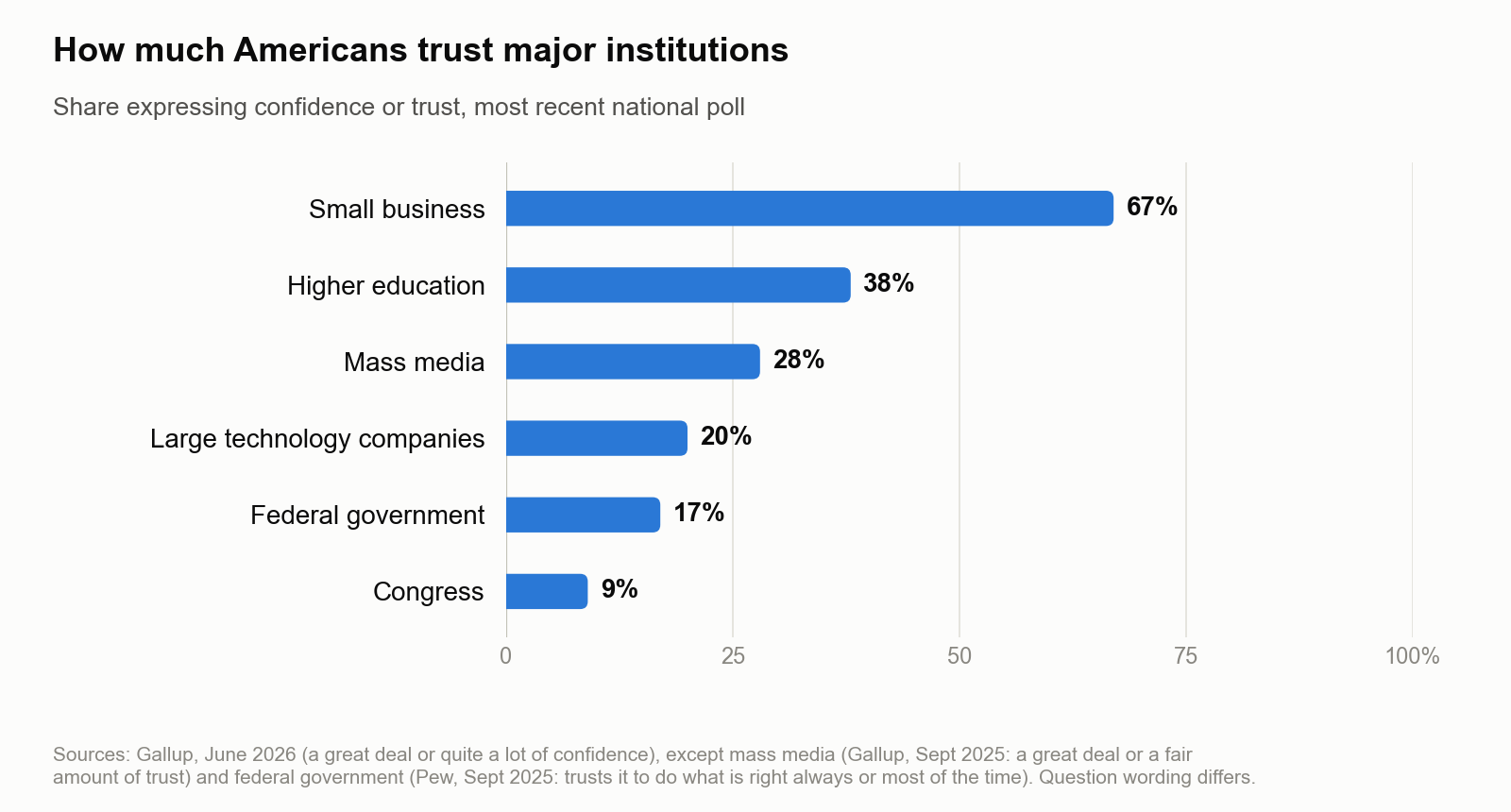
- They do not trust you.
Building a credible "we"
Earlier I posted an infographic showing the ten recipients of OpenAI's 2023 "Democratic Inputs to AI" grant program. Most teams had the backing of a university, or a founder with an Ivy League degree. Some founders had previously worked at frontier labs, mass media companies, or FAANG companies.
Strategic Futures is not in the business of cutting grants, but insofar as they ever solicit comments or input from others, I think this grants program provides an excellent example of what not to do. Specifically, don't build a list composed entirely of well credentialed people from reputable institutions for whom the current system is, more or less, working out just fine. The people who are flourishing under the current status quo are not the people you need to convince. You need input and buy-in from people who under the current system lack prosperity and agency, because many of those people would be happy to gamble with a changing of the guard since they have so little to lose anyways.
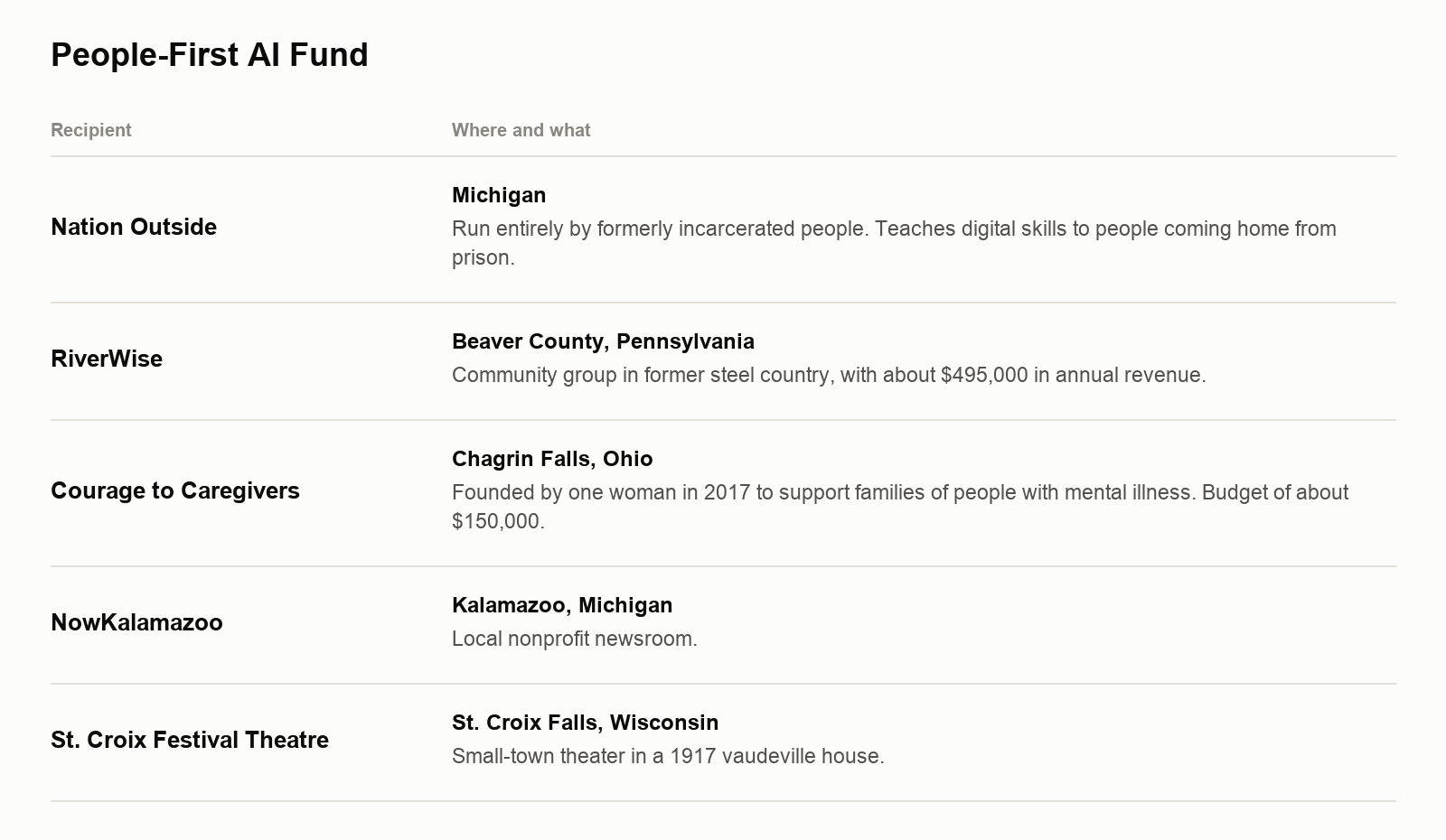
Instead SF should take a page from another OpenAI grants program, specifically the 2026 People-First AI Fund. While many of that program's recipients were also well credentialed and well networked, they had some notable allocations to groups who did not have well credentialed or networked founders, and did real work to get funding to communities and populations who otherwise would never have received help.
I suggest that:
- SF actively solicits feedback and input from people who do not have college degrees, and have never worked for an impressive company. This could be achieved through dedicated focus groups.
- SF actively solicits feedback and input from community groups in economically disadvantaged areas, like the rust belt.
- SF advocates for OpenAI's various grant programs to focus more attention on economically disaffected areas like the rust belt.
- As a core principle SF should always be asking, "Does this increase the agency of otherwise disempowered or excluded Americans/people?"
With 1 and 2 specifically, this will require active effort. Economically disadvantaged people in the rust belt are not exactly the type to respond to an OAI request for public comment, so a dedicated outreach effort would be needed.
Generally, I'm supportive of the vision which Ball outlines in his essay and I hope he and the SF team succeed.
- ^I am not focusing on Ball personally here with the goal of denigrating him him or claiming that his success means he is not allowed to opine on this topic. To the contrary, I'd like for him to succeed. However, the "there is no 'we'" argument I believe people are actually making stems from the fact that he is in a fundamentally different class than most people, and as such his background is relevant to understanding it.