 Newshot
Hands-On With the Mercedes-Benz New E-Class Infotainment: Response Speed Beats the New Forces, but It's Missing a Bit of "Mercedes Flavor"
2026-11-18 22:30
Over the past few years, Mercedes-Benz, a traditional luxury brand, hasn't made much noise in the field of intelligent technology. While the new carmaking forces iterate at high frequency around chips, large models, and smart cockpits, this century-old automaker often appears slow-paced due to longer R&D cycles and cumbersome validation.
Entering the second half of 2026, Mercedes-Benz has clearly accelerated its intelligent technology layout.
Relying on the software-hardware decoupled MB.OS architecture, Mercedes-Benz recently launched two major updates. The first is a new AI smart cockpit developed independently for the Chinese market, and the second is a navigation-assisted driving system powered by the Momenta R7 world model that supports "parking space to parking space."
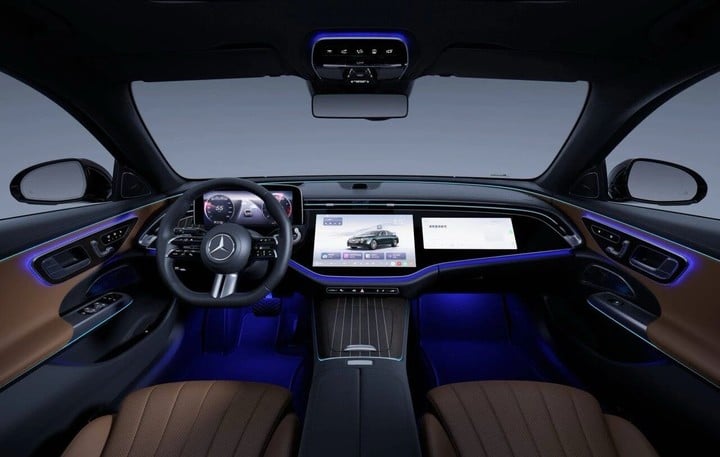
The two systems have different rollout priorities: the new cockpit debuts first on the long-wheelbase E-Class, while the latest R7 assisted driving system lands first on the all-electric GLC and all-electric CLA, and will subsequently cover 9 core models including the new long-wheelbase GLE and the new-generation Maybach S-Class.
Mercedes-Benz officially summarizes this round of intelligent upgrades as "assisted driving and smart cockpit aligned with industry-leading standards," but after experiencing it, Dongchehui found that whether in the polishing of software interface details or the commuting efficiency of assisted driving, this system still leaves considerable room for improvement.
But if compared vertically with Mercedes-Benz's past products, this is undoubtedly a huge leap.
A Usable New Infotainment That Dilutes the Traditional "Mercedes Flavor"
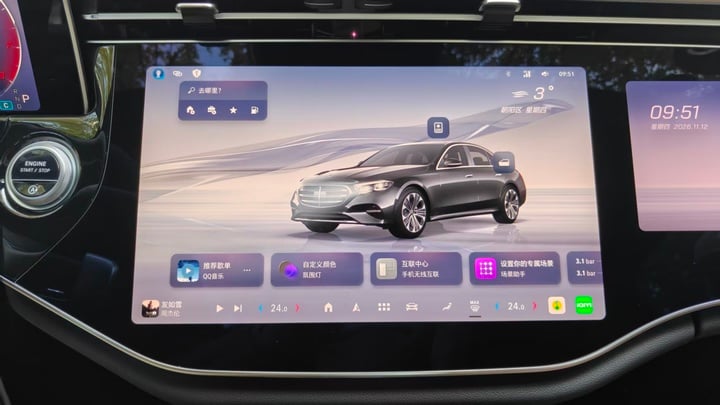
From Dongchehui's actual experience, Mercedes-Benz's "AI smart cockpit system," independently developed by a Chinese R&D team, is almost flawless in fluency and functional completeness, and even has certain advantages in some areas.
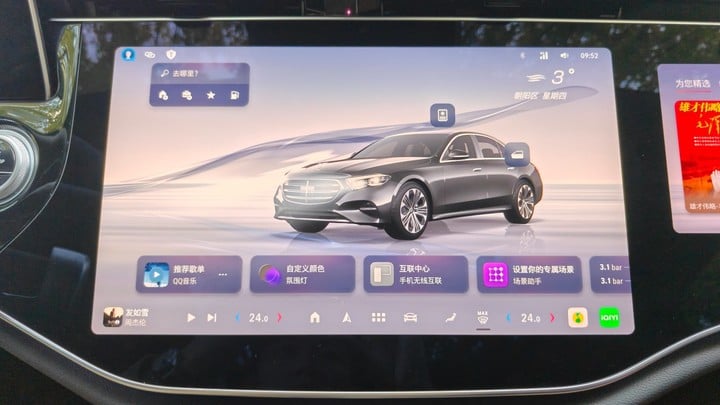
The most prominent aspect is its response speed.
This infotainment's speed is something you can feel without consulting a spec sheet. Whether it's the system interface or the navigation map, the screen refresh rate reaches 60 frames per second. Mercedes-Benz officially also provided a set of more intuitive performance data:
- Medium-distance route planning takes only 1.2 seconds;
- APP cold start time reduced to 1.1 seconds;
- Voice vehicle control response time 0.8 seconds;
- Multi-sound-zone recognition accuracy 98%.
Naturally, we wouldn't test these data points one by one during a test drive, but from an intuitive feel, Mercedes-Benz's claims this time are not false. The lag and delay commonly found in overseas brands' infotainment systems in the past have completely disappeared on this system.
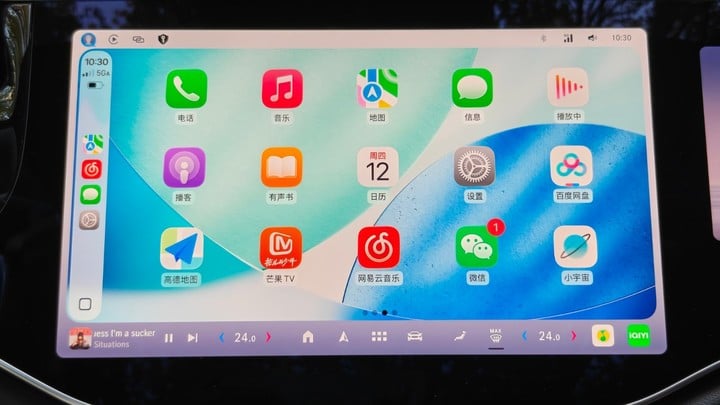
To adapt to Chinese users' daily usage habits, Mercedes-Benz reorganized the menu hierarchy, and the functional classification is much more reasonable than the previous MB.OS. At the same time, the new infotainment's local app ecosystem has been filled out—common apps are basically all there, and it supports one-tap connectivity with Apple CarPlay and Huawei HiCar.
Beyond basic fluency and app ecosystem, the biggest change in this cockpit lies in its introduction of fairly rich scenario-based and agent functions.
First is the new Scenario Assistant. In this infotainment, Mercedes-Benz breaks down the cockpit's software and hardware functions into independent "atomic capabilities." Users can freely combine 11 types of trigger conditions and 15 types of execution actions to customize scenario-based functions for their own needs, with an experience similar to Li Auto's Task Master.
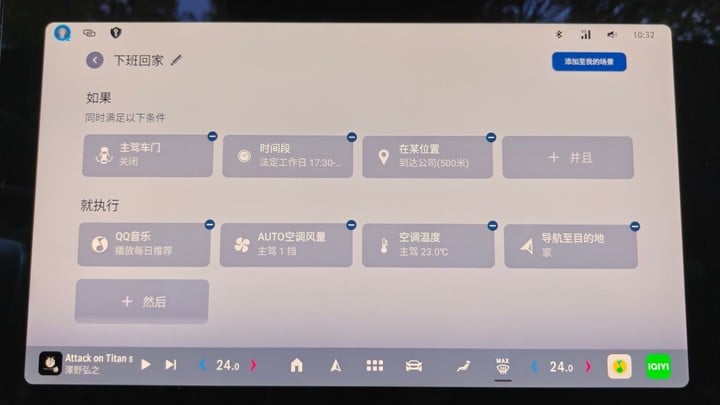
Of course, considering that the E-Class's target users may not be very good at tinkering with these things, Mercedes-Benz has also prepared some preset solutions for them.
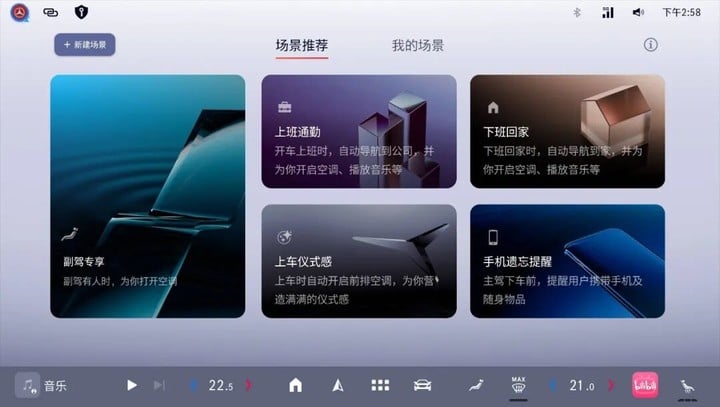
Second is the new infotainment's AI capabilities. A so-called AI smart cockpit naturally needs some "AI" aspects.
This time, Mercedes-Benz upgraded its in-car navigation with an AI travel assistant, supporting automatic congestion avoidance, multi-destination route planning, and fuzzy intent recognition, and it is also the first to integrate Amap's Saostreet ranking.
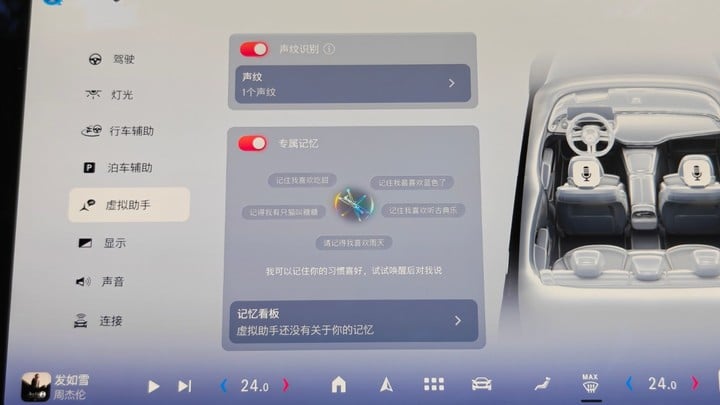
The voice virtual assistant has added voiceprint recognition and a memory dashboard, capable of remembering different drivers' voice characteristics and personal preferences, such as temperature, seat position, and even your dining tastes.
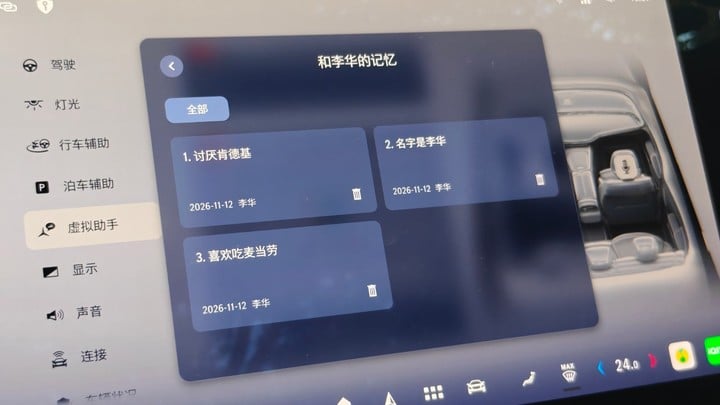
After integrating with offline local life services, Mercedes-Benz's virtual assistant indeed has a bit of a "personal assistant" feel. You only need to issue one command, and it can simultaneously orchestrate multiple cockpit functions, or recommend restaurants that suit your taste.
Mercedes-Benz stated that around January next year, this system will also receive an OTA upgrade to integrate version 2.0 of the Doubao AI large model.
However, after the infotainment interaction fully aligns with mainstream domestic solutions, the problem of homogenization also emerges.
To preserve its original brand characteristics, Mercedes-Benz's design team actually made some attempts, such as making the central car model more refined, adding a frosted-texture shortcut bar to the interface, and supplementing it with silk-like flowing light and shadow animations—the overall look of the interface is still quite exquisite.
The most pleasing part is the air conditioning and seat adjustment interface, where Mercedes-Benz specially recreated the crystal texture from the past MB.OS—it's unmistakably "Mercedes" at a glance.
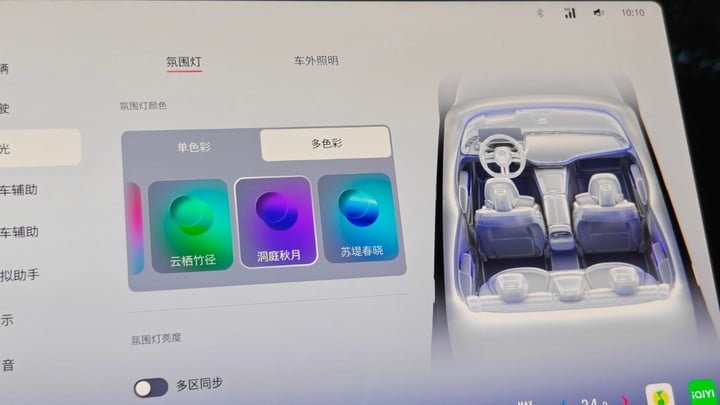
However, visual embellishments still can hardly conceal this infotainment's "new force traces." The luxury feel that Mercedes-Benz previously created through physical buttons and its exclusive MB.OS interface has been diluted considerably within this generic interaction framework.
How to continue strengthening brand recognition in UI and UX while ensuring ease of use is a topic Mercedes-Benz needs to explore next.
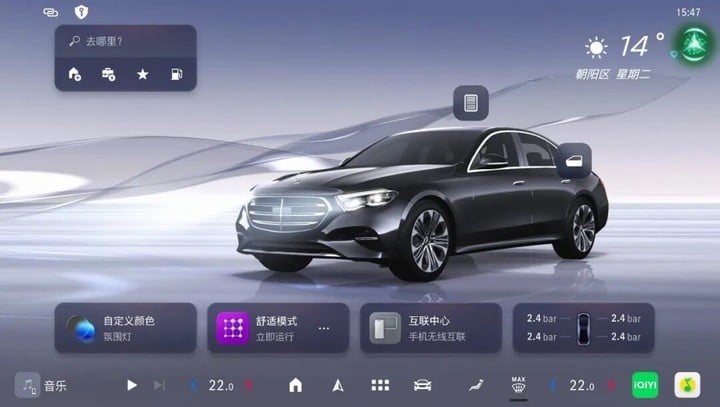
Furthermore, placing a 3D car model in the center of the screen was already the answer for the previous generation of domestic infotainment systems; independent brands have long shifted to map desktops or function cards that emphasize efficiency more.
Mercedes-Benz now puts great effort into polishing the car model to be sufficiently refined, but it still feels a step behind.
The R7 World Model Delivers a Unique "Human-Vehicle Co-Driving"
Intelligence isn't just about the cockpit; its other end is assisted driving.
In the first half of this year, Mercedes-Benz introduced the Momenta R6 flywheel large model based on reinforcement learning, enabling urban and highway navigation that "can be driven nationwide." By the second half of the year, Mercedes-Benz brought Momenta's R7 world model onto the all-new all-electric GLC.
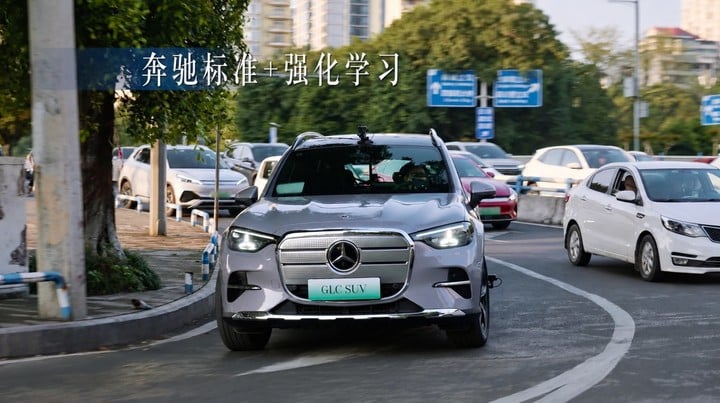
According to official data, this model was trained on 17 billion kilometers of real vehicle mileage and distilled over 168 million segments of golden data for iteration. In terms of underlying architecture, it first masters physical laws through pre-training on massive real data, then uses the world model for closed-loop simulation and reinforcement learning to enhance the system's ability to handle complex long-tail scenarios.
In terms of specific functions, this upgrade brings quite a few new changes.
First is the parking phase, which now supports cross-floor memory parking with a maximum memory distance of 3 kilometers. Second, for urban road commuting, the system adds a roaming cruise assist that can achieve autonomous following, lane changing, and traffic light recognition even without navigation enabled.
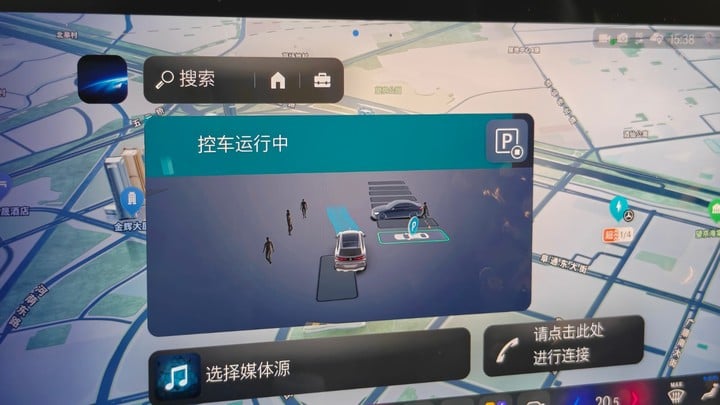
More importantly, with this system, Mercedes-Benz has become the first luxury brand among Momenta's partners to support "parking space to parking space." Whether parked on the roadside or in a parking space, you can start assisted driving with one tap as soon as you shift into D.
From Dongchehui's actual experience, after switching to the R7 world model, the maturity of this system has indeed risen by a notch compared to before, with the takeover frequency on urban roads significantly reduced—under most road conditions, no manual intervention is needed.
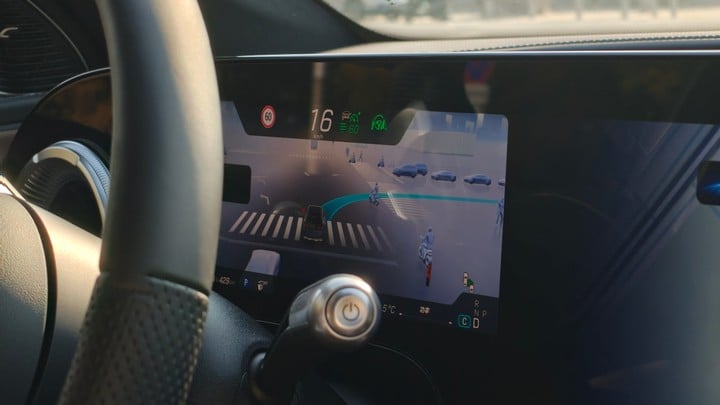
But behind the low takeover rate, this system also exposes a fairly obvious shortcoming—low commuting efficiency.
To ensure driving safety, Mercedes-Benz set a double "safety margin" in the underlying calibration. On one hand, it focuses on guarding against pedestrians and non-motorized vehicles, adopting defensive driving at blind-spot intersections; on the other hand, it significantly reduces unnecessary braking, successfully optimizing the hard-braking feel by 2 times.
This strategy, which highly values smoothness and peace of mind, has pros and cons on actual roads. The good side is that passengers in the car feel very steady; the bad side is that during the starting phase, when passing complex intersections, or when needing to borrow a lane to detour, the system behaves overly cautious.
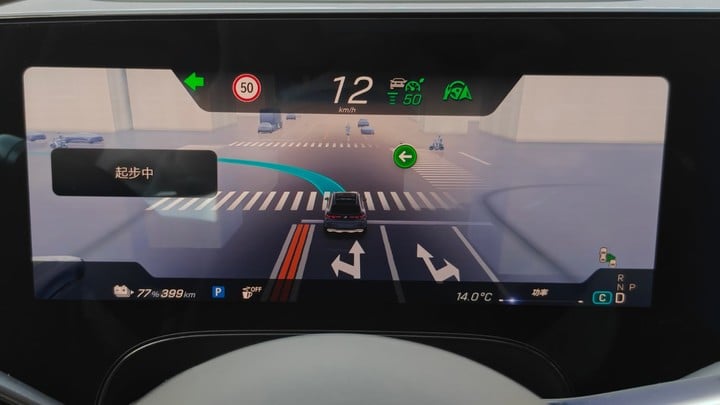
Another point worth discussing is the tiering of driving modes.
Mercedes-Benz has set three modes for this assisted driving system: "Steady," "Standard," and "Agile." In Steady mode, its current leisurely pace fits the positioning very well; however, after switching to Agile mode, the vehicle's lane-changing and detouring strategies are still not aggressive enough.
In real-world driving, these three modes felt more like "very slow," "quite slow," and "slow." That defeats the purpose of having switchable modes.
Traditional Mercedes-Benz customers may be older and more composed, with lower acceptance of aggressive assisted driving. But the all-electric GLC and all-electric CLA that are first to carry this system are aimed precisely at a relatively younger user group that values commuting efficiency more.
If Mercedes-Benz could use the three modes to genuinely differentiate how aggressive assisted driving is, so that different users can find a comfortable way to use it, that would clearly be more reasonable.
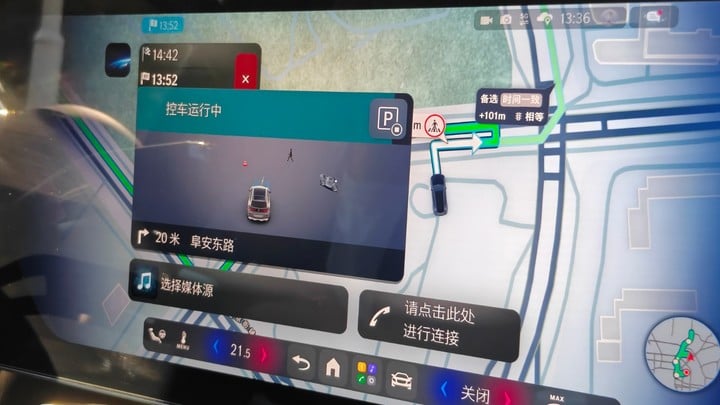
In addition, Dongchehui found that Mercedes-Benz still has room to optimize the interaction for assisted driving.
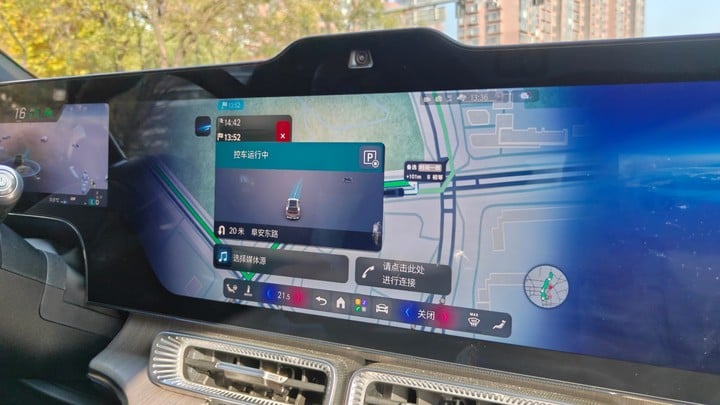
In the current version, the central screen layout is exactly the same whether assisted driving is on or off. But in actual driving, the functions the driver needs in the two situations are not entirely the same. For example, while assisted driving is active, you may need to adjust whether the driving mode is aggressive or conservative, change the speed-limit percentage, or set whether to use ETC at toll booths.
In the current Mercedes-Benz infotainment system, adjusting these options requires going into deeper menus, which is not particularly convenient. By comparison, some domestic new automakers do this better: after assisted driving is activated, they put the relevant functions directly on the main interface so users can adjust them at any time.
All these shortcomings mentioned above are not meant to belittle it. Although many joint-venture brands now use Momenta's solution, Mercedes-Benz has still created a differentiating point that people will remember.
In the face of homogenized competition, BMW chose to differentiate through brake interaction, while Mercedes-Benz chose "human-machine co-driving." Their assisted driving system is the industry's first to support human-machine co-driving across the full 0-130km/h speed range.
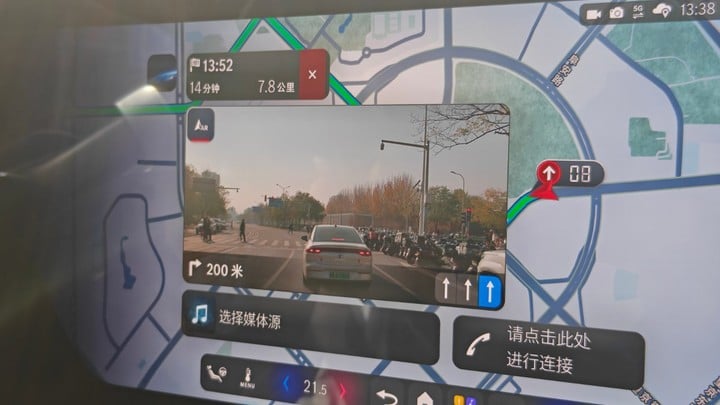
Mercedes-Benz sets the steering wheel's activation torque very low; during assisted driving, the driver can easily turn the steering wheel at any time to control direction. The system does not abruptly disengage; instead, it continuously monitors hand-applied torque and recovers within milliseconds after the driver lets go.
From Dongchehui's experience, this is the best-executed and most seamless human-machine co-driving among all brands currently.
This is not to say its assisted driving capability is poor and therefore requires human-machine co-driving. Mercedes-Benz's choice and approach ultimately represent respect for the driver, and this is the core value of the entire system.