 Newshot
[LW Meta: this post is essentially (a) brief intro to section 3 (b) a meta-summary of Kaj's post Book Summary: Consciousness and the Brain ]
3.0 Now let's talk about higher-level things than physics!
3.0.1 I'm going to write about a seemingly random collection of things in the biological and social worlds, connected by three themes:
- 3.0.1.1 Amplification. Things which amplify information, copying something small and local to a larger scale. Biological reproduction, networks in the brain, and interpersonal attention are some examples.
- 3.0.1.2 History. Amplification events are conditioned on past events, producing a chain. This is history; it enables iterative optimization. As history progresses, equilibrium is approached: it becomes harder and harder for a localized change to propagate to global scale.
- 3.0.1.3 Ambiguity. Things can be interpreted in many ways. A teacup can be used for drinking, but it also might strike you as artistic inspiration, or remind you of days gone by. People, organisms, ideas have an intrinsic dependence on the context in which they arise and exist.
3.0.2 As you might guess, I ultimately want to analogize these things to the phenomena in physics from the last section. Just to clear up any confusion, I'm not claiming that social networks use quantum entanglement to function or something like that. It's more of a structural analogy. I'll get more into this in section 4.
3.1 Amplification in the Brain
3.1.0.1 What is consciousness and how does it relate to the brain? This question has baffled philosophers for centuries. Tabling the philosophical questions about what consciousness even is, though, neuroscience has actually made a lot of progress on a more well-defined question: what's the difference between the processing in the brain of which people are aware, and that which they are not aware of?
3.1.0.2 The material in this section is shamelessly stolen from Kaj Sotala's excellent post Book Summary: Consciousness and the Brain. The rest of his Multiagent Models of Mind sequence is excellent too.
3.1.1 Conscious and Unconscious Processing
3.1.1.1 It's clear that people aren't conscious of almost all of the processing that's going on in their brain. The brain contains ~10^11 neurons and ~10^15 synapses. Each neuron fires about once per second. Obviously we aren't aware of almost any of this. On the other hand, we do have awareness of some things, such as the content of our visual fields.
3.1.1.2 Wait, how do we even define aware? Let's say that people are consciously aware of things that they can verbally report.
3.1.1.3 So what determines the difference between things people are aware of and things they aren't? Neuroscientists have carried out a series of ingenious experiments to determine the boundary between these things.
3.1.1.4 The basic idea is as follows. If you very rapidly turn certain stimuli on and then off, people aren't able to notice that they were there at all. However, you can determine that some part of their brain processed the stimulus, because their performance on tasks related to the stimulus improves.
3.1.1.5 One basic paradigm in these experiments is visual masking. A subject is told to look at a screen on which various geometric shapes are shown[1]. For a very brief interval, the shapes are replaced with some sort of meaningful stimulus such as the word "radio". By controlling the interval for which the stimulus is shown, researchers can control how often subjects report seeing it. If the word is shown for 40ms, nobody sees it; at 50ms, about half can see it.
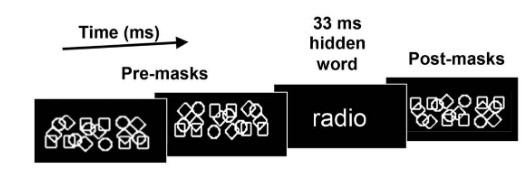
Figure: A masking experiment. Subjects are shown a screen containing a rapid series of random geometric shapes. A meaningful stimulus such as a word is briefly flashed on the screen. From here.
3.1.1.6 Priming experiments show that the subject's brain has nevertheless processed the word, even if they aren't consciously aware of it. The idea is to give subjects a task to complete about 1 second after the word is shown. For instance, after the word "radio" is flashed, subjects might be shown the word "house" and asked to classify it as either a living thing or an object. If the word the subjects are shown is the same as the flashed "priming" word, they are quicker to classify it.
3.1.1.7 Unconscious processing goes beyond mere visual similarity. For instance, the uppercase "RADIO" helps to speed up processing lowercase "radio", although they have very different visual appearances. And contrarily, "ANGER" does not speed up "RANGE", although they have the same letters, suggesting that the meaning of the words is important for the unconscious processing. Quite complex processing can happen without awareness: for instance, chess masters shown a chess position can more quickly classify the position as a check if they are primed with the same position.
3.1.1.8 Besides speeding up conscious decisions, unconscious information can also be used to guide decisions directly, and for learning. In one experiment subjects were tasked with pressing or not pressing a button after being shown a signal (the signal giving no information about which choice was correct). Choosing correctly earned them money. The signals were preceded by briefly-flashed masked shapes which indicated whether pressing or not pressing was the correct response. Although the shapes were shown too briefly to register in consciousness, subjects learned to choose correctly at a better-than-chance rate.
- 3.1.1.8.1 Kaj's post has many more examples demonstrating unconscious processing in masking experiments.
3.1.1.9 So unconscious processing can do a lot. Besides verbal report, what does conscious processing add?
- 3.1.1.9.1 Memory. Things which reach consciousness can be recalled later when needed. Memory also enables learning relationships between things which are separated by more than a few seconds.
- 3.1.1.9.2 Sequential chained operations. Consciousness enables chaining together cognitive operations sequentially. In experiments testing people's ability to do arithmetic unconsciously, it was found that one-step operations such as adding 2 to a single-digit number, or determining if a digit was less than 5, could be done successfully about half the time even if subjects were not conscious of seeing the digit. However, multi-step operations such as adding 2 to a number then determining if it was smaller than 5, were performed no better than chance unconsciously.
- 3.1.1.9.3 Conscious decisions are usually far more accurate and reliable than unconscious ones, even if the latter are better than chance.
3.1.1.10 One other set of experiments people ran concerned the rivalrous nature of consciousness; in other words, consciousness can only strongly focus on one thing at a time. People are shown a series of digits into which 2 letters are inserted. They're told to remember the letters; if the letters are shown too quickly after each other, they may not even notice that the second letter was present. Focusing on the first letter prevents the second from entering consciousness.
- 3.1.1.10.1 This famous video, which tasks viewers with counting the number of times a baseball was passed, is another good example.
3.1.1.11 So that's a brief overview of some experimental evidence we have regarding conscious and unconscious processing. Given this, what can we say about how they are implemented in the brain?
3.1.2 The Global Neuronal Workspace
3.1.2.1 People have run variants of the masking experiments above where they (a) hook up the subjects to an apparatus for measuring brain activity, such as an MRI, EEG, or MEG, and (b) intentionally vary the length of the stimuli presented so that some of the stimuli reach consciousness. Then researchers try to identify differences in brain activity between conscious and unconscious perception.
3.1.2.2 The basic result people have found is that consciousness of a stimulus happens when the neural signal associated with the stimulus exceeds a threshold and is amplified and spreads to distant regions of the brain, whereas unconscious stimuli's signals remain localized to a particular part of the brain and fade away.
3.1.2.3 How does this amplification take place? There are various long-range interconnections between different regions of the cortex. These interconnections feed back on each other, and when a given signal becomes strong enough it can kick off a self-reinforcing loop that eventually synchronizes a large part of the brain on processing the given signal.
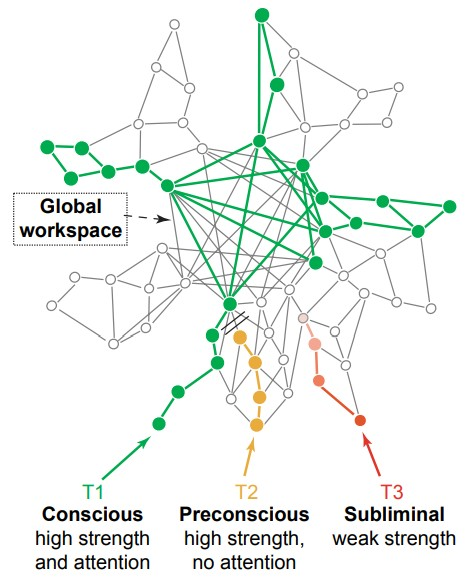
Figure: The global neuronal workspace. The strength of an incoming signal determines if it is strong enough to propagate to the self-reinforcing loops of the GNW. From here.
3.1.2.4 This is called the "global neuronal workspace". Aside from the cortex, the GNW also connects to the basal ganglia, thalamus, hippocampus, and other parts of the brain. The GNW theory of consciousness posits that the contents of consciousness are precisely the things that the GNW is processing in a given moment.
3.1.2.5 The GNW explains various features of consciousness:
- 3.1.2.5.1 Consciousness is binary: you either see a signal or you don't. This is because of the threshold effect: either a signal is strong enough to set off a cascade in the GNW, or it isn't.
- 3.1.2.5.2 Consciousness is rivalrous. If a given stimulus has already begun propagating in the GNW, this makes it more difficult for a new signal to recruit neurons to amplify it.
- 3.1.2.5.3 Consciousness enables memory and verbal report, by connecting incoming stimuli to parts of the brain responsible for speech (parts of the cortex) and long-term memory (the hippocampus).
3.1.2.6 So what's the biological function of consciousness? There are probably a few. Here are some speculations.
- 3.1.2.6.1 The brain is highly parallel because parallelism is more energy-efficient and easier to scale. However, parallelism has certain drawbacks.
- 3.1.2.6.2 Firstly, different brain regions need to talk to each other, to exchange information. The GNW facilitates this, although there are other pathways in the brain that do as well.
- 3.1.2.6.3 For the purposes of planning and motor output, the brain needs to decide on a single, coherent plan. Thus there needs to be some mechanism for getting regions of the brain to agree and sync up on the current global plan. The winner-takes-all dynamics of the GNW can do this.
- 3.1.2.6.4 When planning and acting, you need to prioritize, decide what to do next. Sometimes this might take the form of needing to suddenly switch your attention to something important, e.g. responding to a sudden loud noise behind you in the woods at night. But there's also a constant need to decide e.g. what step of a plan to carry out next, what word to use next when writing, where to look when searching for something. The GNW helps with this by implementing a sort of "attentional Darwinism" where a vast number of hypotheses can be implicitly searched over, with the winning ideas gaining support and being promoted to the GNW.
- ^The purpose of the shapes is to prevent subjects from noticing a small flicker when the word appears, as might happen if the screen was black.