 Newshot
Article title: Microsoft's global outage: why is AI once again the scapegoat?
Microsoft's global outage: why is AI once again the scapegoat?
2026-11-17 10:23
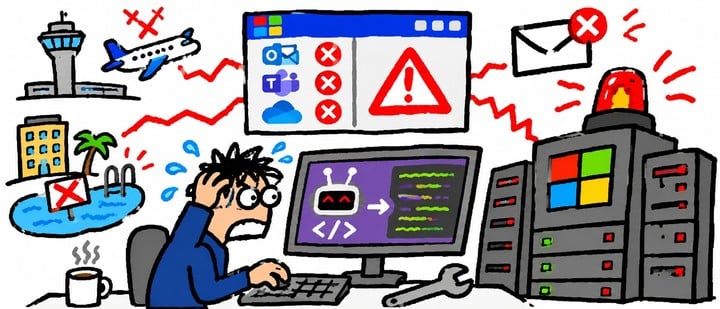
At a hotel in Germany, chlorine levels in the pool exceeded limits, injuring 15 guests. And the alert email that could have warned staff members failed to arrive in time because Outlook was down.
On November 13, at the Ling Bao hotel inside Germany's Phantasialand park, the pool's automatic chlorination equipment malfunctioned. The safety system detected the problem, but because of a Microsoft 365 service failure, it was unable to deliver the email alert to staff members in time.
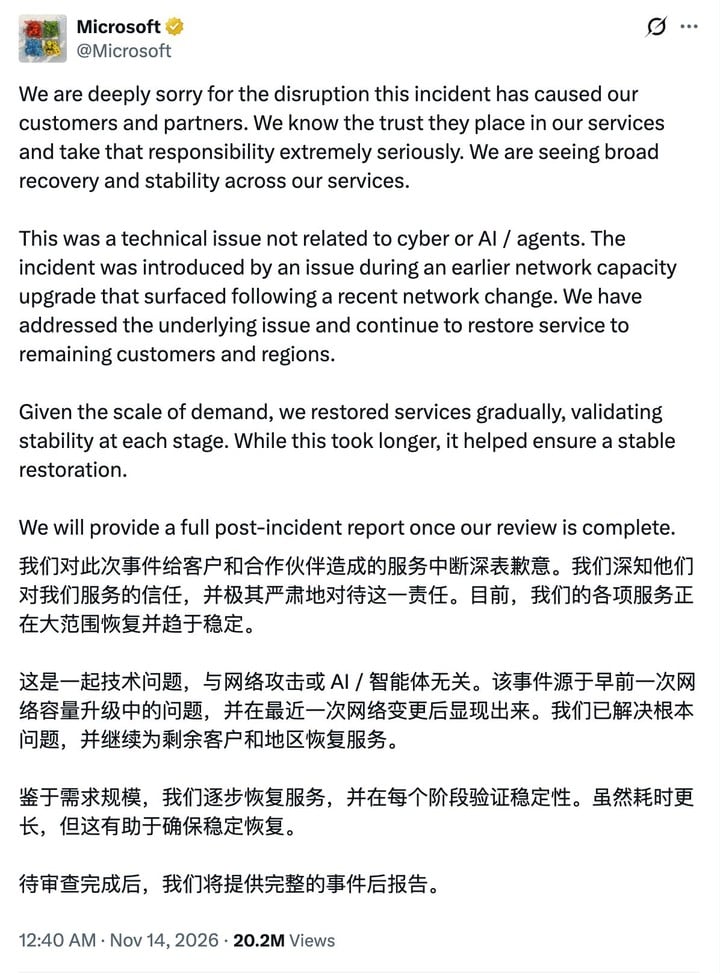
Starting on November 12, multiple Microsoft services including Outlook and Teams experienced successive failures, with the impact lasting into the next day.
At almost the same time, the U.S. FAA implemented a nationwide ground stop due to a communications system anomaly, and a Workday backup test also paralyzed some companies' HR systems.
These incidents each had their own causes, yet they made people realize once again that the digital systems we rely on every day are far less reliable than we imagine.
However, after the incidents, the first thing that sparked argument on social media was AI.
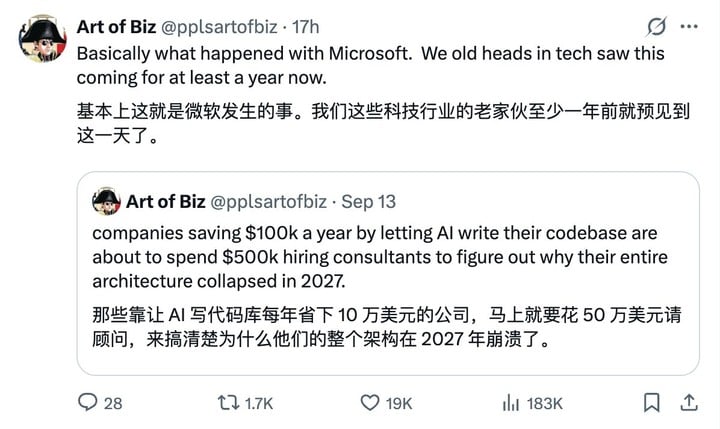
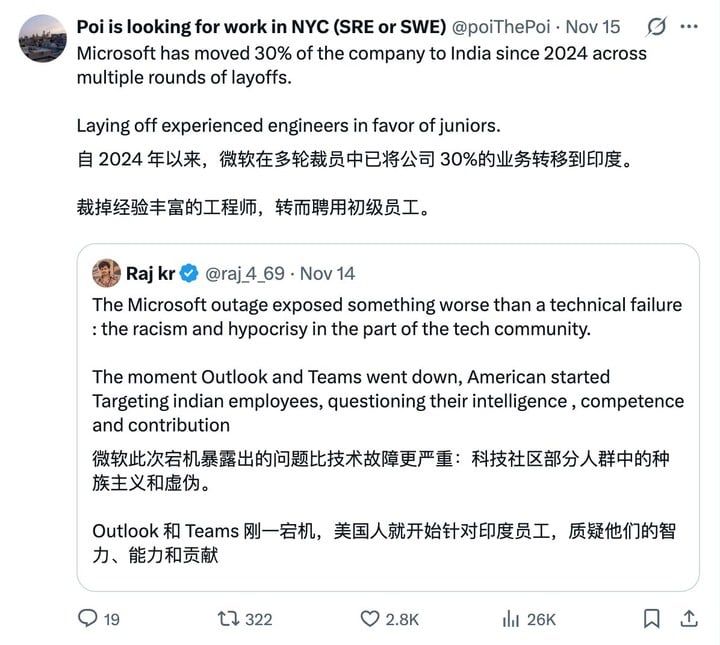
Some argue that AI is writing more and more code that no one can understand; others point the finger at tech companies' continued layoffs, arguing that engineering teams are losing the ability to solve complex problems.
Microsoft has clearly stated that this failure had nothing to do with AI or Agents.
But the debate did not end there. Because as AI can write code faster and faster, a new question arises: when this code really goes wrong, how many people still know how to fix it?
"The Microsoft incident confirms my long-standing view of AI"
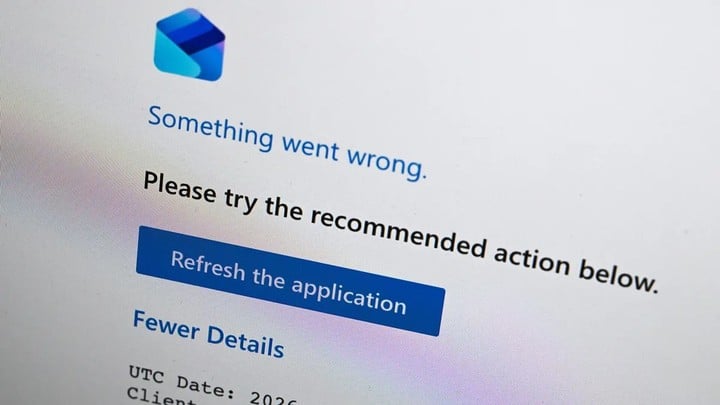
On November 12, multiple Microsoft 365 services experienced connectivity failures, with Exchange Online, Outlook, Teams, and Microsoft 365 Copilot affected to varying degrees.
In its incident report, Microsoft mentioned that a network change exposed a problem left over from an earlier capacity upgrade, causing some servers to be unable to properly handle connection requests. As requests continued to pile up, the failure spread further.
Microsoft also explicitly ruled out cyberattacks, AI, and Agents as causes of the incident. But on social media, a debate around AI programming had already begun.

After all, AI is a convenient enough explanation: it carries the public's suspicion of big tech companies and also responds to engineers' anxiety about layoffs and job changes. Blaming the incident on AI is much easier than understanding network changes, connection queues, router behavior, and backup tests.
Two days after the failure, a hot post appeared on Reddit's r/developersIndia. The poster claimed to be a senior full-stack engineer who had built large projects from scratch at multiple companies in the United States, Europe, and South Korea.
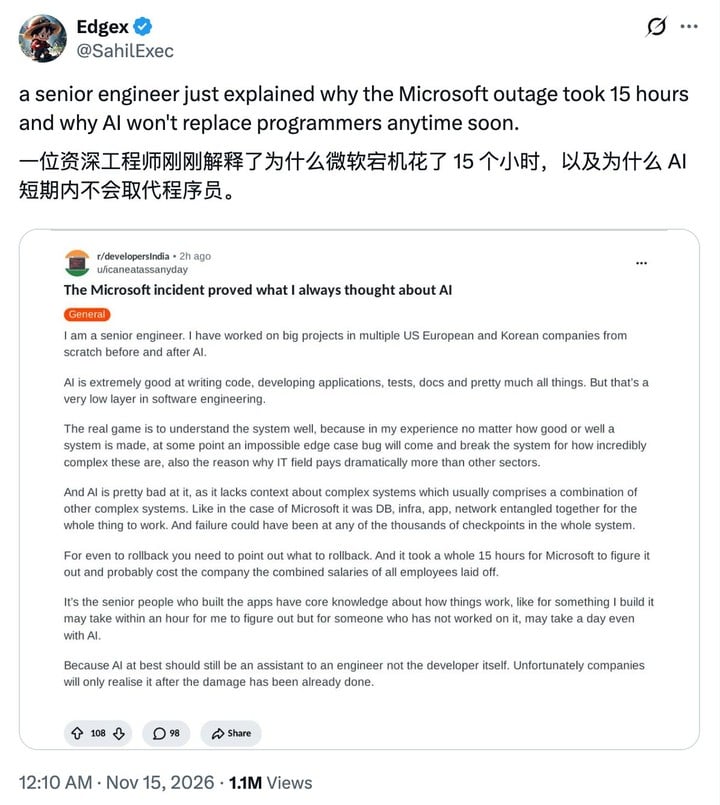
In his view, AI is indeed very good at writing code, tests, and documentation, but these are only relatively basic tasks in software engineering. What is truly difficult is understanding a complex system made up of databases, applications, networks, and infrastructure together.
A system that has run for years may have accumulated countless internal dependencies. Even if everything is normal most of the time, it may crash during some upgrade or under extreme conditions because of an unexpected edge case.
When something goes wrong, engineers first need to know where the problem is. "Even to roll back, you first have to know what to roll back." he wrote.
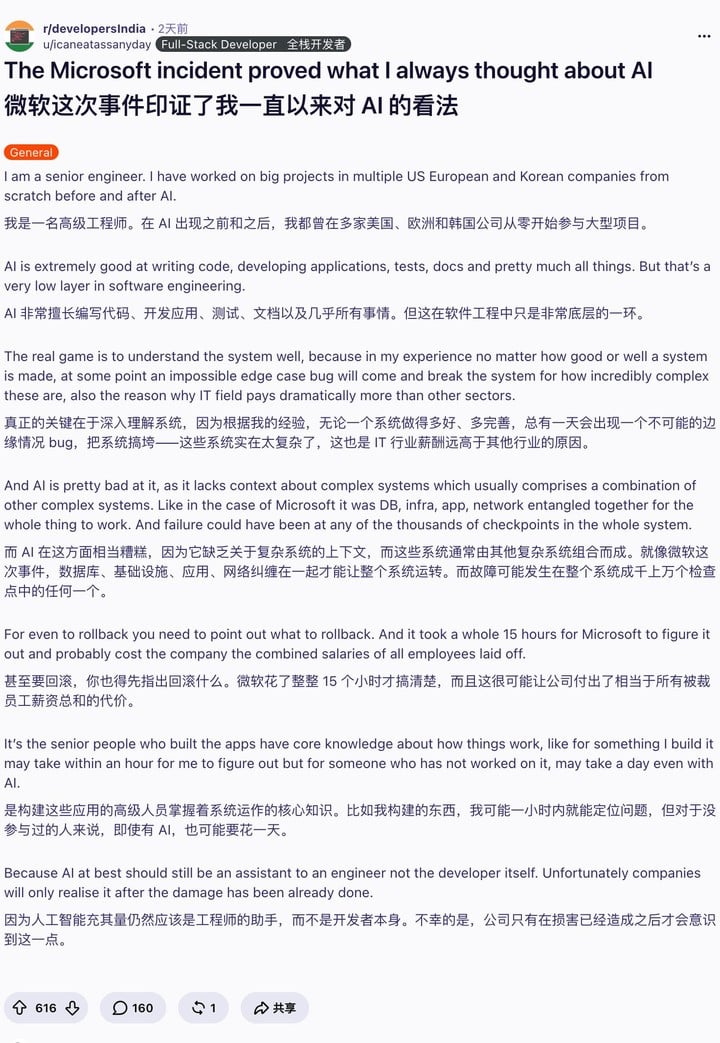
This view resonated with many engineers. In the past, engineers gradually came to understand the relationships between different modules through writing code, handling bugs, and maintaining systems. Which features depend on each other, what is affected when one place is changed, and where to investigate first when something goes wrong—this experience was often accumulated bit by bit in daily development.
Now, AI can generate large amounts of code in a very short time, but the engineers who use this code may not have gone through the process of understanding and building it.
The speed of code production has gone up, but teams' understanding of the system may not keep pace.
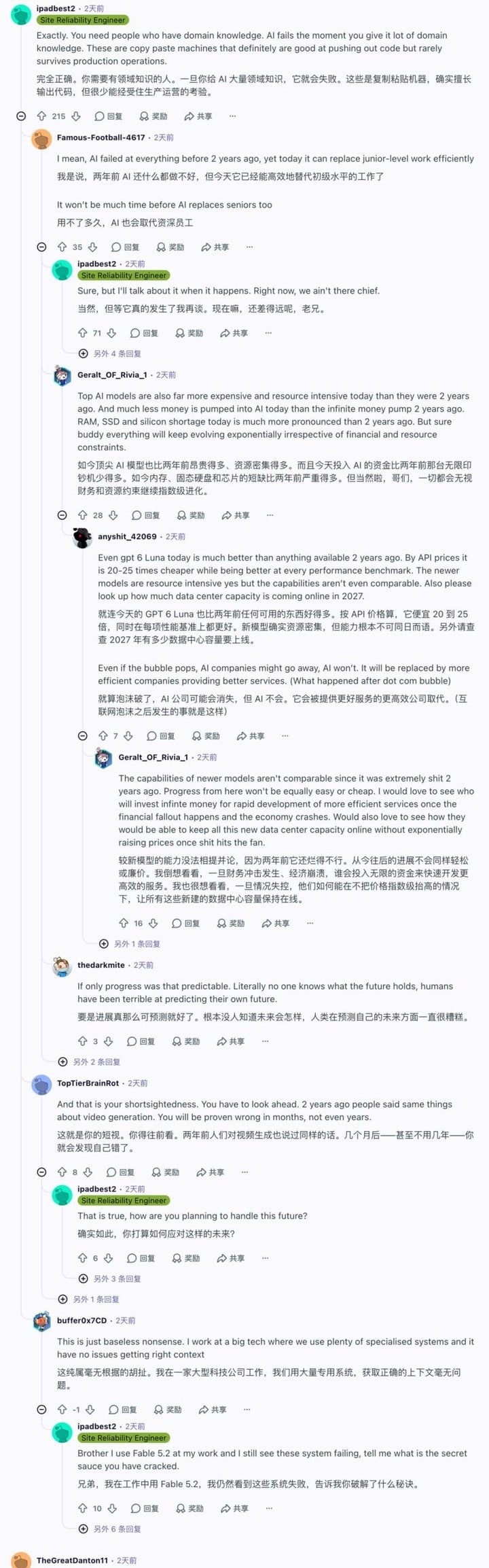
One netizen who claimed to be a site reliability engineer (SRE) argued that handling complex systems requires deep domain knowledge, and AI is currently still hard-pressed to take on such work independently.
More interestingly, another developer shared his experience in a real project. He was in charge of a project that needed to handle complex concurrency problems. AI wrote a piece of core code that he himself might not have been able to write, and he tried to understand it but never fully could.
But because the code passed the existing validation, he ultimately decided to merge it into the project.
When AI starts generating code that engineers themselves do not fully understand, who judges whether it has missed edge cases? And when the system really fails, who should bear the responsibility for maintenance?
Of course, there were also many opposing views. Large systems also went down before generative AI appeared. Merely because Microsoft had a failure, asserting that it was caused by AI programming or layoffs clearly lacks evidence.
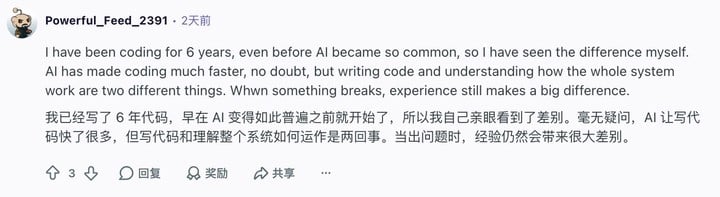
Moreover, AI itself can also help engineers read logs, analyze code, and locate anomalies. If used properly, it may even help companies restore services faster.
In fact, the technical cause of Microsoft's failure also shows one thing: even setting AI aside for now, maintaining a sufficiently complex system is already very difficult in itself.
Why could an ordinary system maintenance cause such a major incident?
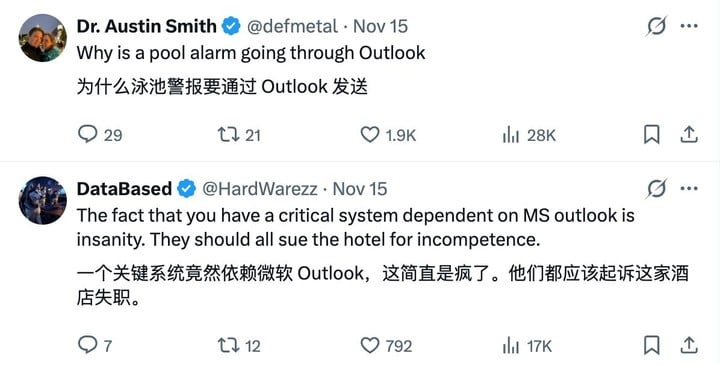
The most intuitive case is still the German hotel pool incident mentioned at the beginning. After the hotel's automatic chlorination equipment malfunctioned, the safety system had actually detected the anomaly and tried to alert staff by email.
The problem was that this email depended on exactly the Microsoft service that was failing at the time.

In most people's eyes, Outlook is just an office tool for sending and receiving emails every day. But for this hotel, it had actually become part of the pool safety monitoring process. As long as the email could not be delivered in time, staff members might miss the opportunity to deal with the equipment anomaly.
This also exposed an easily overlooked problem: as more and more devices, businesses, and safety processes connect to the cloud, seemingly unrelated system failures may produce chain reactions in the real world.
If safety alerts rely only on email, a single mailbox failure can break the entire notification chain. Independent channels such as SMS, automated phone calls, and local audible and visual alarms should be able to provide a second layer of protection at critical moments.
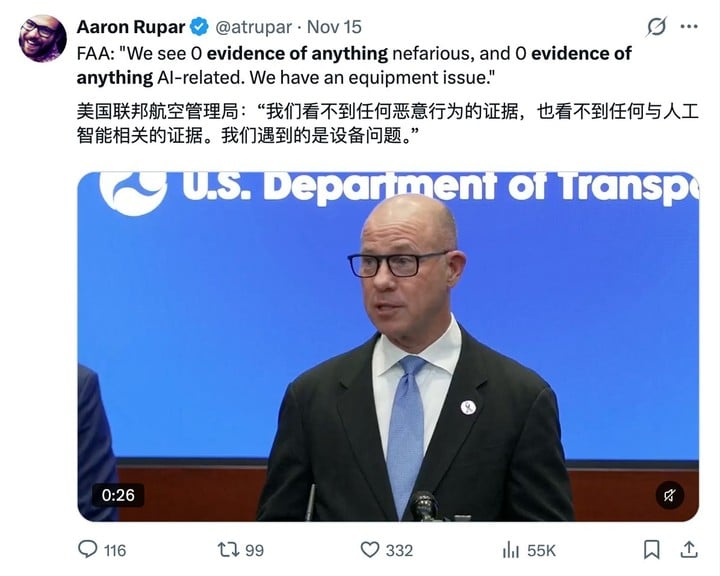
The U.S. FAA incident exposed another kind of risk. On November 13, the U.S. Federal Aviation Administration implemented a nationwide ground stop due to anomalies in air traffic control communications and some radar data, affecting more than 3,500 flights.
U.S. Secretary of Transportation 肖恩·达菲 later explained that at the time of the incident, a contractor was carrying out routine communications upgrades, replacing old copper lines with fiber optics.
What was originally an ordinary technical upgrade, however, because of a router equipment anomaly, sent a large number of connection requests to other routers, ultimately affecting normal communications in the air traffic control system.
The FAA administrator said no evidence related to AI had been found.
Workday's situation was different again: some corporate employees were unable to access functions such as timekeeping, payroll, leave requests, and benefits enrollment. Workday said the problem was discovered while testing a backup system, which left some information in an inconsistent state, and the company then placed some systems into maintenance mode.
There is no evidence that these three incidents share a common technical cause, but they do reveal another commonality: the most fragile moments for complex systems are often when people try to change, upgrade, or verify them.
When a tech giant like Microsoft needs to spend a lot of time to restore service, it is also necessary for us to re-examine the pursuit of development efficiency in the AI era.
The real problem is "efficiency"
And when setting aside the unprovable debate over "whether AI did it," this incident also shows us new engineering problems that come with AI.
According to Microsoft's preliminary incident review circulating in technical communities on November 16, it happens to reveal how difficult complex systems are to maintain.
A latent defect that had been deployed several months earlier, after running normally for a long time, was ultimately triggered by changes in traffic and reduced server capacity. What was more troublesome was that the automatic traffic failover mechanism normally used to ensure service reliability this time put greater pressure on the remaining servers, causing the failure to spread further.
Even when engineers tried to bring servers back online, the backlog of requests would overwhelm them again.
These complex dependencies make the failure very difficult to resolve through a simple rollback.
Article title: Microsoft's global outage: why is AI taking the blame again?
Body: This also raises another question for the age of AI programming. When code can be generated quickly, are companies still willing to invest as much time in helping engineers understand the code, test edge cases, and prepare for system failures?
AI can help engineers develop, debug, and troubleshoot, but engineering experience does not automatically accelerate just because code can be generated faster.
So when the person who wrote the old code by hand is laid off, and the newcomers face an AI-generated codebase, when a failure happens, you are all consulting a stranger.
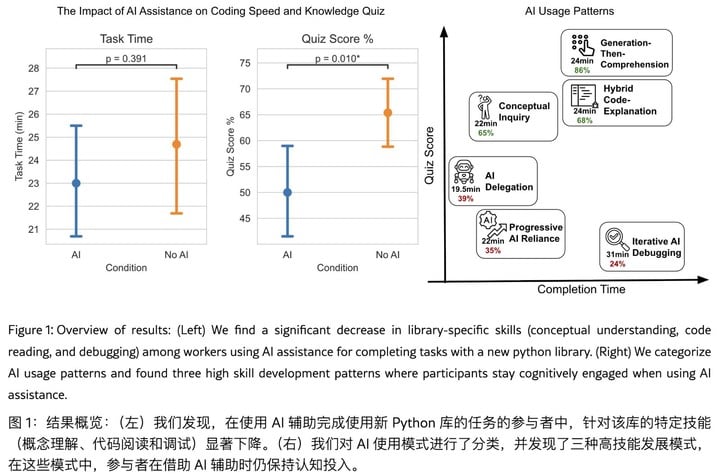
Anthropic previously ran a small experiment: they brought in 52 developers and had them complete a task using an unfamiliar Python library. In the quiz that followed, the AI-assisted group scored about 50% on average, while the control group scored about 67%, with the biggest gap in the debugging questions.
The researchers also observed that even among those using AI, people who actively asked about the underlying principles and had it explain the code tended to perform better than those who simply had it write the code for them.
Right now, tech companies are all calculating how much time AI can save programmers and how much development cost it can cut. But perhaps another account should be tallied too: when the system really fails, how many people on the team still know why it runs the way it does, and how long will it take to fix it?
After all, for ordinary users, we don't care who wrote the code behind it; we only care whether the pool's safety alarm can be delivered in time, whether the plane can take off normally, and whether our salaries can arrive on time...
AI makes writing code cheaper and cheaper, but keeping an entire system running reliably is clearly not just a matter of saying a few words to AI.