 Newshot
Article title: The "6 people, 12 boxes" that almost every domestic new-energy brand markets turns out to be illegal!
Body:
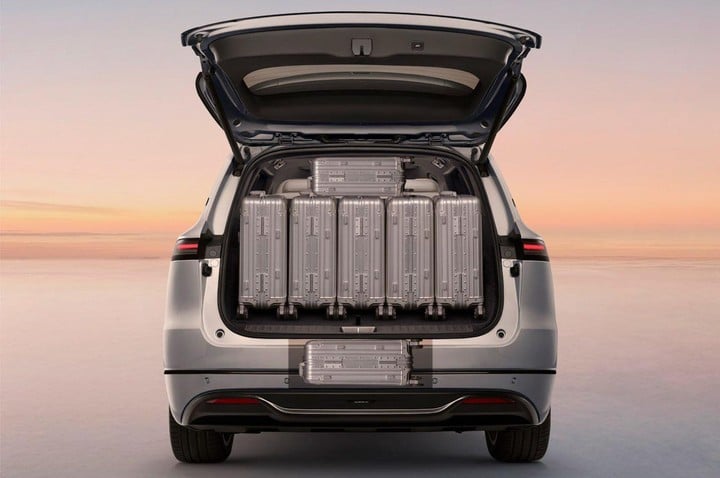
The "6 people, 12 boxes" that almost every domestic new-energy brand markets turns out to be illegal!
2026-11-16 18:27
It's hard to say when it started, but when car companies talk about the trunks of large six-seat and seven-seat SUVs, "X people, X boxes" has become a popular way to replace volume in liters.
With the car fully occupied, the trunk can still fit one suitcase per person—sounds very practical. But if you pay closer attention, you'll notice that the arrangements in some car companies' promotional images are actually non-compliant.
To make the number of suitcases add up to enough, some car companies simply stack another layer horizontally on top of the upright cases, even stacking all the way up to near the roof lining, completely blocking the entire rear windshield.
Taking staged photos like this on a show stand or in a studio is fine—after all, a show stand isn't a road and isn't within the traffic police's jurisdiction. But if you actually take it on the road, this "stack-'em-up" arrangement could get you a ticket.
Cargo capacity cobbled together by blocking the rear window
Article 62 of the Implementation Regulations of the Road Traffic Safety Law of the People's Republic of China stipulates: when driving a motor vehicle, one must not hang or place items within the range of the front and rear windows of the driver's compartment that obstruct the driver's line of sight.
Three-box sedans rarely encounter this problem, but the trunks of SUVs, MPVs, and hatchbacks are connected to the passenger compartment. Once the height of stacked luggage exceeds the backrest of the rear seats, the driver's view of the road behind through the interior rearview mirror is cut off.
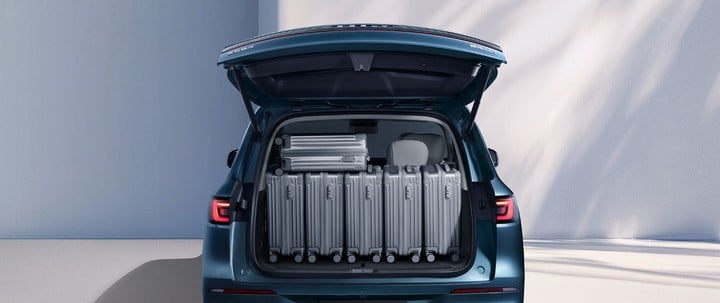
According to Article 90 of the Road Traffic Safety Law, obstructing the rear window constitutes obstructing safe driving, and upon investigation and handling, a warning or a fine of no less than 20 yuan and no more than 200 yuan may be imposed.
In reality, however, cases of drivers being caught by traffic police for obstructing the rear window aren't all that common, and even when they are caught, the penalties aren't exactly severe.
On top of that, many new cars today come equipped with a streaming media interior rearview mirror. Even if luggage blocks the physical rear window, the driver can still see a clear view behind the vehicle from the screen.
Quite a few drivers barely even use the interior rearview mirror at all, so of course there's no issue of it being "obstructed."
So many people think it's no big deal.
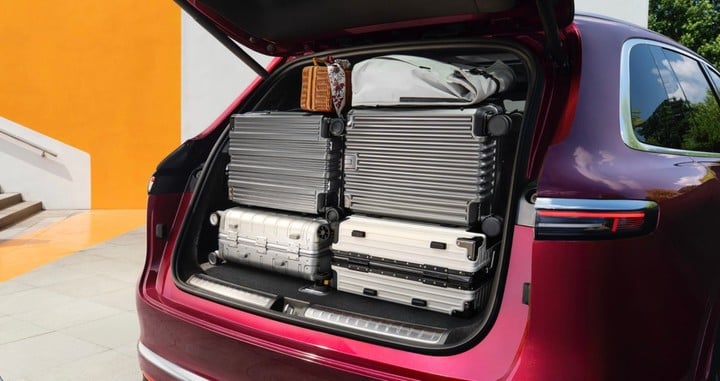
But stacking luggage too high is fundamentally an in-car safety issue. Once a case is stacked above the upper edge of the seat backrest, it lacks adequate securing and is no longer confined within the trunk.
A 20-inch hard-shell suitcase full of clothing can weigh 10 to 15 kilograms. Without adequate securing, a case stacked above the headrests has no physical barrier at all—during a hard emergency brake or a rear-end collision at high speed, it will fly straight over the seat backrest into the passenger compartment.
Ultimately, this still comes down to car companies' marketing arms race. To show loading scenarios more intuitively, product managers really rack their brains—volume figures alone struggle to create a vivid enough picture, but "how many suitcases it can hold" is clearly more enticing.
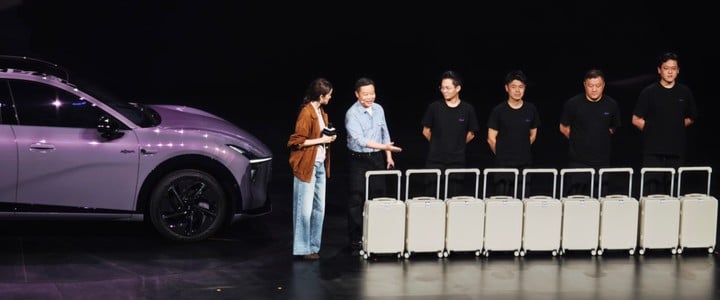
But limited by the vehicle's own body architecture, some new cars may not actually be able to achieve "one box per person," let alone "multiple boxes per person." So some clever folks came up with "ingenious ideas," simply stacking the cases into two layers to make the numbers in the promotional images look more impressive.
It's not just suitcases—some car companies swap the props in the trunk for strollers, camping gear, and so on, making it look especially spacious on the surface, at the cost of car owners taking it at face value and planting safety hazards in their cars.
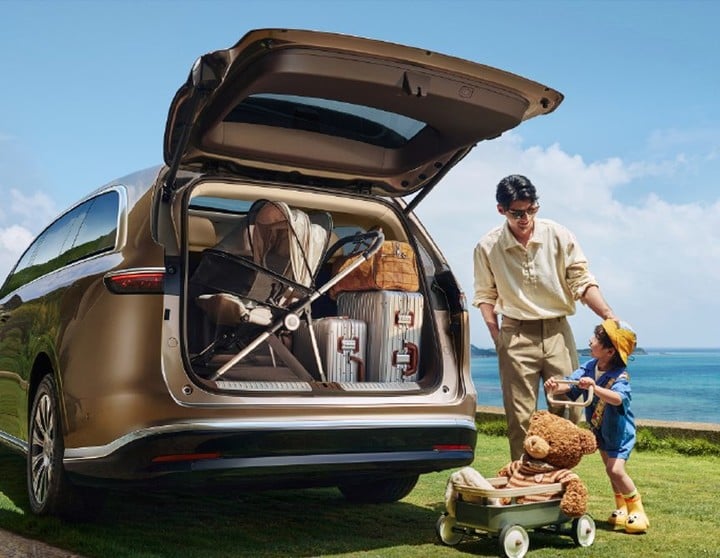
It's worth noting that, according to the "Measuring Method for Passenger Car Luggage Compartment Volume," trunk volume is measured using fixed-size rectangular standard blocks of 1L, 4L, 8L, etc.
When measuring the "standard volume" of an open luggage compartment like that of an SUV, the upper boundary of the stacked blocks must not exceed the upper edge of the rear seat backrest—that is, below the lower edge of the rear window or the height of the cargo cover.
So do these SUVs that fill their rear windows with suitcases strictly follow this logic in their trunk volume figures? That's also a question mark.
Can't we just be realistic?
If there were no boundaries, car companies could go as wild as they wanted—the American auto industry has already demonstrated this.
The SAE J1100 standard set by SAE International allows manufacturers to calculate luggage compartment volume all the way up to the headliner. Not only up to the roof, but this geometrically oriented method essentially treats the rear of the car as a container for air.
Even for a large fastback SUV, the triangular sliver where the slanted rear windshield meets the tailgate, and the irregular corners on both sides of the wheel arches—as long as the volume can be calculated, all of it can be counted toward the official advertised volume.
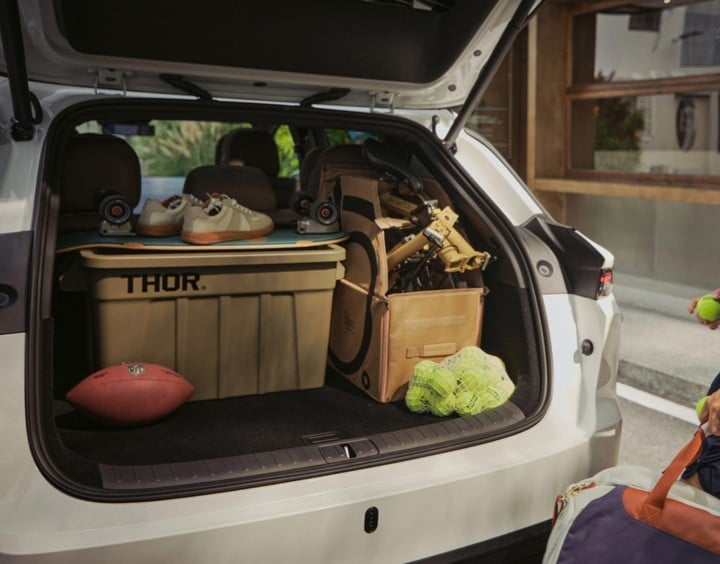
But this "air-style calculation method" brings nothing more than a pretty number and keeps executives smiling; for ordinary consumers it means little. Unless car owners are hauling loose soft-pack liquids when they head out, the volume cobbled together from those corners is simply unusable in daily life.
To squeeze the water out of manufacturers' figures, the U.S. independent testing organization Consumer Reports no longer directly trusts the volumes reported by car companies. Instead, it uses a set of retractable "rigid box frames" made of metal tubes to calculate the largest rectangular volume enclosed by the frame when the tailgate can close normally.
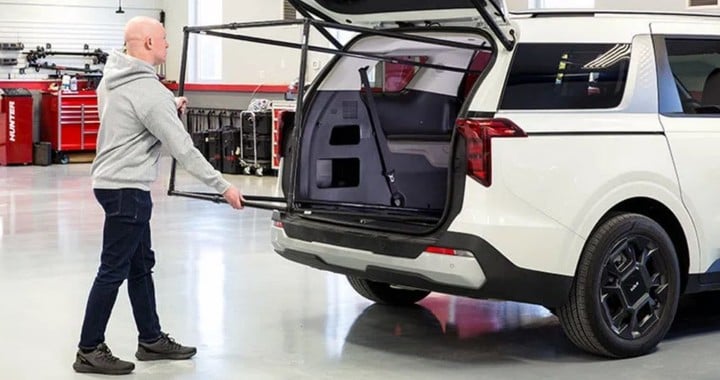
As you can imagine, under Consumer Reports' rules, almost every SUV measures a volume significantly smaller than the official figures, with models that pad their numbers with fastback slopes and roof gaps showing even more obvious gaps.
But the figures measured by Consumer Reports are the trunk space ordinary users can actually use in daily life.
Looking back at the "X people, X boxes" at some domestic launch events, it's really just a change of form. The American standard "counts air," while domestic promotional images "stack 'em up"—in essence, both use the upper half of the space that isn't usable and shouldn't be used in normal times to satisfy car companies' marketing gimmicks.
Better to pursue real innovation than fake data
"Stack 'em up" is indeed a staged show, but Chinese families' demand for carrying lots of luggage is also real. For family road trips, a fully occupied car with each person bringing a 20-inch carry-on suitcase is a very common usage scenario.
For car companies to solve "one box per person," what's needed is real innovation in engineering and technology.
In fact, we've already seen quite a few innovative cases in storage space, such as the large-capacity underfloor hidden compartments that many new cars come with today, and the large front trunks carved out by optimizing the layout of the electronic control system.
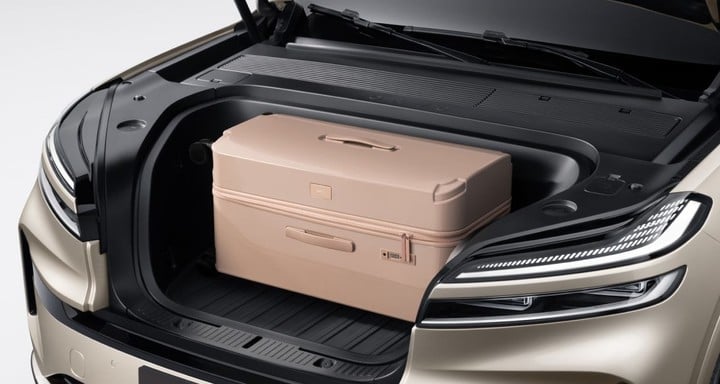
Through extra storage space, these new cars can directly offload two carry-on cases, making "one box per person" easier to achieve.
And models like the Xiaomi Pengcheng, along with more and more vehicles that use long sliding rails to create "variable space," offer another approach. By sliding the rear seats forward and backward to extend the trunk's depth, capacity can be expanded without exceeding the rear window limit.
Take the Pengcheng N70 Max as an example. In the normal five-seat state, moving the second row forward a bit frees up more generous rear depth. And if the second-row seats are moved forward and folded down, the cargo space can be expanded to a maximum of 2425L.
What the market really needs is more "one box per person" achieved through ingenious engineering design, rather than playing number games in gray areas and leaving traffic-regulation risks and safety hazards to car owners on the road.
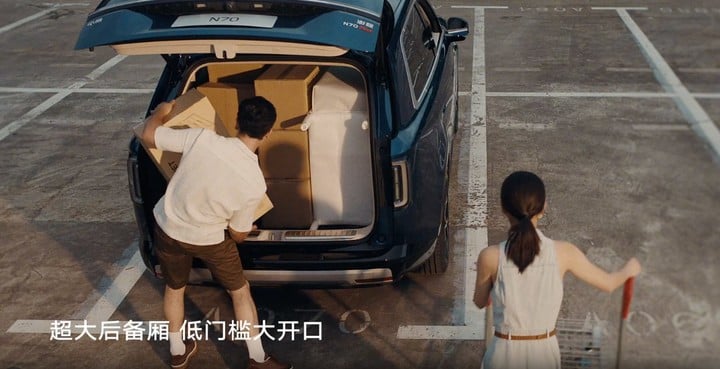
Unfortunately, even after achieving the utmost in space engineering, Xiaomi still couldn't resist in its promotional video, stacking the cases up to the height that blocks the rear window.
As things stand now, both car companies and consumers still lack sufficient awareness of these safety hazards hidden in the trunk. Compared with safety, everyone has clearly put more thought into marketing.