 Newshot
Europe is behind the US in the AI data centre race. It loses some of the economic upside to scarce grid connections and high energy prices.
Yet Donald Tusk’s government wants to change that: it has signed up to the EU’s AI gigafactory programme. Beating Texas prices looks challenging when a quarter of our natural gas is liquefied on the US Gulf Coast and shipped across the Atlantic.
However, in this blog post I point to one site in Poland that, at today’s gas prices and without a public subsidy, could match or beat US sites.
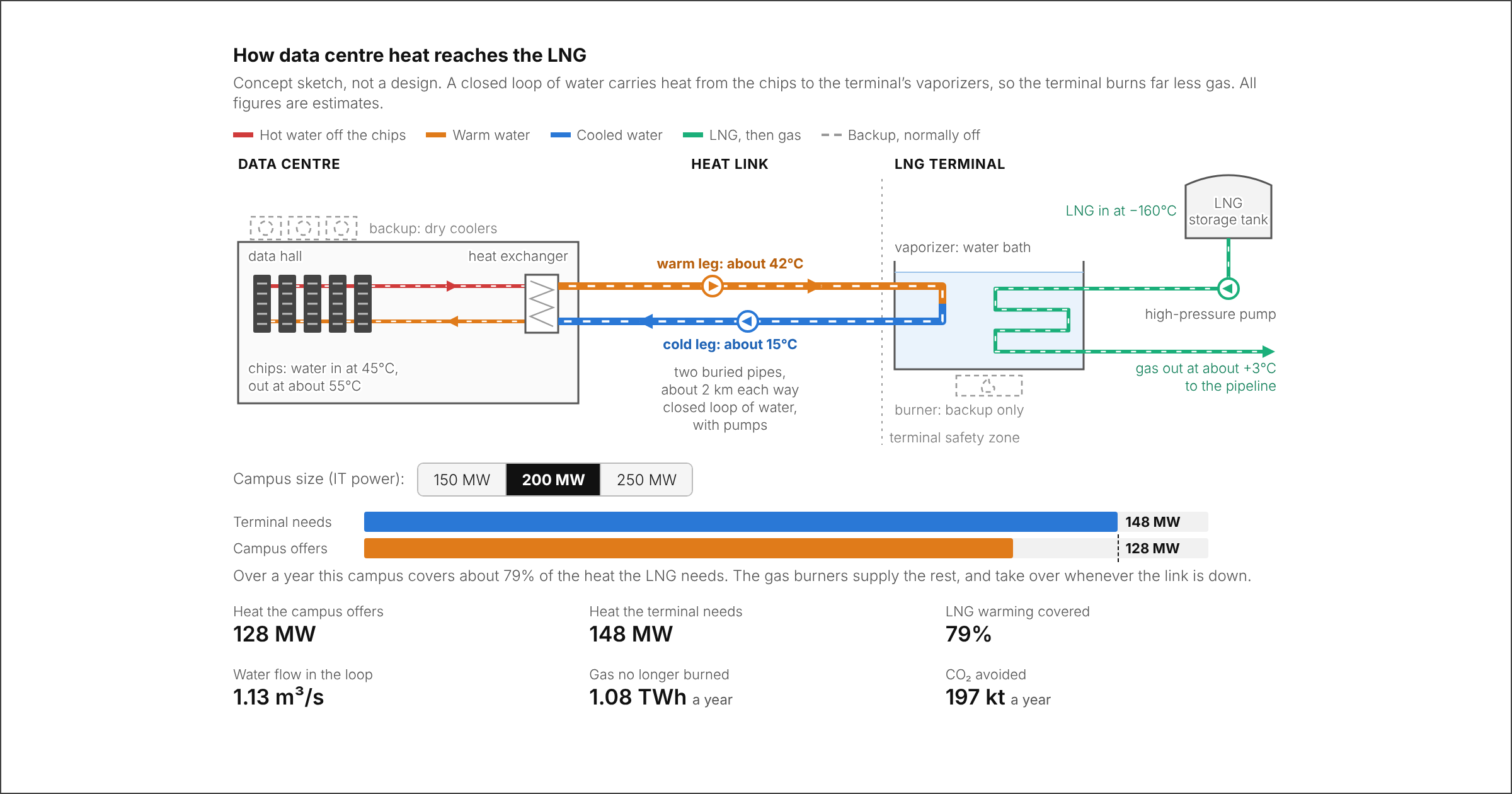
The coolest place in Poland is the Świnoujście LNG terminal, which regularly unloads ships of LNG at minus 160°C and burns gas to warm it into natural gas at about 3°C. Meanwhile, data centres produce a lot of waste heat and need cooling. We can replicate a British trick from the Thames estuary, where since 2012 a power station has piped its waste heat to the LNG terminal next door.
Coolest exchange: data centre (needs cooling) - LNG import terminal (needs heating)
Sources and assumptions
The European energy dilemma
Texas got cheap natural gas thanks to fracking, and cheap power from abundant wind and sun.
Meanwhile, Poland gets over 70% of its LNG from the US, paying a premium for the gas, liquefaction and shipping. So in the best case Polish gas costs 2.5 to 3 times the Texas price, and right now, across Europe, it costs 8 to 10 times as much because of the Strait of Hormuz crisis. Eventually energy prices might be decoupled from natural gas, but currently that looks like 5+ years away, while AI data centres needed to be built yesterday.
Still, about 90% of the cost over the first 10+ years of an AI data centre is chips, facilities and land. Even in the US, many investors pay a premium for pricey behind-the-meter gas turbines to build faster. However, we should still look for sites with compelling economics. Luckily, there are sites in Poland that can win on all fronts if we change the law, and we should build the first big data centres there.
Poland’s data centres add up to about 200 MW, while a single AI gigafactory would be bigger than all of them combined.
Why US gas costs Poland 2 to 3 times the Henry Hub price
Sources and assumptions
Let’s use physics to our advantage
Almost 6 million tonnes of LNG came through Świnoujście in 2025, nearly all of it Orlen’s, in 81 tanker loads. That is more than a third of all gas supplied to Poland: 91.6 TWh of LNG out of about 254 TWh of imports and domestic output. The terminal needs to run at capacity in the post-Russian gas order.
Meanwhile, we burn 1.5% of each cargo just to turn the liquid into gas. We could avoid that with an ambient source of heat, but the Baltic is too cold and too shallow. Any industrial heat, even low-grade, would help, but the terminal is far from power plants and factories, and we need about 150 MW of heat year round.
I am not the first one to think of it: the Isle of Grain terminal takes a power station’s waste heat, Dunkerque uses a nuclear plant’s cooling water, Zeebrugge got a gas turbine for it in 1997, and Barcelona sends LNG cold into district cooling. With a data centre, it has so far only been pitched, by TeraCool in 2012.
Has anyone done this?
Also operating, with no MW figure published
- Dunkerque LNG, FranceWarm cooling water from the Gravelines nuclear plant reaches the terminal through a 5 km tunnel and warms the LNG. In use since 2017.
- Gate terminal, Rotterdam, NetherlandsWarms its LNG with residual heat from companies in the area, mainly the neighbouring Uniper power station.
Sources and assumptions
In Poland, the cold has been discussed before, at a Sejm committee hearing in December 2024. Gaz-System said it was possible, but the use case discussed was different and not feasible. AI data centres were not mentioned.
A 250 MW AI data centre produces about 160 MW of usable heat, which covers almost all of the terminal’s needs. The main gain is that the terminal stops burning about 1.26 TWh of gas a year and stops emitting about 230,000 tonnes of CO2.
We need a new law and a new economic model
The saved gas is worth about €114 million a year, including carbon allowances. Sharing this gain is an important piece of the puzzle in our plan.
How shared savings impact economics
Where the terminal's saving goes (EUR million a year)
Cost of 1 MW of AI compute for a year (EUR million)
In this scenario, sharing alone cannot close the gap with Texas. Cheaper capital or a faster build has to do the rest.
Sources and assumptions
Split half and half, 1 MW of AI compute in Poland costs about €8.10 million a year: the same as Finland, and about 1% more than Texas (€8.01 million).
How to get a grid connection for a data centre
There is a lot of wind potential in northern Poland, yet most industrial demand is in the south. So putting a large power consumer in the north helps balance the grid, as was mentioned at the Choczewo substation opening. AI data centres were mentioned as a good use. In this region, wind and solar paired with batteries can cover long stretches of the year.
There is a large dispatchable power plant 80 km south, Dolna Odra. It has 1,366 MW of CCGT gas units, a 400 MW battery launching soon, and four 225 MW coal units (900 MW). During a rare Dunkelflaute it offers solid backup as a cold reserve, and the government has already looked for an investor to keep the coal units.
Poland can improvise fast
In the AI era, speed is everything. Some US data centres were built in a hurry, even through tricks: xAI ran Colossus on trailer-mounted gas turbines, and Elon Musk then bought APR Energy, which runs one of the world’s largest fleets of mobile gas turbines. The EU is usually not fast, but this time it wants to match Texas speed with an 18-month deadline for a gigafactory’s first phase.
Months from decision to first power
A large data centre in Poland takes about 49 months today. A special act and a prepared site could cut that to 18 months (the author's target). The other rows are reported figures for comparison.
10 years of 1 MW of AI compute, counting the wait (EUR million)
Sources and assumptions
Poland has improvised big changes fast before. In 1989 the Balcerowicz plan went from a television presentation to dismantling a planned economy in less than 100 days.
Poland is a master of the specustawa, the special act: democratic, yet with almost Chinese speed. Building a 187 km steel wall on the Belarus border took 8.5 months, from the 2021 law to finished construction.
Even a tricky 900 km gas pipeline, Baltic Pipe, took just 46 months, even though it went through two seas and Danish territory and was heavily contested in court there.
Poland has managed to get strategic things done despite two-party polarisation. A PiS government decided on the Świnoujście terminal in 2006, a PO government passed its special act in 2009, and President Lech Kaczyński signed it. Two parties that rarely agree built it together. A KO government and a PiS-backed president can do it again, for data centres, before the 2027 election.
Game plan
Let’s convince politicians of this vision so that they act together.
It is time for a special act for data centres: an AI gigafactory specustawa. We need to establish a special purpose company spun out of Gaz-System. It should prepare the site and tender it while some of the work is still going on.
Last but not least, PSE and Enea Operator should work on the electrical grid connection.
Let’s continue the Polish golden era by building the coolest AI data centre.
Sources are on a separate page.