 Newshot
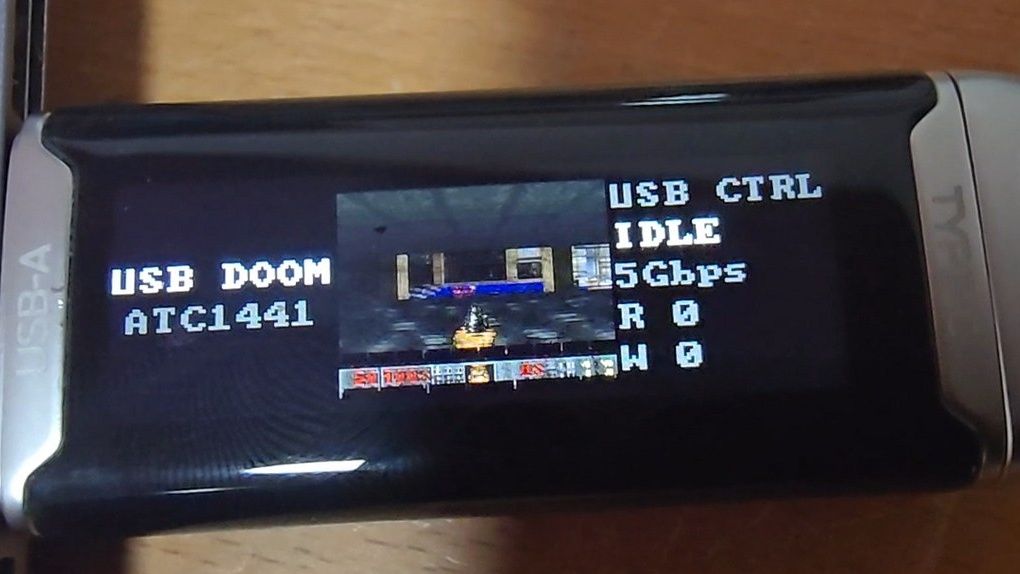
Doom now runs on a USB flash drive’s built-in LCD and is played by copying files to and from it, as hardware hacker Aaron Christophel showed in a teardown video. The marking on the drive’s display chip had been removed, but an open debug port let him extract its firmware, which enabled identification. He was then able to use AI to reverse-engineer the hardware and get the game running on the drive’s screen.
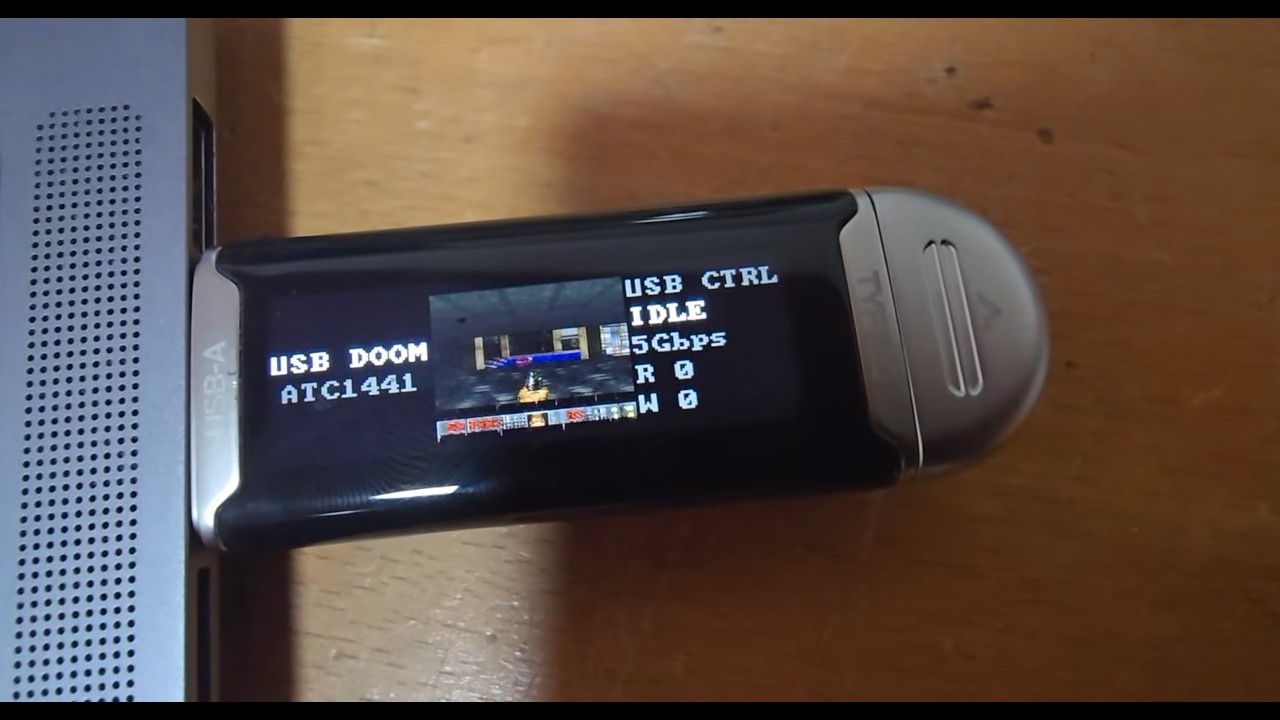
The off-the-shelf drive, the MOVESPEED MSSU10, has USB-A on one end and USB-C on the other, and the 128GB model, the smallest capacity in the range, cost him about 50 euros. Its screen normally shows status data such as transfer speed, how full the drive is, and its temperature.
The main flash controller is the Silicon Motion SM2320G, one we have reviewed in portable SSDs like the Kingston XS2000 and Lexar SL660 Blaze, with a separate C*Core CCM4101 microcontroller — which has 2MB of flash and a small amount of RAM to itself — for the 428 x 142 color LCD. The NAND carries SanDisk markings. All of this is fairly standard portable SSD hardware, aside from the display.
The drive’s metal body uses heavily glued plastic end pieces but, past that, the display lifts off first and unplugs. The board slides out after the USB-C end cap is removed, in this case with minor cosmetic damage inflicted. The display chip’s marking is scrubbed, most likely with a laser, by the hacker’s reckoning, which can hinder identification and tinkering. Luckily, a probe on the debug pads, ground, and a 3.3V pin connected on the first try, and memory was immediately readable.
The bootloader returned a version string dated 2023, followed by the full firmware, which helped greatly with identification. He says the chip is marketed as one for security — for fingerprint readers and access control, for example — but no related features were found to be enabled for this drive. He also discovered that, although the data sheet and stock firmware declare a 200 MHz operating clock frequency, it measured 40.2 MHz. This is unexplained.
One critical issue is immediately apparent: how do you play on a drive with no buttons? The display chip has no USB connection of its own and, from the connected PC or host, it only sees the storage controller’s activity, which it uses to gauge transfer speed. The primary storage controller has read and write counters, and the chip pulls these every 50 ms over I2C. Christophel says this is far easier than relying on a single physical button, as he did on a previous power bank mod.
The solution, then, is a PC script, doomctl.py, which turns key presses into small, timed transfers in each direction. The commands are simply encoded as transfer rates, at five levels per direction, and each read/write pair can map to a certain button combination. Arrow keys are for movement and turning, Space or Ctrl for firing and opening doors, and M for the menu, keeping it simple. Ordinary copying, without the script, can still steer, but the control scheme is much nicer.
Get Tom's Hardware's best news and in-depth reviews, straight to your inbox.
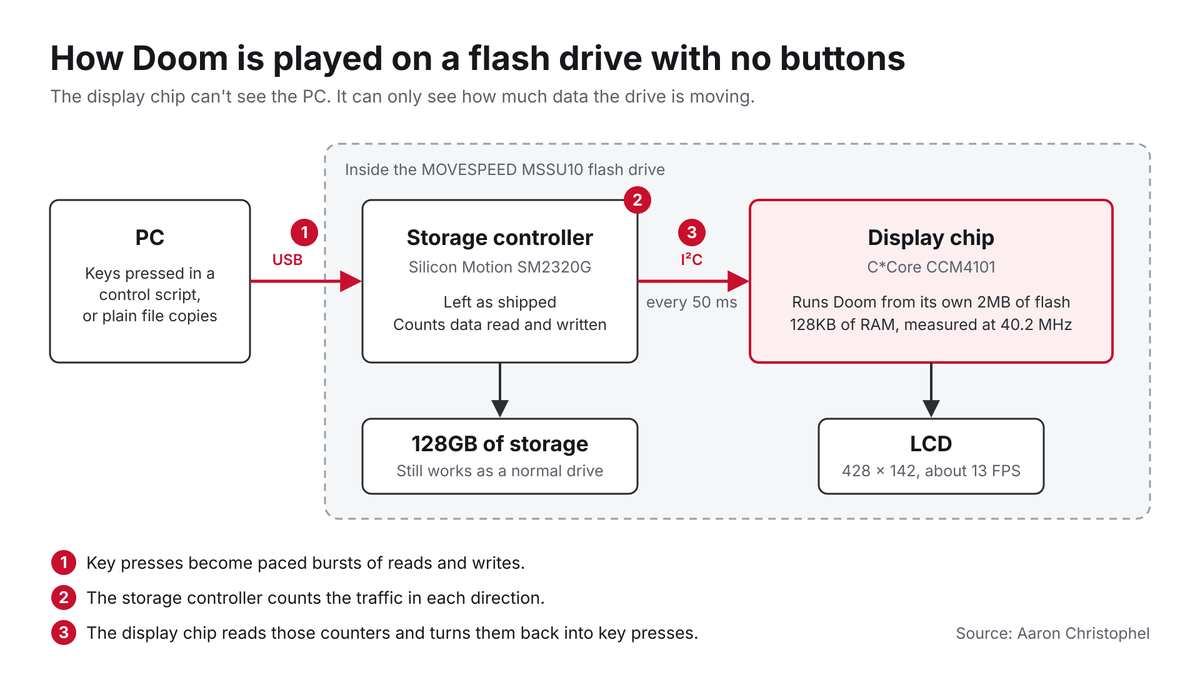
Performance is…well, not really playable at about 13 frames per second, although the game logic runs at Doom’s normal 35 ticks per second. This is why he names the chip’s clock as the biggest potential performance gain. The game itself is built on DMC100-DOOM, Artur Bieniek’s port for very small microcontrollers. Only the first map, E1M1, fits in the chip’s flash, and no sound is produced as the drive lacks a buzzer. Christophel did play the level end to end, noting the low resolution.
AI did the heavy lifting: the reverse engineering as well as the port, and Christophel said, “I would not be able to do such a thing in a few hours.”
The open-source project, with its code and prebuilt firmware published, is likely to draw attention and may spawn similar hacks. The tools required are relatively minimal, mainly a debug probe, and he does suggest backing up the stock firmware before trying. For his own unit, he put it back together to use as a normal drive, but one that can still play Doom, if so desired.

Follow Tom’s Hardware on Google News, or add us as a preferred source, to get our latest news, analysis, & reviews in your feeds.

Shane Downing is a Contributing Writer for Tom’s Hardware, covering consumer storage, PC hardware, and AI.