 Newshot
As 2027 approaches, I’m thinking about what AI will be like next year, how it will impact my job and what I’ve learned about it so far. I think 2026 was the year where we started to glimpse how powerful it can be, and 2027 will be the year when we will refine our intuition and learn when and how to apply AI most effectively. Here are some thoughts on what I’ve learned and what I think is next.
Categories of AI problems
AI is a broadly powerful tool, but I like to think about the categories of problems where it can be most effective and what those kinds of problems have in common.
- Using AI to build products. This is probably the area most of us think of when we think about AI right now, and it’s probably where we spend most of our time. AI agents are doing most of the actual coding at most companies and in some places even more (like reviewing code). While I think the changes to productivity are somewhat overblown, they are still significant. I won’t talk too much about this because I think it’s pretty familiar to everyone already.
- Using AI for research and understanding. This is, honestly, my favorite use-case and one area where I think AI has the potential to benefit humanity at large. I love using AI to research and understand problems. It’s like having a very smart and very patient tutor. I like to ask it to challenge my ideas, offer alternatives and come up with pros/cons I might have missed. Even the most sycophantic AI will be perfectly willing to critique you if you ask explicitly. Perhaps I’ll write an article about this in the future.
- Building AI-based product features. There are a lot of people parroting the refrain of “don’t just slap AI onto your product”, but in a lot of cases, a little AI feature on top can bring real value to customers. There are probably lots of places where you can safely and easily add an LLM or a third-party AI product to an existing feature to make it more useful. Adding small features is also a great way to dip your toes in and build intuition about what we can and can’t do with AI, which is something we all need more of.
- Building whole new product categories based on AI. The idea of building “AI-native” products is probably the most exciting area for AI, but I think it’s also still the wild west. In many cases, I think it’s still best to approach a business or customer problem by asking, “How could a combination of humans and software solve this problem?” and then start swapping AI in for some of the human work.
How to build AI-based product features
There are a number of ways to build AI features inside an existing codebase. Here are two ways I’ve found work well:
- Add an AI feature to something that already works. For example, at Rutter we have a tool that categorizes 4XX-range errors our customers receive and gives them a short AI explanation of what they are doing wrong and what to do instead. This definitely smacks of “AI slapped on top”, but it was easy to build and added real value for our users.
- Start with a HITL (“Human in the loop”) workflow, and replace parts of the workflow with AI. This has been a great way to build automations since the time of the first computers. It continued working well through the big-data, microservice, data-science, and machine-learning eras, and it still works in the AI era. Starting off with a working flow gives you a “gold standard” to iterate on, and means that adding AI is an optimization problem you can solve iteratively rather than a problem of inventing a new solution from scratch. For example, at GIPHY we used to have all uploaded GIFs evaluated by two humans to make sure they were suitable for the site. By the time I left in 2025, we still used human evaluators, but the team added an AI step to filter out the worst content, which spared us time and money, and spared our human workers a lot of trauma.
How to build whole new product categories based on AI
If we define AI-native products as being products that weren’t imagined before AI, then what counts as AI-native depends on how much imagination you have. After all, a lot of what AI does today is what human labor did yesterday. I think most of what seems like “AI-native” technology is really just products that could be imagined before, but were cost prohibitive because they involved too much labor.
That means the two techniques I mentioned about building features can also be used to build AI-native products; you just need to develop your imagination.1
Let’s take a concrete example: AI-powered support chat-bots are one of the most successful AI-native products on the market today, but they can be built by taking an existing workflow and substituting human parts with AI.
When our team evaluated third-party AI-powered chat bots, we found them lacking (probably because of the amount of technical nuance in our product). Eventually we solved the problem ourselves by inserting AI into our flow to draft responses. We still keep a human in the loop, but a lot of the agonizing research for subtle issues is now automated. It’s essentially the same workflow, we’ve just got an agent doing some of the work.
I still think solving a problem manually before diving into AI is generally the right approach – that helps you understand the problem, and makes sure the problem is doable before you jump into automation.
AI still isn’t a magic wand
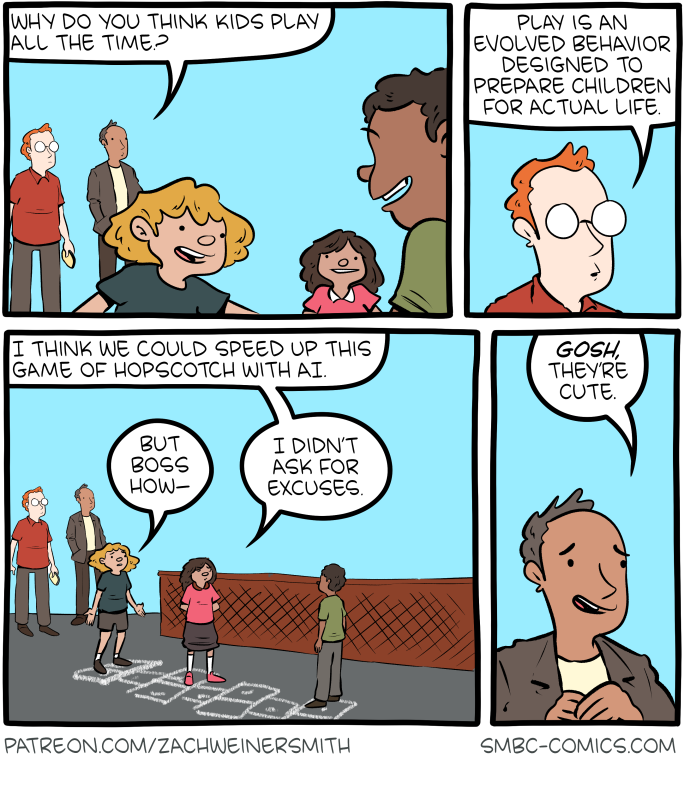
This time last year I advised people to think of AI like a mediocre person (“Imagine what a determined, but mediocre person can do. Use AI for that”, I’d say)2.
It’s gotten way past that, but it still isn’t magic: big migrations are still a pain. Building things right still takes forethought. Understanding a problem and making the right decision still requires thinking things through. Understanding if fixing a bug requires a simple patch or a more fundamental rewrite requires judgement. Don’t listen when someone says “just do it with AI”, when you know it’s still going to be a heavy, human-intensive project.
Build prototypes instead of designs
Maybe it’s because I’m at a less product-oriented company since AI really took off, but I’ve found building prototypes can be just as fast as designing – and prototypes are far more useful than designs because you can evaluate them much more easily. AI is good enough at sticking with existing design styles and building UIs, that I’ve found I can do a lot of work without a designer. Instead of doing wireframes, having conversations about it, then making detailed designs, then refining and iterating, we can jump straight to building the interface and trying it out. Iterating on prototypes is easy, too. Working this way is so easy I’m even seeing people outside of engineering build and iterate on prototypes.
The value of a good designer is still high – I don’t want my AI making branding decisions, creating my branding guidelines, or polishing my designs – but a prototype is worth 1000 designs.
Don’t make slop
There’s a natural temptation to make slop with AI. Why thoughtfully answer a question when you can just have AI do it? Why think through writing a PRD when you can just have AI do it? I see and hear about people who let AI do the thinking for them. These people fail to really understand the problem or evaluate the solution correctly.
Other people channel all conversations through a chatbot and do not filter the responses themselves. Passing an incomprehensible mass of text around doesn’t solve problems, it makes them.
How to get out of this? Two rules of thumb:
- If AI is helping you avoid thinking through an important decision that’s a core part of your job, you are probably using it wrong.
- If you are doing something with AI that makes your job easier and someone else’s job harder, you are definitely using it wrong.
The models are good enough
Big AI companies Anthropic and OpenAI are competing to build the biggest, most capable models, while most of us aren’t even using the most capable models available now. This makes it hard for me to understand how big AI is going to recoup their investments.
Speaking for myself, I don’t want bigger models that can do more in one jump. I’m not trying to solve the Navier-Stokes problem or pass the Bar exam. Instead, I want models that do the job, and do it cheaper.
Despite people on X and LinkedIn talking about the nuances of what one model can do better than another, most people are already treating AI like a commodity – where a model from one company can be easily swapped out for a similar model from another. The models know how to test things and try something else when it fails. They know how to use “reasoning” rather than trying to one-shot a complex problem. Hallucinations still happen, but fewer and fewer of the hallucinations cause problems in the finished product.
The tools attached to models (“agents” or “harnesses”) are becoming capable enough to give the models context and take action. Most teams have already set up really good README and AGENTS.md files in their codebases, so the agents can figure things out faster than humans, and with ever less prompting. AIs even update the docs as they go to help themselves in the future.
Big AI companies like Anthropic and OpenAI can keep working on their giant models – maybe they’ll be more useful than I anticipate – but for now I think we have the models we need.
If I had to guess, I would say 2027 is going to be about using the models and tools we have now better, not about building better models.3
Quality engineering still matters
Do we still need big teams and experienced engineers? Do we need senior engineers at all? Do we need junior engineers? These are questions I’m hearing people ask. For the time being, engineering knowledge and expertise still matter, particularly around systems, infrastructure and architecture. Minutiae like garbage collection systems, exact details of complex but common algorithms, and so on matter less. Understanding exactly how IEEE 754 floating point numbers work seems quaint.
However, it’s still helpful to be acquainted with these concepts and know there are design considerations and choices to make. You can ask an AI which sorting algorithm performs best for some use-case, but if you don’t know to ask that, the AI may make the wrong choice.
The development bottlenecks are shifting
AI speeding up development has some surprising consequences. Engineers can write more code, but more new code means more PRs submitted, which means more PRs to review, which means PR review becomes a new bottleneck. I think most teams are working through these issues, but it’s not totally solved. One place I’ve had trouble recently is keeping my teams’ backlog properly groomed because I’m forgetting that some projects go a lot easier and faster than they used to.
I think the important thing to remember is that some stages of product development are benefiting from AI more than others, and resources have to shift. Can we put some effort into making the whole process go faster? In some cases this makes sense – some PRs can get an AI review, and some design can be replaced with prototypes. Even competitive analysis and testing can go faster for some products. But there’s still no substitute for everything: like meeting with stakeholders to help you prepare a thoughtful, hand-written and carefully researched PRD.
How afraid should we be?
One thing I don’t know is how afraid we should be of AI. Will it take all our jobs? Will it end the world? Will it bring about a post-scarcity utopia? All of this seems far-fetched to me, but I do think some of the dangers people are fretting about are real. Some smart people think it will just take time for us to adapt and that AI will create different jobs, just like technology in the past. Others ask what jobs will be left if neither intelligence nor physical labor are still needed. Even in the best scenarios, we need to acknowledge that past technological shifts have been painful for many people, and this one is coming faster and with more money behind it than any in the past.
AI will certainly become a huge part of the economy, and it clearly has the potential for good and bad. Leaving it unregulated and in the hands of a handful of out-of-touch Silicon Valley elites with savior complexes isn’t going to set things right, but that’s where we are now, and that does worry me.
As with my own job, politicians, economists, and the public need to develop their intuition and understanding of AI so they understand what’s possible.
Notes
- I’m sure some people reading this will think to themselves, “well that’s not true in field X”. Maybe you are right about that – I certainly don’t know all about every AI use-case – but even so I encourage you to think about traditional techniques and ask in what ways working with AI is the same and in what ways it’s different. ↩
- I also said, “AI is like Ricky Gervais. At first you thought it was pretty cool, but after a little more attention you realized how mediocre it is and you are secretly worried it could go off on a racist tirade at any moment”. To my surprise, AI went on a racist tirade but Ricky Gervais has not. AI has also gotten better. ↩
- You may say tech history is one of ever-increasing power and capability, so it is only logical that the biggest and most powerful will always win. But the market history shows development is often driven by the cheaper, lower-cost end, rather than the high end. ↩