 Newshot
Revolut's David Abitbol Says Self-Hosted GLM Models Cut AI Coding Costs 90% for 2,000 Engineers
Revolut serves 80 million customers across 45 markets, and a secondary share sale that closed in July 2026 valued it at $115 billion, making it Europe's most valuable private company. It also, according to the man who runs its AI operations, now spends about one-tenth on AI coding tokens what it used to pay Anthropic and OpenAI. The blended cost of running self-hosted GLM models is 30 cents per million tokens, David Abitbol said on the AI Engineer podcast — and that single number is quietly rewriting how a regulated bank buys artificial intelligence.
The striking part is not the discount. It is that Revolut reached it by doing less: fewer GPUs than the workload would seem to demand, less context than the models advertise, less precision than the hardware allows, and fewer permissions than an autonomous agent would want. Constraint, not capacity, turned out to be the lever.
From Gemini to GLM: a year of measuring what actually works
Revolut's numbers come from a sample of 2,000 engineers tracked over roughly a year, which makes them unusual — most enterprises deploying AI assistants have no clean before-and-after.
The first rollout, Gemini in January 2025, delivered a 10% improvement in lead time and 20% in coding time. Abitbol credits the coding gain to engineers no longer digging through Stack Overflow and documentation. Claude Code was trialed around February 2025 and launched at scale in January 2026, but showed little measurable impact at first — and the cost raised eyebrows. Engineers were spending $1,000 to $10,000 a month with weak returns, so the rollout arrived with strict budget caps.
Self-hosting open-source models from around April 2026 changed the picture. GLM 5.1 at that point delivered a 60% improvement in coding time and 70% in lead time.
| Period | Tool | Lead time change | Coding time change |
|---|---|---|---|
| Jan 2025 | Gemini | +10% | +20% |
| Feb 2025 – Jan 2026 | Claude Code | minimal at launch | minimal at launch |
| Apr 2026 | Self-hosted GLM 5.1 | +70% | +60% |
The asymmetry is the insight. The larger gain landed on lead time, not coding time, because writing code was never the bottleneck. "What we find is the bottleneck for engineering is not necessarily coding," Abitbol said. "You can save a lot of time not having to dig through your inbox or messing with Jira and Confluence."
There is a second-order effect that does not show up in the table. When tokens are effectively unlimited, engineers stop rationing them — saving the expensive tool for the end of the quarter or the hardest task — and start using it on everything. Abitbol's posture now is blunt: open source is the priority, billing is flat with no month-to-month bill shock, and frontier models are the exception. Codex, Claude Code and Gemini remain in the toolbox for the hardest problems, but they are no longer the default.
Fifty-six GPUs, 2,000 engineers, and a Slack inbox as the real benchmark
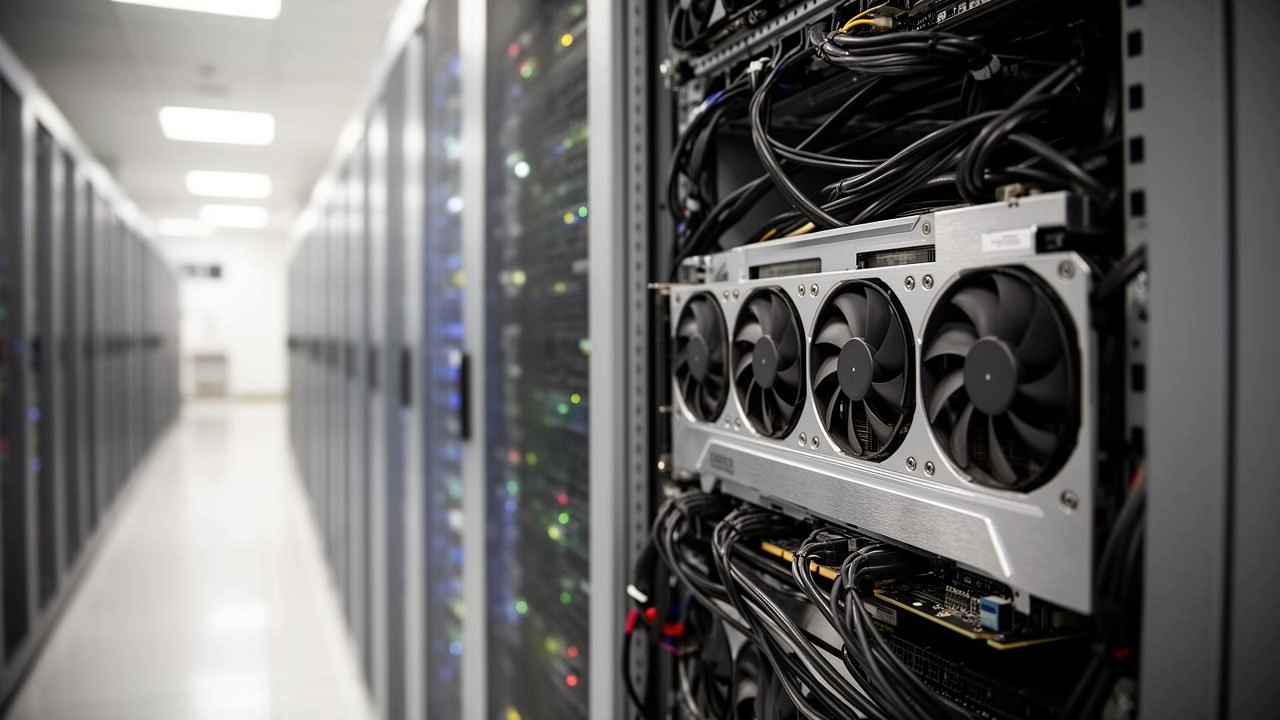
The infrastructure math is refreshingly concrete. Serving 2,000 engineers on GLM 5.3 takes about 56 Nvidia B200s. The model is a mixture-of-experts design: roughly 750 billion parameters in total, but only about 40 billion active for each token. That distinction matters for the bill — the cluster has to hold all the weights, while each generated token exercises only a fraction of them, which is what lets 56 GPUs sustain interactive latency for 2,000 engineers.
Abitbol's latency targets are empirical rather than theoretical. Aim for sub-three-second time-to-first-token, because past five seconds "my Slack inbox starts to blow up." Throughput matters less for interactivity: 200 tokens per second is fine, since engineers now fire off tasks in parallel and check back when they finish rather than watching thinking tokens stream. Engineers who connect after 5 p.m., when the GPUs sit idle, get 800 tokens per second.
Then there is the invoice. "Self-hosting GLM, our blended cost of token is 30 cents per million, and so our invoice is one-tenth of what we were spending depending on Anthropic and OpenAI," he said.
The denominator is worth sizing. A configured eight-GPU B200 server lists at about $390,700 from one integrator, so 56 GPUs represent roughly $2.7 million of hardware before power and networking. Rented at the $6 to $8 per GPU-hour that mainstream clouds charged in October, the same 56 cards would run $245,000 to $327,000 a month — about $120 to $165 per engineer — against the $1,000 to $10,000 a month Revolut was paying per engineer for frontier APIs. Revolut has not disclosed whether it owns or rents the cluster.
The 88% gain that came from tuning, not buying
Abitbol's central operational warning is that dropping weights onto GPUs and running inference produces terrible performance, because results depend heavily on configuration. Revolut held GPU count fixed at 56 from April to August 2026 and improved time-to-first-token from over 10 seconds to about 1.6 seconds, while requests per second rose from roughly 3 to more than 7.
That is an 88% performance improvement against 76% higher demand, achieved without adding a single card — and it is the strongest argument in the talk against the reflex to scale hardware. "We've had 88% improvement in performance for 76% increased demand," he said. "So the learning from this is there's a lot of parameters that you can improve on, and you really need to resist scaling if you're looking to self-host some model."

Long context is a scam, and FP4 is the floor
Ask an inference engineer what to tune and you usually get a list of techniques. Abitbol leads with a contrarian verdict: long context is a trap. "Long context is a scam," he said. "You really need to be mindful that even though you can serve one million tokens, 256 is really what you need."
The same discipline applies to precision. On Blackwell-generation GPUs, nothing above FP4 is worth running — moving from FP4 to FP8 costs roughly 40% more GPU footprint for zero precision gain, by his account.
The rest of the checklist reads like a field manual:
- Tensor parallelism: GLM fits on TP4, but the KV cache runs short; TP8 may serve better depending on workload size.
- Cache hit rate: coding tasks need above 90%. Below that, the economics and the latency both degrade.
- Advanced techniques: optimized speculative decoding, sequential pre-fill, and PD — prefill-decode — disaggregation.
Note what is absent: any suggestion that a bigger cluster solves these problems. Every item on the list is a configuration decision, and each one compounds.
Take the smarter text model and route images elsewhere
GLM is text-only, which Abitbol treats as an acceptable trade rather than a defect. "The trade-off, I would say, we would make every time is get the smarter model and figure out how to do image recognition another way."
The "other way" is a local router such as OpenCode, which can send image tasks to Gemini or Luna while GLM handles the main coding workload. For teams that genuinely need vision in the primary model, GLM 5.3-Flash works well — Revolut's UI designer uses it, and Abitbol says UI product turnaround has improved substantially.
On tooling, every endpoint is OpenAI-compatible with a response API, so they plug straight into OpenCode, Codex and the Codex app. That compatibility is what Revolut recommends to anyone building the same stack.
The compliance answer: weights, not endpoints
The most useful part of the conversation for any risk-averse technology chief is how Revolut justified Chinese open-weight models inside the strictest regulatory regime it faces. The stigma, Abitbol argues, rests on a confusion between renting an inference endpoint and downloading a file.
"You're not using the inference, the dedicated endpoint that goes to China, you're just getting the weights and putting them on a US-based service," he said. "So for data sharing side, this is totally fine."
One detail the data-sharing argument skips: the weights are not a licence-free download. GLM 5.3 ships under a custom Z.ai licence rather than the MIT terms of its predecessor. The grant is broadly permissive, but a licensee running a model-as-a-service business with more than $10 billion in annual revenue must clear a Z.ai security review before commercial use — a clause aimed at large cloud platforms, not at a bank serving its own engineers. The smaller multimodal model, GLM 5.3-Flash, remains MIT-licensed.
For an EU-regulated bank, the argument to regulators rests on classification: coding tasks are not autonomous agents because a human is always in the loop. The proof is a sandbox built to guarantee it. Codex CLI's approval features let Revolut set allow and deny rules for specific operations — allow grep, deny gradle, for instance — giving a regulator confidence that the system cannot act unsupervised.
The sandbox does double duty. It guards against rogue internal use — "You'd be surprised what you find in a large company," Abitbol said — and against prompt injection, which he calls a smaller threat now given model capability but still a live risk.
On data privacy, GPUs can sit in any country covered by the data equivalency framework — the US, EU, UK or Israel — and GPU and inference providers carry zero data retention by default. The final requirement is strong OpenTelemetry, so any incident can be traced through deep logs, with analytics as a side benefit.

What this means beyond Revolut
Abitbol's numbers are one company's internal sample, and the one-tenth cost comparison assumes frontier API pricing holds. That assumption is already being tested: Anthropic cut Claude Opus 5.5 by 20% and OpenAI followed within roughly 90 minutes with models at about half the price of its prior generation. If the frontier labs keep cutting, Revolut's advantage narrows — but the direction of travel does not reverse, because self-hosting also buys flat billing, no bill shock, and full control of the stack.
The second thing to watch is whether 56 GPUs stays enough. GLM 5.3 already carries roughly 750 billion parameters, and successors will be larger; the tuning-first discipline buys headroom, but not indefinitely.
The third is precedent. If regulators accept the human-in-the-loop sandbox as sufficient for an EU bank running Chinese weights on American silicon, that argument becomes available to every financial institution in Europe — and the addressable market for open-weight models widens sharply. The same logic is spreading through the startup economy: renting GPUs, deploying open Chinese models and reselling tokens has become a recognizable business, with some ventures reaching $1 million in monthly revenue within months, according to Menlo Ventures investor Deedy Das. When the cheapest tokens come from open weights on rented silicon, the pricing power of closed frontier APIs depends on being meaningfully smarter — a gap that has to be re-earned with every release.
In the US, the compliance question has a different shape. There is no federal ban on private companies downloading or running open-weight models, but procurement rules now reach past the model itself. A Department of Homeland Security order published on October 20 required federal civilian agencies to remove not only DeepSeek products but third-party products and services built using DeepSeek technology, with exceptions available on request. Any company selling into federal agencies, or working as a federal contractor, therefore has to trace the weights inside its stack and not just the vendors it buys from. Revolut's "we only downloaded a file" argument answers a data-protection regulator; it is not a defence against an origin-based procurement rule.
Regulators elsewhere are at different stages. Japan's Financial Services Agency published a discussion paper in March 2026 that lays out initial questions about how financial institutions use AI, including governance and internal rules, without imposing binding requirements. Taiwan's Financial Supervisory Commission opened a 30-day consultation in October on agentic AI safety, grading deployments on data sensitivity, the impact of the actions they can take, and how far their capabilities can spread, and applying zero-trust principles such as least privilege and traceability. Both are circling the boundary Revolut drew: whether the system acts on its own.
For investors, the read-through is less about Revolut than about the shape of AI spending. Goldman Sachs now expects the growth impulse from AI capital expenditure to peak in late 2026 or early 2027, and its strategists estimate the five largest US hyperscalers need about $300 billion in annual AI revenue just to break even — against AI cloud revenue that was running only about $70 billion above its pre-boom trend in the second quarter, a gap of roughly $230 billion. The same team expects hyperscaler capital spending to rise from about $800 billion in 2026 to $1.2 trillion in 2027. Revolut's answer to that arithmetic was to stop paying retail for intelligence and run its own inference stack, tuned to the workload it actually has rather than the benchmark it might one day need. Every large enterprise that follows will compress the revenue pool the hyperscalers are counting on — and reward whoever sells the picks and shovels, from B200s to the software that makes 56 of them behave like 200. If Abitbol's central claim holds that most of the gain came from parameters rather than hardware, the bottleneck in enterprise AI is not chips. It is the willingness to constrain the system.
- Goldman Sachs Says AI Job Losses Are Spreading Beyond Tech as Spending Boom Nears Peak
- AI Subscriptions Pile Up as Users Face Monthly Bills of Hundreds of Dollars
- Renting GPUs and Reselling Tokens for $1 Million a Month: Chinese Open-Source Models Become Silicon Valley's Startup Darling
- OpenAI Says Retell Runs 80% of Calls on Its Models, Tops 100 Million Monthly
- Nvidia Invests in AI Video Startup Higgsfield, Expanding August Series B Round
Once added, BigGo Finance appears first in Google Search Top Stories, so you get the broadest, most up-to-the-minute, and most comprehensive global financial news first.